The icons at the top of your iPhone screen are status icons. Apple says a lock means the iPhone is locked, a moon means Do Not Disturb is on, a clock means an alarm is set, and an arrow means an app is using your location. A small dot means an app is using your camera or microphone.
The icon list here follows Apple’s Learn the meaning of iPhone status icons page for iOS 27. Most icons look the same in iOS 26 and earlier versions. On iPhones with Face ID, more status icons appear at the top of Control Center.
How to See Every Status Icon
The status bar is the strip at the very top of the screen with the time, signal and battery. On an iPhone with Face ID, the notch or Dynamic Island sits in the middle of that strip, so only a few icons fit. The rest are hidden until you open Control Center.
- Swipe down from the top-right corner of the screen. Control Center opens, and the full row of status icons appears across its top, including the battery percentage and, with Dual SIM, both carrier names.
- Look over the icons, then swipe up from the bottom center of the screen to close Control Center.
On an iPhone with a Home button, all the icons already show in the status bar. Swipe up from the bottom edge if you want Control Center. Apple’s Control Center guide explains the controls you see there.
The Two Lock Icons
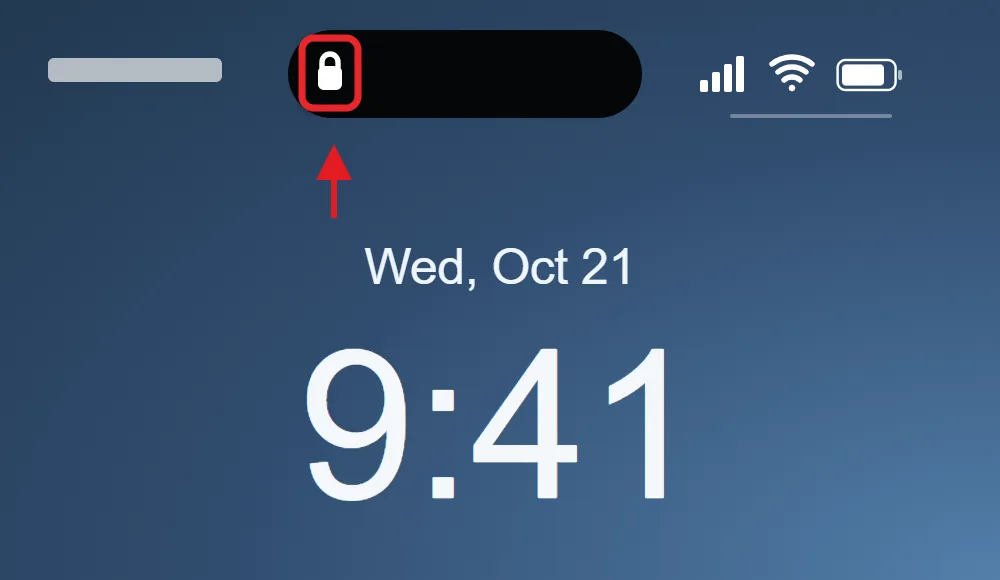
Two different lock symbols can appear at the top of the screen, and they mean very different things.
| Icon | What it means | What to do |
|---|---|---|
| Plain padlock | The iPhone is locked. | Nothing. It goes away when you unlock with Face ID, Touch ID or your passcode. |
| Padlock inside a circular arrow | Portrait orientation lock is on, so the screen won’t turn sideways. | Turn it off in Control Center if you want the screen to rotate. |
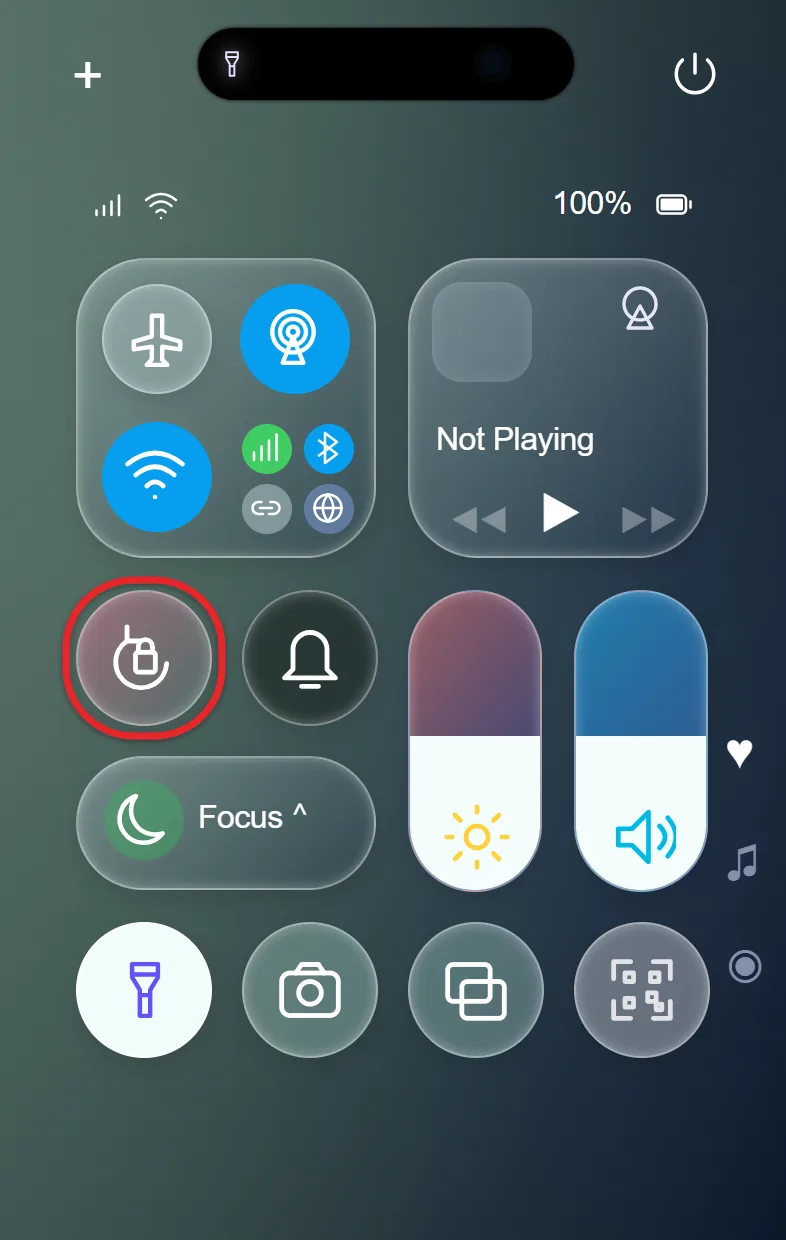
To turn off portrait orientation lock:
- Open Control Center (swipe down from the top-right corner, or up from the bottom on an iPhone with a Home button).
- Tap the Portrait Orientation Lock button, which shows the same padlock with a circular arrow. It changes from highlighted to dim.
- Close Control Center and turn your iPhone sideways in an app that supports landscape view.
The icon disappears from the status bar once the lock is off. The steps match Apple’s Rotate the screen on your iPhone page. For more detail, read about turning rotation lock on or off.
Common iPhone Status Icons
- Lock: iPhone is locked.
- Moon: Do Not Disturb is on. Any Focus you turn on shows its own icon in the status bar, such as a bed for Sleep.
- Clock: an alarm is set.
- Arrow: an app is using Location Services.
- Lock with a circular arrow: portrait orientation lock is on. To turn it off, open Control Center and tap the orientation lock button.
- Headphones: Bluetooth headphones are paired, turned on, and in range.
- Airplane: Airplane Mode is on, so you can’t make calls and other wireless features may be off. To clear it, follow the steps for turning off the airplane icon.
- AirPlay: AirPlay is on, so audio or video is going to another device such as an Apple TV.
Camera and Microphone Dots
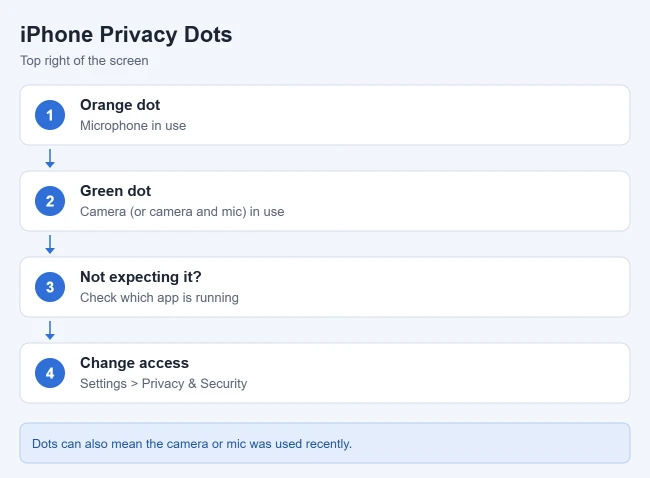
The camera and microphone indicators count as privacy icons. They have appeared since iOS 14. Here is what the colors mean, according to Apple’s orange and green indicators article:
- Orange dot: an app is using the microphone.
- Green dot: an app is using the camera, or the camera and microphone together.
The dot turns on during normal use, such as a call, a voice memo or a Siri request, so it isn’t a sign of a problem by itself. If you’re not using the camera or mic, check which app is running. To review which apps are allowed to use them:
- Open Settings and tap Privacy & Security.
- Tap Camera or Microphone. You see a list of apps that asked for access.
- Turn off the switch next to any app that shouldn’t have it. The app asks again the next time it needs access.
If the whole display looks tinted instead, see why your iPhone screen looks orange.
The location arrow
An arrow icon appears in the status bar or in Control Center when an app is using Location Services. To see which apps can use your location, go to Settings > Privacy & Security > Location Services, tap an app, and choose a different option, such as Never or While Using the App. The steps for turning Location Services on or off, including for one app walk through each choice.
Battery Icons
- Battery: shows the battery level. It turns yellow when Low Power Mode is on.
- Battery charging: the battery is charging. A gray icon means charging is paused.
- Bluetooth battery: shows the battery level of a paired Bluetooth device.
To see the exact number on the battery icon, go to Settings > Battery and turn on Battery Percentage. To turn a yellow battery back to normal, turn off Low Power Mode on the same screen or in Control Center.
Connection Icons
- Wi-Fi: the fan-shaped icon means you’re online over Wi-Fi.
- Bars: your cell signal strength. “No Service” appears when there’s no signal. With Dual SIM, the top row is your cellular data line and the bottom row is your other line.
- 5G, 5G UC, 5G+, 5G UW, LTE: your carrier’s network type is available. UC, + and UW can include higher-frequency 5G, depending on the carrier.
- 5G E, 4G, 3G, E, G: older or carrier-specific networks. These include 5G E, 4G (UMTS or LTE), 3G (UMTS or EV-DO), E (EDGE) and G (GPRS or 1xRTT). Seeing one of these usually reflects the coverage where you are.
- SOS only: full service isn’t available, but emergency calls may work through other networks. If it sticks, try these fixes to get an iPhone out of SOS mode.
- Satellite: satellite features like Emergency SOS, Find My, Roadside Assistance and Messages via satellite are available (iPhone 14 and later).
- SAT: the iPhone is using a satellite feature provided by your carrier.
- Wi-Fi Calling: Wi-Fi calling is set up, shown with your carrier name.
- Personal Hotspot, VPN, call forwarding: you’re joined to a hotspot, connected through a VPN, or have call forwarding set up.
- Network activity: a spinning icon means data is moving. Some third-party apps also use it to show an active process.
Seeing 5G or LTE in the status bar? You can turn 5G on or off to choose which network your phone uses.
Active Sessions and the Colored Bubble
Apple’s list of active-session icons covers a phone call, a FaceTime call, screen recording, providing a Personal Hotspot, turn-by-turn navigation, CarPlay, Siri Eyes Free, syncing with a computer, Do Not Disturb, portrait orientation lock and a set alarm.
On iPhone X and later, the time can sit inside a colored bubble that shows an active session. Apple’s current icon page doesn’t describe the colors, so use this as a general guide:
- Blue: Screen Mirroring is on or an app is using your location.
- Green: you’re on a call or sharing a Personal Hotspot.
- Red: iPhone is recording sound or your screen. It shows up while you screen record on an iPhone, for example.
- Purple: SharePlay is sharing content.
Icons lower down on a locked iPhone are a different thing, so see why there is an app icon on your iPhone Lock Screen for those.
Accessibility Icons
A Voice Control icon means you can control iPhone with your voice (you can turn Voice Control on or off), and a TTY icon means software RTT/TTY or hardware TTY is on. If you want to hide that one, you can remove the TTY phone icon from the top of the iPhone screen.
How to Make a Status Icon Go Away
Status icons can’t be hidden one by one. Each one disappears when you turn off the feature it stands for.
| Icon | How to turn it off |
|---|---|
| Moon or other Focus icon | Open Control Center, tap Focus, then tap the active Focus |
| Portrait orientation lock | Control Center > Portrait Orientation Lock button |
| Airplane | Control Center > Airplane Mode button |
| Alarm clock | Clock app > Alarms, then turn off each alarm’s switch |
| Yellow battery | Settings > Battery > Low Power Mode |
| VPN | Settings > VPN switch, or disconnect in the VPN app |
| Call forwarding | Settings > Apps > Phone > Call Forwarding |
| Location arrow | Settings > Privacy & Security > Location Services |
| Voice Control | Settings > Accessibility > Voice Control |
The lock, signal, Wi-Fi and battery icons are always part of the status bar and can’t be removed.
If You Don’t Recognize an Icon
- Open Control Center first. Face ID iPhones often hide the icon you’re looking for, and Control Center shows the full set.
- Compare it with Apple’s list. Apple’s status icon page is updated for each iOS version, and new icons sometimes arrive with updates.
- A dot stays on. Close the app you were using, then check Settings > Privacy & Security > Camera and Microphone for apps you don’t expect.
- A VPN you didn’t set up. Go to Settings > General > VPN & Device Management to see which app or profile added it. On a work or school iPhone, ask your IT department before removing it.
- A Focus turns itself on. A Focus can be scheduled to start at a set time or place. Check Settings > Focus and tap the Focus to see its schedule.
iPhone Status Icon Questions
Why is my iPhone battery icon yellow?
A yellow battery means Low Power Mode is on. Here are the steps to turn Low Power Mode on or off.
What does the moon icon mean on iPhone?
It means Do Not Disturb is turned on. Here’s how to turn on Do Not Disturb.
Why is there a lock icon at the top of my iPhone screen?
A plain padlock means the iPhone is locked, and it goes away when you unlock it. A padlock inside a circular arrow means portrait orientation lock is on. Turn that one off with its button in Control Center.
Why do I only see a few icons at the top of my iPhone?
On iPhones with Face ID, the notch or Dynamic Island takes up the middle of the status bar. Swipe down from the top-right corner to open Control Center and see the rest.
Is the orange dot a sign that my iPhone was hacked?
Not by itself. The orange dot means an app is using the microphone, which happens during calls, voice messages and Siri requests. If it appears when you aren’t using any of those, check which apps have microphone access in Settings > Privacy & Security > Microphone.

Matthew Burleigh is the founder, head writer, and editor of Solve Your Tech, which he launched in 2012. He has written technology tutorials since 2008 and worked in IT since 2003, including small-business support, IT management, and consulting. He holds Bachelor’s and Master’s degrees in Computer Science from Arizona State University.
Matthew writes practical guides for Windows, iPhone and iPad, Microsoft Office, Outlook, Google apps, and Android. Solve Your Tech’s guides are checked step by step against the device or app maker’s own documentation and tested on his own devices whenever he has the hardware or software, with clear steps, sources, and update dates.
Read more about Matthew and how Solve Your Tech writes and updates its guides, or report a correction.