To make a Google Doc landscape, click File > Page setup, make sure Pages is selected at the top, choose Landscape under Orientation, and click OK. To turn only one page landscape, highlight its content, right-click, and choose Change page to landscape.
These steps cover Google Docs in a web browser on a Windows PC, Mac or Chromebook, plus the Google Docs app on Android, iPhone and iPad. They follow Google’s Change page settings on Google Docs help page.
Before you start, make sure you can edit the document and that it uses Pages format, not Pageless (a continuous scroll with no page edges). The troubleshooting section shows how to fix either one.
Make the Whole Document Landscape
- Open the document in Google Docs.
- Click File in the menu bar, then Page setup near the bottom of the menu. The Page setup window opens.
- At the top of the window, select Pages. If Pageless is selected, your document is pageless and has no orientation until you switch it to Pages.
- Under Orientation, choose Landscape.
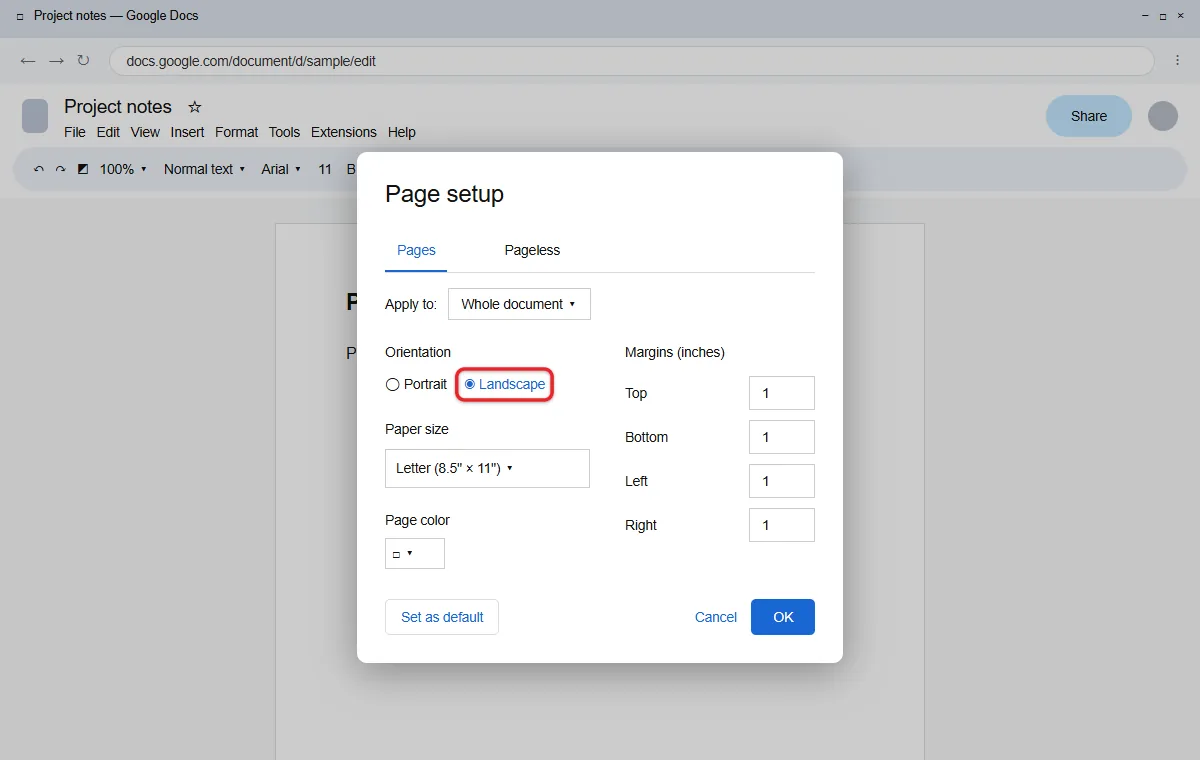
- If an Apply to menu appears, set it to Whole document. This menu shows up when the document has section breaks or when text was highlighted before you opened Page setup.
- Click OK.
The pages are now wider than they are tall. Text, tables and images reflow to fit, so check page breaks, wide tables and image placement before you share or print. To switch back, repeat the steps and choose Portrait.
When the layout looks right, you can print the Google Doc from Chrome and check the preview first.
The same window also holds Paper size (Letter, Legal, A4 and several others), Margins and Page color. Landscape keeps your paper size and margins. A Letter page in landscape is 11 inches wide and 8.5 inches tall.
Headers and footers also need Pages format before you can add a header in Google Docs.
Make One Page Landscape
A single document can mix portrait and landscape pages. This is useful for a wide table, chart or photo in the middle of an otherwise portrait report.
To build or resize that wide table first, here’s how to create and edit tables in Google Docs.
- Highlight the text, table or image you want on a landscape page.
- Right-click the selection.
- Choose Change page to landscape.
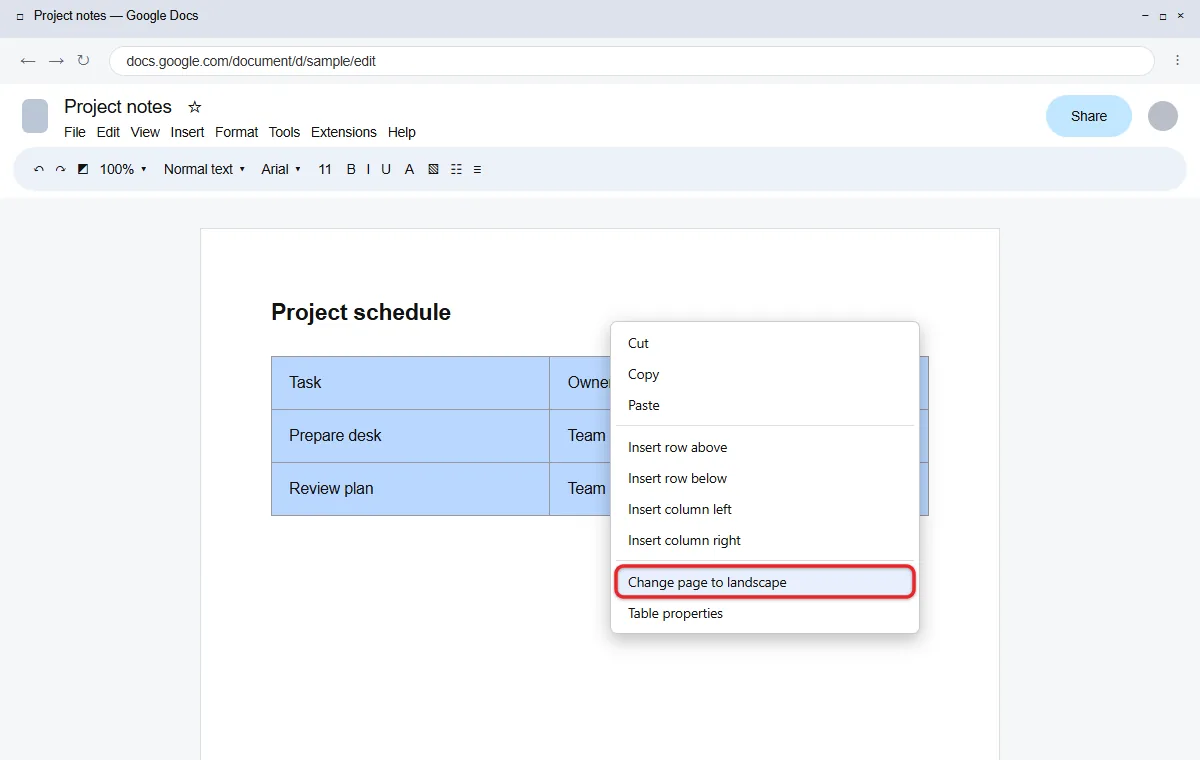
Google Docs moves the selection onto its own landscape page by adding section breaks before and after it. The pages around it stay portrait. To undo it, select the same content, right-click, and choose Change page to portrait.
If you prefer the menu, highlight the content, open File > Page setup, set Apply to to Selected content, choose Landscape, and click OK. The result is the same.
If the selection is long, the landscape section can run onto more than one page.
Make One Section Landscape
Use this when you want everything from a certain point onward, or a specific chunk between two breaks, in landscape.
- Click where the landscape part should begin.
- Go to Insert > Break > Section break (next page). A new section starts on a fresh page.

- Click anywhere inside the new section.
- Open File > Page setup, or go to Format > Page orientation.
- Set Apply to to This section, or to This section forward to change this section and every section after it.
- Choose Landscape and click OK.
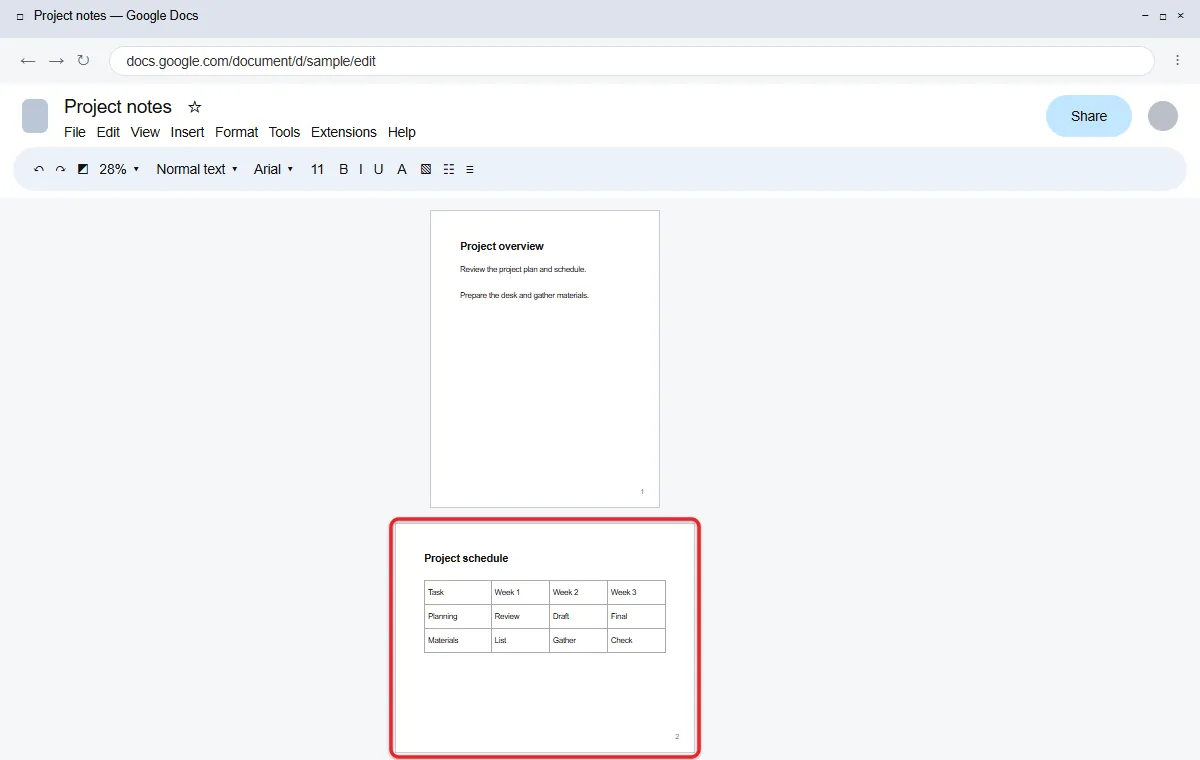
To return to portrait later in the document, add another section break where portrait should resume, click inside that section, and set it to Portrait with Apply to: This section forward.
Turn on View > Show section breaks to see where each section starts. That makes it easier to click in the right place. For more on breaks, read about inserting a page break in Google Docs.
Section breaks also let you start page numbers on a later page of the same document.
Clean Up Leftover Section Breaks
Switching a page back to portrait does not always remove the section breaks around it, which can leave a half-empty page. To remove one, turn on View > Show section breaks, click at the end of the text just before the break line, and press the forward Delete key (Fn + Delete on a Mac keyboard without one). Removing a break merges two sections, so check the margins, headers and page numbers on both sides afterward.

Make Landscape the Default for New Documents
- Open any document and go to File > Page setup.
- Choose Landscape, plus any paper size or margins you want new documents to use.
- Click Set as default, then OK.
Every new blank document you create afterward starts in landscape. Existing documents don’t change. Templates from the template gallery keep their own layout. To go back, set Portrait and click Set as default again.
Change Orientation in the Google Docs App
Android:
- Open the document in the Google Docs app.
- Tap Edit (the pencil button) in the bottom-right corner.
- Tap More (three dots) in the top-right corner.
- Tap Page setup, then Orientation.
- Choose Landscape and go back to the document.

iPhone and iPad:
- Open the document in the Google Docs app.
- Tap More (three dots) in the top-right corner.
- Tap Page setup, then Orientation, and choose Landscape.
If the page doesn’t look any different, turn on Print layout in the same More menu to see the page edges. The app changes the whole document. To make a single page or section landscape, use Google Docs in a web browser. If Page setup is missing, the document is pageless; switch it to Pages on a computer first.
How to Check It Worked
Scroll through the document with print layout on. Landscape pages appear wider than portrait ones. Then open File > Print and look at the preview: each page should show the orientation you chose. If something is off, press Ctrl + Z right away, or open Page setup again and change it back.
If You Can’t Find the Orientation Setting
- The document is pageless. Orientation, paper size and margins only exist in Pages format. Go to File > Page setup, select Pages, and click OK. Google’s pages or pageless article explains that headers, footers, page numbers and watermarks hidden in pageless format return when you switch back.
- Change page to landscape is missing from the right-click menu. Make sure the document is in Pages format and that you highlighted text or an image before right-clicking. Right-clicking a spelling suggestion or a link shows a different menu. Try selecting a word in plain text.
- The whole document changed when you only wanted one part. Undo with Ctrl + Z (Command + Z on a Mac), then check Apply to in Page setup and choose This section or Selected content.
- You can’t see page edges. Turn on View > Show print layout. If the wider pages look too small on screen, change the zoom level in Google Docs.
- Page setup is grayed out. You can only view or comment. Ask the owner for edit access, or make a copy with File > Make a copy.
- The printed page comes out portrait. In the print window, check that your printer’s own layout setting isn’t forcing portrait. Downloading the document as a PDF with File > Download > PDF Document keeps each page’s orientation.
Google Docs Orientation Questions
Can a Google Doc have both portrait and landscape pages?
Yes. Highlight the content and right-click Change page to landscape, or use section breaks and set Apply to: This section in Page setup. The rest of the document stays portrait. Older guides that say Docs can only rotate the whole document are out of date.
Can a pageless document be landscape?
No. Pageless documents scroll continuously with no page edges, so there’s nothing to rotate. Switch to Pages in File > Page setup first.
Does landscape change my margins?
No. Your margins stay the same size, they just sit on a page that’s turned sideways. Adjust them in the same Page setup window if you need more room.
Next step: if your landscape page holds a chart, you can insert a Google Sheets chart into the document so it stays linked to its data.

Matthew Burleigh is the founder, head writer, and editor of Solve Your Tech, which he launched in 2012. He has written technology tutorials since 2008 and worked in IT since 2003, including small-business support, IT management, and consulting. He holds Bachelor’s and Master’s degrees in Computer Science from Arizona State University.
Matthew writes practical guides for Windows, iPhone and iPad, Microsoft Office, Outlook, Google apps, and Android. Solve Your Tech’s guides are checked step by step against the device or app maker’s own documentation and tested on his own devices whenever he has the hardware or software, with clear steps, sources, and update dates.
Read more about Matthew and how Solve Your Tech writes and updates its guides, or report a correction.