To strikethrough text in Google Docs, select the words you want to cross out, then choose Format > Text > Strikethrough. On Windows or a Chromebook, you can press Alt + Shift + 5 instead. On a Mac, press Command + Shift + X. Use the same command again to remove the line.
These steps cover Google Docs in a web browser on Windows, Mac, and ChromeOS, plus the Google Docs app for Android, iPhone, and iPad. On a phone or tablet, open the document in the app, enter editing mode, select the text, and tap the strikethrough option in the text-formatting controls.
Before you start
You need edit access. If the document opens in Viewing mode, or you only have comment access, the text options under Format are unavailable. Ask the owner to make you an editor. In Suggesting mode, your strikethrough shows as a suggestion until someone accepts it.
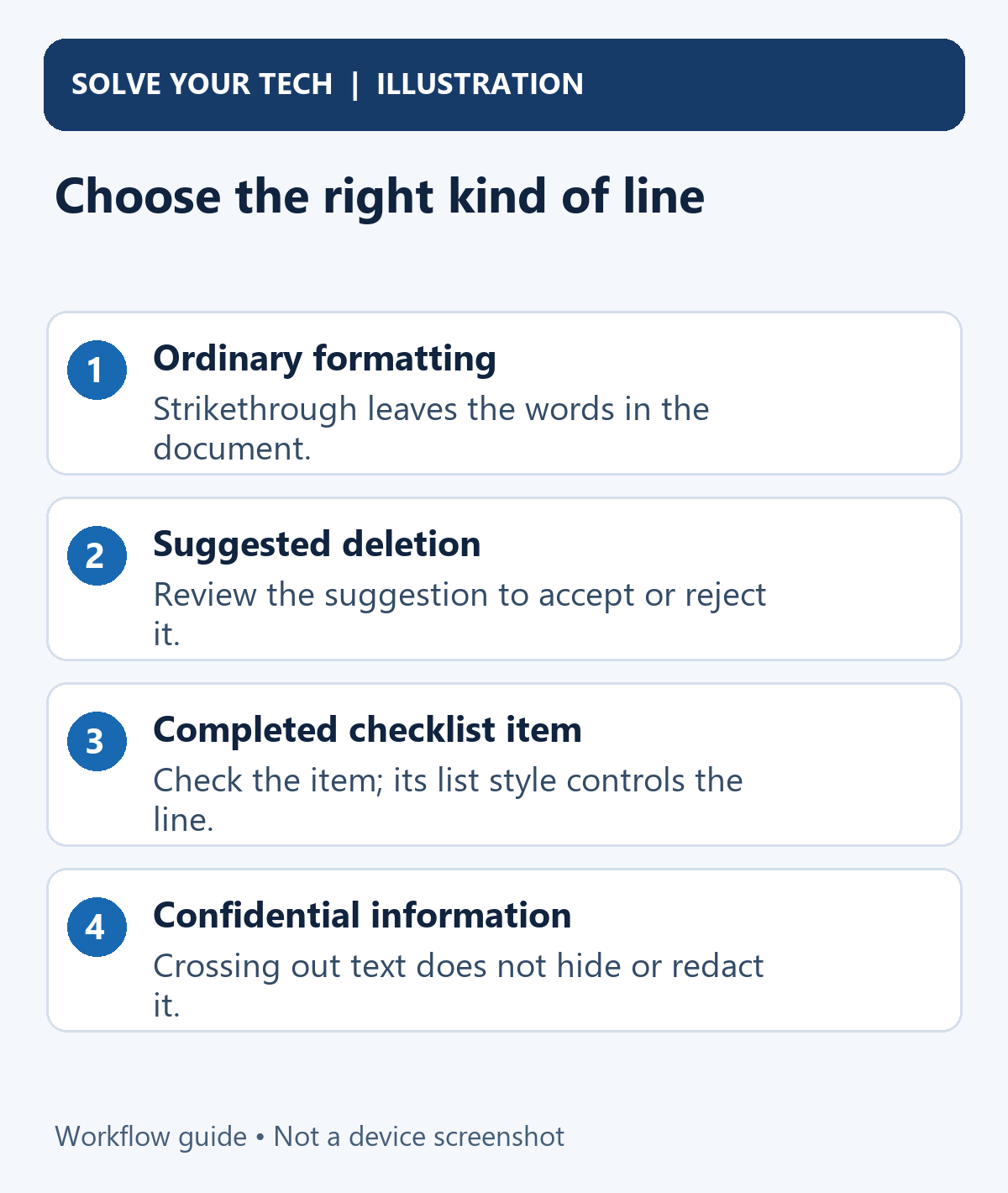
Do not use strikethrough to hide a password, personal information, or anything else that must be removed before sharing. The words remain in the document and can still be read, copied, and searched.
This method works in Google Docs in a desktop browser on Windows, Mac, or ChromeOS. Google documents the route in its paragraph and font formatting guide.
- Open the document in Google Docs on a computer.
- Select the words you want to cross out. Double-click to pick one word, drag across a phrase, or press Ctrl + A (Command + A on a Mac) to select the whole document. The selection turns blue.
- Click Format in the Docs menu bar.
- Point to Text, then click Strikethrough. A line appears through the selected words.
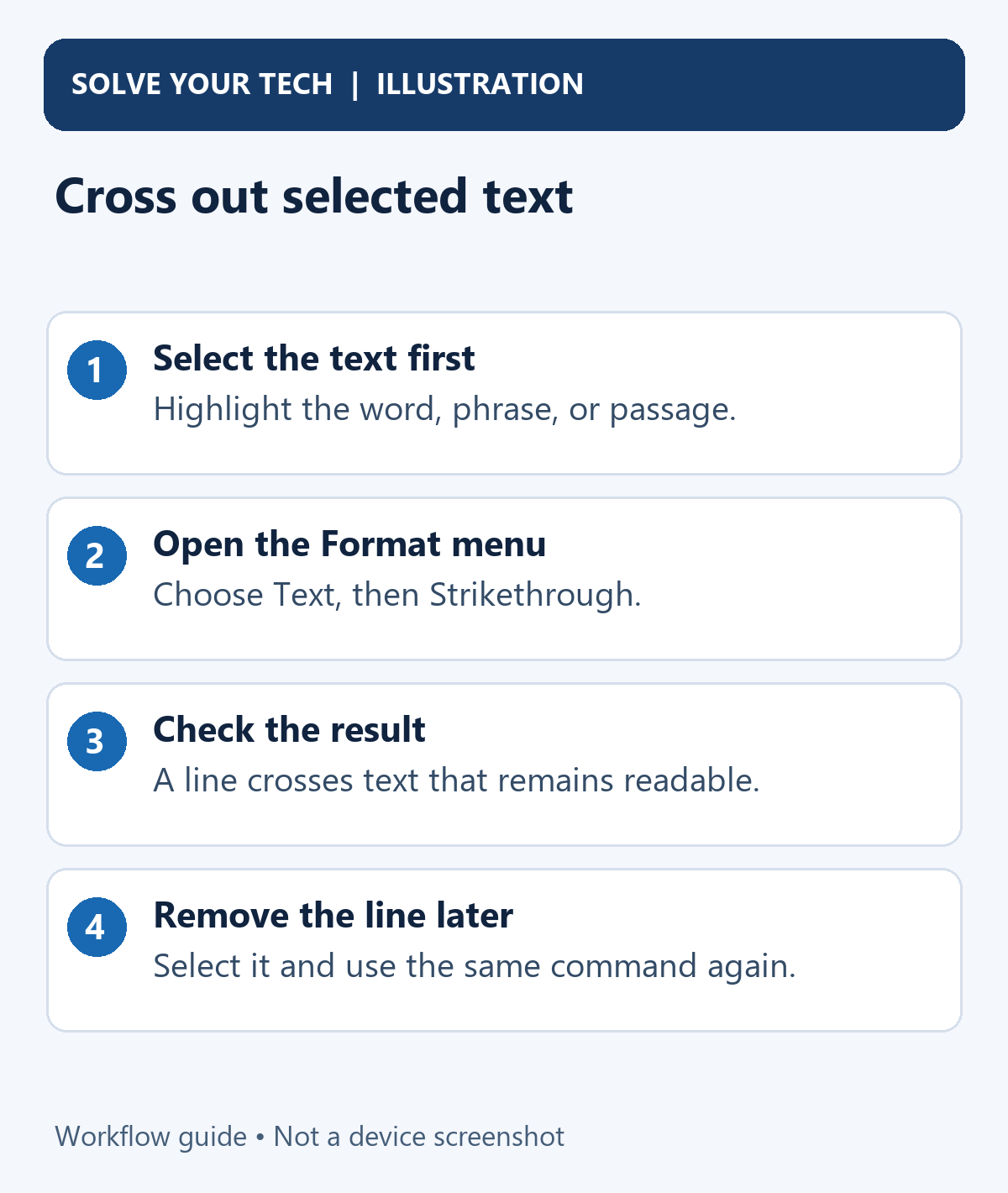
To check that it worked, click anywhere outside the selection. The line should stay through the words, and the words should still be readable.
Use a keyboard shortcut
If you cross out text often, the keyboard route saves opening two menus. Select the text first, then press the keys for your operating system together:
| Computer | Google Docs strikethrough shortcut |
|---|---|
| Windows | Alt + Shift + 5 |
| Chromebook / ChromeOS | Alt + Shift + 5 |
| Mac | Command + Shift + X |
Use the 5 in the number row above the letters, not the 5 on a numeric keypad. Press the same shortcut again to remove the line. The full list is in Keyboard shortcuts for Google Docs. If a shortcut doesn’t work with your keyboard layout, use Format > Text > Strikethrough.
You can also find the command by name. Press Alt + / (Option + / on a Mac) to open Tool finder, type strikethrough, and press Enter.
Add strikethrough on Android, iPhone, or iPad
The Google Docs app works the same way on Android, iPhone, and iPad. Google’s mobile formatting instructions cover the app’s Edit mode.
- Open the document in the Google Docs app.
- Tap Edit (the pencil icon).
- Double-tap a word, then drag the blue markers to cover the text you want.
- Tap Format (the A icon) at the top of the screen.
- On the Text tab, tap Strikethrough (an S with a line through it). The line appears on the selected words.
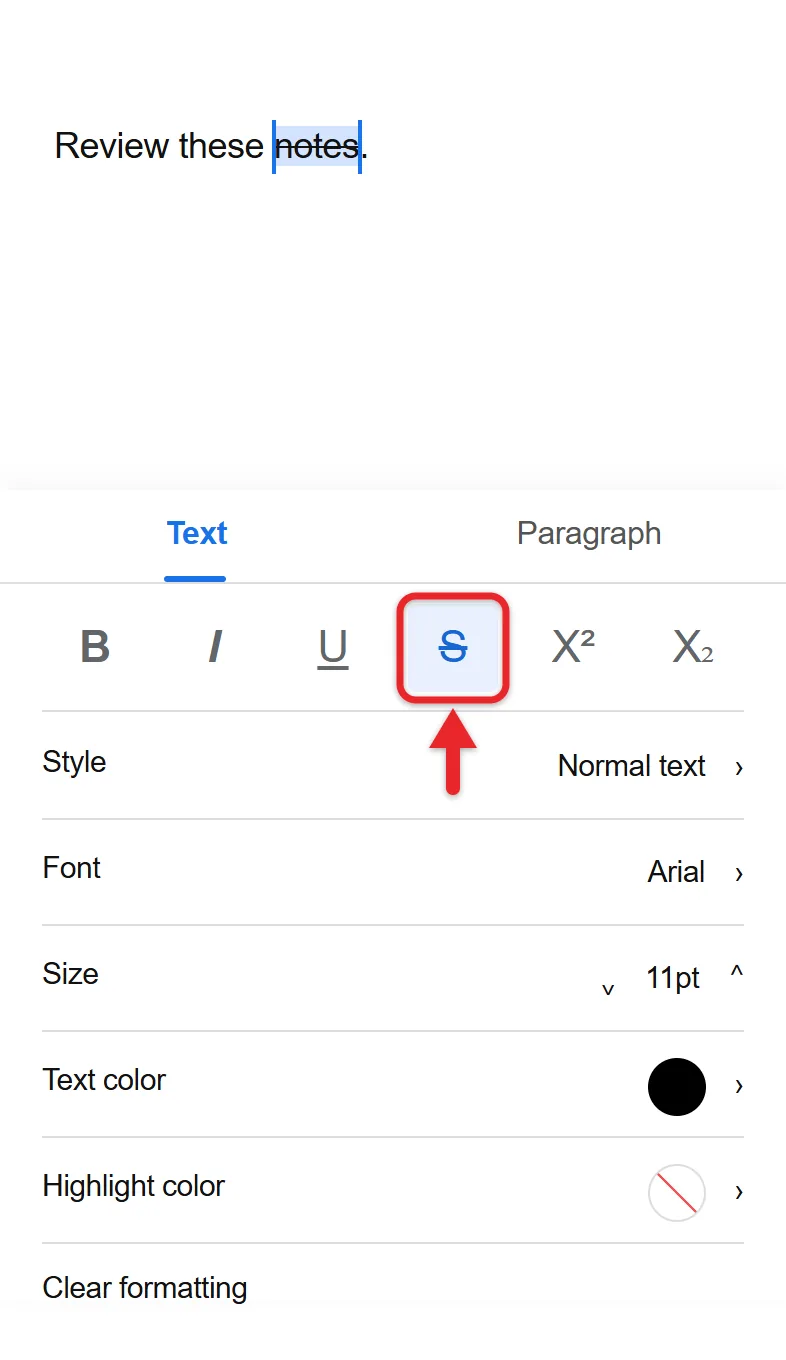
- Tap the checkmark to finish editing.
If you don’t see the Text tab or the strikethrough icon, update the Google Docs app from the App Store or Google Play. Older versions arranged the formatting panel differently.
Copy strikethrough to other text
When several separate phrases need the same line, you don’t have to apply it to each one from the menu.
- Click inside text that already has strikethrough.
- Click Paint format (the paint roller icon) in the toolbar.
- Drag across the next phrase. It picks up the strikethrough and the rest of the copied formatting, such as font and color.
Double-click Paint format instead of clicking once to keep it on for several phrases, then press Esc to stop. Google’s shortcut list also has Copy text formatting (Ctrl + Alt + C, or Command + Option + C on a Mac) and Paste text formatting (Ctrl + Alt + V, or Command + Option + V).
Find and replace can’t apply formatting, so it won’t cross out every match of a word. Use Ctrl + F (Command + F on a Mac) to jump to each match and press the strikethrough shortcut on each one.
How to remove strikethrough
For ordinary formatting, select the crossed-out words and use the same command you used to add the line:
- On a computer, choose Format > Text > Strikethrough, or press your device’s shortcut again.
- In the mobile app, select the crossed-out text and tap Strikethrough again in the formatting controls.
If you just added the line by mistake, press Ctrl + Z (Windows or ChromeOS) or Command + Z (Mac) to undo it.
Clear formatting (Ctrl + \, or Command + \ on a Mac) is a broader reset. It removes bold, italics, color, and other styling you may want to keep, so use the strikethrough toggle when the line is the only problem. When several unwanted effects need resetting, clear formatting in Google Docs and review the result carefully.
Strikethrough, suggested deletions, and checklists
Several different Google Docs features can produce crossed-out text. The right way to remove the line depends on which feature created it.
A deletion in Suggesting mode
When you delete text in Suggesting mode, Docs crosses it out in your suggestion color as a proposed deletion. That is a review item, not the formatting command applied to the words. To stop this, switch from Suggesting back to Editing.
Google’s suggested edits guide explains that suggestions do not replace the original text until approved. A reviewer with appropriate permission can choose Accept or Reject on the suggestion. Accepting a proposed deletion removes the words; rejecting it keeps the original text.
Use ordinary strikethrough when you want readers to see that something is finished or no longer applies. Use Suggesting mode when someone else needs to approve the removal.
A completed checklist item
Google Docs supports checklists with or without strikethrough. If you want a list that crosses items out when completed, choose the checklist style that includes the effect, then check the item.
On a computer, Google’s list formatting guide directs you to Format > Bullets & numbering when changing a list type, including its checklist style. A checklist is useful for a series of tasks; manually striking through selected words is more useful when you want control over a particular phrase.
Need to create the list first? Inserting a checkbox in Google Docs explains clickable checklists, keyboard controls, and the difference between a checklist item and a static box symbol.
What strikethrough changes and what it doesn’t
- The line uses the text color. Docs has no separate setting for the line’s color. To get a red line, change the text color of the crossed-out words with Text color in the toolbar; the words and the line both turn red. Gray text with a line is a common way to mute finished items.
- There is no double strikethrough. Some guides suggest drawing lines over text with Insert > Drawing. That creates a separate drawing that doesn’t move with the words when you edit, so it is best avoided.
- The words still count. Crossed-out text is still in the document, so it is included in Tools > Word count, Find results, and anything a reader copies.
- The line comes along in most copies. Strikethrough stays when you download the file as a Word document (.docx) or PDF and when you print. Pasting into a plain text app, such as Notepad, drops it.
- It doesn’t record who made the change. To see who crossed something out and when, use File > Version history.
Troubleshooting
The shortcut does nothing or triggers a different action
Click inside the document, select the text, and check the shortcut for your operating system in the table above. A browser extension can claim the same keys; try the shortcut in a private or incognito window, where most extensions are off, to find out. On a Mac, an app that uses Command + Shift + X for its own feature can also block it. If a keyboard layout, browser shortcut, or extension intercepts it, use the Format menu instead.
I cannot see the Format menu or cannot change the text
Make sure you are in the desktop editor if you are following the desktop steps. The mobile app uses its own formatting controls.
On a computer, the menus may be hidden in compact mode. The show/hide menus shortcut is Ctrl + Shift + F on Windows, ChromeOS, and Mac; on Mac this particular command uses Control. Restore the menus if that is the problem.
If you can see the document but cannot select and edit its text, check Viewing mode, your Google account, and the owner’s sharing permissions. Request editing access if direct formatting is required. Do not confuse access restrictions with a missing strikethrough feature.
New words keep appearing crossed out
The active text style can carry into new typing. Place the cursor where you want ordinary text, turn strikethrough off, and type a short word to check the result. Select any words already affected and remove their strikethrough separately. Undo the test word afterward if you do not need it.
The line is colored and won’t go away with the toggle
Colored crossed-out text with a matching colored insertion nearby is usually a suggestion. Click it and choose Accept or Reject instead of using the strikethrough command.
Frequently asked questions
Is there a strikethrough button in the desktop toolbar?
No. Google Docs doesn’t show a strikethrough button in the desktop toolbar or the right-click menu. Use Format > Text > Strikethrough, the keyboard shortcut, or Tool finder instead.
Does the same shortcut work in Google Sheets?
Yes. In Google Sheets, the strikethrough shortcut is Alt + Shift + 5 on Windows and ChromeOS and Command + Shift + X on a Mac. Google Slides text boxes also have strikethrough under Format > Text.
Can I do the same thing in an email?
Many email editors have their own formatting controls, but the Google Docs shortcut and menu are not universal. For Microsoft’s email app, here’s how to use strikethrough in Outlook.
Should I delete crossed-out text before I share the final version?
Usually, yes. A few crossed-out lines show what changed, but many make a long document hard to read. Once everyone has seen the change, delete the words, and add a comment if readers need to know why something was removed.

Matthew Burleigh is the founder, head writer, and editor of Solve Your Tech, which he launched in 2012. He has written technology tutorials since 2008 and worked in IT since 2003, including small-business support, IT management, and consulting. He holds Bachelor’s and Master’s degrees in Computer Science from Arizona State University.
Matthew writes practical guides for Windows, iPhone and iPad, Microsoft Office, Outlook, Google apps, and Android. Solve Your Tech’s guides are checked step by step against the device or app maker’s own documentation and tested on his own devices whenever he has the hardware or software, with clear steps, sources, and update dates.
Read more about Matthew and how Solve Your Tech writes and updates its guides, or report a correction.