To wrap text in Google Sheets, select the cells, click the Text wrapping button in the toolbar (or choose Format > Wrapping), and choose Wrap. Long text then drops to new lines inside the cell, and the row gets taller to fit. To break a line at a specific spot, edit the cell and press Ctrl + Enter on Windows or Command + Enter on Mac.
These steps cover Google Sheets in a web browser on a Windows PC, Mac or Chromebook, plus the Google Sheets app for Android, iPhone and iPad. Google lists “Wrap text in a cell” among the formatting options on its Edit & format a spreadsheet help page.
How to Wrap Text in Google Sheets
- Open your spreadsheet in Google Sheets on a computer.
- Select the cells you want to wrap. Drag across a range, click a column letter to select a whole column, or click a row number to select a whole row.
- Click the Text wrapping button in the toolbar. It sits to the right of the alignment buttons, and its icon shows a line of text with a curved arrow. If your browser window is narrow, click More (three dots) at the right end of the toolbar to find it. You can also click Format > Wrapping.
- Choose Wrap, the middle of the three options.
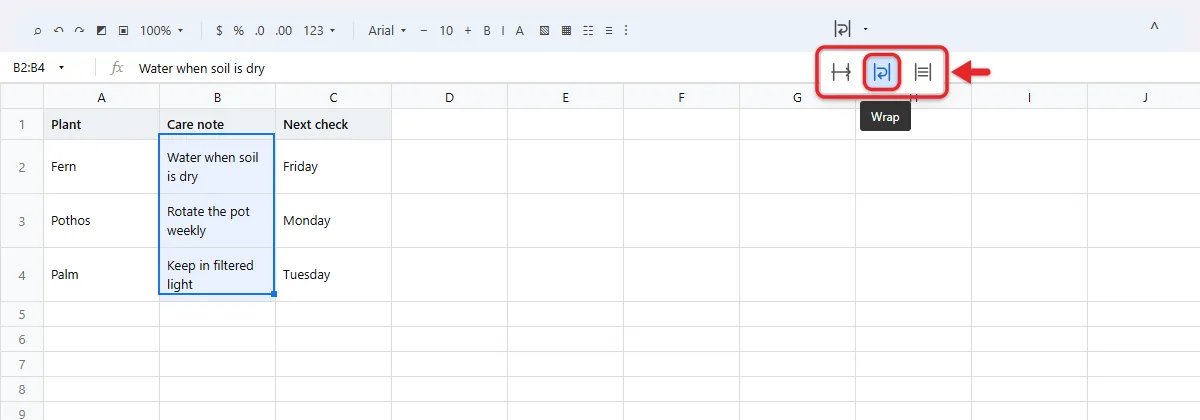
The text appears on multiple lines inside the cell, and the row height adjusts automatically so all the text fits. Wrapping changes only how the text looks. The cell contents stay exactly the same, and the full text still shows in the formula bar above the sheet.
Wrap breaks lines at spaces between words. A long string with no spaces, such as a web address, gets split wherever it reaches the cell edge. If a word breaks in an awkward spot, widen the column a little.
Wrap a whole column or the whole sheet
To wrap a column, click its letter and choose Wrap. The setting covers every cell in that column, including cells you type in later.
To wrap the whole sheet, select every cell first by clicking the blank box between row 1 and column A or pressing Ctrl + A (Command + A on a Mac), then choose Wrap. This is useful for sheets full of notes, descriptions or addresses.
Use the keyboard instead
Google’s keyboard shortcut list for Sheets has no single shortcut for wrapping, but you can reach the menu without the mouse. Select the cells, then press Alt + O in Chrome on Windows (Alt + Shift + O in other browsers) or Ctrl + Option + O on a Mac to open the Format menu. Use the arrow keys to move to Wrapping, then to Wrap, and press Enter.
Wrap vs. Overflow vs. Clip
The Text wrapping menu has three settings. Here is how they compare:
| Setting | What you see | Row height | Good for |
|---|---|---|---|
| Overflow (default) | Text spills into empty cells to the right. If the next cell has data, the text is cut off at the edge. | Stays one line | Short labels and titles over empty columns |
| Wrap | All the text shows on several lines inside the cell. | Grows to fit | Notes, descriptions, addresses, long headers |
| Clip | Only what fits in the column width shows, even when the next cell is empty. | Stays one line | Long URLs, IDs and codes you don’t need to read |
With Clip, the hidden text is still there. Click the cell to read it in the formula bar, or double-click the cell to see it while editing.
To unwrap text, select the cells and choose Overflow from the same menu. The rows shrink back to one line unless you set a fixed height.
The Format > Wrapping submenu doesn’t show which setting a cell already uses. Select the cell and look at the icon on the toolbar’s Text wrapping button instead, which changes to match.
How to Force Text to the Next Line in a Cell
Wrapping picks the line breaks for you based on column width. A manual line break puts the break exactly where you want it.
- Double-click the cell, or select it and press F2, to edit it.
- Click where you want the new line.
- Press Ctrl + Enter on Windows or Chromebook, or Command + Enter on Mac, while editing the cell.
- Press Enter when you’re done.
The text always breaks at that point, no matter how wide the column is. This works one cell at a time.
To put a list in one cell, type the first item, press Ctrl + Enter (Command + Enter on Mac), and type the next item. Add a dash or bullet before each item if you like. This is plain text, not a dropdown, so use separate rows if you need to sort or count the items.
Add line breaks with a formula
If your text uses a separator, such as commas in an address, use a formula that swaps each separator for a line break:
=SUBSTITUTE(B2, ", ", CHAR(10))
CHAR(10) returns a line break character and SUBSTITUTE replaces each comma and space in cell B2 with it. Put the formula in an empty cell, then copy it down the column for the other rows. If the result still shows on one line, apply Wrap to that cell.

How to Wrap Text in the Sheets App
The Android, iPhone and iPad apps use the same steps.
- Open the spreadsheet in the Google Sheets app and tap a cell. Drag the blue markers to select more cells, or tap a column letter or row number to select a whole column or row.
- Tap the Format button (the A with lines) at the top.
- Tap the Cell tab.
- Turn on Wrap text.

The selected cells wrap. Tap the sheet to close the formatting panel and save the change. Turn the same switch off to unwrap them.
Add a line break in the app
Double-tap the cell to edit it and place the cursor where the new line should start. On Android, tap Insert line break. On iPhone or iPad, tap Next > Insert line break. With a keyboard connected, press Ctrl + Enter on Android or Command + Enter on iPhone or iPad.
When Text Still Spills Over
- The text still spills over or is cut off. Check the toolbar’s Text wrapping icon. The cell may still be set to Overflow or Clip. Select it and choose Wrap again.
- Nothing seems to change. Wrapping only adds lines when the text is wider than the column. If the column is already wide enough, the text stays on one line. Narrow the column to see it wrap.
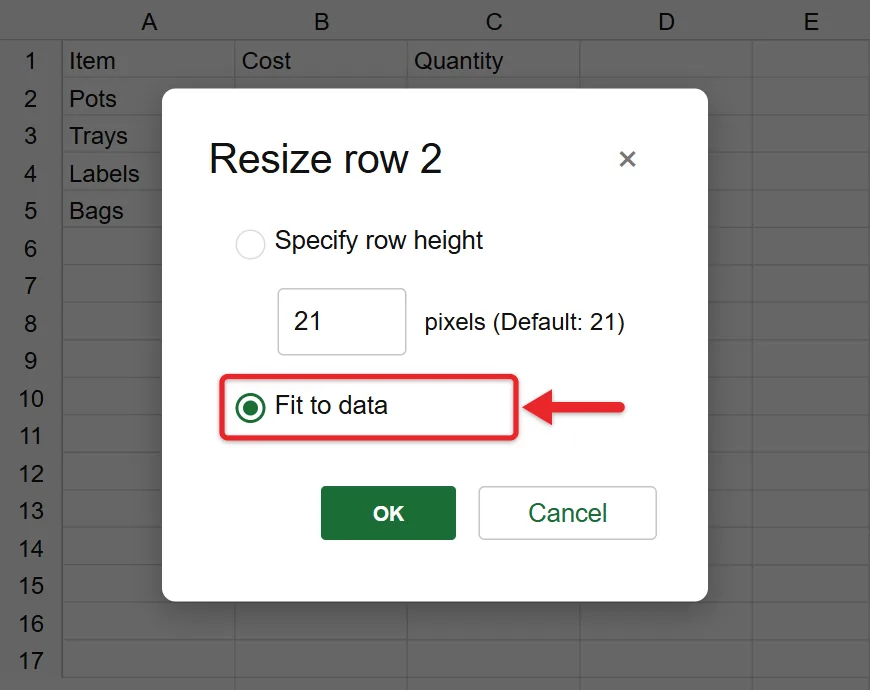
- The wrapped text is hidden because the row stays short. The row probably has a fixed height. Right-click the row number, select Resize row, choose Fit to data, and click OK. You can also double-click the bottom edge of the row number. Both methods are on the resize rows and columns help page.
- Wrapped text in merged cells is cut off. Merged cells don’t always make the row taller. Set the row height yourself after you wrap.
- The rows are far too tall. Make the column wider by dragging the right edge of its letter, and the rows shrink to fit. For columns you only skim, switch them to Clip.
- The Text wrapping button is greyed out. You probably have view-only or comment access to the file, or the range is protected. Ask the owner for edit access.
Wrapped rows get taller, so your column labels scroll out of view sooner. Freezing the header row in Google Sheets keeps them on screen.
How to Wrap Text in Microsoft Excel
In Excel, select the cells and choose Wrap Text on the Home tab, which works much like the Wrap option in Sheets.
- Select the cells you want to wrap. Click a column letter to wrap the whole column.
- On the Home tab, in the Alignment group, select Wrap Text. The text breaks to fit the column width and rewraps when you change the width.
- If the row doesn’t grow tall enough, go to Home > Format and choose AutoFit Row Height under Cell Size, or drag the bottom border of the row.
To start a new line at a specific spot, double-click the cell (or select it and press F2), click where the break should go, and press Alt + Enter. In Excel for Mac, the shortcut is Control + Option + Return.
You can also turn wrapping on from a dialog box. Right-click the cells, choose Format Cells, open the Alignment tab, and check Wrap text under Text control. Shrink to fit isn’t available while wrapping is on. Select Wrap Text again to turn it off. Microsoft’s Wrap text in a cell in Excel page notes that a fixed row height or merged cells can keep wrapped text from showing in full.
Sheets Wrap Text Questions
Why didn’t my row get taller after wrapping?
The row most likely has a fixed height. You can change the row height yourself or use Resize row > Fit to data so it grows with the text. Also try merging cells so wrapped text has more room without making other rows taller. Wrapping is also useful after you make the font bigger in Google Sheets, because larger text needs more room.
Can I wrap text in only part of a sheet?
Yes. Wrapping applies only to the cells you select, so you can wrap one column and leave the rest set to Overflow or Clip. The row still grows to fit its tallest wrapped cell, so every cell in that row gets the same height.
Is there a Shrink to fit option in Google Sheets?
No. The Wrapping menu has only Overflow, Wrap and Clip. To make long text fit without taller rows, widen the column, lower the font size, or use Clip.
Does wrapped text print on several lines?
Yes. Print uses the wrapping and row heights you see on screen, so wrapped cells print on several lines. Check File > Print to preview the page first.
How do I remove wrapping from the whole sheet?
Press Ctrl + A (Command + A on a Mac) to select every cell, then choose Overflow from the Text wrapping button. If you want to reset all formatting at once, clear the formatting in Google Sheets instead, but that also removes fonts, colors and number formats.
Related Guides
- How to merge cells in Google Sheets
- How to change row height in Google Sheets
- How to align text in Google Sheets

Matthew Burleigh is the founder, head writer, and editor of Solve Your Tech, which he launched in 2012. He has written technology tutorials since 2008 and worked in IT since 2003, including small-business support, IT management, and consulting. He holds Bachelor’s and Master’s degrees in Computer Science from Arizona State University.
Matthew writes practical guides for Windows, iPhone and iPad, Microsoft Office, Outlook, Google apps, and Android. Solve Your Tech’s guides are checked step by step against the device or app maker’s own documentation and tested on his own devices whenever he has the hardware or software, with clear steps, sources, and update dates.
Read more about Matthew and how Solve Your Tech writes and updates its guides, or report a correction.