To clear formatting in Google Sheets, select the cells and click Format > Clear formatting, or press Ctrl + \ (Command + \ on a Mac). Fonts, colors, borders and number formats go back to the default, and the data in the cells stays put. To clear the contents instead, select the cells and press Delete: the values and formulas go away, and the formatting stays.
These steps are for Google Sheets in a web browser on a computer. A separate section covers the Sheets app on iPhone, iPad and Android, which has fewer options. The shortcuts come from Google’s list of keyboard shortcuts for Google Sheets.
Clear Contents vs. Clear Formatting
Every cell holds two separate things: what’s in it (text, numbers, formulas) and how it looks (font, colors, borders, number format). Google Sheets lets you remove either one without touching the other.
| You want to | Do this | What stays |
|---|---|---|
| Reset the look | Format > Clear formatting or Ctrl + \ | Values and formulas |
| Empty the cells | Delete or Backspace, or Edit > Delete > Values | Formatting |
| Start fresh | Delete the contents, then clear formatting | The cells themselves |
| Remove the cells completely | Right-click > Delete row or Delete column | Nothing; other cells shift |
You need edit access to the file for any of these. If you can only view or comment, the menu options are grayed out.
How to Clear Formatting in Google Sheets
- Open your spreadsheet in Google Sheets.
- Select the cells you want to reset. Drag across a range, hold Ctrl (Command on a Mac) and click to pick separate cells, or click a column letter or row number to select the whole column or row.
- Click Format in the menu bar. The Format menu opens.
- Click Clear formatting at the bottom of the menu.
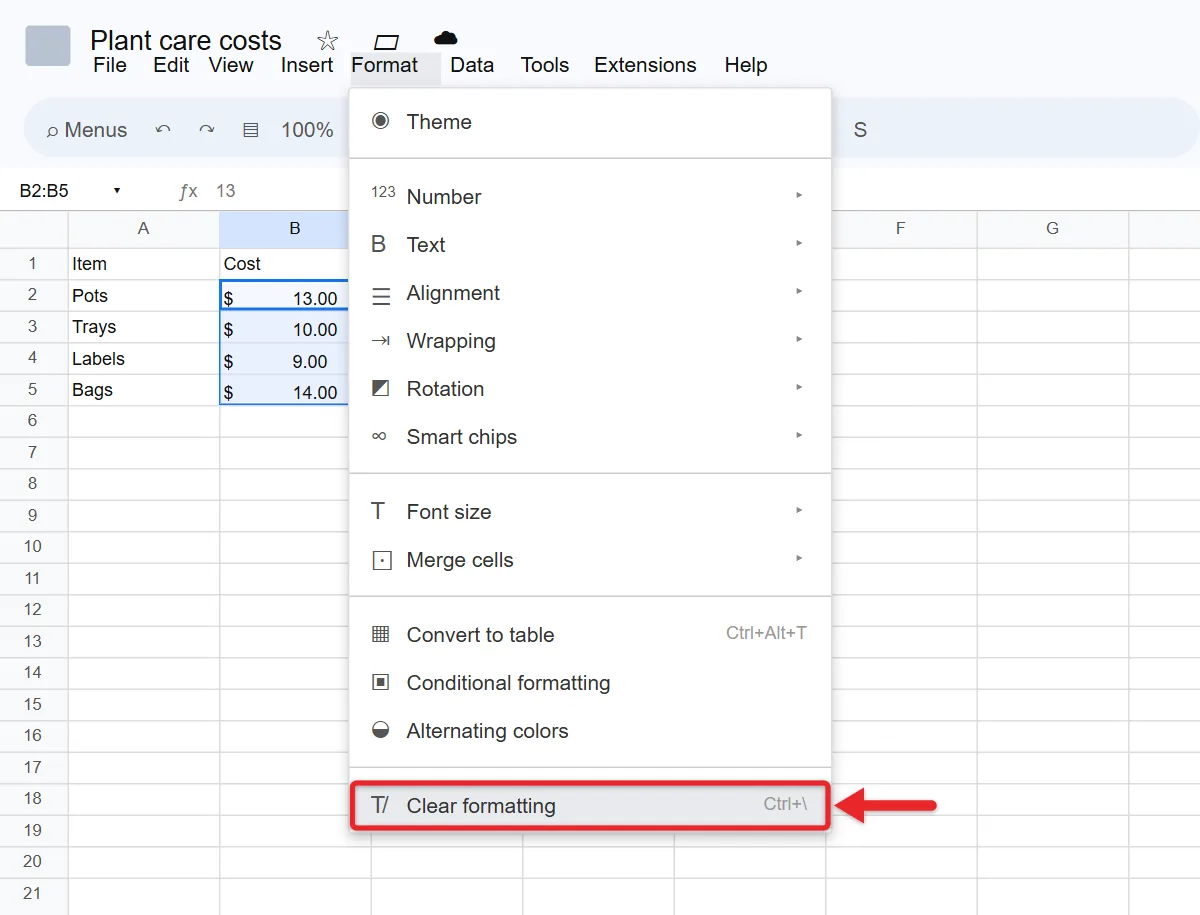
The selected cells switch back to the default font, size and color, with no fill, borders or custom number formats. Your text, numbers and formulas are unchanged.
Text wrapping goes back to the default too, so you may need to wrap text in Google Sheets again for long entries.
Clearing formatting also resets alignment, so numbers return to the right side of the cell. You can left align numbers in Google Sheets again if you need to.
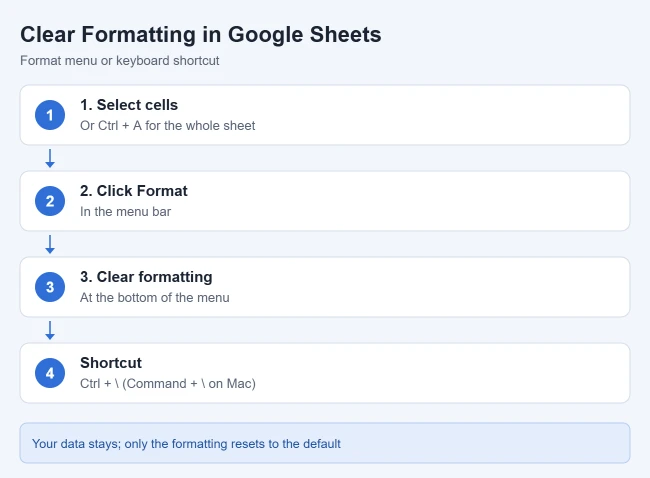
Use the keyboard shortcut
Select the cells and press Ctrl + \ on Windows or ChromeOS, or Command + \ on a Mac. Google lists this as the Clear formatting shortcut. The backslash key is usually above the Enter key on a US keyboard.
Clear formatting from the whole sheet
Press Ctrl + A (Command + A) or click the empty box above row 1 and left of column A to select every cell, then use Format > Clear formatting or the shortcut.
The entire sheet is back to the default look. Other sheets (tabs) in the file aren’t affected, so repeat this on each tab you want to reset.
What changes and what stays
Clear formatting resets cell styling: font, font size, bold, italic, underline, strikethrough, text color, fill color, borders, alignment, text wrapping and number formats such as currency, percent and dates.
It doesn’t change your data, formulas, column widths or row heights. Gridlines also stay, because they’re a view setting. To hide them, click View > Show and uncheck Gridlines.
Formatting That Clear Formatting May Leave Behind
Some formatting in Google Sheets is stored as a rule or a range setting rather than as cell formatting. Check these if cells still look formatted afterward.
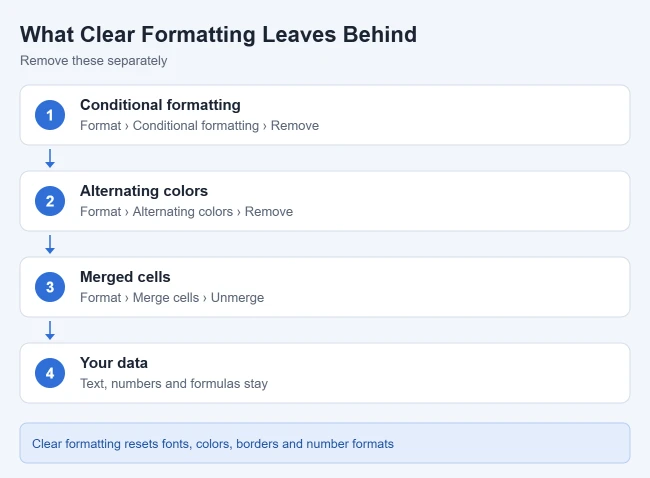
- Conditional formatting: these colors come from rules that you manage in their own sidebar. Select the range, click Format > Conditional formatting, point to the rule and click Remove. Google’s conditional formatting guide also notes that copying cells with rules pastes those rules too.
- Alternating colors: click inside the range, then Format > Alternating colors > Remove alternating colors.
- Tables: if your data was converted to a table, click the table menu (the down arrow next to the table name) and choose Revert to unformatted data. Google’s tables help page says this removes the table style and keeps the data. Don’t choose Delete table, which removes the data too.
- Merged cells: select them and click Format > Merge cells > Unmerge.
- Dropdowns and checkboxes: these are data validation, not formatting. See the steps below.
Clear formatting doesn’t split merged cells. To combine or split cells on purpose, follow the steps for merging and unmerging cells in Google Sheets.
Remove dropdowns and checkboxes
Google’s dropdown help page gives these steps:
- Select the cells with the dropdown.
- Click Data > Data validation. A sidebar lists the rules for those cells.
- Click Remove rule, then Done.

To remove checkboxes, select them and press Delete, according to Google’s checkbox help page.
Remove Only One Kind of Formatting
Clear formatting resets everything at once. If you only want to drop one style and keep the rest, use the toolbar instead:
- Fill color: click the Fill color button (paint bucket) and choose Reset. For more detail, read about removing fill color in Google Sheets.
- Text color: click the Text color button (the letter A) and choose Reset.
- Borders: click the Borders button and choose Clear borders.
- Number format: click Format > Number > Automatic to drop currency or date formatting while keeping fonts and colors.
How to Clear Cell Contents While Keeping the Formatting
To empty cells but keep their look:
- Select only the cells you want to clear.
- Press Delete or Backspace. You can also click Edit > Delete > Values.
The values and formulas disappear, and the borders, colors and number formats remain, so the next entry picks up the same style.
Don’t use Delete cells, Delete rows or Delete columns from the right-click menu, because those remove the cells themselves and shift the sheet.
Check any formulas that use those cells, because their results can change. If this is a reusable template, select its input cells only; including formula cells clears those formulas too. Press Ctrl + Z (Command + Z on a Mac) right away if you cleared the wrong range.
Watch out for dropdowns. Selecting empty dropdown cells and pressing Backspace removes the dropdown. Press Delete once to clear a choice; if the cell is already empty, pressing it again can remove the dropdown itself.
Clear one value everywhere with Find and Replace
When you need to wipe a placeholder such as “TBD” from many cells, Find and Replace is faster than hunting for each one.
- Click Edit > Find and replace, or press Ctrl + H (Command + Shift + H on a Mac).
- Type the text in the Find box and leave Replace with empty.
- Check Match case or Match entire cell contents if you don’t want to change cells that only contain the text as part of a longer entry.
- Choose where to look in the Search list, such as this sheet or all sheets.
- Click Replace all, then Done.

Every match is cleared, and the cells keep their formatting.
Clear both contents and formatting
To return a range to a blank, default state without deleting rows or columns, select it, press Delete, then press Ctrl + \ (Command + \). For a whole tab, select all cells first.
How to Paste Without Formatting
To avoid formatting in the first place, paste only the values. Copy the cells or text, select where it should go, and press Ctrl + Shift + V (Command + Shift + V). That is the Paste values only shortcut. You can also right-click and choose Paste special > Values only.
The content arrives in the destination cell’s existing format, without fonts or colors from the source. This is the easiest fix for tables copied from websites or emails.
Other Ways to Reset Formatting
- Paste format only: copy a blank, unformatted cell, select the formatted range, then right-click and choose Paste special > Format only.
- Paint format: click a blank cell, click the Paint format (paint roller) button in the toolbar, then drag across the cells you want to reset.
- Undo: if you just applied the formatting, press Ctrl + Z (Command + Z) to step back instead. If the change is too old to undo, you can restore an older version of the Google Sheets file.
- Apps Script: if you reset the same range often, Google’s Apps Script Range reference has clearFormat() to clear formatting and clearContent() to clear contents while leaving the formatting intact. Open it from Extensions > Apps Script, and test on a copy of the file first.
Clearing Formatting in the Sheets App on a Phone or Tablet
The Google Sheets app on iPhone, iPad and Android has no Format menu with Clear formatting, and the Ctrl + \ shortcut needs a keyboard. To reset cells on a phone, select them, tap Format (the A with lines icon), and change the font, colors and fill back on the Text and Cell tabs. For a full reset, open the file in a browser on a computer and use Format > Clear formatting.
Troubleshooting
- Colors are still there. They’re probably from conditional formatting, alternating colors or a table style. Remove them as described above.
- Numbers look different. Clear formatting removes custom number formats, so dates and currency may show as plain numbers. Reapply a format with Format > Number. To put the currency symbol back, follow the steps for currency formatting in Google Sheets.
- Formatting comes back when you type. A conditional formatting rule or a table is still applied to the cells. Check the Conditional formatting sidebar and the table menu.
- Nothing changed. Make sure the cells were selected first, and check that you have edit access to the file.
- You get a protected-range warning. The owner has protected those cells. Ask the owner for access, or remove the sheet protection if it’s your file.
Frequently Asked Questions
Does Clear formatting delete my data?
No. It only resets how the cells look. To delete the contents, select the cells and press Delete.
Can I undo Clear formatting?
Yes. Press Ctrl + Z (Command + Z) or click Edit > Undo right away. For older changes, use the file’s version history.
Is there a single command to clear contents and formatting together?
Not in the menus. Press Delete to clear the contents, then Ctrl + \ to clear the formatting, with the same cells selected.
Does Clear formatting remove comments or notes?
No. Notes and comments aren’t formatting. To delete them, remove comments and notes from Google Sheets separately.
Does the shortcut work in Excel too?
No. Excel doesn’t use Ctrl + \ for this. In Excel, go to Home > Clear > Clear Formats.
Related Guides
- How to remove fill color in Google Sheets
- How to remove borders in Google Sheets
- How to change font size and strikethrough in Google Sheets

Matthew Burleigh is the founder, head writer, and editor of Solve Your Tech, which he launched in 2012. He has written technology tutorials since 2008 and worked in IT since 2003, including small-business support, IT management, and consulting. He holds Bachelor’s and Master’s degrees in Computer Science from Arizona State University.
Matthew writes practical guides for Windows, iPhone and iPad, Microsoft Office, Outlook, Google apps, and Android. Solve Your Tech’s guides are checked step by step against the device or app maker’s own documentation and tested on his own devices whenever he has the hardware or software, with clear steps, sources, and update dates.
Read more about Matthew and how Solve Your Tech writes and updates its guides, or report a correction.