To create a new Google Sheets spreadsheet in Google Drive, open drive.google.com, click New, and choose Google Sheets > Blank spreadsheet. Open the folder where you want the file first if you already know its location. When the spreadsheet opens, click Untitled spreadsheet, enter a name, and press Enter.
You can also start from a template, the Sheets home screen, or the Sheets app on a phone or tablet. Sheets saves your changes automatically while you are online, so there is no Save button to click.
Before you create the file
You need a Google account and access to Google Drive or Sheets. On a computer, use a web browser; you do not need to install Microsoft Excel to create a Google Sheets file. Google Docs is the word processor, Google Sheets is the spreadsheet app, and Drive is where you organize the files. To gather answers from other people into a spreadsheet, you can create a survey with Google Forms and link it to Sheets.
Check the account shown by your profile picture before starting. A file created while signed in to a personal account may be hard to find later if you look in a work account. If you are using a shared folder or an organization’s shared drive, you also need permission to create files there.
Create a new spreadsheet in Google Drive
These steps match Google’s guide to getting started with Sheets.
- Open drive.google.com in your browser and sign in if needed.
- Open the folder where you want to keep the spreadsheet. You can create it in My Drive instead if you have not chosen a folder yet.
- Click New near the top left of Drive.
- Choose Google Sheets. If a submenu appears, select Blank spreadsheet. Depending on the menu layout, clicking Google Sheets itself can open a blank file.
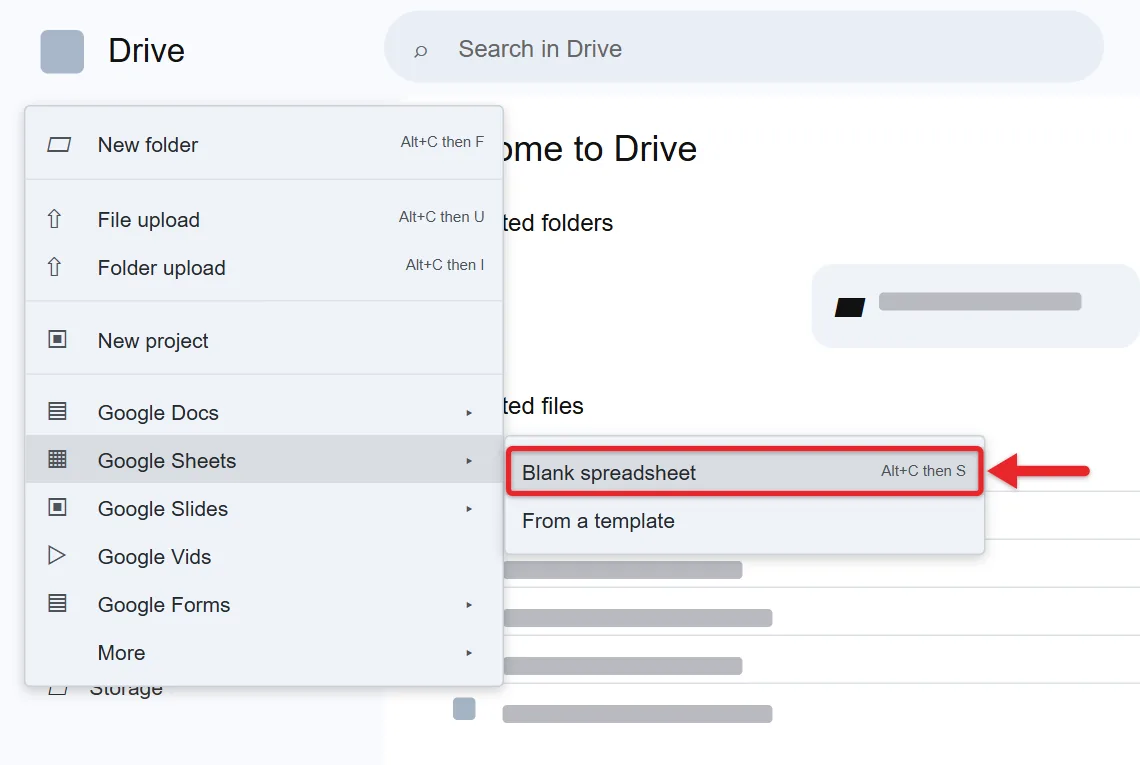
- Let the new spreadsheet open. You should see a grid of numbered rows and lettered columns, with an initial sheet tab at the bottom.
- Click Untitled spreadsheet at the top, enter a descriptive file name, and press Enter. For example, “October Expenses” is easier to find later than several files named Untitled spreadsheet.

The new spreadsheet usually opens in another browser tab. The original Drive tab can remain open behind it. If you do not see the grid, check your browser’s tabs before clicking New again; repeatedly starting the process can leave you with several empty files.
Confirm that the spreadsheet is saved
There is no separate Save button required for ordinary online editing. Google saves changes as you type, but you should finish a cell edit by pressing Enter or clicking outside that cell. Google specifically calls out finishing the cell edit in its create, view, and download help.
Check the save status next to the file name before you close the tab. If it says changes are still saving or that you are offline, keep the tab open until that clears.
To confirm, go back to Drive and open the file by its name. Your title and any data you entered should be there.
If your folders hold a lot of files, it helps to show more files on the Google Drive screen at once.
Once your data is in, you can insert a row in Google Sheets anywhere you need more space.
Other ways to start a new spreadsheet
Use the Google Sheets home screen
Open sheets.google.com, check your account, and choose the Blank or New (+) option. The new file opens in the editor. Name it and check saving just as you would when creating it from Drive.
Google also documents sheets.google.com/create as a direct creation URL in its getting-started instructions. Enter it in the browser’s address bar when you want a new file, rather than using it to search for or reopen an existing spreadsheet.
Use a Drive keyboard shortcut
Google’s Drive keyboard shortcut list lists Alt + C, then S for Windows and ChromeOS, and Control + C, then S for Mac. These are sequential keys: use the first combination, then press S. They apply to Drive’s desktop web interface.
Have Drive active and move out of a text-entry field before using the shortcut. If your keyboard layout or browser handles the keys differently, use the New menu. You can display Drive’s shortcut list with Ctrl + / on Windows or ChromeOS, or Command + / on Mac. You do not need to install an extension to use the documented shortcuts.
Start from a template instead
A template is useful when you want a prepared budget, schedule, or tracker rather than an empty grid. In Drive, open New > Google Sheets and choose From a template if that option is shown. You can also open the Sheets home screen and select Template Gallery.
- Browse the available templates and choose one that fits your task.
- Let its copy open, then give your new file a recognizable name.
- Review the sample data and replace it with your own entries.
- Check the formulas or totals before using the results. Removing an entire column or overwriting a formula can change how the template works.
- Confirm saving and the file’s location in Drive.
Google’s template guidance says choosing a template opens a copy, so the original stays unchanged. Some templates are only available with a work or school account.
Create a spreadsheet on iPhone, iPad, or Android
Use the Google Sheets app for the mobile steps. Check the signed-in account inside the app before creating the file, particularly if you switch between personal and work accounts.
iPhone or iPad
- Open Google Sheets.
- Tap Create (+) at the bottom right.
- Choose New spreadsheet for a blank file, or the template option when you want a prepared layout.
- For a new file, enter a name and tap Create.
- Enter your data, then tap outside the cell to finish the edit and allow it to save.
Android
- Open Google Sheets.
- Tap Create (+) at the bottom right.
- Choose a new spreadsheet or a template. The app opens the new file.
- If you need to change its name afterward, return to the file list, tap More beside the file, choose Rename, enter the name, and tap OK.
- Finish each cell edit by tapping outside the cell.
Google documents these differences in the iPhone/iPad and Android tabs of its file creation help. When online, edits save automatically; offline edits save to the device and sync after reconnecting. Look for the new file under the same account when you return to Drive on your computer.
If you already have an Excel or CSV file
You can import existing data instead of retyping it into a blank grid. Google’s first-spreadsheet guide describes uploading an existing file to Drive and opening it with Sheets. Excel files can also be edited without always converting them to a separate Google Sheets file, so check the format you are working in.
For a CSV, here’s how to open a CSV in Google Sheets or Drive. Its import steps explain the separator and destination choices. Create new spreadsheet and Replace current sheet have different effects; read that choice before importing over existing work.
After an import, check a few rows and columns against the original file. Dates, long ID numbers, and numbers with leading zeros are the most likely to change.
Fix common creation and saving problems
You cannot create a file in the selected folder
Check that you are signed in to the right Google account and that you have permission to add files to that folder. If the folder belongs to another person or a shared drive, ask its owner or manager about your access. Creating a file in your own My Drive may help identify whether the limitation is specific to that destination.
If the problem affects creation everywhere, check your connection and any account or storage message. An account at its storage limit cannot create or upload Drive files, as Google’s storage guidance makes clear. For a work or school account, an administrator may need to check access to the service.
The spreadsheet seems to have disappeared
Search Drive using the file name you entered, and check Recent. Confirm the account shown by your profile picture. The Sheets home screen and Drive can display the same spreadsheet, but only through an account that has access to it.
Your latest entries are missing
Check whether you finished the cell edit, whether you were online, and whether saving finished. Reopen the same file, not a similarly named copy. On a phone or tablet, tap outside the cell before leaving it.
If you made the change offline, reconnect the device where you made it and let it sync. Use File > Download when you need a copy saved on your computer.
Frequently asked questions
Does the new spreadsheet appear in Downloads?
A Google Sheets file is stored in Drive. Creating it does not automatically put an Excel or CSV file in your computer’s Downloads folder. Export through File > Download if you need a local file in another format.
Here’s how to convert a Google Sheet to PDF, Excel, or CSV.
Can I undo a mistaken entry or file name?
For a recent cell change, use Edit > Undo or the Undo button. To fix the file name, click the title at the top and type the new name.
Can I reuse the same layout without changing the original?
Open the existing spreadsheet and use File > Make a copy. Give the copy a new name and choose its location. The copy starts with the original’s content, while New > Google Sheets starts a blank file.
If the original has comments or notes you don’t want, remove comments and notes in Google Sheets from the copy.
Do I need a paid plan or Gemini to create a basic spreadsheet?
No. A free personal Google account can create and edit spreadsheets. Gemini features are optional, and you don’t need them to start a blank sheet or enter data.
What should I check before closing the browser tab?
Give the file a useful name, finish the cell you’re editing, and wait for saving to finish. Then make sure you can find the file in the right Drive account and folder.

Matthew Burleigh is the founder, head writer, and editor of Solve Your Tech, which he launched in 2012. He has written technology tutorials since 2008 and worked in IT since 2003, including small-business support, IT management, and consulting. He holds Bachelor’s and Master’s degrees in Computer Science from Arizona State University.
Matthew writes practical guides for Windows, iPhone and iPad, Microsoft Office, Outlook, Google apps, and Android. Solve Your Tech’s guides are checked step by step against the device or app maker’s own documentation and tested on his own devices whenever he has the hardware or software, with clear steps, sources, and update dates.
Read more about Matthew and how Solve Your Tech writes and updates its guides, or report a correction.