To convert a Google Sheet to a PDF, open it on a computer and click File > Download > PDF (.pdf), pick what to export and how the pages should look, then click Export. The same File > Download menu saves the spreadsheet as a Microsoft Excel (.xlsx) file or the current tab as a Comma-separated values (.csv) file, and those download right away.
These steps cover Google Sheets in a web browser on Windows, Mac, and Chromebook, plus the Google Sheets app for iPhone, iPad, and Android. They follow Google’s Download a file, Print from Google Sheets, and Export spreadsheets help pages.
Which Format Should You Choose?
Downloading never changes your Google Sheet. You get a separate file on your computer, and the original stays in Google Drive, still editable and still shared with the same people. Later edits to the sheet don’t update the file you downloaded, so download a fresh copy after big changes.
| Format | What you get | Best for |
|---|---|---|
| PDF (.pdf) | Fixed pages that look the same everywhere; nobody can edit the cells | Invoices, reports, schedules, anything you print or attach |
| Microsoft Excel (.xlsx) | Every tab, with formulas, formatting, and most charts | Someone who works in Excel, or a local backup you can edit |
| Comma-separated values (.csv) | Plain text values from one tab, no formatting | Importing into another app, database, or online form |
| OpenDocument (.ods) | Every tab in an open format | LibreOffice Calc and other open-source apps |
| Tab-separated values (.tsv) | Like CSV, but split by tabs | Data that contains lots of commas |
| Web page (.html) | A zipped web page of the sheet | Viewing the table in a browser |
How to Save a Google Sheet as a PDF
- Open the spreadsheet at sheets.google.com or from Google Drive.
- Decide what you want in the PDF. To export one tab, click that tab at the bottom. To export only part of a sheet, drag across those cells to select them.
- Click File > Download.
- Choose PDF (.pdf). A preview opens with the settings panel on the right.
- Open the Export menu at the top of the panel and choose Current sheet, Workbook (every visible tab), or Selected cells.
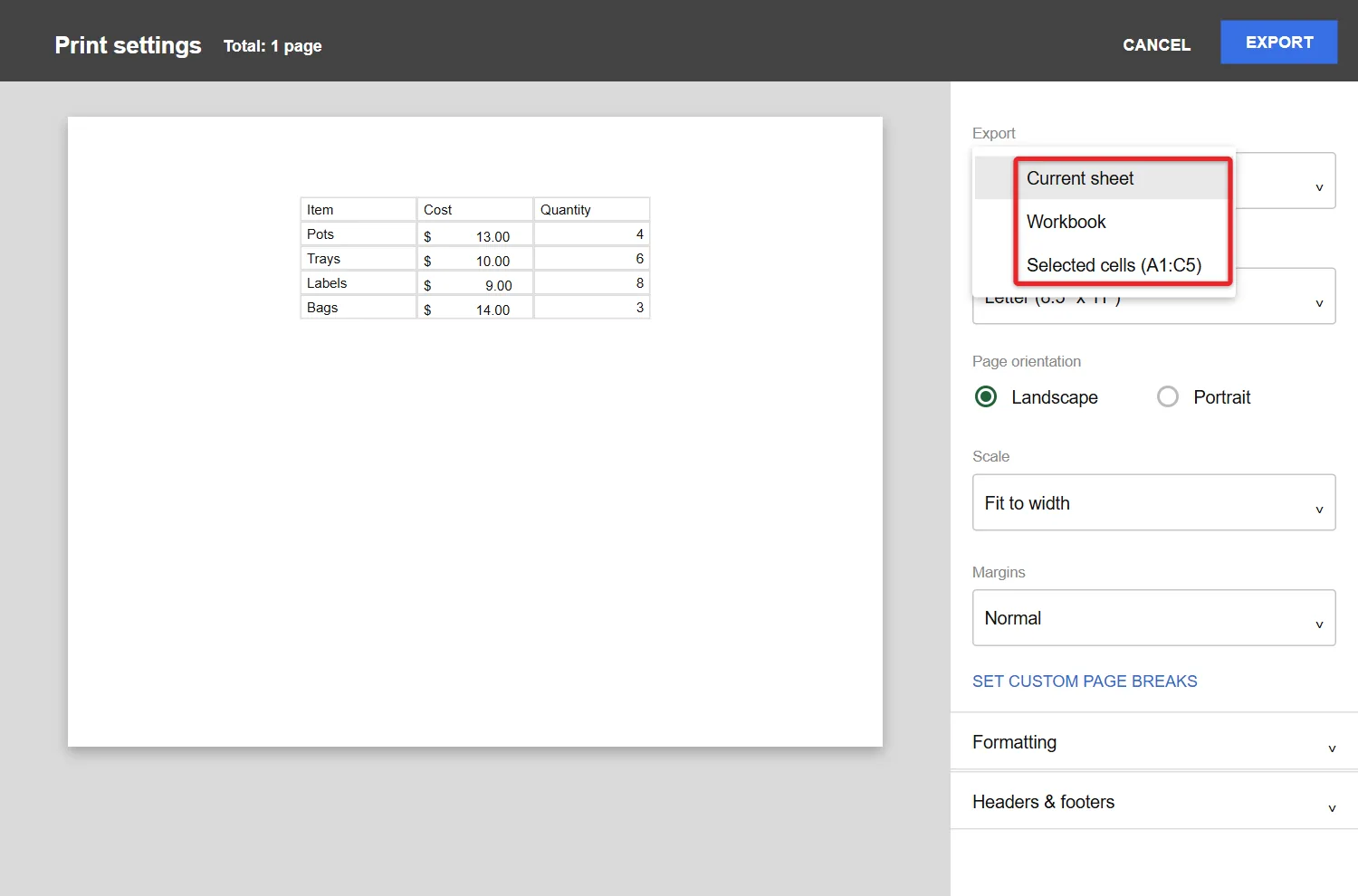
- Set the page options described in the next section. The preview updates as you change them.
- Click Export.
Your browser saves the PDF, usually to your Downloads folder, with the spreadsheet’s name. Open it to check that every column made it onto the page.

PDF page options
These settings sit in the right panel. Google’s print page uses the same panel, so anything you learn here also applies to printing.
- Paper size: Letter is the US default. You can pick sizes such as Legal, Tabloid, or A4, or choose Custom size and type a height and width.
- Page orientation: Landscape gives wide sheets more room; Portrait suits long, narrow lists.
- Scale: Normal keeps the real size. Fit to width squeezes every column onto the page, Fit to height fits every row, and Fit to page does both. You can also type a custom percentage.
- Margins: Normal, Narrow, Wide, or Custom numbers.
- Formatting: Turn gridlines and notes on or off, and set the page order and the alignment of the table on the page.
- Headers & footers: Add page numbers, the workbook title, the sheet name, and the current date or time. Click Edit custom fields to change their wording or position, then Confirm. This section also has Repeat frozen rows and Repeat frozen columns, which print your column labels on every page. They only work on rows you’ve frozen, so set up a header row first if your labels vanish after page 1.
- Custom page breaks: Click Set custom page breaks, drag the blue lines to where each page should end, and click Confirm breaks. Click Remove on a break you don’t want.
For a one-page PDF, choose Fit to page and Narrow margins. For more layout tips, read about printing a Google Sheet on one page.
Another route: File > Print
You can also click File > Print (or press Ctrl + P on Windows or Command + P on a Mac), set the same options, and click Next. Google says Firefox and Safari download a PDF at this point, while Chrome opens its print window, where you can set Destination to Save as PDF and click Save. The Download menu is the more direct choice in every browser.
How to Download a Google Sheet as an Excel File
- Open the spreadsheet.
- Click File > Download.
- Choose Microsoft Excel (.xlsx).
The .xlsx file downloads right away, with every tab in the spreadsheet. Open it in Excel, Numbers, or another spreadsheet app. You can also right-click a Google Sheets file in Google Drive and choose Download, and Drive saves it as an .xlsx file. If Excel on your Mac keeps saving copies in the wrong format afterward, change the default save type in Excel for Mac.
How to Save a Google Sheet as a CSV
- Click the tab of the sheet you want to save. CSV holds one tab only.
- Click File > Download.
- Choose Comma-separated values (.csv).
A .csv file with that tab’s data downloads, named after the spreadsheet and the tab. Repeat the steps for each tab you need. A CSV keeps the values you see in the cells, so formulas become their results, and formatting, charts, images, comments, and extra tabs are left out. For tab-separated text, choose Tab-separated values (.tsv) in the same menu.

Before you send a CSV to someone else, open it in a text editor or reopen it in Sheets to check that long numbers, dates, and leading zeros came through as you expect. To bring a CSV back into Sheets later, read about opening a CSV file in Google Sheets.
How to Email a Copy as a PDF or Excel File
- Click File > Email > Email this file.
- Select a format, such as PDF or Excel.
- Enter the email addresses or groups to send it to.
- Add a message, then click Send.
Google sends a copy as an attachment. The people you send it to get a file, not access to your live spreadsheet, and changes you make later won’t reach them. The same menu works in Google Slides, and you can also download Google Slides as a PDF with notes or handouts. For documents, the matching steps are in how to save a Google Docs file as a PDF.
How to Convert a Google Sheet on iPhone, iPad, or Android
The Google Sheets app doesn’t have the Download menu, so you send a copy in the format you want instead.
- Open the spreadsheet in the Google Sheets app.
- Tap More (three dots) at the top right.
- Tap Share & export.
- Tap Send a copy.
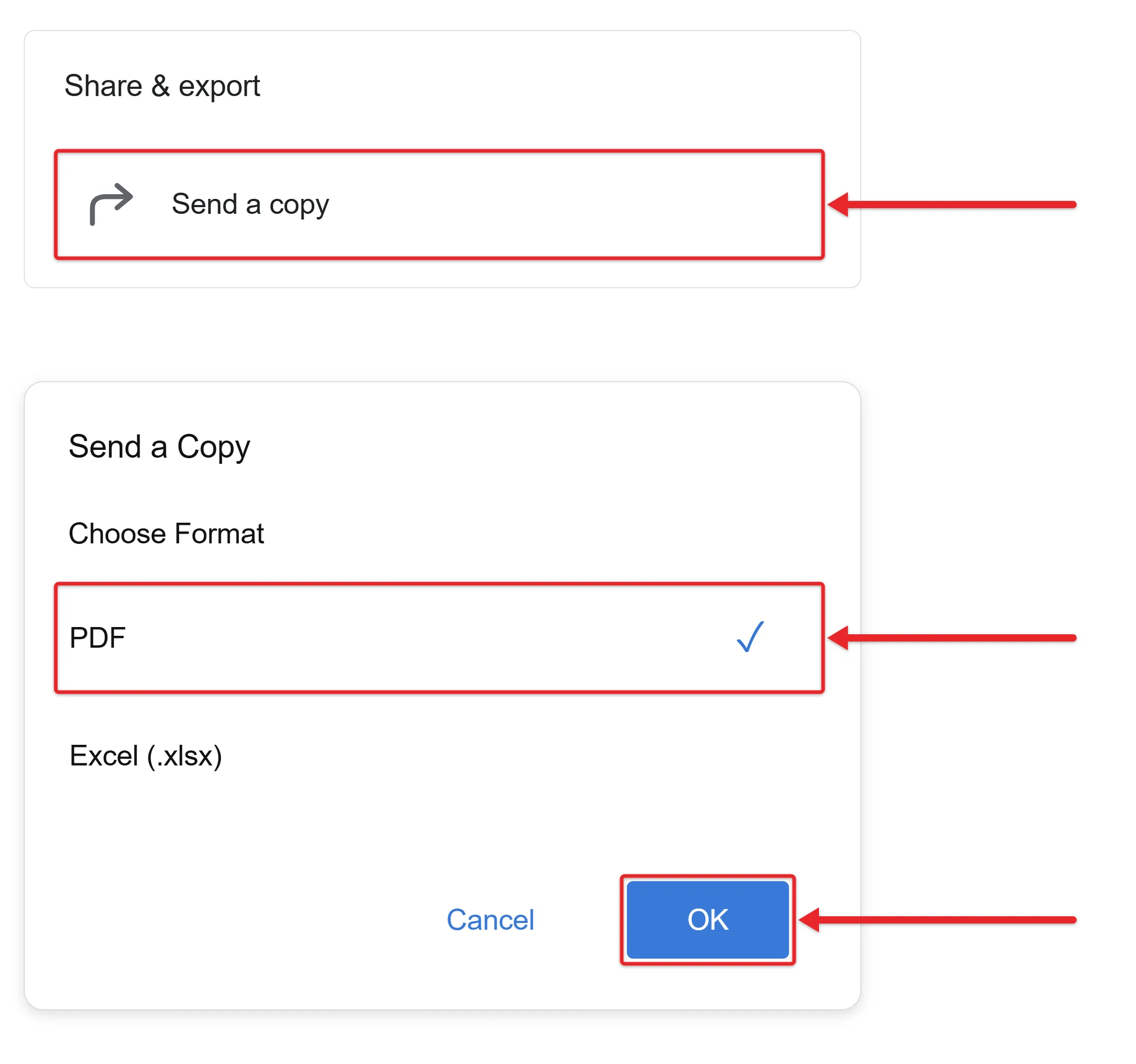
- Choose PDF or the Excel option and tap OK.
- Pick an app, such as Gmail, Drive, or Files, to send or save the copy.
Some app versions also show Save as under Share & export, which saves an Excel copy to Drive. The phone app doesn’t offer the PDF page options, so set up paper size and scale on a computer first if the layout matters.
If you mostly edit on your phone, you can also hide gridlines in the Google Sheets iPhone app so the sheet looks cleaner before you export it.
How to Publish a Sheet as a PDF Link
If you want a link that stays current instead of a file, go to File > Share > Publish to web, pick the whole document or one sheet, choose PDF document (.pdf) as the format, and click Publish. Google can republish automatically when the sheet changes; turn that off under Published content & settings. Anyone with the link can see the published version, so be careful with private or sensitive information.
To change the publish settings or stop publishing later, read about publishing a Google Sheet to the web as a PDF.
When Download Is Grayed Out or Missing
- Download is grayed out or missing: The file owner can turn off download, print, and copy for people with view or comment access. Ask the owner for edit access, or ask them to send you a copy.
- Nothing downloads in Chrome: Blocking third-party cookies can stop downloads from Drive. Allow third-party cookies for drive.google.com only, then try again.
- The PDF cuts off columns: Change Scale to Fit to width or switch to Landscape, and check the preview before you click Export.
- A tab is missing from the PDF: Current sheet exports only the open tab. Choose Workbook for all of them. Hidden tabs stay out of the export, so unhide the sheet tab first.
- Column labels only show on page 1: Freeze the header row, then turn on Repeat frozen rows under Headers & footers.
- The CSV is missing tabs: Each CSV holds one tab. Download each tab separately, or choose Excel to keep them together.
- Charts are missing: CSV can’t hold charts. Use PDF or Excel, or click a chart, open its three-dot menu, and choose Download to save it as an image or PDF. Here’s how to make a graph in Google Sheets.
Google Sheets Export Questions
Does converting a Google Sheet change the original?
No. Every download, email, or app copy is a separate file. The spreadsheet in Drive keeps its formulas, sharing settings, and version history.
Will my formulas work in Excel?
Most standard functions, such as SUM, IF, and VLOOKUP, work the same in Excel. Some functions exist only in Google Sheets, such as GOOGLEFINANCE, IMPORTRANGE, and GOOGLETRANSLATE, and Excel can’t recalculate them, so you may see the last value or an error. Open the file in Excel and check your formulas before you share it.
Can I convert a Google Sheet to PDF without the gridlines?
Yes. In the PDF settings panel, open Formatting and turn off the gridlines option before you click Export. Borders you added yourself still print.
Can I export just a few rows or columns?
Yes. Select the cells first, then choose File > Download > PDF (.pdf) and pick Selected cells in the Export menu. For Excel or CSV, copy the cells to a new tab and download that tab instead.
Why does Excel show odd characters in my CSV?
Google saves CSV files as UTF-8 text. Older versions of Excel can misread accented letters or symbols when you double-click the file. In Excel, use Data > From Text/CSV and choose UTF-8 as the file origin.
Related Guides
- How to print a Google Sheet on one page
- How to open a CSV file in Google Sheets
- How to make a graph in Google Sheets (and download it)

Matthew Burleigh is the founder, head writer, and editor of Solve Your Tech, which he launched in 2012. He has written technology tutorials since 2008 and worked in IT since 2003, including small-business support, IT management, and consulting. He holds Bachelor’s and Master’s degrees in Computer Science from Arizona State University.
Matthew writes practical guides for Windows, iPhone and iPad, Microsoft Office, Outlook, Google apps, and Android. Solve Your Tech’s guides are checked step by step against the device or app maker’s own documentation and tested on his own devices whenever he has the hardware or software, with clear steps, sources, and update dates.
Read more about Matthew and how Solve Your Tech writes and updates its guides, or report a correction.