Yes, you can convert a PDF to a Google Doc for free. Upload the PDF to Google Drive, right-click it, and choose Open with > Google Docs. Google reads the text in the PDF and puts it in a new, editable document. Plain text converts well, but Google warns that lists, tables, columns, footnotes, and endnotes usually aren’t detected.
These steps come from Google’s help page on converting PDF and photo files to text. The same method works for photos (.jpeg, .png, and .gif) of printed text.
How to Convert a PDF to a Google Doc
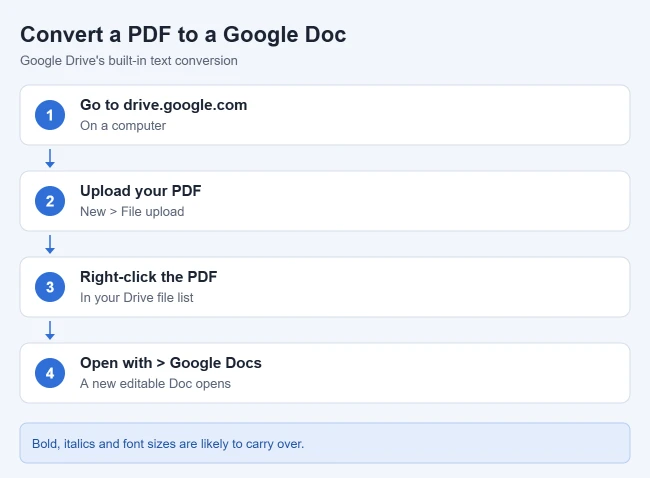
- On a computer, go to drive.google.com.
- Click New > File upload and choose your PDF.
- When the upload finishes, right-click the PDF.
- Click Open with > Google Docs.
Result: A new Google Doc opens with the text from the PDF. Google says bold, italics, font size, font type, and line breaks are likely to carry over.
How to Get a Cleaner Conversion
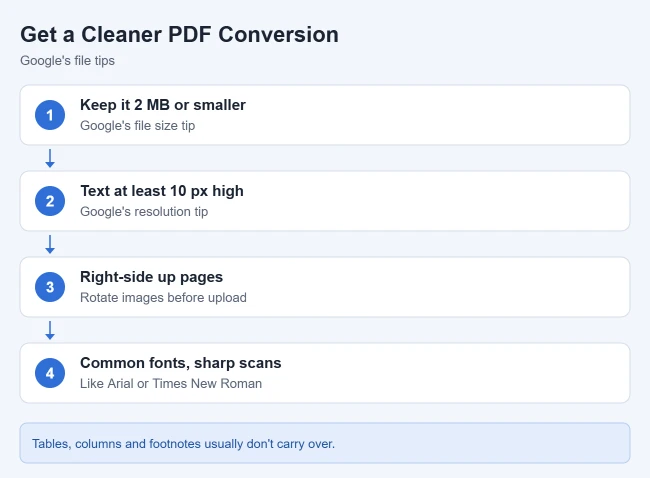
Google lists these tips for the best results:
- Format: PDFs (multipage documents) or photo files (.jpeg, .png, and .gif).
- File size: 2 MB or smaller.
- Resolution: Text at least 10 pixels high.
- Orientation: Pages must be right-side up. Rotate an image before you upload it if it faces the wrong way.
- Fonts: Common fonts such as Arial or Times New Roman.
- Image quality: Sharp images with even lighting and clear contrast.
- Language: Google Drive detects the language of the document and supports a long list of languages.
What Won’t Convert Well
Google says lists, tables, columns, footnotes, and endnotes aren’t likely to be detected. If your PDF depends on those, plan to rebuild them in Docs after the conversion, or keep the PDF for reference. For a PDF that is mostly tables, you can instead convert the PDF to an Excel spreadsheet with Acrobat. If you would rather add the PDF to an existing document as a link or a picture, see how to put a PDF into Google Docs. To put the notes back, see how to add footnotes in Google Docs. You can clear formatting in Google Docs to tidy up text that comes through with odd styles.
Converting Word Files Is Different
Office files don’t need the PDF conversion step. Google’s page on working with Office files says you can double-click a Word file in Google Drive to open and edit it directly in Google Docs. Google notes some features, such as macros, aren’t supported, and embedded charts and videos in Word files are converted to images.
If you upload Office files often, Google’s upload help page describes a Drive setting at drive.google.com/drive/settings called Convert uploads to Google Docs editor format, which converts files like Word documents as you upload them. You can only change Drive settings from a computer. For slide decks, see how to convert PowerPoint to Google Slides.
What to Do Next
- Turn your edited Doc back into a PDF: how to save a Google Docs file as a PDF.
- Shared the converted file by mistake? Here’s how to stop sharing a Google Docs file.
Frequently Asked Questions
Is converting a PDF to a Google Doc free?
Yes. It uses Google Drive’s built-in Open with Google Docs option, so you don’t need a separate converter.
Why is my converted Doc missing text or jumbled?
Check Google’s tips: the file should be 2 MB or smaller, the text at least 10 pixels high, the pages right-side up, and the scan sharp. Complex layouts like tables and columns often don’t come through.
Can I convert a photo of a document?
Yes. Google says the same steps work for .jpeg, .png, and .gif files.
Can I convert a PDF to a Google Doc on my phone?
Google’s Android help for this feature says to go to drive.google.com on your computer to convert PDF and photo files to text, so use a computer for this step.
If you only need part of the PDF, first see how to save individual pages from a PDF in Acrobat.

Matthew Burleigh has been writing tech tutorials since 2008. His writing has appeared on dozens of different websites and been read hundreds of millions of times.
After receiving his Bachelor’s and Master’s degrees in Computer Science he spent several years working in IT management for small businesses. However, he now works full time writing content online and creating websites.
His main writing topics include iPhones, Microsoft Office, Google Apps, Android, and Photoshop, but he has also written about many other tech topics as well.