To save a Google Docs file as a PDF, open the document and click File > Download > PDF Document (.pdf). The PDF goes to your computer’s Downloads folder. The same menu also saves the file as a Word document (.docx), an EPUB ebook, plain text and other formats, and your original Google Doc stays in Drive unchanged.
The computer steps follow Google’s Drive Help article Download a file, which explains that you can save Docs, Sheets and Slides files in a different format when you download them. Google’s article doesn’t cover exporting from the Docs app on a phone, so the iPhone and iPad steps below come from a Diamond Product Expert answer in Google’s Docs Editors Help Community. If you want to keep working in the live document instead, see how saving works in Google Docs.
How to save a Google Docs file as a PDF on a computer
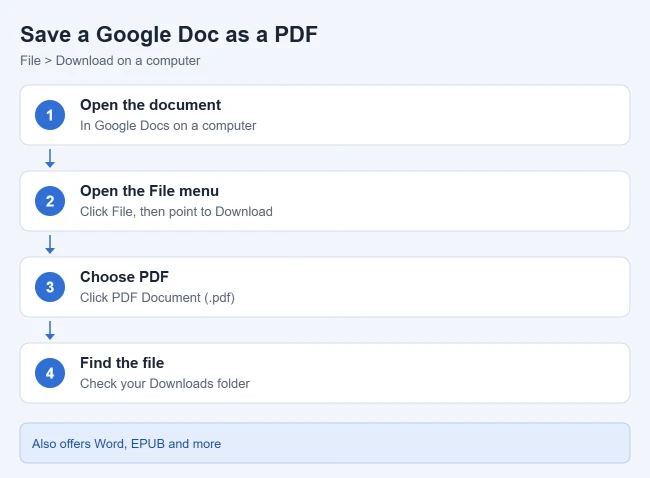
- Open the document in Google Docs in a web browser.
- Click File at the top of the page.
- Point to Download.
- Click PDF Document (.pdf).
- Open your Downloads folder to find the PDF.
Result: you get a PDF with the same name as your document. Edits you make to the Google Doc later won’t appear in that PDF, so download a new copy after big changes.
Google Docs saves your edits automatically, but if you were just working offline, wait for the document to finish syncing before you download so the PDF has your latest text.
How to save a Google Doc as a PDF on iPhone or iPad
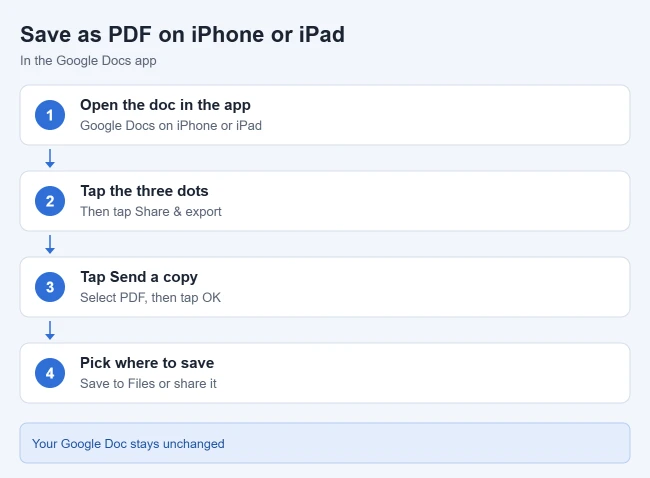
- Open the document in the Google Docs app.
- Tap the three dots (More) in the top right.
- Tap Share & export.
- Tap Send a copy.
- Select PDF (or Word .docx), then tap OK.
- Choose where to send or save the file, such as Save to Files.
Result: a PDF copy is saved to the location you chose or attached to the app you picked. The Docs app on Android also has a Share & export menu in the same three-dot menu, though option names can differ slightly.
How to save a Google Doc as a Word file (.docx)
- Open the document.
- Click File > Download.
- Click Microsoft Word (.docx).
Result: a .docx file you can open in Word, Pages or LibreOffice. Some fonts and complex layouts can shift a little in Word, so check the file before you send it.
How to export a Google Doc as an EPUB ebook
- Open the document.
- Click File > Download.
- Click EPUB Publication (.epub).
Result: an ebook file that opens in Apple Books and most ebook readers. Use headings in your document so the ebook gets a table of contents. If you open your exported files on an iPhone, you can group them in a Books collection.
Other download formats
The File > Download menu also offers OpenDocument (.odt), Rich Text (.rtf), Plain Text (.txt), Web Page (.html, zipped) and Markdown (.md). Pick the one the other app or person needs. Plain text drops all formatting and images, while the zipped web page keeps images as separate files.
If you can’t download the file
- The owner turned off downloads. Google says owners can disable printing, downloading and copying for people with comment or view access. Ask the owner for edit access or a copy.
- Third-party cookies are blocked. Google notes that Drive uses third-party cookies to talk to its download server, so blocking them in Chrome can stop downloads. Google’s article explains how to allow them for drive.google.com only.
- The download is slow or stuck. Very large documents with many images take longer to convert. Wait a moment, then check your browser’s downloads list.
Result: once the cause is fixed, the File > Download menu should work normally.
Frequently asked questions
Does downloading a PDF change the original Google Doc?
No. Downloading makes a separate copy. The Google Doc in Drive stays the same and stays editable. If you don’t want other people editing the original after you send the PDF, you can stop sharing the Google Docs file.
Can I turn a PDF back into a Google Doc?
Yes, though layouts may not come through perfectly. Our guide on putting a PDF into Google Docs also covers adding it as a link or picture. See how to convert a PDF to a Google Doc.
Why does my PDF formatting look different?
Check page setup, margins and indents before you download. For example, our guide to indenting the second line in Google Docs helps with hanging indents in citations.

Matthew Burleigh is the founder, head writer, and editor of Solve Your Tech, which he launched in 2012. He has written technology tutorials since 2008 and worked in IT since 2003, including small-business support, IT management, and consulting. He holds Bachelor’s and Master’s degrees in Computer Science from Arizona State University.
Matthew writes practical guides for Windows, iPhone and iPad, Microsoft Office, Outlook, Google apps, and Android. Solve Your Tech’s guides are tested on current devices or checked against official product documentation, with clear steps, sources, and update dates.
Read more about Matthew and how Solve Your Tech writes and updates its guides, or report a correction.