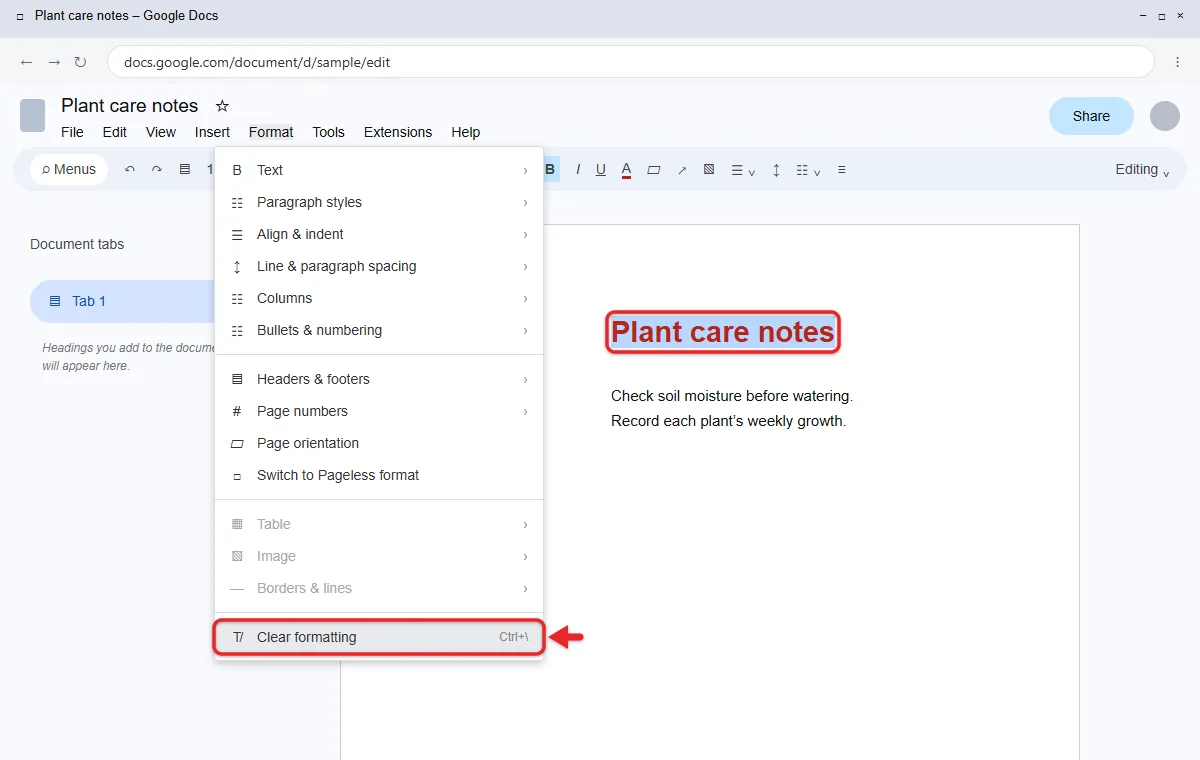
To clear formatting in Google Docs, select the text and press Ctrl + \ (Command + \ on a Mac), or click Format > Clear formatting. The selected text loses its bold, italics, colors, highlighting, and font changes and goes back to the document’s Normal text style.
These steps are for Google Docs in a web browser on Windows, Mac, and Chromebook, with a short section for the Google Docs app on Android, iPhone, and iPad. You need edit access to the document; if it was shared with you as a viewer or commenter, the formatting commands are unavailable.
How to Clear Formatting in Google Docs
- Select the text you want to reset by dragging across it. To select the whole document, press Ctrl + A (Command + A on a Mac).
- Click Format in the menu bar at the top of the page. The Format menu opens.
- Click Clear formatting near the bottom of the menu. The selected text changes to match the surrounding Normal text right away.
- Look over the text. If you cleared more than you meant to, press Ctrl + Z (Command + Z) to undo it.
Google’s keyboard shortcuts for Google Docs page lists Ctrl + \ (Command + \ on a Mac) as Clear text formatting, plus Ctrl + Space on Windows. The backslash key is usually above Enter, not the forward slash near the right Shift key.
The toolbar has a button for it too: the slanted T with a line through it, at the right end (under More, the three dots, in a narrow window).
What Clear Formatting Removes and Keeps
| Removed | Kept |
|---|---|
| Bold, italics, underline, strikethrough | The words themselves (no text is deleted) |
| Font, font size, text color | Links (the text stays clickable) |
| Highlight color | Headings and other paragraph styles |
| Superscript and subscript | Bullets and numbered lists |
| Images and tables |
If a heading is still large, it isn’t manual formatting; it’s a paragraph style. Select it and choose Normal text from the style box in the toolbar, or press Ctrl + Alt + 0 (Command + Option + 0 on a Mac).
Clearing formatting also removes strikethrough, so check first whether any crossed-out text was a deliberate mark; see what strikethrough means in a document.
How to Paste Text Without Formatting
If the formatting comes from text copied out of a website, email, or PDF, strip it as you paste:
- Copy the text as usual.
- Click where you want it in your document.
- Press Ctrl + Shift + V (Command + Shift + V on a Mac), or click Edit > Paste without formatting. You can also right-click and choose Paste without formatting.

The text takes on the font around it, and links in the copied text are dropped. If Docs keeps turning web addresses you type into links, you can turn off link detection in the Google Docs AutoCorrect settings. The same shortcut helps when you copy a page from one Google Doc to another and want it to match the new document’s styles.
How to Remove One Type of Formatting Only
To remove a single style and keep the rest, undo that style directly:
- Highlighting: select the text, click Highlight color (the marker icon) in the toolbar, and choose None.
- Bold, italics, or underline: select the text and click the same toolbar button again, or press Ctrl + B, Ctrl + I, or Ctrl + U.
- Text color: follow the steps for removing text color in Google Docs.
- Strikethrough: apply the command again to turn it off (more in using strikethrough in Google Docs).
- A link: click the linked text, then click Remove link (the broken chain icon) in the box that appears. More detail is in how to add, edit, or remove a hyperlink in Google Docs.
How to Copy Formatting With Paint Format
- Select the text that already looks the way you want.
- Click Paint format (the paint roller) in the toolbar. Google says the cursor changes to show you’re in paint format mode.
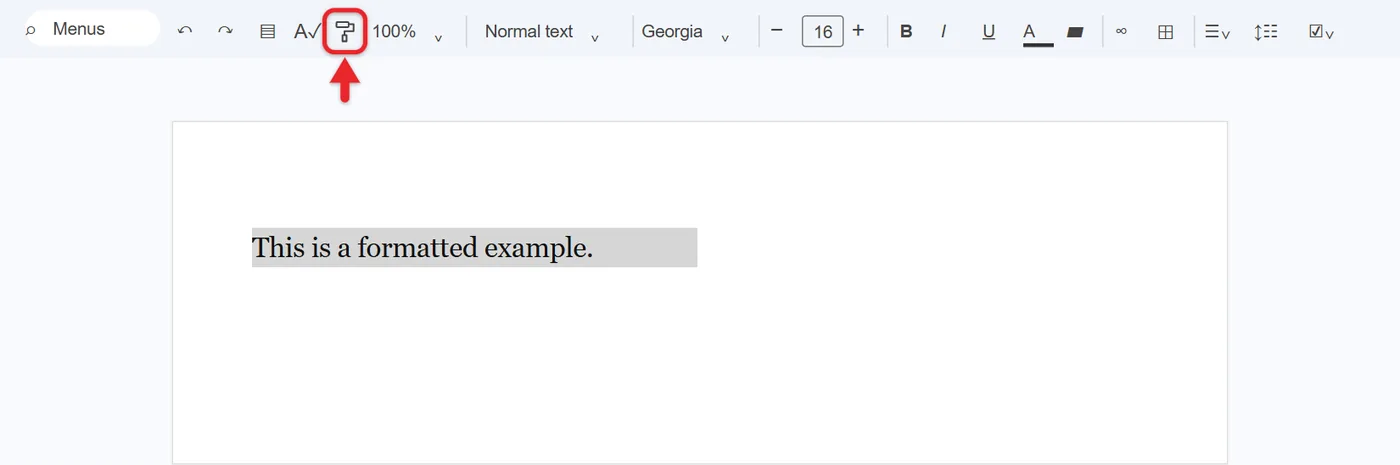
- Select the text you want to change. It takes on the same formatting.

To apply it in several places, double-click Paint format, then click it again when you’re done, as Google’s copy and paste help page describes. The keyboard version is Ctrl + Alt + C to copy formatting and Ctrl + Alt + V to paste it (Command + Option + C and Command + Option + V on a Mac).
Clear Formatting in the Google Docs App
- Open the document in the Google Docs app on Android, iPhone, or iPad and tap Edit (the pencil) if you’re in view mode.
- Double-tap a word and drag the handles to select the text.
- Tap Format (the A icon at the top). The formatting panel opens on the Text tab.

- Scroll down and tap Clear formatting.
When the Shortcut Does Nothing
- The shortcut does nothing: select text first. Some shortcuts don’t work with every language or keyboard layout, so use Format > Clear formatting.
- Clear formatting is greyed out or missing: you probably have view or comment access only. Ask the owner for edit access.
- A colored band stays behind the text: that’s paragraph shading, often from pasted web tables. Click Format > Paragraph styles > Borders and shading, set Background color to none, and click Apply.
- The font still doesn’t match the rest: the document’s Normal text style may use a different font. To fix it for the whole document, change the default font in Google Docs.
- Shortcuts fail in every document: try an incognito window. If they work there, a browser extension is catching the keys.
Clear Formatting Questions
Does clearing formatting delete any text?
No. Only the styling changes. The words, links, images, and tables stay where they are.
Is there a shortcut to open the Format menu?
Yes. It’s Alt + O in Chrome on Windows and ChromeOS, Alt + Shift + O in other Windows browsers, and Ctrl + Option + O on a Mac. Press Ctrl + / (Command + /) to see the full shortcut list.
Formatting a reference list next? Here’s how to indent the second line in Google Docs. Using Outlook instead? Here’s how to remove formatting from an email in Outlook.
Can’t see your cursor in a document? See why your cursor is white in Google Docs.

Matthew Burleigh is the founder, head writer, and editor of Solve Your Tech, which he launched in 2012. He has written technology tutorials since 2008 and worked in IT since 2003, including small-business support, IT management, and consulting. He holds Bachelor’s and Master’s degrees in Computer Science from Arizona State University.
Matthew writes practical guides for Windows, iPhone and iPad, Microsoft Office, Outlook, Google apps, and Android. Solve Your Tech’s guides are checked step by step against the device or app maker’s own documentation and tested on his own devices whenever he has the hardware or software, with clear steps, sources, and update dates.
Read more about Matthew and how Solve Your Tech writes and updates its guides, or report a correction.