The airplane icon at the top of your iPhone screen means Airplane Mode is turned on. To turn it off, open Settings and tap the Airplane Mode switch at the top of the list, or open Control Center and tap the orange airplane button. The icon goes away and your iPhone reconnects to your cellular network within a few seconds.
These steps work on iOS 26 back to iOS 17, and the Settings switch is in the same place on older iPhones. If the icon looks more like a tilted arrow, it’s probably Location Services, covered further down.
What the Airplane Icon Means
Airplane Mode is a single switch that shuts off your iPhone’s wireless radios so it doesn’t transmit on a plane. According to Apple’s Airplane Mode guide, turning it on switches off every radio except Bluetooth on iPhone. While it’s on:
- You can’t make or receive regular phone calls or text messages over your carrier’s network.
- Cellular data stops, so apps can’t get online unless you turn Wi-Fi back on.
- Bluetooth stays on unless you turned it off yourself, so AirPods and an Apple Watch can stay connected.
- Apps that work offline, such as downloaded music, videos, books, and games, still work normally.
Where the icon appears depends on your iPhone. On an iPhone with Face ID (a notch or Dynamic Island at the top), the airplane shows on the right side of the status bar, in the spot where the signal bars usually are. On an iPhone with a Home button, such as an iPhone SE, it appears on the left side. You can see the full set of status icons on a Face ID iPhone by opening Control Center. The rundown of what the icons at the top of your iPhone screen mean covers the other symbols you might see there.
Turn Off Airplane Mode in Settings
- Open the Settings app. It’s the gray gear icon on your Home Screen.
- Look near the top of the list, just below your name. Airplane Mode is the first switch, with an orange airplane icon next to it.
- Tap the Airplane Mode switch. When it’s on, the switch is green. When it’s off, the switch is gray and the knob sits on the left.
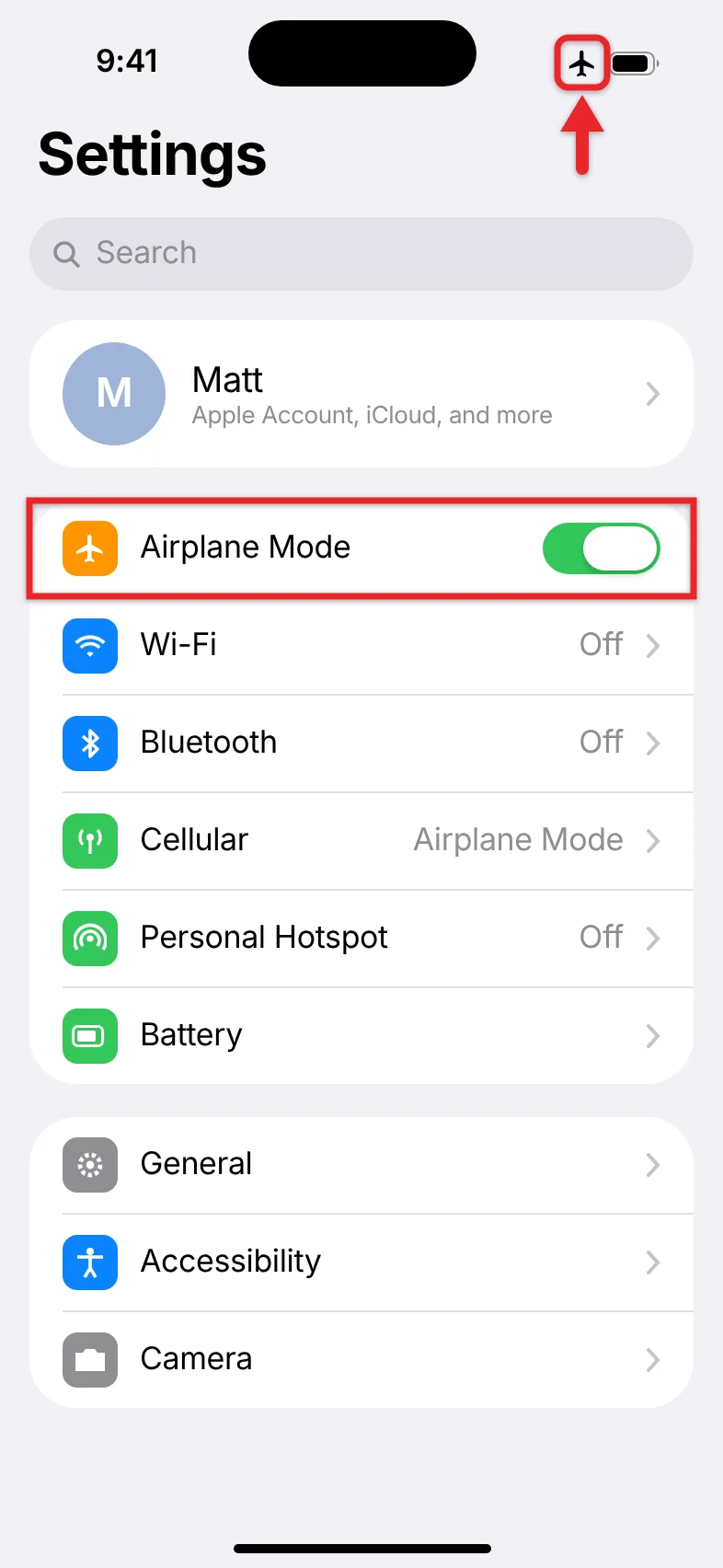
- Look at the top of the screen. The airplane icon disappears, and the signal bars and your carrier’s name or 5G/LTE label come back once your iPhone finds the network. This usually takes a few seconds.
To turn Airplane Mode back on later, tap the same switch again so it turns green.
Turn Off Airplane Mode in Control Center
Control Center is faster because it works from any screen, including the Lock Screen.
- Open Control Center. On an iPhone with Face ID, swipe down from the top-right corner of the screen, where the battery icon is. On an iPhone with a Home button, swipe up from the bottom edge of the screen.
- Find the Airplane Mode button. In iOS 18 and iOS 26 it’s in the group of connection buttons at the top left, next to Cellular Data, Wi-Fi, and Bluetooth. It’s orange when Airplane Mode is on.
- Tap the airplane button. It turns gray, and the airplane icon at the top of the screen goes away.
- Swipe up from the bottom of the screen (or tap an empty area) to close Control Center.
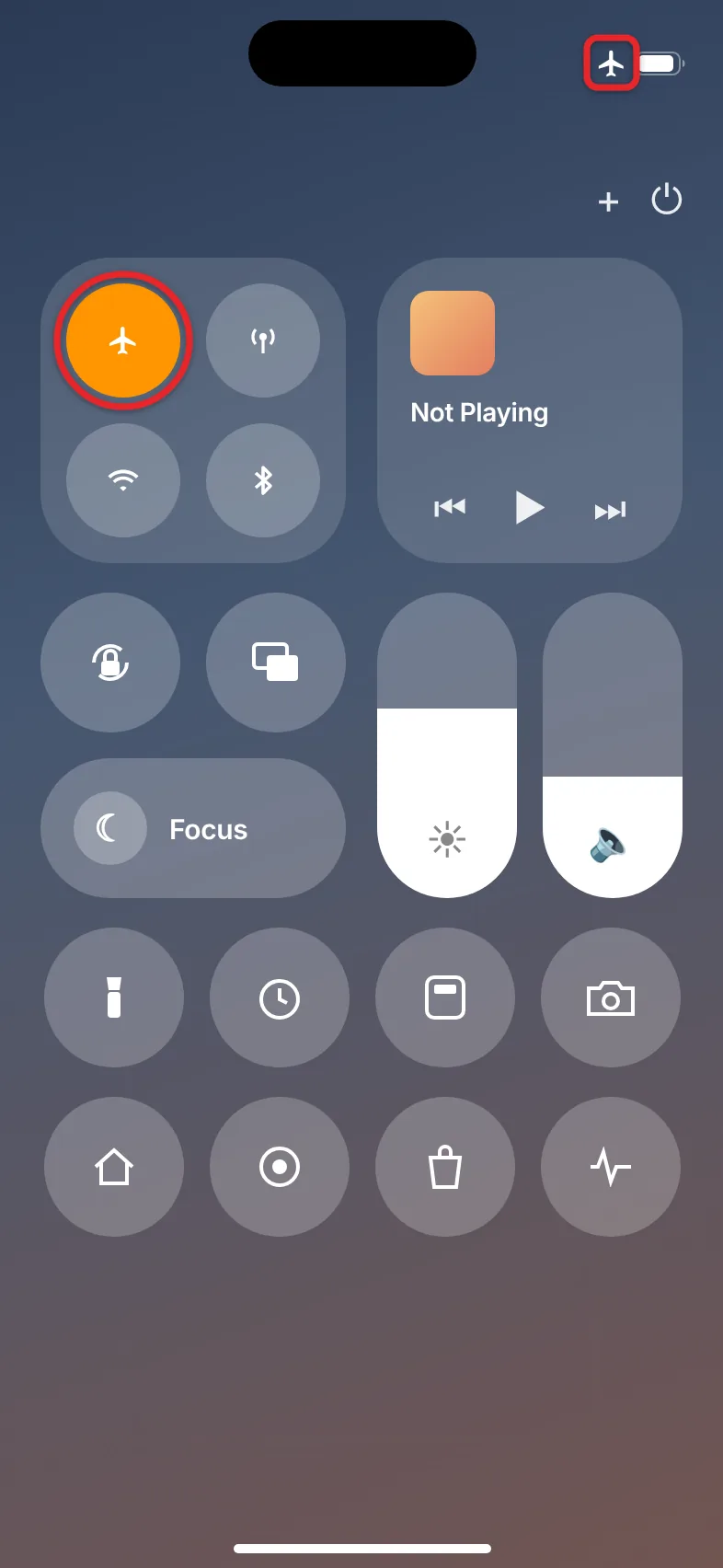
If you only see a single button where the four connection buttons used to be, touch and hold that group to expand it. Here’s how to open Control Center and change which controls appear.
Use Wi-Fi or Bluetooth While Airplane Mode Is On
On a flight that offers Wi-Fi, you can keep Airplane Mode on and still get online. Turn on Airplane Mode, then tap the Wi-Fi button in Control Center and connect to the airline’s network. You can turn Bluetooth on the same way if you want to use wireless headphones.
Your iPhone remembers this choice. If you turn Wi-Fi or Bluetooth back on while in Airplane Mode, they stay on the next time you use Airplane Mode. Turn them off again in Control Center if you want everything off.
The Bluetooth switch in Settings and the Control Center button work differently; here’s how to turn Bluetooth on or off on iPhone.
Paper Airplane or Arrow: the Location Services Icon
Many people search for the “paper airplane” icon on their iPhone. Usually they mean the small slanted arrow that appears near the clock at the top of the screen. That arrow isn’t Airplane Mode. It’s the Location Services icon, and Apple’s Location Services privacy page says it appears in the status bar or Control Center when an app is using your location. Maps, Weather, Find My, ride-share apps, and camera apps are common reasons it shows up.
Here’s how to tell them apart:
| Icon | What it looks like | What it means |
|---|---|---|
| Airplane Mode | A small airplane seen from above, with wings and a tail | Your cellular radio is off |
| Location Services | A solid arrow pointing up and to the right, like a paper airplane | An app is using your location right now or did a moment ago |
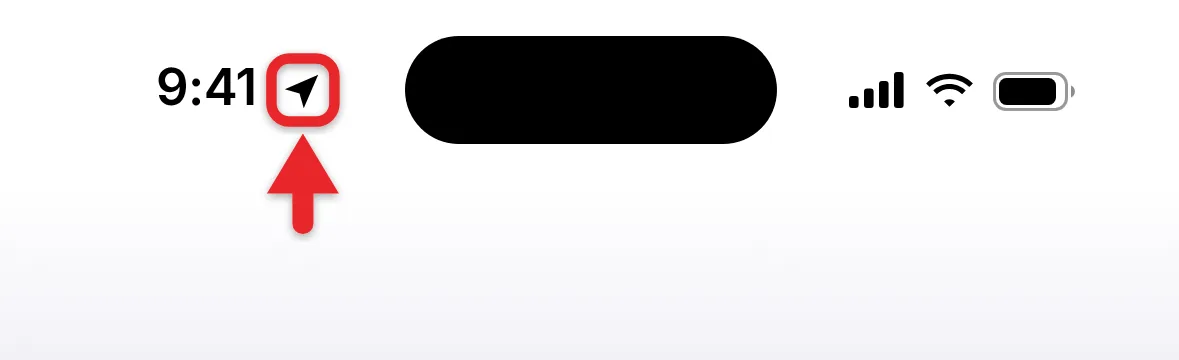
To see which app is using your location:
- Open Control Center. The name of the app using your location appears at the very top of the screen, next to the arrow.
- For a full list, open Settings and tap Privacy & Security, then Location Services.
- Scroll through the app list. A purple arrow next to an app means it used your location recently. A gray arrow means it used your location in the last 24 hours.
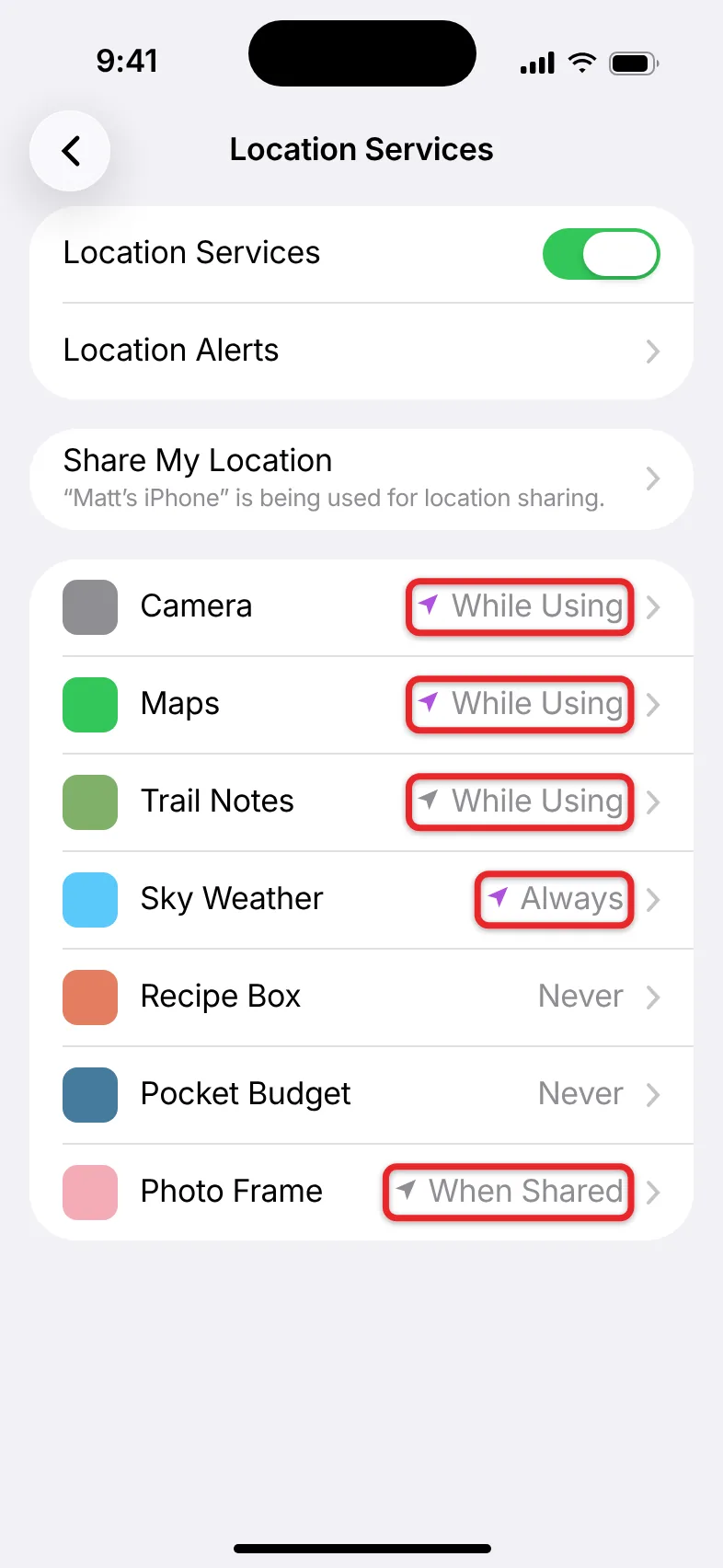
- Tap an app and choose Never, Ask Next Time Or When I Share, While Using the App, or Always. Choosing While Using the App stops most apps from triggering the arrow in the background.
You can also turn off Location Services entirely with the switch at the top of that screen, but that also stops Maps directions and Find My from finding your iPhone. The steps for turning Location Services on or off walk through the per-app settings in more detail.
Paper airplane shapes also show up inside some apps as a Send button. Telegram, Instagram’s direct messages, and several email apps use one. Those only appear inside the app and never in the status bar, so they don’t mean a setting is turned on.
A small VPN label in the status bar is a different icon. Here’s what VPN means on an iPhone and how to turn it off.
Apple also explains every status icon in its free iPhone User Guide, and here is how to get the iPhone User Guide for your iOS version.
A phone handset with a row of dots under it is a different status icon. It means RTT or TTY is on, and you can remove the TTY phone icon in Accessibility settings.
The battery icon in the status bar can also show a number. Here’s how to show the battery percentage on iPhone.
If the Airplane Icon Keeps Coming Back or Won’t Go Away
- Someone turned it on from the Lock Screen. Control Center works on the Lock Screen by default, so a pocket swipe or a child can tap the airplane button. To block that, go to Settings > Face ID & Passcode (or Touch ID & Passcode), enter your passcode, and turn off Control Center under Allow Access When Locked.
- A Shortcuts automation turns it on. Open the Shortcuts app, tap Automation, and look for one that uses the Set Airplane Mode action, such as a bedtime or alarm automation. Tap it to change or delete it.
- The button is missing from Control Center. In iOS 18 and later, you can remove controls. Touch and hold an empty spot in Control Center, tap Add a Control, and add the connection controls back. The Settings switch always works in the meantime.
- You still have no service after turning it off. Wait 30 seconds, then turn Airplane Mode on and off again. This forces your iPhone to search for the network again. If the status bar still shows No Service or SOS, restart your iPhone and check that Cellular Data is on in Settings > Cellular.
- You’re confusing it with Focus or Do Not Disturb. A moon or other Focus icon silences notifications but leaves calls and data working. Airplane Mode actually disconnects you. If you just want quiet time without missing important calls, a Focus is usually the better choice.
Airplane Mode Icon Questions
Can people call or text me when Airplane Mode is on?
Regular calls go straight to voicemail, and SMS texts wait until you turn Airplane Mode off. If you turn Wi-Fi back on, iMessage, FaceTime, and messaging apps can still work. Wi-Fi Calling may also work if your carrier supports it and it’s turned on in Settings > Cellular > Wi-Fi Calling.
Does Airplane Mode turn off Wi-Fi and Bluetooth?
Wi-Fi turns off unless you turned it back on during an earlier Airplane Mode session. Bluetooth stays on in Airplane Mode on iPhone. You can switch either one on or off from Control Center without leaving Airplane Mode.
Does Airplane Mode save battery?
Yes. With the cellular radio off, your iPhone isn’t searching for a signal, which helps the most in places with weak coverage. It also prevents roaming charges when you travel, since no cellular data is used. If you would rather keep calls working abroad and block only mobile data, turn off data roaming on your iPhone instead.
If you want to save battery without losing calls and texts, you can turn off 5G on your iPhone and stay on LTE instead.
Will my Apple Watch go into Airplane Mode too?
It can. Open the Watch app on your iPhone, tap General, then Airplane Mode, and turn on Mirror iPhone. After that, turning on Airplane Mode on your iPhone also turns it on for the watch.
Does the Location Services arrow mean I’m being tracked?
Not by itself. It means an app on your phone asked for your location, which is normal for apps like Maps and Weather. Check the app list under Privacy & Security > Location Services and change any app you don’t recognize, or that doesn’t need your location, to Never.
If you’d rather see it done, the site’s short video about the airplane icon on an iPhone 13 shows the Settings and Control Center switches.

Matthew Burleigh is the founder, head writer, and editor of Solve Your Tech, which he launched in 2012. He has written technology tutorials since 2008 and worked in IT since 2003, including small-business support, IT management, and consulting. He holds Bachelor’s and Master’s degrees in Computer Science from Arizona State University.
Matthew writes practical guides for Windows, iPhone and iPad, Microsoft Office, Outlook, Google apps, and Android. Solve Your Tech’s guides are checked step by step against the device or app maker’s own documentation and tested on his own devices whenever he has the hardware or software, with clear steps, sources, and update dates.
Read more about Matthew and how Solve Your Tech writes and updates its guides, or report a correction.