To turn off the passcode on an iPhone, open Settings, tap Face ID & Passcode (or Touch ID & Passcode on an iPhone with a Home button), enter your current passcode, and tap Turn Passcode Off. The same screen is where you turn a passcode back on or change it.
The steps below come from Apple’s iPhone User Guide page on setting a passcode and Apple’s support article on using a passcode with your iPhone.
How to Turn Off the iPhone Passcode
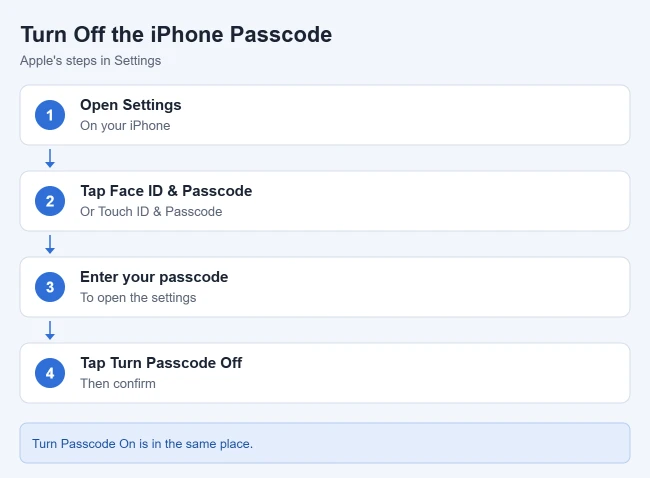
- Open the Settings app.
- Tap Face ID & Passcode. On an iPhone with a Home button, tap Touch ID & Passcode.
- Enter your current passcode. Apple notes your iPhone asks for it whenever you view or change passcode settings.
- Tap Turn Passcode Off, then confirm.
Result: Your iPhone no longer asks for a code to unlock.
Think Twice Before Turning It Off
Apple explains that setting a passcode also turns on data protection, which encrypts your iPhone data with 256-bit AES encryption. A passcode is also what lets you use Face ID or Touch ID to unlock your iPhone. Without one, anyone who picks up your phone can open it. If you just want to enter the code less often, set up Face ID or Touch ID instead.
How to Turn On or Change Your iPhone Passcode

- Open Settings and tap Face ID & Passcode or Touch ID & Passcode.
- Tap Turn Passcode On, or tap Change Passcode if you already have one.
- Enter a six-digit passcode, or tap Passcode Options to switch to a four-digit numeric code, a custom numeric code, or a custom alphanumeric code.
- Enter the passcode again to confirm it.
Result: The new passcode is active. Apple says the custom alphanumeric and custom numeric codes are the most secure options.
If You Forget a New Passcode
In iOS 17 and later, Apple’s Passcode Reset feature gives you 72 hours after a change during which you can still unlock your iPhone with your previous passcode. If you do, you’re asked to change your passcode again right away. If you’re sure you’ll remember the new code, tap Expire Previous Passcode Now in the same settings screen to end that window early.
Other Passcode Settings Worth Knowing
Apple’s support article describes these options on the Face ID & Passcode (or Touch ID & Passcode) screen:
- Require Passcode: By default, your iPhone asks for the passcode as soon as you lock the screen. Apple notes that if you use Touch ID, Face ID, or Apple Pay, you can’t change the immediate requirement.
- Allow Access When Locked: Choose which features work without unlocking, such as Today View, Notification Center, Control Center, Siri, Reply with Message, Wallet, Return Missed Calls, and USB accessories. See how to use Control Center on the lock screen.
- Erase Data: Erase the iPhone automatically after 10 failed passcode attempts. Apple says you’ll need to restore from a backup afterward.
To change how long your iPhone waits before it locks, go to Settings > Display & Brightness > Auto-Lock. More detail is in how to change the lock screen timeout on iPhone.
Why Your iPhone Still Asks for the Passcode
Even with Face ID or Touch ID set up, Apple says you must enter your passcode when you:
- Turn on or restart your iPhone.
- Haven’t unlocked it for more than 48 hours.
- Haven’t used the passcode in the last 6.5 days and haven’t used Face ID or Touch ID in the last 4 hours.
- Receive a remote lock command, or have five unsuccessful Face ID or Touch ID attempts.
- Start Emergency SOS or try to view your Medical ID.
What to Do If You Forgot Your Passcode
Apple recommends trying Passcode Reset first. If that doesn’t work, you can reset your iPhone without a computer from the lock screen in iOS 15.2 and later: keep entering the passcode until the Unavailable screen appears, tap Forgot Passcode?, then follow the steps to reset. That option needs Find My turned on and an internet connection. The last resort is to use a computer to reset your iPhone. Each of these erases your iPhone, so you’ll restore from a backup afterward if you have one.
Frequently Asked Questions
Can I turn off the passcode on an iPad too?
Yes, the steps are similar. See how to turn off the passcode on iPad.
Related Guides

Matthew Burleigh has been writing tech tutorials since 2008. His writing has appeared on dozens of different websites and been read hundreds of millions of times.
After receiving his Bachelor’s and Master’s degrees in Computer Science he spent several years working in IT management for small businesses. However, he now works full time writing content online and creating websites.
His main writing topics include iPhones, Microsoft Office, Google Apps, Android, and Photoshop, but he has also written about many other tech topics as well.