To silence an Apple Watch, press the side button to open Control Center and tap the Silent Mode button (the bell). You can also open Settings > Sounds & Haptics on the watch and turn on Silent Mode, and Apple says you still feel haptic taps for notifications while the sounds are off.
These steps are for watchOS 27 and also match watchOS 26 and other recent versions, where the side button opens Control Center. They follow Apple’s Silence notifications for extended periods on Apple Watch and Adjust volume and haptics on Apple Watch guides.
How to Silence an Apple Watch From Control Center
Silent Mode is one of the default buttons in Control Center on Apple Watch.
- Press the side button (the flat button below the Digital Crown). Control Center opens.
- Tap the Silent Mode button, which looks like a bell. The button changes color to show Silent Mode is on. If you don’t see it, scroll down with the Digital Crown.
- Press the side button again to close Control Center.

Tap the bell again whenever you want sound back. Silent Mode stays on until you turn it off. Siri can still speak in Silent Mode unless you change its response setting or turn off Siri on your Apple Watch.
Your watch stops playing alert sounds, but it still taps your wrist and lights up for notifications. Silent Mode also mutes the turn tones during a Maps route; to stop the wrist taps as well, turn off Maps directions on Apple Watch.
If only one app keeps buzzing, you can turn off that app’s notifications on Apple Watch instead.
If the bell button is missing from Control Center, scroll to the bottom, tap Edit, tap the Add button, choose Silent Mode, then tap Done. Apple also offers Settings > Control Center > Reset Control Center Layout to bring back the default buttons.
How to Silence an Apple Watch in Settings or From Your iPhone
- Open the Settings app on your Apple Watch.
- Tap Sounds & Haptics.
- Turn on Silent Mode. The switch turns green.
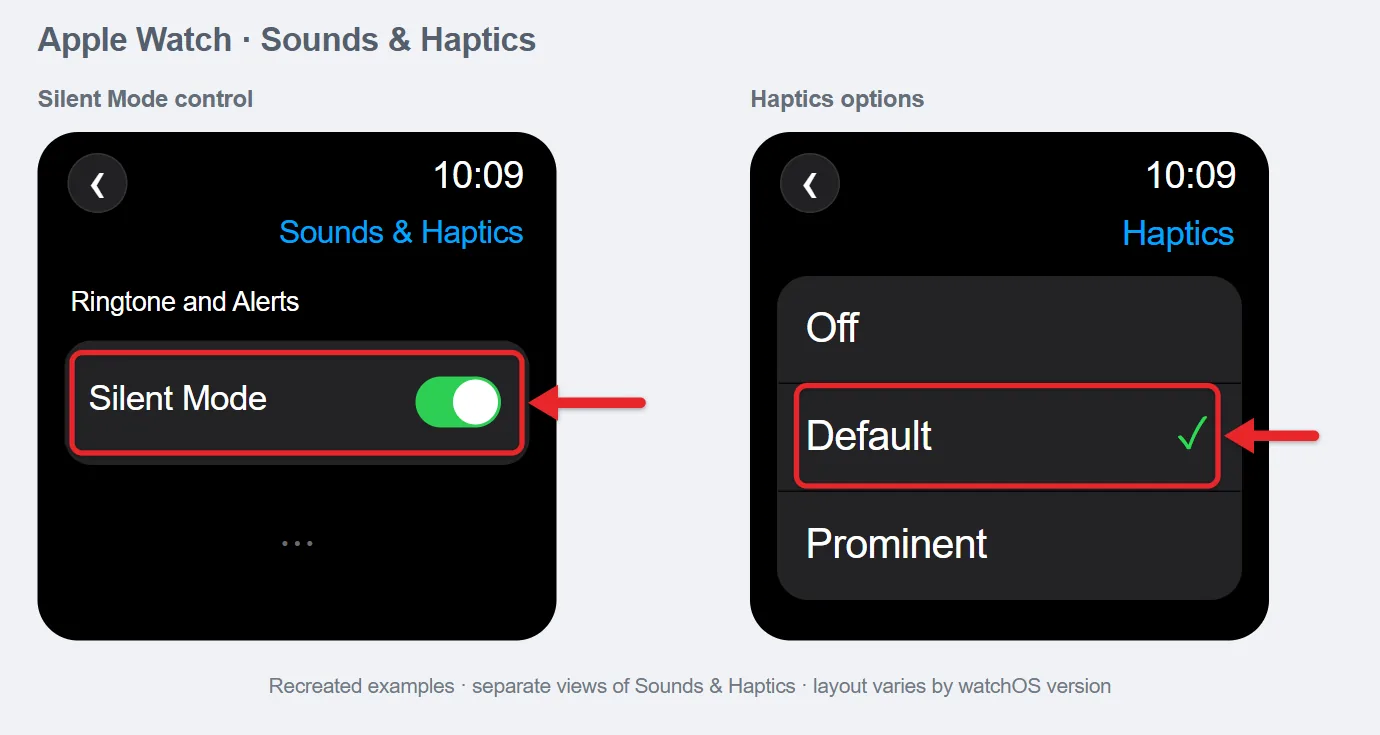
You can do the same from your iPhone: open the Apple Watch app, tap My Watch, tap Sounds & Haptics, then turn on Silent Mode. The change syncs to the watch, which is handy if it’s charging across the room.
While your Apple Watch is charging, alarms and timers still sound, even in Silent Mode.
Silent Mode vs. Theater Mode vs. Do Not Disturb
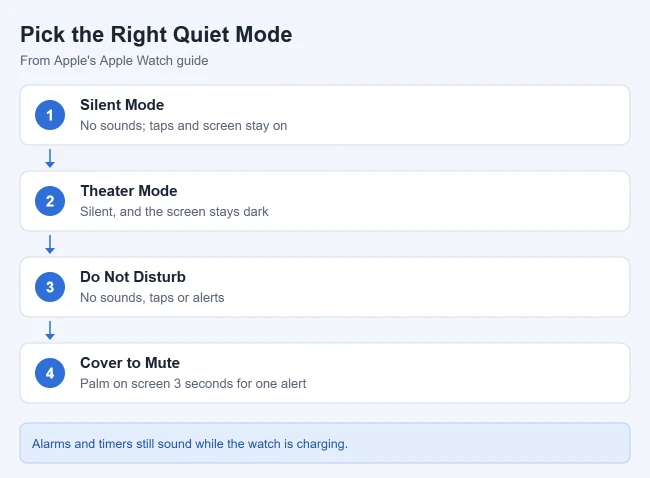
Apple offers several ways to quiet your watch for a longer stretch. Each one handles sounds, taps and the screen differently:
| Mode | Sounds | Wrist taps | Screen | Best for |
|---|---|---|---|---|
| Silent Mode | Off | On | Lights up for alerts | Classes, quiet offices |
| Theater Mode | Off | On | Stays dark until you tap it | Movies, concerts |
| Do Not Disturb | Off (alarms still sound) | Off | Stays on, no alerts shown | Meetings, sleep |
| Focus | Off except people and apps you allow | Off except allowed | Stays on (Sleep can dim it) | Work hours, schedules |
- Theater Mode also turns on Silent Mode and keeps the display from turning on when you raise your wrist. A small Theater Mode icon appears at the top of the screen. To wake the watch, tap the screen, press the side button, or turn or press the Digital Crown.
- Do Not Disturb can last 1 hour, until you leave a location, until an event ends, or until you turn it off. It silences calls and alerts, but not alarms.
- Focus works like Do Not Disturb, with exceptions and schedules you set, such as a Sleep or Work Focus. Turning on a Focus on your watch also turns it on for your iPhone.
To turn on Theater Mode, press the side button and tap the button with the two masks. For Do Not Disturb or a Focus, tap the Focus button (the moon), choose one, then tap On or pick an ending point such as On for 1 hour. A timed option is safer if you tend to forget to turn it off.
If you’d rather have the watch fully powered down, here’s how to turn off an Apple Watch.
If the screen still looks dark after you leave Theater Mode, here’s how to make the Apple Watch screen brighter.
How to Mute a Single Alert With a Gesture
If you only need to stop one ringing call or timer, Apple’s gesture guide describes two shortcuts. Both are on by default, and you can turn them on or off in Settings > Gestures.
- Cover to Mute: rest your palm on the display for at least 3 seconds while an alert plays, such as an incoming call or a timer going off. A haptic tap confirms it. You can still answer the call or reset the timer afterward. This gesture does not silence wake-up alarms, so you can’t dismiss one by accident in your sleep.
- Wrist Flick: quickly turn your wrist away from you and back to mute an incoming call, stop a timer or dismiss a notification. It needs a newer watch (Apple Watch Series 9, Ultra 2 or a later model), so older watches don’t show this setting.
How to Stop the Taps Too
Silent Mode turns off sounds but keeps haptics. To stop the wrist taps as well:
- Open Settings on your Apple Watch.
- Tap Sounds & Haptics.
- Set Haptics to Off. You can also choose Default or Prominent.
Your watch stops tapping your wrist for notifications. The same screen lets you turn off Crown Haptics (taps when you scroll with the Digital Crown) and System Haptics (taps for controls and other interactions). To silence everything for a while instead, use Do Not Disturb.
If the taps you want to stop are ring and stand reminders, you can turn off Activity notifications on Apple Watch instead.
If most of the taps come from one social app, you can turn off X notifications on Apple Watch instead.
Want stronger taps rather than none? You can make Apple Watch vibrations stronger.
If those reminders keep coming because your ring is hard to close, it may help to change your Move goal on Apple Watch to a number that fits your day.
How to Turn the Volume Down Instead
If you want quieter alerts rather than none at all, go to Settings > Sounds & Haptics. In watchOS 26 and later, the Apple Watch SE 3, Series 9, Ultra 2 and later models can adjust alert volume based on the noise around you. Tap Level and choose Default, Louder or Quieter. Turn off Automatically Adjust Volume to set the slider yourself. For music and podcasts, turn the Digital Crown while audio plays.
If Your Apple Watch Still Makes Sound
- An alarm or timer rang anyway: check whether the watch was on its charger. Alarms and timers sound while charging, even in Silent Mode.
- Siri talks out loud: Silent Mode doesn’t cover Siri’s voice. Change Siri’s responses in Settings > Siri, or turn Siri off.
- Cover to Mute does nothing: make sure it’s on in Settings > Gestures, and keep your palm on the screen for a full 3 seconds.
- Sound comes back later: someone may have tapped the bell, or a Focus ended. Open Control Center and check the Silent Mode button again.
- Your iPhone is still ringing: the watch setting only covers the watch. Silence the phone separately.
Apple Watch Silent Mode Questions
Will my alarm still go off in Silent Mode?
Apple only promises that alarms and timers sound in Silent Mode while the watch is charging. Otherwise, Silent Mode mutes alert sounds, but you still feel the haptic tap.
Does Silent Mode on my watch silence my iPhone?
No. Silent Mode on the watch only affects the watch. To quiet your phone, silence calls on the iPhone separately.
Does Silent Mode affect the handwashing timer?
Silent Mode mutes sound effects, so features like the Apple Watch handwashing timer won’t make a sound. You’ll still feel the haptic feedback.
Will I still get calls in Silent Mode?
Yes. Calls still come through with a tap on your wrist and a screen alert. To block them for a while, use Do Not Disturb instead.
How do I keep email alerts from showing on my wrist?
A silenced watch still taps your wrist when it unlocks your phone for you. That tap comes from the feature that lets you unlock your iPhone with Apple Watch.
The same Control Center has a flashlight and a Ping iPhone button. Learn how to use the flashlight on Apple Watch.

Matthew Burleigh is the founder, head writer, and editor of Solve Your Tech, which he launched in 2012. He has written technology tutorials since 2008 and worked in IT since 2003, including small-business support, IT management, and consulting. He holds Bachelor’s and Master’s degrees in Computer Science from Arizona State University.
Matthew writes practical guides for Windows, iPhone and iPad, Microsoft Office, Outlook, Google apps, and Android. Solve Your Tech’s guides are checked step by step against the device or app maker’s own documentation and tested on his own devices whenever he has the hardware or software, with clear steps, sources, and update dates.
Read more about Matthew and how Solve Your Tech writes and updates its guides, or report a correction.