Yes, you can make Apple Watch vibrations more noticeable. Open Settings on the watch, tap Sounds & Haptics, tap Haptics, and change it from Default to Prominent. On the same screen you can make alerts louder, check Silent Mode, and turn Crown Haptics on or off.
These steps cover watchOS 27 (the current version) and watchOS 26 on any Apple Watch that runs them. Automatic volume needs watchOS 26 or later on Apple Watch SE 3, Series 9, Ultra 2 or a newer model. They follow Apple’s Change the volume, audio, and haptic settings on your Apple Watch support article and its Adjust volume and haptics user guide page.
What “Haptics” Means on Apple Watch
Haptics are the taps you feel on your wrist. Apple Watch uses three kinds, and each has its own setting:
| Setting | What it controls | Choices |
|---|---|---|
| Haptics | Taps for notifications, calls and alarms | Off, Default, Prominent |
| Crown Haptics | Small clicks when you turn the Digital Crown to scroll | On or off |
| System Haptics | Taps for system controls and interactions | On or off |
Only the first one changes how strongly alerts get your attention. Some older articles describe a haptic strength slider, but current watchOS uses the three choices above.
How to Make Apple Watch Vibrations Stronger
- Open the Settings app on your Apple Watch.
- Scroll down and tap Sounds & Haptics.
- Tap Haptics.
- Choose Prominent. The other choices are Default and Off.
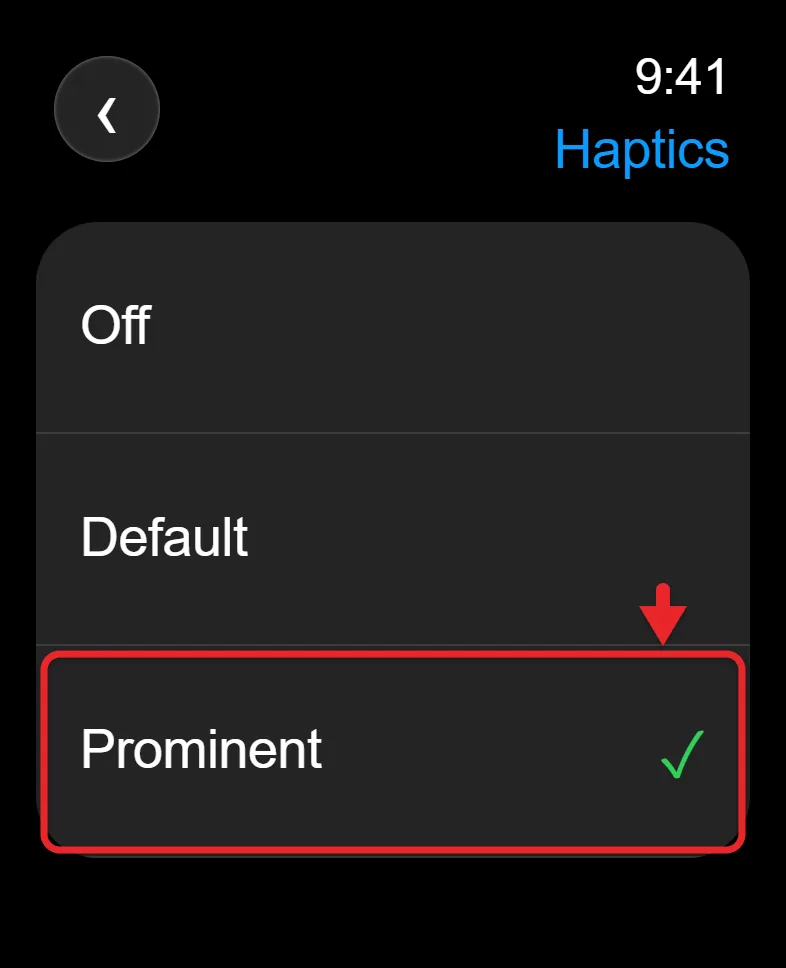
The change takes effect right away. Apple explains that Prominent adds an extra haptic tap that pre-announces some of your other haptic alerts, which makes them easier to notice. It doesn’t make every tap harder; it gives you a warning tap first, so you are more likely to feel the alert that follows.
Your watch can only tap you well if it touches your skin. The back of the watch needs skin contact for the best haptic results, so wear it snug but comfortable. You can also tighten the band for workouts and loosen it afterward, as the guide to wearing Apple Watch suggests, which helps if you miss taps while running.
If the taps you want fewer of come from navigation, you can turn off Maps turn alerts on Apple Watch instead.
If too many of those taps come from texts or other apps, you can turn off app notifications on Apple Watch one app at a time.
How to Change Haptics From Your iPhone
- Open the Apple Watch app on your iPhone.
- Tap the My Watch tab.
- Tap Sounds & Haptics.
- Under haptics, choose Prominent.
The setting syncs to your watch. This screen also lets you change haptic settings for specific apps, which is the easiest place to fine-tune alerts on the bigger screen.
How to Make Apple Watch Alerts Louder
Apple Watch has separate volume controls for system sounds (alerts, alarms and timers), Siri, and media. Siri can also be turned off or quieted on Apple Watch if you’d rather it not speak at all. For alerts:
- Open Settings > Sounds & Haptics.
- If Automatically Adjust Volume is on, tap Level and choose Louder. The other choices are Default and Quieter.
- To set a fixed level instead, turn off Automatically Adjust Volume, then tap the volume up button or tap the slider and turn the Digital Crown.
With watchOS 26 and later, the watch adjusts ringtone and alert volume to your surroundings. The user guide lists automatic volume for Apple Watch SE 3, Series 9, Ultra 2 and later, and notes that the volume doesn’t go past a certain level while it is on. Turning it off lets you push the slider up to 100%.

Alerts now play at the louder level you chose. To make Siri louder, open Settings > Siri > Siri Responses and adjust Voice Volume the same way.
How to Pick Alert Tones You Can Tell Apart
Apple’s alert sounds guide says each built-in sound has a matching haptic pattern you can feel. Choosing different tones for calls and texts helps you recognize them by feel alone, even in Silent Mode.
- Open Settings > Sounds & Haptics.
- Tap Ringtone, Text Tone or another category.
- Tap a tone to preview its sound and haptic pattern, and pick the one you want.
You can make the same choices in the Apple Watch app on your iPhone under My Watch > Sounds & Haptics.
Other Sound and Haptic Settings
- Silent Mode: silences alert sounds, but the watch still delivers haptic notifications. Turn it on or off with the bell button in Control Center (press the side button).
- Cover to Mute: rest your palm on the display for at least three seconds to silence an alert as it sounds. If it doesn’t work, check Settings > Gestures > Cover to Mute.
- Crown Haptics and System Haptics: turn these off if the clicks and taps from scrolling distract you from real alerts.
- Chimes: in Settings > Accessibility > Chimes, the watch can chime on the hour or every 30 or 15 minutes, with Birds or Bells sounds.
- Media volume: turn the Digital Crown while music plays, or use the volume button in Control Center.
The watch can also read what’s on screen aloud once you turn on VoiceOver on Apple Watch, which has its own volume setting.
Taps matter for features like the Apple Watch handwashing timer. When you want no sound at all, you can silence an Apple Watch completely.
If alerts are also hard to read, you can make the Apple Watch screen brighter and the text bigger.
How to Confirm It Worked or Undo It
Ask someone to send you a text, or set a timer for one minute, and wait with the watch on your wrist. With Prominent on, many alerts start with an extra warning tap. To go back, open Settings > Sounds & Haptics > Haptics and choose Default, or turn Automatically Adjust Volume back on.
What to Do If You Still Miss Alerts
- Check Haptics: make sure it isn’t set to Off.
- Check the fit: a loose band makes taps hard to feel. Wear the watch snug, with the back touching your skin.
- Check Do Not Disturb: Do Not Disturb keeps calls and alerts, except alarms, from sounding or lighting up the screen, and sends notifications to your iPhone. Look for its icon at the top of the watch face, and turn it off in Control Center.
- Check your iPhone: according to Apple’s notifications article, alerts go to your iPhone instead of the watch when the iPhone is unlocked. They also go to the iPhone when the watch is locked.
- Check the app’s notification setting: in the Apple Watch app, tap My Watch > Notifications, tap the app, and make sure it isn’t set to Notifications Off or Send to Notification Center, which delivers alerts without tapping you.
- Check the connection: if your watch and iPhone disconnect, notifications go to the iPhone. Restart both devices, and unpair and pair them again if the problem continues.
- Update the watch: installing the latest Apple Watch update gives you the current settings.
Apple Watch Haptics Questions
Does Cover to Mute silence my wake-up alarm?
No. Wake-up alarms are not silenced with the Cover to Mute gesture, to avoid accidental cancellations during sleep.
Can I change haptics for just one app?
Prominent applies to all alerts. To change or turn off alerts from one app, open the Apple Watch app on your iPhone, tap My Watch > Notifications, and tap the app. Apple also lists app-specific haptic options under My Watch > Sounds & Haptics.
Does Silent Mode stop vibrations?
No. Silent Mode turns off sounds, but you still feel the taps. To stop the taps too, set Haptics to Off, or use Do Not Disturb.
What is the icon at the top of my watch face?
Related Guides
- How to set an alarm on Apple Watch
- What the icons on Apple Watch mean
- How to change the wrist setting on Apple Watch
Those wrist taps also confirm when your watch unlocks your phone. Learn how to unlock iPhone with Apple Watch.
If one app is responsible for most of the taps, you can switch off just that app. For example, you can turn off X (Twitter) notifications on Apple Watch without touching other apps. For ring and stand reminders, you can turn off Activity notifications.
If the Activity reminders feel too frequent because your goals are out of reach, you can also change your Move goal on Apple Watch.

Matthew Burleigh is the founder, head writer, and editor of Solve Your Tech, which he launched in 2012. He has written technology tutorials since 2008 and worked in IT since 2003, including small-business support, IT management, and consulting. He holds Bachelor’s and Master’s degrees in Computer Science from Arizona State University.
Matthew writes practical guides for Windows, iPhone and iPad, Microsoft Office, Outlook, Google apps, and Android. Solve Your Tech’s guides are checked step by step against the device or app maker’s own documentation and tested on his own devices whenever he has the hardware or software, with clear steps, sources, and update dates.
Read more about Matthew and how Solve Your Tech writes and updates its guides, or report a correction.