To delete a picture from a text message on iPhone, open the conversation, touch and hold the photo, tap More, and tap the Delete button. To delete lots of photos at once, tap the contact’s icon at the top of the conversation, open Photos, and use Edit > Select.
This guide covers deleting one picture, deleting many, recovering or permanently removing deleted photos, and freeing up Messages storage. The steps come from Apple’s Delete messages and attachments in Messages on iPhone guide.
How to Delete One Picture From a Conversation
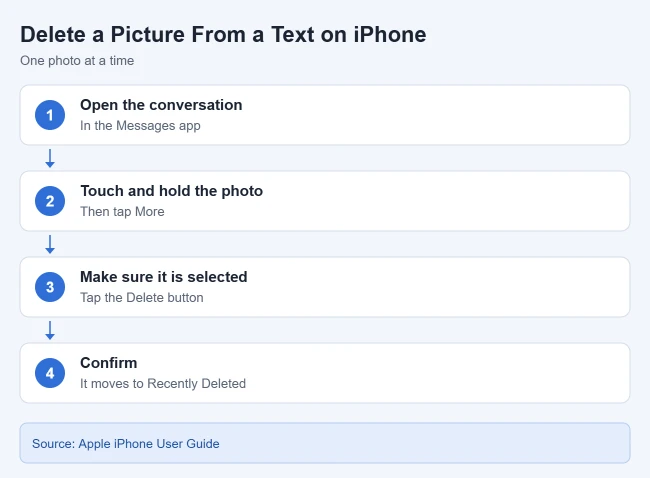
- Open the Messages app and the conversation.
- Touch and hold the picture.
- Tap More.
- Make sure the picture is selected, then tap the Delete button.
Result: The picture disappears from the conversation on your iPhone. Apple says deleting doesn’t affect what your recipients see, so the other person still has it.
How to See and Delete All Pictures in a Conversation
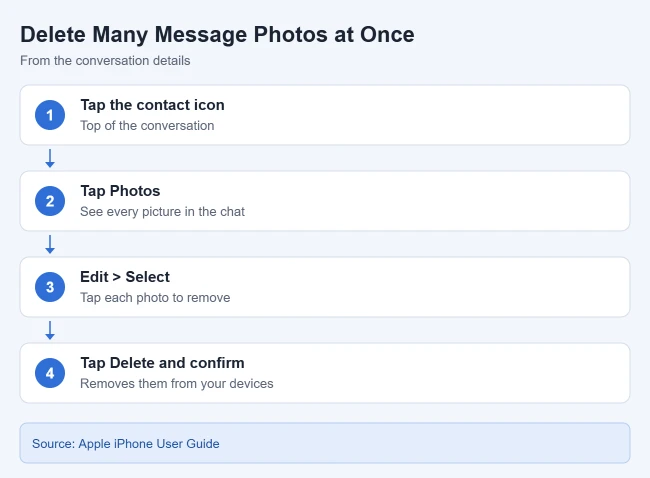
- Open the conversation.
- Tap the contact or group icon at the top.
- Tap Photos to see every picture in the chat. Apple says you can filter to only Screenshots, Videos, or Photos.
- Tap Edit, then tap Select.
- Tap each picture to delete, tap the Delete button, and confirm the number of attachments.
Result: The selected photos are removed from the conversation, while the text messages stay.
Recover or Permanently Remove Deleted Pictures
Apple says deleted messages and attachments stay in Recently Deleted for up to 30 days, and you can recover them during that time.
- In the Messages conversation list, tap the menu button and choose Recently Deleted.
- Select the conversations to recover or remove.
- Tap Recover, or tap Delete to remove them permanently.
Apple warns that permanently deleting can’t be undone.
Free Up Storage Used by Message Photos
- Review large attachments: Go to Settings > General > iPhone Storage > Messages, where you can review large attachments and delete the ones you don’t need.
- Delete old messages automatically: Apple says to go to Settings > Apps > Messages > Keep Messages and choose 30 Days or 1 Year. Apple warns that this removes whole conversations, including attachments, after that time.
- Save before you delete: if you want to keep a photo, save it to the Photos app first. Deleting it from Messages doesn’t remove copies you already saved.
Good to Know Before You Delete
- Messages in iCloud: Apple says that if Messages in iCloud is on, deleting a picture on your iPhone deletes it on all your devices that use it.
- Other people keep their copies: you can’t delete messages or attachments for anyone else.
- Undo Send is different: Apple says Undo Send can retract a message for both of you, but only within 2 minutes of sending.
Before deleting an attachment you still need to share, forward the picture message and check that it went through.
Troubleshooting
- No More option: make sure you touch and hold the picture itself, not the space next to it.
- The photo came back on another device: check whether Messages in iCloud is on for all your devices, or delete it there too.
- Storage didn’t go down right away: deleted items wait in Recently Deleted for up to 30 days. Remove them permanently to free space sooner.
Frequently Asked Questions
Does deleting a picture delete the whole conversation?
No. Only the picture you select is removed. To delete the entire thread, Apple says to swipe left on the conversation in the list and tap the Delete button.
Will the other person know I deleted a photo?
Apple says deleting only affects your own devices. The other person still sees the photo in their copy of the conversation.
More iPhone Guides
- How to stop iPhone from deleting old messages
- How to block text messages on iPhone
- Blue vs. green text messages on iPhone

Matthew Burleigh is the founder, head writer, and editor of Solve Your Tech, which he launched in 2012. He has written technology tutorials since 2008 and worked in IT since 2003, including small-business support, IT management, and consulting. He holds Bachelor’s and Master’s degrees in Computer Science from Arizona State University.
Matthew writes practical guides for Windows, iPhone and iPad, Microsoft Office, Outlook, Google apps, and Android. Solve Your Tech’s guides are tested on current devices or checked against official product documentation, with clear steps, sources, and update dates.
Read more about Matthew and how Solve Your Tech writes and updates its guides, or report a correction.