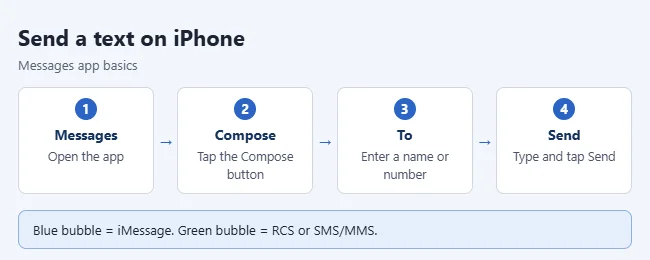
To send a text message on an iPhone, open Messages, tap the Compose button, enter a name or phone number in the To field, type your message, and tap the Send arrow. Your iPhone picks the message type for you: iMessage (blue bubble) when the other person uses an Apple device, or RCS, SMS, or MMS (green bubble) for everyone else.
This guide covers the whole Messages app in plain steps: sending and replying, what the bubble colors mean, group texts, scheduling, editing and unsending, deleting and recovering, cutting down on spam, and what to do when a message will not send.
What you need before you start
The steps here follow Apple’s current iPhone User Guide for iOS 27. Most of them also apply to iOS 26 and iOS 18, but a few buttons have moved between versions, and those differences are called out where they matter. To check your version, go to Settings > General > About.
- For iMessage: a Wi-Fi or cellular data connection, and iMessage turned on in Settings > Apps > Messages.
- For SMS and MMS: a text-messaging plan from your carrier and a cellular connection.
- For RCS: iOS 18 or later and a carrier that supports RCS on iPhone. Apple notes that RCS is not offered by every carrier or in every country.
If your iPhone runs an older version that has no Apps entry in Settings, look for Messages in the main Settings list instead.
How to send a text message on an iPhone
- Open the Messages app. You see the conversation list, which is every chat you have, newest first.
- Tap the Compose button to start a new message. In iOS 27, Apple places it at the bottom of the conversation list. On earlier versions it may sit in a top corner of the screen.
- Tap the To field and type a contact name, phone number, or Apple Account email address. Tap a suggestion to add it, or tap the add button in the To field to pick from your contacts.
- Tap the text field above the keyboard and type your message.
- Tap the Send arrow. A blue arrow means the message goes as an iMessage. A green arrow means it goes as RCS, SMS, or MMS.
The message appears in a bubble on the right side of the conversation. Under an iMessage you normally see Delivered, and later Read if the other person shares read receipts. Our guide to what Delivered means on iPhone explains those status labels.
Apple’s own instructions are in Send and reply to messages on iPhone and Use Messages on your iPhone or iPad.
Add photos, emoji, and more
Tap the button to the left of the text field to attach photos, videos, stickers, audio messages, polls, or your location. In the United States the same list includes Apple Cash, and you can turn off the option to send money through Messages if you do not want it. Tap the emoji key on the keyboard to add emoji (see how to use emoji on iPhone if that key is missing), or tap the microphone to dictate instead of typing. If you want animated pictures, see how to send GIFs on iPhone.
How to reply to a message
Messages are grouped by conversation, so you do not need to start a new message each time. A dot next to a conversation means it has something you have not read.
- Open Messages and tap the conversation.
- Tap the text field, type your reply, and tap the Send arrow.
A few other ways to respond:
- Reply to one specific message: swipe right on the bubble, or touch and hold it and tap Reply. This is called an inline reply. It quotes the original message so a busy chat stays easy to follow.
- React without typing: touch and hold a bubble and pick a Tapback, such as a thumbs-up or a heart. See how to like or react to a message.
- Reply from the Lock Screen: touch and hold the notification, type, and tap Send. If that does not work on an iPhone with Face ID, go to Settings > Face ID & Passcode and turn on Reply with Message.
- See when a message arrived: swipe left on the bubbles to show timestamps.
- Pass a message along: see how to forward a text message on iPhone.
Blue vs. green bubbles: iMessage, RCS, SMS, and MMS
The bubble color tells you which service carried the message. You do not choose it by hand. The iPhone uses iMessage when it can and falls back to a carrier service when it cannot.
| Type | Bubble | Works with | What to know |
|---|---|---|---|
| iMessage | Blue | Apple devices | Sent over Wi-Fi or cellular data. End-to-end encrypted. Supports read receipts, typing indicators, editing, and unsending. |
| RCS | Green | Non-Apple phones and iPhones | A newer carrier standard with high-resolution photos, read receipts, and typing indicators. Needs iOS 18 or later and carrier support. |
| SMS/MMS | Green | Almost any phone | The basic carrier fallback. SMS is plain text and MMS carries pictures and video. Not end-to-end encrypted. |

End-to-end encryption means only the people in the conversation can read the messages while they travel between devices. Apple says encrypted RCS is rolling out in beta starting with iOS 26.5 and only works when every carrier involved supports it. An RCS chat that is protected shows Encrypted with a lock at the top. If you do not see that label, treat the chat like ordinary SMS.
Apple compares the services in What is the difference between iMessage, RCS, and SMS/MMS? For a closer look, read our explanation of blue vs. green text messages on iPhone.
Turn iMessage on or off
- Open Settings.
- Tap Apps, then tap Messages.
- Turn iMessage on or off.
- Tap Send & Receive to choose which phone number and email addresses people can reach you at.
Our walkthrough of how to turn on iMessage covers activation problems. To read and answer texts on a Mac or iPad too, see how to turn on Text Message Forwarding.
Send a group text
- Open Messages and tap the Compose button.
- Add two or more people in the To field.
- Type your message and tap the Send arrow.
If even one person in the group is not using iMessage, the whole group shows green bubbles. Some group features then stop working. For example, Apple says you can only name a group so that everyone sees it, or remove a person, in an iMessage group.
To name a group, tap the group icons at the top of the conversation, tap Edit, then tap Edit Name & Photo. To get one person’s attention, type @ followed by their name. You can leave a group only when it has at least three other people in it. For more, see the iPhone group messaging guide and how to add someone to a group text.
Schedule a message to send later
Send Later holds a message and delivers it at a time you pick, up to 14 days ahead. It requires iOS 18 or later and only works when you are using iMessage. The other person can be on any device and is not told the message was scheduled.
- Open the conversation, or start a new one.
- Tap the button to the left of the text field, then tap Send Later.
- Tap the time shown and choose when the message should go out.
- Type the message and tap the Send arrow. The bubble keeps a dashed outline until it is delivered.
To change your mind, tap Edit next to the date above the scheduled message. From there you can tap Edit Time or Send Message. To cancel, touch and hold the bubble and tap Delete. Apple’s steps are in Schedule a text message on iPhone to send later.
Edit or unsend a message
Both options have short time limits and only work on iMessages. You cannot edit or unsend a green-bubble SMS, MMS, or RCS message.
- Unsend: within 2 minutes of sending, touch and hold the bubble and tap Undo Send. Both of you see a note that a message was unsent.
- Edit: within 15 minutes of sending, touch and hold the bubble, tap Edit, make the change, and send it again. You can edit a message up to five times. It is marked Edited, and either person can tap that label to see earlier versions.
Keep in mind that the other person may have already read the original. Also, if they use a device older than iOS 16, the original message stays on their screen. See Apple’s Unsend or edit messages on iPhone.
Delete and recover messages
Deleting a message removes it from your devices only. The other person still has their copy.
- Delete one message: touch and hold the bubble, tap More, select the messages, and tap the trash button.
- Delete a whole conversation: swipe left on it in the conversation list and tap the trash button, or touch and hold it and tap Delete.
Deleted messages stay in Recently Deleted for up to 30 days. To get one back, open the filter menu in the conversation list, tap Recently Deleted, select the conversation, and tap Recover. Apple documents this in Recover deleted messages.
Warning: two actions cannot be reversed. Removing a conversation from Recently Deleted erases it for good, and a message you pulled back with Undo Send is permanently deleted. Also check Settings > Apps > Messages > Keep Messages before changing it. Any choice other than Forever automatically removes older conversations and their attachments.
If you use Messages in iCloud, deleting a message on your iPhone also deletes it on your other Apple devices that have the feature turned on.
Keep your conversations organized
- Pin a conversation: touch and hold it and tap Pin. It moves to the top of the list as a large icon. Apple allows up to nine pins. To undo it, touch and hold the pinned conversation and tap Unpin.
- Mute a conversation: swipe left on it and tap the Hide Alerts button. You still receive the messages, just without notifications. A small icon marks the muted chat. See why there is a bell or moon next to a text.
- Mark as unread: swipe right on a conversation to flag it so you remember to come back to it.
- Find photos and links: tap the name or icon at the top of a conversation to browse the photos, links, and documents shared in it.
- Control read receipts: go to Settings > Apps > Messages and switch Send Read Receipts on or off. You can also set it for one person from inside their conversation. Our guide to turning read receipts on or off on iPhone shows both.
- Save a conversation elsewhere: see how to email a text message from your iPhone.
Filter unknown senders and block spam
Messages can move texts from people who are not in your contacts into a separate folder, so they do not interrupt you.
- Open Messages.
- In the conversation list, tap the filter button, then tap Manage Filtering.
- Turn on Screen Unknown Senders.
- Tap Allow Notifications and turn on the categories you still want alerts for, such as time-sensitive texts like verification codes.
Before you turn this on, know the tradeoff: a text from a new number, such as a delivery driver or a doctor’s office, lands in Unknown Senders and you may not be notified. Check that folder now and then. When a sender is legitimate, open the message and tap Mark as Known. If the folder does not appear on your phone, see how to find messages in the Unknown Senders folder. Apple’s instructions are in Screen and filter text messages on iPhone.
To block one person, open their conversation, tap their icon at the top, tap Info, scroll down, and tap Block Contact. Blocking also applies to Phone, FaceTime, and Mail, and the person is not told. For the Phone and Settings routes, see how to block text messages and calls on iPhone. To reverse it, see how to unblock a contact on iPhone.
If a message won’t send
A red exclamation point with Not Delivered means the message did not go through. Work through these checks in order.

- Check your connection. iMessage, RCS, and MMS need Wi-Fi or cellular data. SMS needs a cellular signal, unless Wi-Fi Calling is turned on.
- Try again. Tap the red exclamation point, then tap Try Again.
- Send it as a text. Tap the exclamation point and choose Send as Text Message. Your carrier’s messaging rates may apply. To make this fallback automatic, turn on Send as Text Message in Settings > Apps > Messages.
- Check the recipient. Make sure the phone number or email address is correct.
- Restart the iPhone and send the message again.
- Contact your carrier if SMS, MMS, or RCS messages still fail. Those services run on the carrier’s network, not Apple’s.
Other common problems:
- Messages turned green after setting up a new iPhone: go to Settings > Apps > Messages, turn iMessage off and back on, then tap Send & Receive and select your phone number.
- Pictures will not send: see how to fix “MMS Messaging needs to be enabled”. Apple also suggests freeing up storage or turning on Low Quality Image Mode in the Messages settings.
- A setting is missing: options such as RCS Messaging and Send as Text Message depend on your carrier. If you do not see one, your carrier may not support it.
- You stopped getting group messages: open the group and check whether it says you left the conversation. Someone in the group has to add you back.
Apple’s full list is in If you can’t send or receive messages on your iPhone or iPad.
Frequently asked questions
Do iMessages cost money?
iMessage itself has no per-message fee. It uses Wi-Fi or cellular data instead of your texting plan, and Apple notes that cellular data rates might apply when you are off Wi-Fi. SMS and MMS messages count against your carrier’s text-messaging plan.
Why did my message send as green instead of blue?
A green bubble means the message went as RCS, SMS, or MMS. That happens when the other person does not use an Apple device, when iMessage is turned off on either phone, or when iMessage is temporarily unavailable. Check that iMessage is on in Settings > Apps > Messages and that you have a data connection.
Can I text someone who has an Android phone?
Yes. Enter their phone number the same way you would for anyone else. The message goes as RCS if both carriers support it, or as SMS or MMS if not, and it appears in a green bubble. Editing, unsending, and Send Later are not available in those conversations.
Can I unsend a text on iPhone?
Only an iMessage, and only for 2 minutes after you send it. Touch and hold the blue bubble and tap Undo Send. Green-bubble messages cannot be unsent.
Does the other person know if I delete a message?
No. Deleting a message or conversation only removes it from your own iPhone and your other Apple devices. The other person keeps their copy and is not notified.
How do I see my texts on my iPad or Mac?
Sign in to the same Apple Account on each device. Then on the iPhone go to Settings > Apps > Messages > Text Message Forwarding and turn on the devices that should receive your SMS, MMS, and RCS texts. To keep your full message history in sync, turn on Messages in iCloud under Settings > [your name] > iCloud > Messages. Be aware that it uses iCloud storage.
Next step
Send a test message to a friend, then open Settings > Apps > Messages and review three settings: iMessage, Send as Text Message, and Send Read Receipts. Those three control most of what happens when you tap Send.

Matthew Burleigh has been writing tech tutorials since 2008. His writing has appeared on dozens of different websites and been read hundreds of millions of times.
After receiving his Bachelor’s and Master’s degrees in Computer Science he spent several years working in IT management for small businesses. However, he now works full time writing content online and creating websites.
His main writing topics include iPhones, Microsoft Office, Google Apps, Android, and Photoshop, but he has also written about many other tech topics as well.