To forward a text on iPhone, open Messages, touch and hold the message bubble, tap More, select the message, and tap the curved forward arrow. Enter a recipient, review the outgoing content, and tap Send. If you are new to the app, start with our guide to text messaging on iPhone.
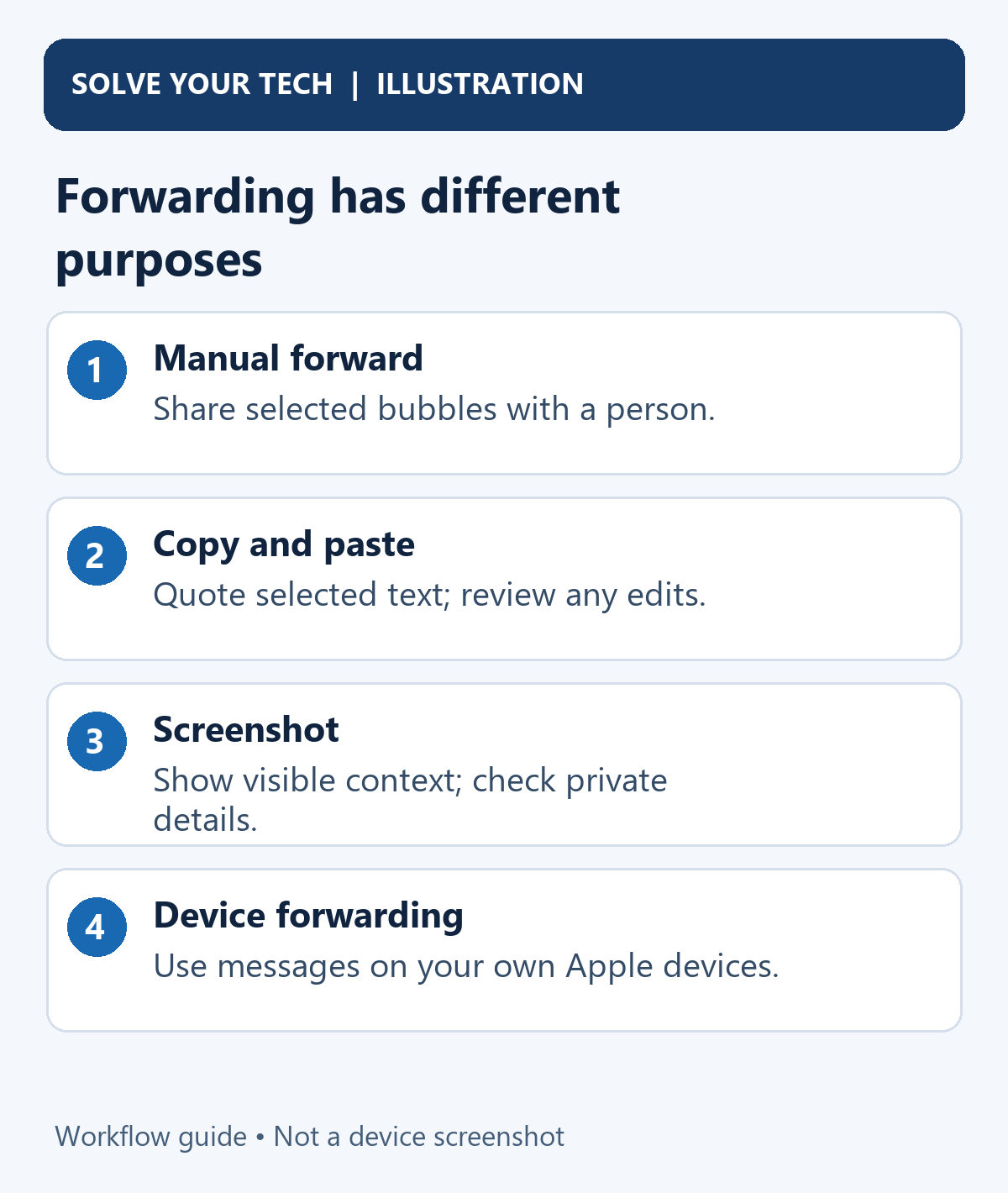
This manually shares selected content with another person. The Text Message Forwarding setting has a different purpose: making your iPhone's messages available on your own compatible Apple devices. It does not automatically route all texts to another person's number.
Before you forward
Check the original message and the intended recipient. A message can contain a private address, verification code, personal photograph, or information that was meant only for its original conversation. Share only the content that belongs in the new conversation.
Also consider whether the recipient needs context. A forwarded bubble may not preserve the original sender's identity or original timestamp in the way a screenshot does. Add a short explanation when the source matters rather than expecting the new recipient to infer who said it.
Apple's forwarding and sharing guide describes the manual selection controls and the option to share a screenshot.
Forward one message
- Open Messages and enter the original conversation.
- Find the specific bubble you want to share.
- Touch and hold the bubble until its action menu appears.
- Tap More.
- Confirm that the intended message is selected.
- Tap the forward arrow. Avoid the trash button, which deletes selected messages instead.
- Enter the recipient's name, phone number, or eligible messaging address in To.
- Check the recipient and outgoing content, add any useful explanation, and tap Send.
The selected content appears in a new outgoing message. The person receiving it sees it as communication from you; forwarding does not create a verified record of the original sender's identity.
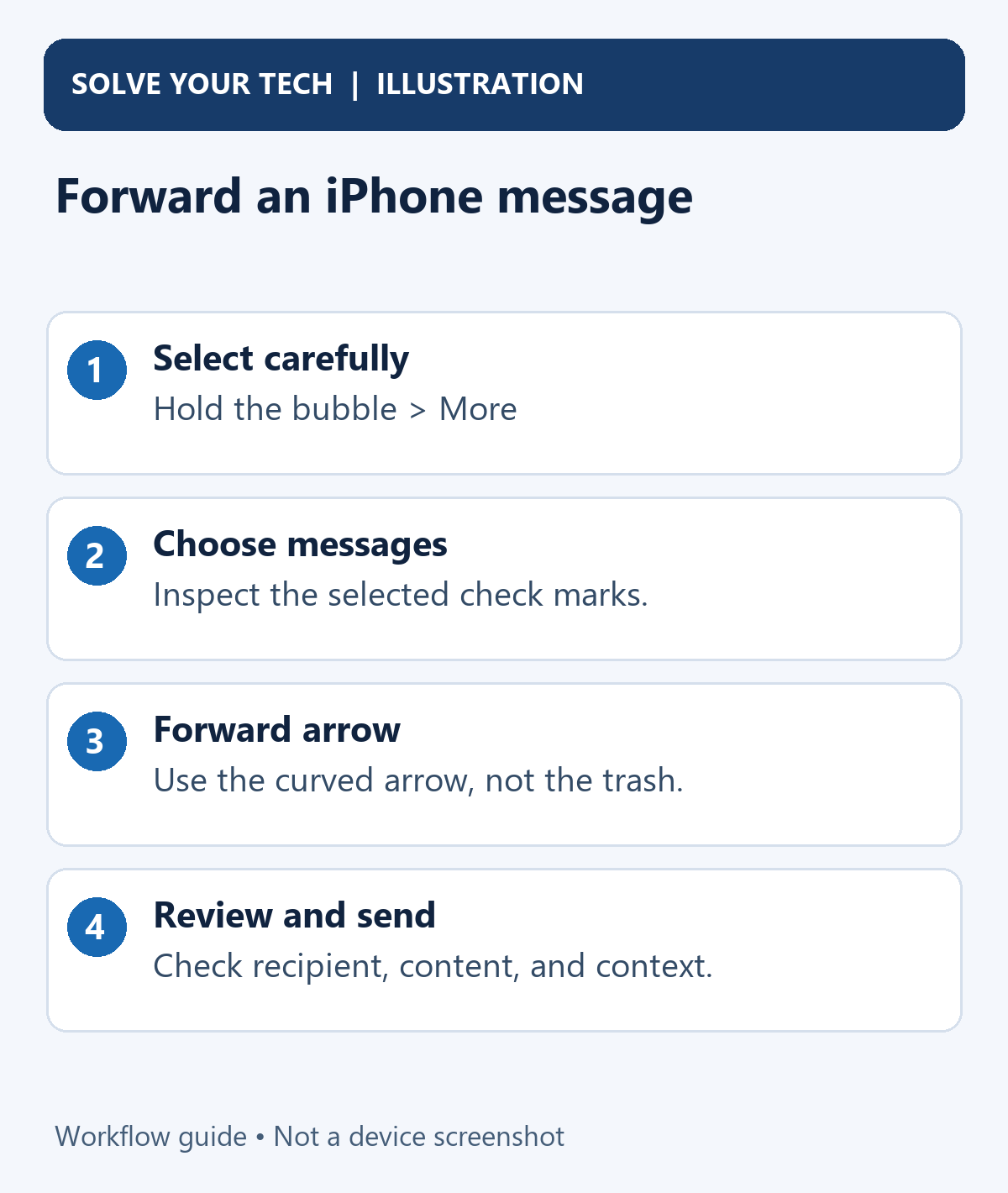
If you opened actions for a link or image preview rather than the message, dismiss that menu and hold the bubble itself. The More selection mode is the route you need for choosing the message content.
Forward several messages or an attachment
After tapping More, select additional bubbles before tapping the forward arrow. Inspect the check marks beside the messages so you do not accidentally include unrelated content.
This is helpful when a plan spans several short messages. Review the order and add a sentence explaining the context if necessary. Forwarding several bubbles does not automatically include every earlier message in the thread.
Photos, videos, and other supported attachments can also be selected for forwarding. Let the attachment download or finish loading before attempting to send it. The outgoing service may impose size limits or handle quality differently, so do not assume the recipient receives an identical full-resolution file in every conversation.
If the purpose is to preserve a picture before removing it from the original thread, verify the saved or forwarded copy first. Our guide to deleting pictures from Messages explains the separate deletion action.
Choose between forwarding, copying, and a screenshot
| Method | Best use | What to check |
|---|---|---|
| Forward selected bubbles | Share particular message content quickly. | Recipient, selection, and missing source context. |
| Copy and paste text | Quote a portion or add an explanation. | Accuracy; edits can change the original meaning. |
| Share a screenshot | Show the visible conversation context. | Names, timestamps, and unrelated private information in the image. |
| Add someone to an existing group | Include a participant in that conversation where supported. | Group compatibility and who will receive later replies. |
Copying and pasting lets you edit the outgoing text, but identify any changes when accuracy matters. A screenshot preserves what is visible on your display; crop or redact unrelated information and inspect the finished image before sending it.
Adding a person to a group is not the same as forwarding selected content. See adding someone to a group message for that separate task. Likewise, a Tapback reaction acknowledges a bubble inside its existing conversation without sharing it with someone outside the thread.
Sending to multiple people
Entering several recipients can create a group conversation, depending on the messaging service. Later replies may be visible to other members. If each person should receive a private copy, send separate messages and review each To field.
Do not rely on forwarding to preserve secrecy about a conversation. The new recipient can retain, copy, or share what you send. Review the destination just before Send, particularly when autocomplete offers contacts with similar names.
Blue bubbles, green bubbles, and delivery problems
Blue bubbles indicate iMessage. Green bubbles can indicate RCS or SMS/MMS. The service affects attachment support, delivery behavior, and potential carrier charges; the color alone does not explain every capability.
If a forwarded message does not send, inspect any visible failure indicator. Confirm the recipient's address, internet or carrier connectivity as applicable, and whether a large attachment is still loading. Text may send successfully while a large video needs a different supported sharing method.
Do not assume Wi-Fi alone supports every carrier message or that every text is free under every plan. Check the service and plan involved when those details matter. Turning off iMessage or signing out of your Apple Account is a broad change and should not be the first response to one incorrectly addressed message.
Get your iPhone texts on your own Mac or iPad
Apple's Text Message Forwarding feature makes supported messages available on compatible Apple devices associated with your account. It is separate from the forward arrow used to send a bubble to another person.
Apple documents two related approaches in forwarding iPhone messages to other devices. With Messages in iCloud, message history—including supported iMessage, SMS, MMS, and RCS messages—stays synchronized, and separate Text Message Forwarding setup may be unnecessary.
For the other setup route on current iOS, open Settings > Apps > Messages > Text Message Forwarding, then enable your own eligible devices. Older versions place Messages directly in Settings. The iPhone must be on and connected, and the devices must use the same Apple Account as required by Apple's instructions.
If prompted for a verification code, follow the code instructions for your own device. If a device is missing, check its account and Messages configuration rather than giving another person access to your Apple Account. Our Text Message Forwarding setup guide covers that device-sharing task.
There is no universal SMS forwarding dial code that turns this into automatic forwarding to an unrelated number or email address. Carrier call forwarding is a different feature. Business messaging systems may offer their own routing tools, but those are outside this manual iPhone procedure.
Common questions
Does forwarding delete the original?
The forward arrow creates an outgoing copy of selected content. It is different from the trash control. Keep the original if you need its full conversation context or a recovery reference.
Can I edit the text before sharing it?
For a controlled quotation or edited excerpt, copy and paste into a new message and review the final wording. Make clear when you have changed or shortened the original so the recipient does not mistake the edited version for an exact quotation.
Can I undo a sent forward?
Do not assume every messaging service supports unsending. Available controls depend on the service and software. The reliable point to correct the recipient or content is before tapping Send.
How do I remember to handle a message later?
Use mark as unread as a reminder for yourself. It does not forward the message or retract anything another person has already received.
After sending, inspect the new conversation for the intended content and any failure indicator. For important attachments, ask the recipient to confirm that the file opens rather than treating the presence of an outgoing bubble as proof of a usable copy.

Matthew Burleigh has been writing tech tutorials since 2008. His writing has appeared on dozens of different websites and been read hundreds of millions of times.
After receiving his Bachelor’s and Master’s degrees in Computer Science he spent several years working in IT management for small businesses. However, he now works full time writing content online and creating websites.
His main writing topics include iPhones, Microsoft Office, Google Apps, Android, and Photoshop, but he has also written about many other tech topics as well.