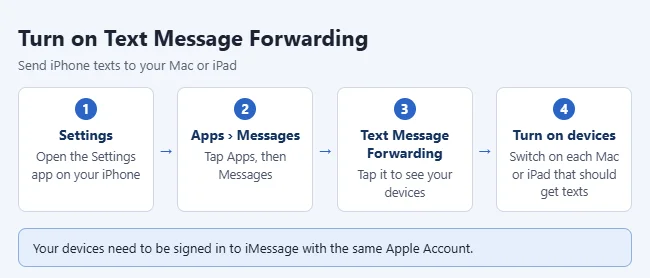
To turn on Text Message Forwarding, open Settings on your iPhone, tap Apps > Messages, tap Text Message Forwarding, and turn on the Mac or iPad you want. Regular green texts (SMS, MMS and RCS) will then show up on those devices too. For the basics of sending and replying, see our guide to text messaging on iPhone.
This guide covers turning on Text Message Forwarding, how it differs from Messages in iCloud, what to do when a device or the option is missing, and why calls and texts may appear on other devices. It is based on Apple’s Forward text messages from your iPhone to other devices, Set up Messages on iPhone and Use iPhone to allow calls and text messages on your iPad and Mac.
Before You Start
- Apple says each device must be signed in to iCloud with the same Apple Account.
- Your iPhone must be on, connected to Wi-Fi or cellular, and able to send and receive messages.
- Apple notes availability varies by region and carrier, and RCS isn’t supported by all carriers.
How to Turn On Text Message Forwarding
- Open the Settings app on your iPhone.
- Tap Apps, then tap Messages.
- Tap Text Message Forwarding.
- Turn on each device you want to send and receive your texts. Turn a device off to stop sending texts to it.
Result: Apple says the SMS, MMS or RCS messages you send and receive on your iPhone also appear on your Mac, iPad or Apple Vision Pro. If a device isn’t using two-factor authentication, a verification code appears on it, and you enter that code on your iPhone. If your iPhone uses Dual SIM, Apple says to turn on each line.
Text Message Forwarding vs. Messages in iCloud
Apple says Messages in iCloud keeps your entire message history, including SMS, MMS, RCS and iMessage, up to date on every device signed in to your Apple Account. Text Message Forwarding is built into Messages in iCloud, so you don’t need to set it up separately if your devices use it. To turn on Messages in iCloud, go to Settings > your name > iCloud > Messages and turn on Use on this iPhone. Apple notes that with Messages in iCloud, messages you delete on one device are deleted on the others too.
If a Device or the Option Is Missing
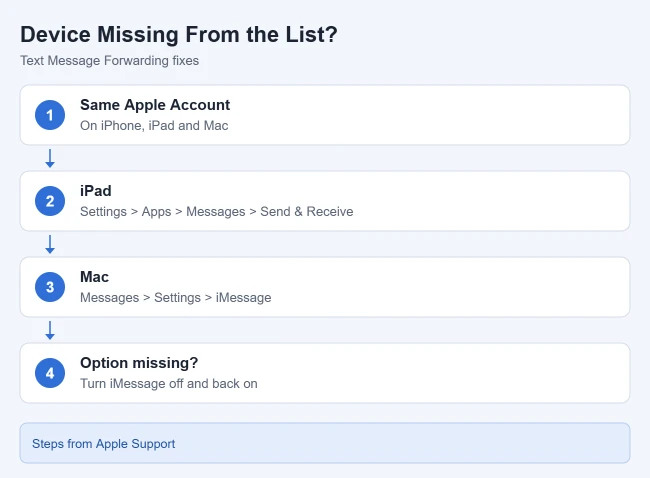
- Option missing: Apple says to turn iMessage off and back on (the switch is covered in how to turn on iMessage on iPhone), then tap Send & Receive and sign in again.
- iPad not listed: on the iPad, go to Settings > Apps > Messages, make sure iMessage is on, tap Send & Receive, and check that the Apple Account at the bottom matches your iPhone.
- Mac not listed: open Messages, choose Messages > Settings, click iMessage, and make sure the Apple Account matches.
Also try checking that both devices use the same Apple Account and restarting the iPhone if the option still doesn’t appear.
Why Are My Texts or Calls Showing Up on Other Devices?
Texts appear on other devices when Text Message Forwarding or Messages in iCloud is on for them. Calls can also ring on your iPad or Mac when calls on other devices are allowed. Apple says to go to Settings > Apps > Phone > Calls on Other Devices and choose which devices can make and receive calls. Apple notes those devices must be near your iPhone, on the same Wi-Fi network, and signed in to the same Apple Account.
Frequently Asked Questions
Can I forward texts to another person’s phone automatically?
Text Message Forwarding only sends texts to your own Apple devices signed in to your Apple Account. Apple says you can manually forward selected messages to anyone.
Do my devices need to be on the same Wi-Fi?
For texts, Apple says your iPhone needs a Wi-Fi or cellular connection. For calls on your iPad or Mac, Apple says the devices need to be on the same Wi-Fi network.
More iPhone Guides
- What is the difference between blue and green texts?
- How to forward a text message on iPhone
- How to sign out of your Apple Account on iPad

Matthew Burleigh has been writing tech tutorials since 2008. His writing has appeared on dozens of different websites and been read hundreds of millions of times.
After receiving his Bachelor’s and Master’s degrees in Computer Science he spent several years working in IT management for small businesses. However, he now works full time writing content online and creating websites.
His main writing topics include iPhones, Microsoft Office, Google Apps, Android, and Photoshop, but he has also written about many other tech topics as well.