To mark a text as unread on iPhone, open Messages, swipe right on the conversation in your list, and tap Unread. The blue dot comes back beside the conversation and the Messages icon counts it again, so it works as a reminder to reply later.
These steps work on iOS 16 and later, including iOS 26 and iOS 27, for iMessage, RCS, and SMS conversations in Apple’s Messages app. The unread marker is only for you: if you already opened the conversation with read receipts on, the sender still sees Read.
iOS 16 or Later Required
- iOS 16 or later. The unread option arrived with iOS 16. Check your version in Settings > General > About.
- Apple’s Messages app. WhatsApp, Messenger, Gmail, and other apps have their own unread controls, and nothing in Messages changes them.
- The conversation list. You mark a whole conversation unread from the list of chats. There is no unread option for a single bubble inside an open conversation.
Mark one conversation unread
- Open Messages. If a conversation opens, tap the back arrow at the top left until you see the full list of conversations.
- Find the conversation you want to come back to. Read conversations have no blue dot on their left edge.
- Swipe right slowly on that conversation. A blue Unread button appears on the left side of the row.
- Tap Unread. The button slides away and a blue dot appears next to the conversation.
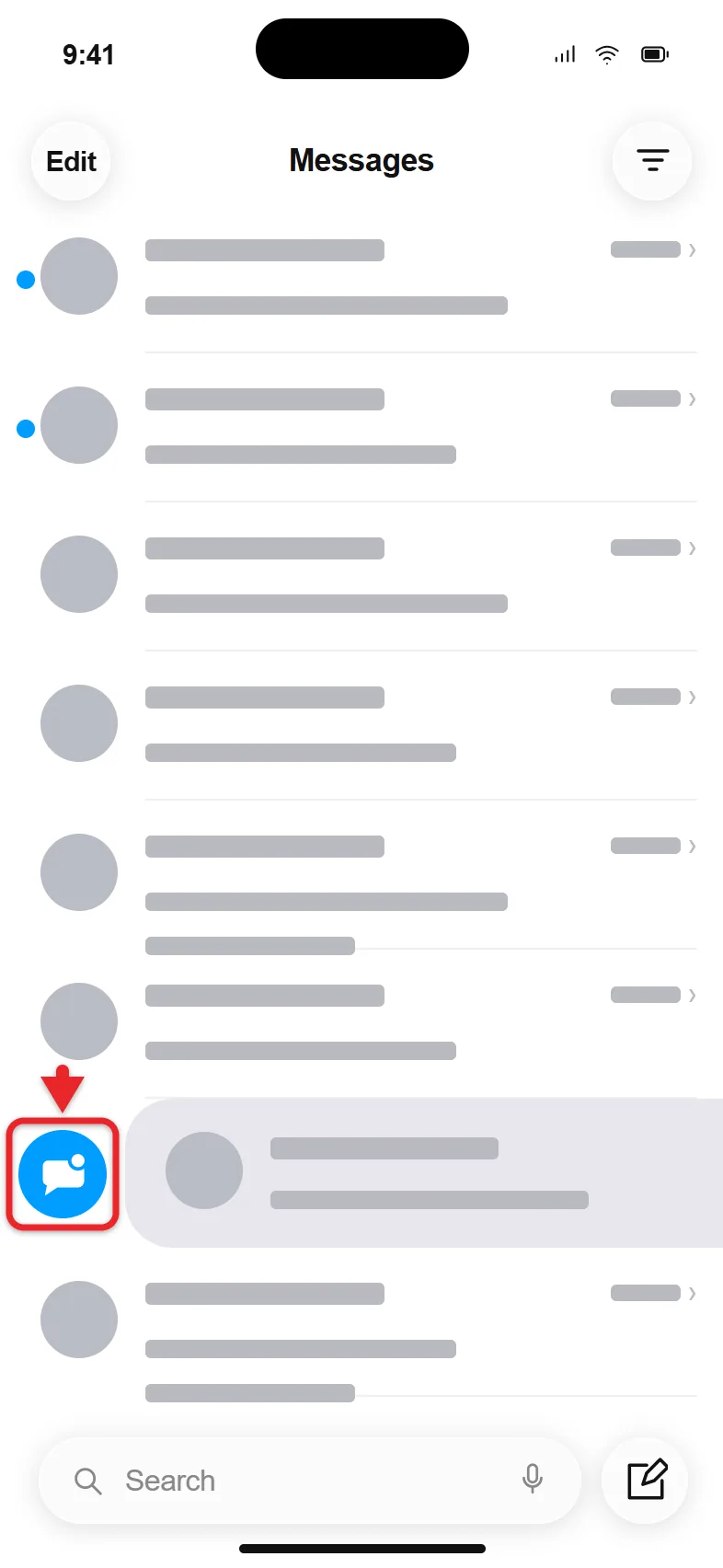
For a faster version, swipe all the way across the row in one long motion. Messages marks the conversation unread without you tapping the button. If you swipe left by mistake, you see buttons such as Delete instead; nothing happens until you tap one, so tap anywhere else in the list to close them.
The blue dot stays until you open the conversation again. Opening it, even for a second, marks it read, so leave it closed until you are ready to answer.
This works on group threads too, and if a busy group keeps pulling you back, you can mute or leave the group text instead.
- In the conversation list, touch and hold the conversation until a menu appears.
- Tap Mark as Unread.
This is the easiest way to handle a pinned conversation. Pinned conversations show as large circles at the top of the list, and you can’t swipe them the way you swipe a normal row.
Regular rows show smaller contact circles, and you can hide those contact pictures in Messages if you prefer.
Mark several conversations unread at once
- In the conversation list, tap Edit at the top. On newer versions you may see a More button (three dots) instead.
- Tap Select Messages. A circle appears next to every conversation.
- Tap each conversation you want to mark. A check mark fills its circle.
- Tap Unread at the bottom left of the screen.
The button at the bottom changes based on what you picked. If it says Read instead of Unread, at least one of the conversations you selected is already unread. Deselect it and the Unread button returns.
Find your unread conversations later
- In the conversation list, tap Filters at the top. Apple sometimes shows this as a button with stacked lines instead of a word.
- Tap Unread Messages. Only the conversations with a blue dot remain in the list.
- When you are done, tap Filters again and choose the main conversation view so all your chats show again.
If Unread Messages isn’t in the menu, message filtering is turned off. On iOS 26 and later, tap Filters > Manage Filtering (or go to Settings > Apps > Messages) and turn on Screen Unknown Senders. On iOS 18 and earlier, the switch is called Filter Unknown Senders. Finding the Unknown Senders folder in Messages walks through those settings for each version.
Mark conversations as read again
- One conversation: swipe right on it and tap Read, or open it.
- Every conversation at once: tap Edit (or More) > Select Messages, leave everything unselected, and tap Read All at the bottom left. All blue dots disappear. Nothing is deleted; only the unread markers are cleared.
What the sender sees
Marking a conversation unread changes your list, not the other person’s phone. This table shows what happens in common cases.
| What you did | What you see | What the sender sees |
|---|---|---|
| Opened an iMessage with read receipts on | Conversation read | Read and the time |
| Opened it, then marked it unread | Blue dot is back | Still Read |
| Opened an iMessage with read receipts off | Conversation read | Delivered only |
| Opened an SMS text (green bubble) | Conversation read | No read status at all |
If you want to read texts without the other person seeing Read in the future, turn off Send Read Receipts in Settings > Apps > Messages (on iOS 17 and earlier, Messages is directly in Settings). You can also change it for one person: open their conversation, tap their name at the top, and turn Send Read Receipts off. Apple explains both options in its read receipts guide. For what each label means, read about turning read receipts on or off. Neither setting can take back a Read label that was already sent.
Mark conversations unread on iPad and Mac
iPad: the steps are the same as on iPhone. Swipe right on a conversation and tap Unread, or use Edit > Select Messages for several at once.
Mac (macOS Ventura or later): open Messages, select a conversation, and do one of these:
- Choose Conversation > Mark as Unread in the menu bar.
- Control-click the conversation and choose Mark as Unread.
- On a trackpad or Magic Mouse, swipe right with two fingers on the conversation, then click the Mark as Unread button.
To mark it read again, choose Conversation > Mark as Read. To see only unread chats on a Mac, choose View > Unread Messages. The Messages for Mac guide covers these menus.
If marking a conversation unread doesn’t work
- No Unread button appears. Make sure you are in the conversation list, not inside a chat, and that you are swiping to the right. If the button says Read, the conversation is already unread. If you see neither, check that your iPhone runs iOS 16 or later.
- The blue dot keeps disappearing. Something opened the conversation. That includes tapping into it from a notification or opening it on your iPad or Mac.
- No number on the Messages icon. Badges may be off. Go to Settings > Notifications > Messages and turn on Badges. A Focus with Hide Notification Badges turned on also hides the number while that Focus is active. Read what badges are on iPhone for the rest of the badge settings.
- You can’t find the conversation. Clear any active filter, or type the contact’s name in the Search field in Messages. If you deleted it, check Filters > Recently Deleted, where deleted conversations stay for up to 30 days.
Unread Message Questions
Does marking a text unread notify the other person?
No. The sender gets no alert, and their screen does not change. If they already saw Read, it stays that way.
Can I mark one message unread instead of the whole conversation?
No. The unread marker applies to the whole conversation. If one message in a busy thread is important, mark the conversation unread and remember which message you need, or pin the conversation so it stays at the top.
Does marking a conversation unread send me a new alert?
No. It brings back the blue dot and the badge count, but it doesn’t play a sound or show a banner. If you need a timed nudge, create a reminder in the Reminders app.
Can I do this on iOS 15 or earlier?
No. The option isn’t available before iOS 16. On an older iPhone, pin the conversation instead: swipe right on it and tap the pin button, or touch and hold it and tap Pin.
How do I clear all the unread dots at once?
Tap Edit (or More) > Select Messages > Read All. Every conversation is marked read, and nothing is deleted.
When you come back to a conversation you marked, reply as usual and the blue dot clears on its own.

Matthew Burleigh is the founder, head writer, and editor of Solve Your Tech, which he launched in 2012. He has written technology tutorials since 2008 and worked in IT since 2003, including small-business support, IT management, and consulting. He holds Bachelor’s and Master’s degrees in Computer Science from Arizona State University.
Matthew writes practical guides for Windows, iPhone and iPad, Microsoft Office, Outlook, Google apps, and Android. Solve Your Tech’s guides are checked step by step against the device or app maker’s own documentation and tested on his own devices whenever he has the hardware or software, with clear steps, sources, and update dates.
Read more about Matthew and how Solve Your Tech writes and updates its guides, or report a correction.