To delete most items on an iPhone, swipe left on the item in a list and tap Delete (or the trash icon), or touch and hold the item and pick Delete. Photos, messages, and notes then stay in a Recently Deleted folder for about 30 days, so you can get them back.
This quick reference covers photos, messages, emails, apps, notes, music, downloaded videos, voicemails, contacts, and Safari history on iOS 26, with a link to our full guide for each.
Before You Delete Anything
Two settings change what “delete” actually means on your iPhone, so it’s worth knowing how they work before you start.
- iCloud syncing. If you use iCloud Photos, Messages in iCloud, or iCloud Notes, deleting an item on your iPhone also deletes it from your iPad, Mac, and iCloud.com. If you only want to free up space on the phone, see the storage section near the end of this guide instead.
- Recently Deleted. Photos, messages, and notes aren’t erased right away. They move to a Recently Deleted area and are removed for good after about 30 days (Messages says 30 to 40 days). Space isn’t fully freed until that happens, or until you empty the folder yourself.
If any of the items are important, back them up first. Our guide to backing up iPhone photos to an external drive covers one easy way to keep a copy of your pictures.
Delete Photos and Videos
- Open the Photos app and find the picture or video in your library.
- Tap it to open it full screen.
- Tap the Trash icon, then tap Delete Photo (or Delete Video). The item moves to Recently Deleted.
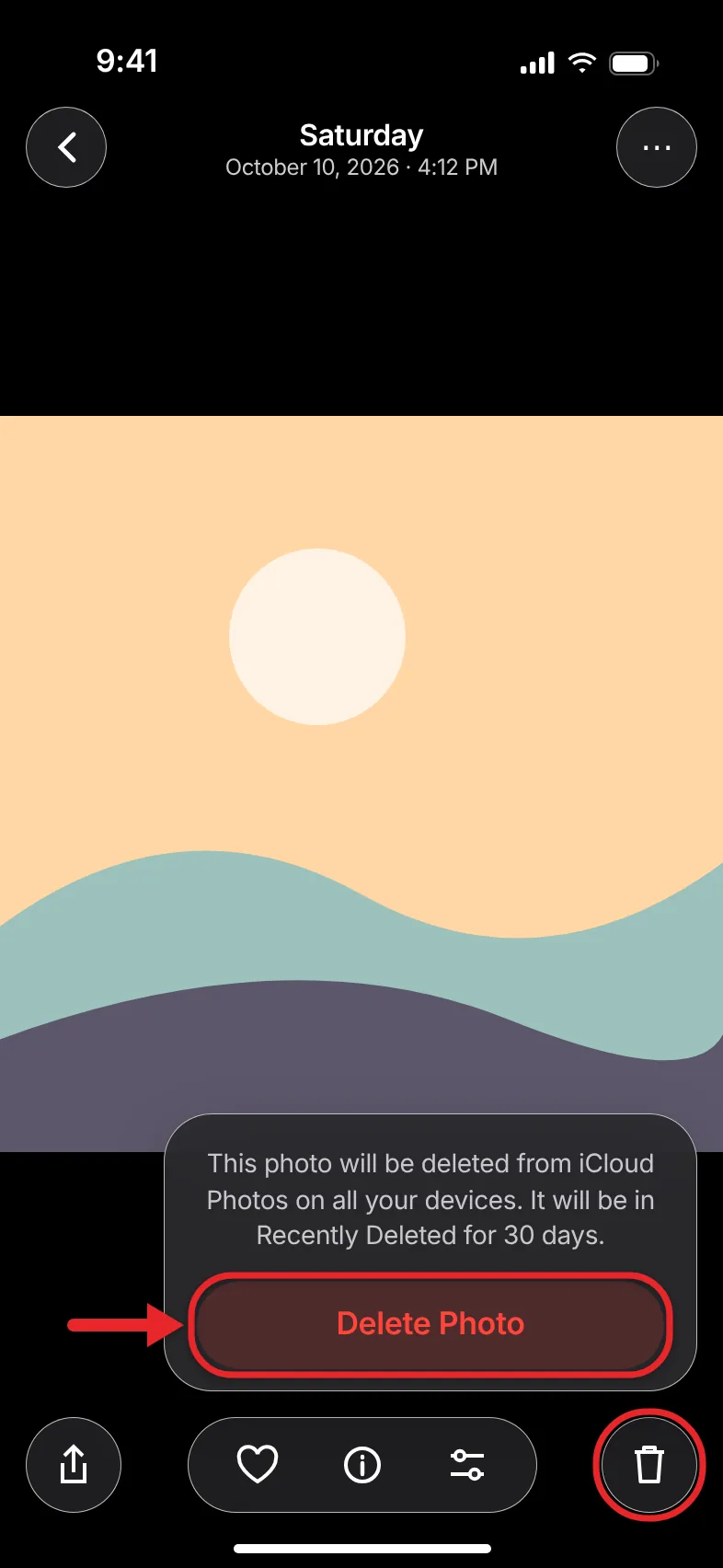
To delete several at once, tap Select at the top of the library, tap each photo or drag your finger across a row of thumbnails to select a group, then tap the Trash icon and confirm. To see only your videos, which tend to take up the most space, tap Collections, then look under Media Types and tap Videos.
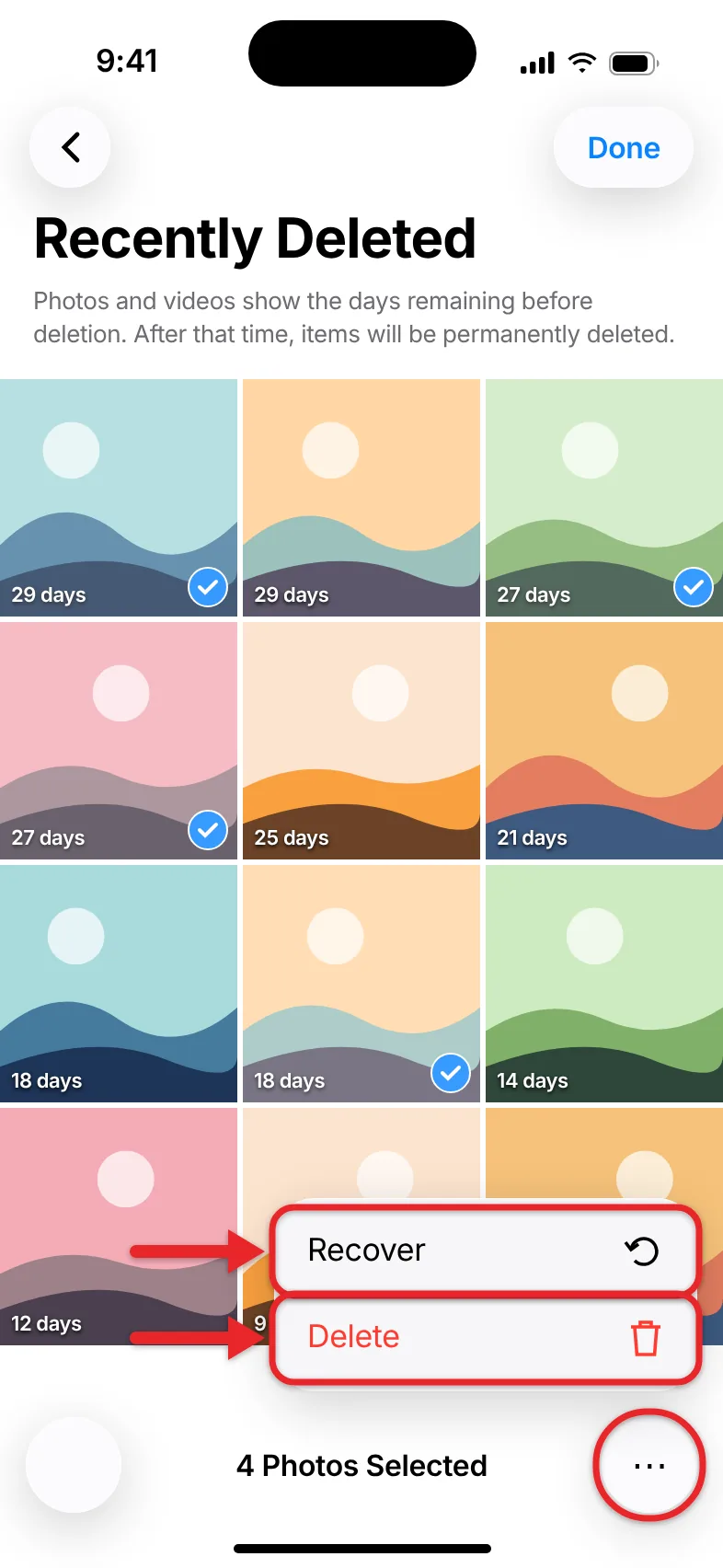
To recover or permanently erase deleted photos:
- In Photos, tap Collections and scroll down to Utilities.
- Tap Recently Deleted, then tap View Album and unlock it with Face ID, Touch ID, or your passcode.
- Tap Select, choose the items, then tap the More button (three dots). Pick Recover to put them back in your library, or Delete to remove them for good.
Apple’s guide to deleting photos and videos explains the Recently Deleted options in more detail, including how shared libraries handle deletions. If you want to remove photos from one device but keep them in iCloud, read our article on turning iCloud Photos on or off first, because that setting decides whether a deletion syncs.
Delete Text Messages and Conversations
To delete a whole conversation:
- Open Messages.
- Swipe left on the conversation in the list.
- Tap the red Trash icon, then tap Delete to confirm.
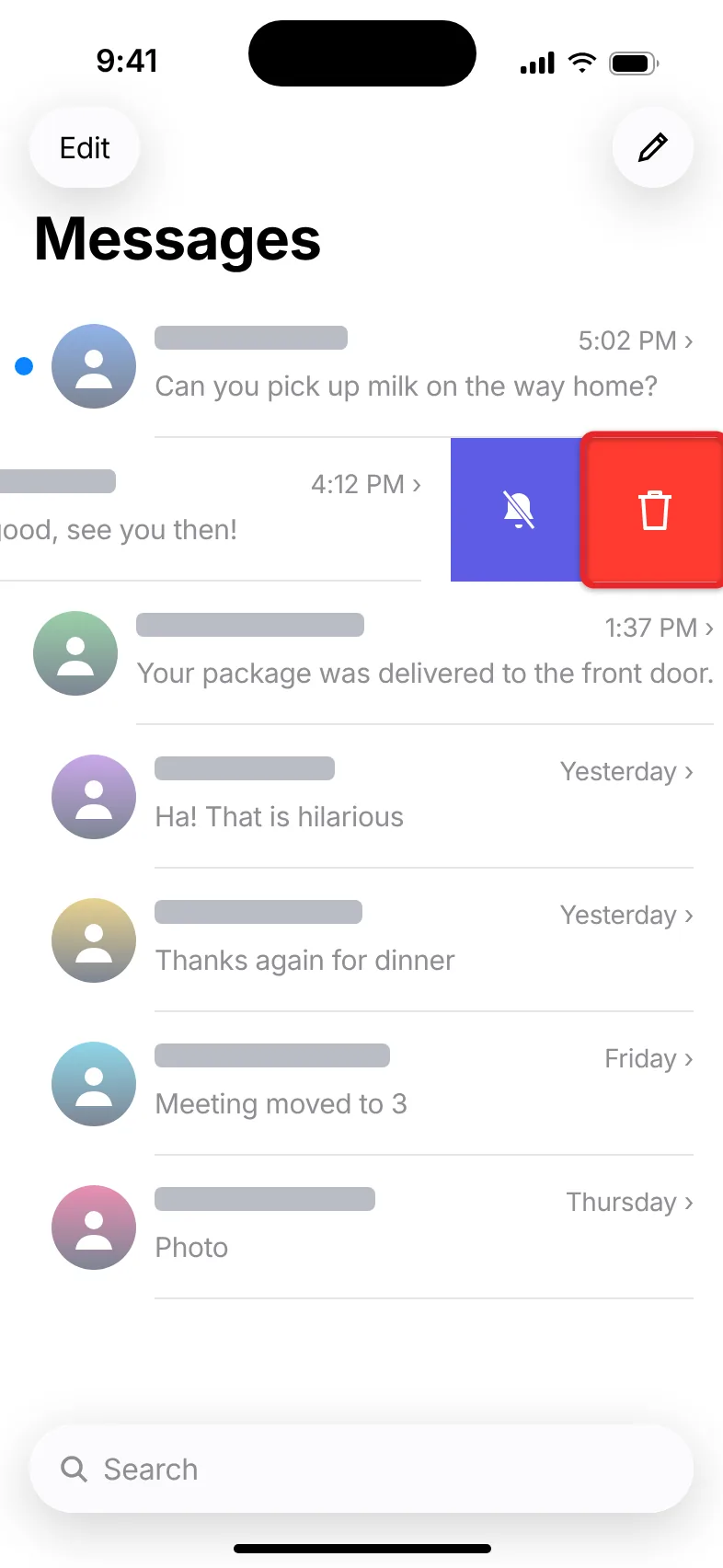
To delete several conversations, tap the More button (three dots) at the top of the conversation list (Edit on older versions), tap Select Messages, select the ones you want, and tap Delete.
To delete one message inside a conversation:
- Open the conversation and touch and hold the message bubble.
- Tap More. A circle appears next to each message, and the one you held is already checked.
- Check any other messages you want to remove, then tap the Trash icon at the bottom and confirm.
To recover a deleted message: In the conversation list, tap the Filter button at the top of the screen and choose Recently Deleted. Select the conversation and tap Recover. You can also tap Delete there to erase it right away. Messages deleted before you updated to iOS 16 can’t be recovered this way, as explained in Apple’s article on recovering deleted messages.
Photos and videos in your conversations often take up more space than the texts themselves. Our guide on deleting pictures from text messages shows how to clear them without deleting whole threads. If you’d rather have old texts remove themselves, see how to set how long your iPhone keeps messages.
Delete Emails
- Open Mail and go to the mailbox that has the email.
- Swipe left on the email and tap Trash. You can also swipe all the way to the left to delete it in one motion.
To delete several emails, tap the More button at the top right, tap Select, check the emails, and tap the Trash button. If you see Archive instead of Trash, your account is set to archive mail. Touch and hold Archive to choose a delete option, or change the account’s default under Settings > Apps > Mail > Mail Accounts, then your account, Account Settings > Advanced > Move Discarded Messages Into, and pick Deleted Mailbox.
Deleted emails go to the account’s Trash folder, and how long they stay there depends on your email provider. If messages keep coming back, our guide to fixing iPhone Mail when it won’t delete emails covers the usual causes. To remove a whole email account from the phone, see how to delete an email account on iPhone.
Delete Apps
- Touch and hold the app icon on your Home Screen.
- Tap Remove App.
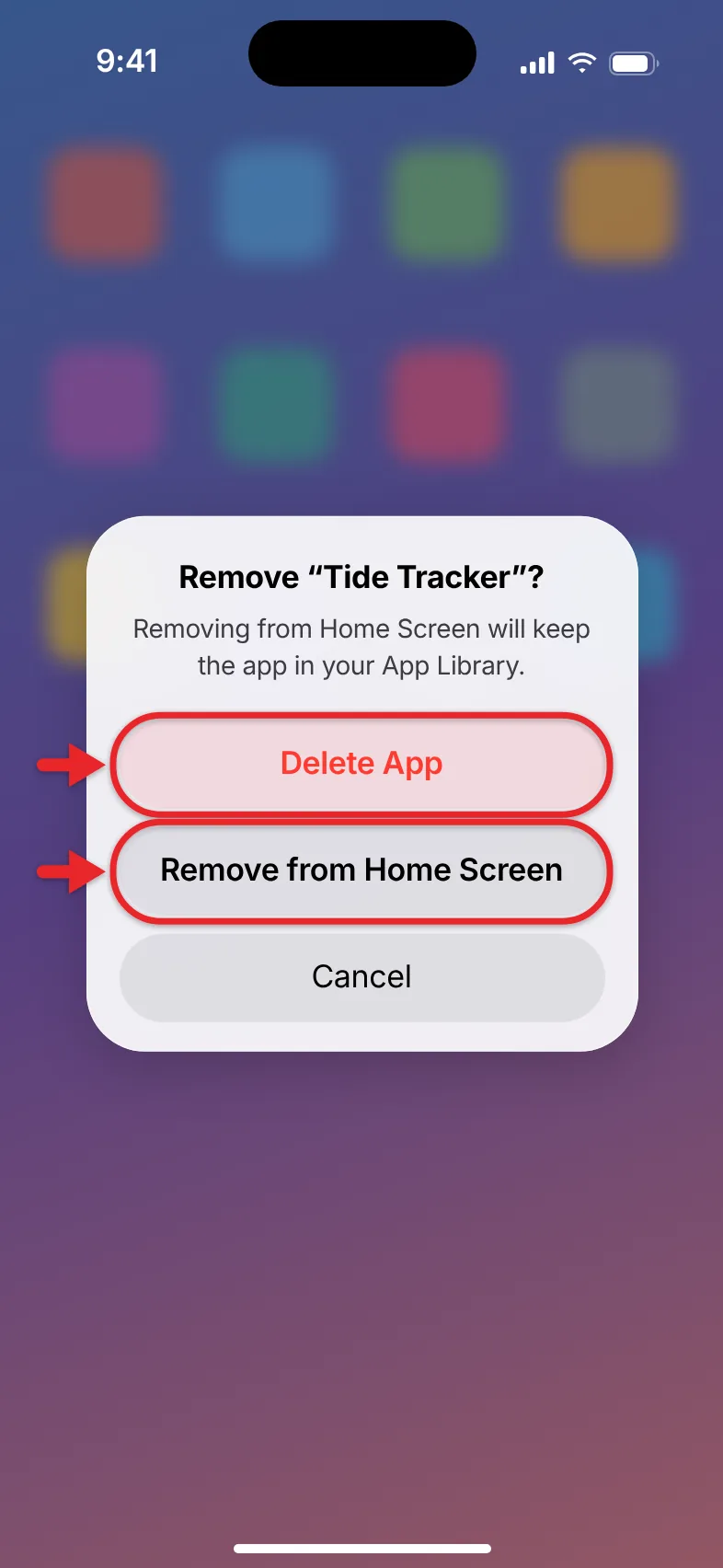
- Tap Delete App, then tap Delete to confirm. The app and its data are removed from the iPhone.
The same menu has a Remove from Home Screen option. That only hides the icon. The app stays installed and still appears in the App Library, so it doesn’t free up any space.
Deleting an app doesn’t cancel a subscription you pay for through it. Cancel the subscription first if you no longer want it. Some built-in Apple apps can’t be deleted, and Screen Time restrictions can hide the delete option entirely. Our full guide to deleting apps on iPhone covers those cases, plus offloading, which removes an app but keeps its documents and data so you can pick up where you left off if you reinstall it.
Delete Notes
- Open Notes and go to the folder that has the note.
- Swipe left on the note and tap the Trash icon. You can also open the note, tap the More button (three dots), and tap Delete.
The note moves to the Recently Deleted folder, which you’ll find on the main Folders screen in Notes. To get a note back, open Recently Deleted, open the note, tap it, and tap Recover when the prompt appears. Notes stay there for 30 days before they’re removed. A shared note that someone else owns doesn’t go to Recently Deleted when you remove it from your list.
Delete Music
In the Music app, touch and hold a song, album, or playlist and tap Remove. You’ll see two choices:
- Remove Download deletes the copy saved on your iPhone. The song stays in your library and plays by streaming when you’re online.
- Delete from Library removes it from your library completely. If Sync Library is on, it also disappears from your other devices.
If you’re trying to save space, Remove Download is usually what you want. Our guide to deleting songs on iPhone has more detail on both options.
Delete Downloaded Movies and TV Shows
- Open the Apple TV app and tap Library.
- Tap Downloaded. If you don’t see it, nothing is downloaded on this iPhone.
- Swipe left on the movie or episode and tap Delete, then confirm.
Purchased titles stay in your library, so you can stream or download them again later. Streaming apps such as Netflix and Prime Video have their own Downloads screens. Our guide to watching, downloading, and deleting TV shows on iPhone covers both, and podcast episodes are covered in how to delete podcast downloads.
Delete Voicemails
iOS 26 gives the Phone app two layouts, and voicemails are in a different place in each:
- Classic layout: tap the Voicemail tab, swipe left on a message, and tap Delete.
- Unified layout: tap Calls, tap the Filter button at the top right, and choose Voicemails. Then swipe left on the message and tap Delete.
Apple explains how to switch between the two in its article on the Phone app’s Unified layout. With most carriers, deleted voicemails go to a Deleted Messages list at the bottom of the voicemail screen, where you can undelete them or tap Clear All to erase them for good.
Delete Contacts
- Open Contacts (or the Contacts tab in the Phone app).
- Tap the contact, then tap Edit.
- Scroll to the bottom, tap Delete Contact, and confirm.
You can also touch and hold a name in the contact list and tap Delete Contact. If your contacts sync with iCloud, Gmail, or Outlook, the contact is removed from that account too. Our guide to deleting contacts on iPhone covers deleting several or all of them.
Delete Safari History
- Open Settings, tap Apps, then tap Safari.
- Tap Clear History and Website Data.
- Choose a time range, such as Last hour or All history, and tap Clear History.
This removes your browsing history, cookies, and cached website data on every device signed in to the same iCloud account with Safari syncing on. It doesn’t remove saved passwords or AutoFill information. To remove just a few sites instead, see our guide to clearing the cache on iPhone.
Find What’s Using the Most Space
If you’re deleting things to free up storage, start by looking at what’s actually taking up space:
- Open Settings and tap General.
- Tap iPhone Storage. It can take a few seconds for the bar at the top to fill in.
- Review the recommendations, such as Offload Unused Apps, then scroll down to see your apps sorted by size.
- Tap any app to see how much space it and its data use, and to delete or offload it from there.
This screen often shows that one app, such as Photos, Messages, or a streaming app with downloads, is using far more than everything else. Our guide to checking and freeing up storage on iPhone walks through each recommendation.
To delete everything at once before you sell or give away your iPhone, go to Settings > General > Transfer or Reset iPhone > Erase All Content and Settings. This wipes the whole phone, so back it up first.
If Something Won’t Delete
- The space didn’t come back. Deleted photos, messages, and notes still take up space until Recently Deleted is emptied. Empty it in that app, then check iPhone Storage again.
- There’s no Delete App option. Screen Time can block deleting apps. Go to Settings > Screen Time > Content & Privacy Restrictions, open the App Store purchases section, and make sure Deleting Apps is set to Allow. A work or school iPhone managed by an organization may also block it.
- You see Share App instead of a delete option. You’ve opened the quick actions menu rather than the edit menu. Our article on why there’s a Share option instead of an X explains how to get to the right one.
- Emails reappear after you delete them. The account may be set to archive instead of delete, or the email server may be out of sync. Check the Move Discarded Messages Into setting described above.
- A deleted photo is still on your Mac or iPad. It may be in that device’s own Recently Deleted album, or iCloud Photos may be turned off on one of the devices.
Frequently Asked Questions
How long do deleted items stay in Recently Deleted?
Photos and notes stay for 30 days. Messages stay for 30 to 40 days. After that they’re erased automatically, and you can’t recover them from the iPhone.
Does deleting something free up space right away?
Not always. Items in Recently Deleted still count against your storage until they’re permanently removed. Empty Recently Deleted in Photos, Messages, or Notes to get the space back sooner.
If I delete something on my iPhone, is it deleted from iCloud?
Yes, if that app syncs with iCloud. Photos with iCloud Photos on, Messages in iCloud, iCloud Notes, and iCloud contacts all sync deletions to your other devices.
Can I get back something I deleted permanently?
Only if it’s in a backup, such as an iCloud or computer backup made before you deleted it. Restoring from a backup replaces everything on the iPhone with that older copy, so it’s usually a last resort.
What’s the difference between offloading and deleting an app?
Offloading removes the app but keeps its documents and data on your iPhone, and the icon stays on the Home Screen with a small cloud next to it. Deleting removes the app and its data. Either way, you can download the app again from the App Store.

Matthew Burleigh is the founder, head writer, and editor of Solve Your Tech, which he launched in 2012. He has written technology tutorials since 2008 and worked in IT since 2003, including small-business support, IT management, and consulting. He holds Bachelor’s and Master’s degrees in Computer Science from Arizona State University.
Matthew writes practical guides for Windows, iPhone and iPad, Microsoft Office, Outlook, Google apps, and Android. Solve Your Tech’s guides are checked step by step against the device or app maker’s own documentation and tested on his own devices whenever he has the hardware or software, with clear steps, sources, and update dates.
Read more about Matthew and how Solve Your Tech writes and updates its guides, or report a correction.