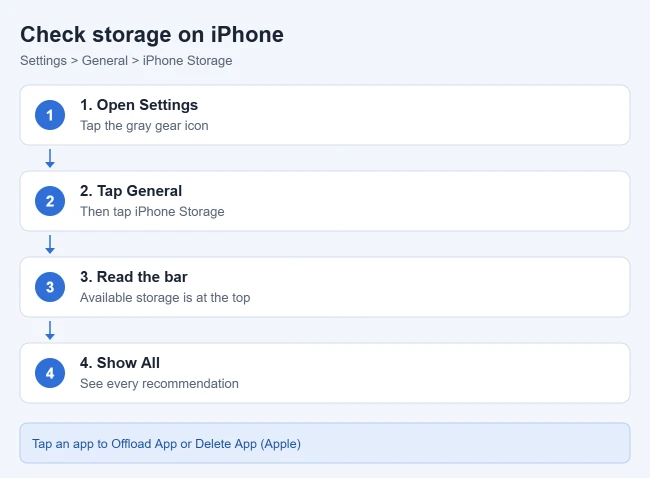
To view all of your iPhone’s recommendations for saving storage space, open Settings, tap General, tap iPhone Storage, and then tap Show All next to the recommendations. Your available storage is shown at the top, followed by the recommendations and a list of apps with the space each one uses. To free up space, offload or delete apps you don’t use, store photos in iCloud, and clear out old messages, downloaded videos, and files. Downloaded YouTube videos are one common example of what you can delete on an iPhone.
These steps are written for iOS 27 and also match iOS 26 and iOS 18, where app settings moved under Settings > Apps. On an iPad the screen is called iPad Storage. Apple covers them in Manage storage on iPhone, How to check the storage on your iPhone and iPad, Manage your photo and video storage, Delete messages and attachments and How to recover deleted photos.
How to Check iPhone Storage
- Open the Settings app.
- Tap General, then tap iPhone Storage. The screen can take a few seconds to calculate.
- Check the available storage at the top of the screen.
- Scroll down to see your apps and how much space each one uses. Tap an app’s name for details.
You see a storage bar divided by category, any recommendations for your iPhone, and the app list. Apple notes that cached and temporary data might not count toward an app’s usage.
Counting the total number of apps is a different check: count the apps installed on your iPhone.
How to View All Storage Recommendations
- On the iPhone Storage screen, find the recommendations under the storage bar.
- Tap Show All. The full list opens, with a short description and the space each one could save.
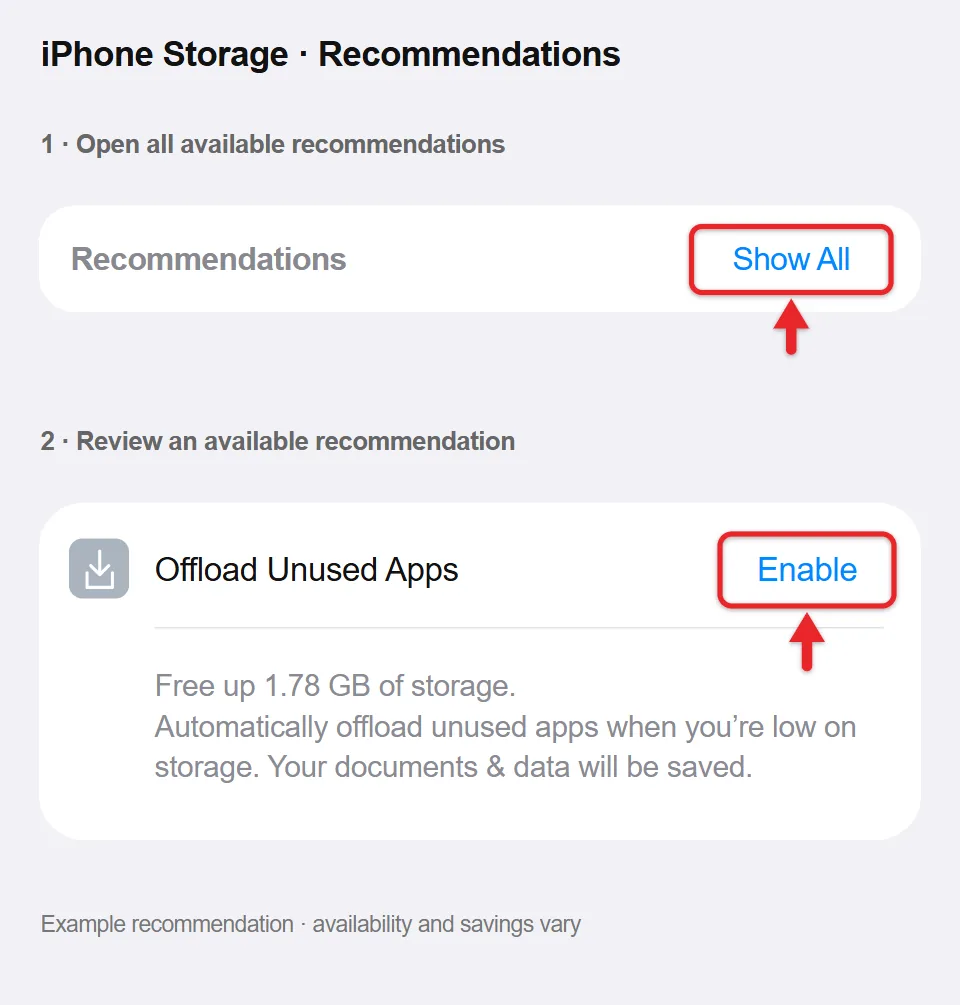
- Read a recommendation’s description.
- Tap Enable to turn it on, or tap the recommendation itself to review the items it would remove.
Recommendations change with what’s on your iPhone, so two phones rarely show the same list. Common ones include turning on iCloud Photos, offloading unused apps, reviewing large Messages attachments, removing downloaded videos, and emptying the Recently Deleted album. If you see a “Storage Almost Full” alert, these recommendations are the place to start.
What the Common Recommendations Do
| Recommendation | What happens when you use it | Can you undo it? |
|---|---|---|
| iCloud Photos | Uploads your library to iCloud and keeps smaller copies on the iPhone | Yes, turn sync off; originals stay in iCloud |
| Offload Unused Apps | Removes apps you rarely use but keeps their data | Yes, tap the app to reinstall it |
| Review Large Attachments | Lists big photos, videos and files in Messages to delete | No, so check each item first |
| Recently Deleted album | Permanently removes deleted photos and videos | No |
| Downloaded videos | Lists movies and shows saved for offline viewing | Download them again later |
If you’re not sure, tap the recommendation instead of Enable to see what it would remove before you decide.
What the Storage Categories Mean
- Apps: installed apps and their content, files in the “On My iPhone” folder of the Files app, and Safari downloads.
- Photos: photos and videos in the Photos app.
- Media: music, videos, podcasts, ringtones, artwork, and voice memos. To clear music, remove downloaded songs from the iPhone.
- Mail: emails and their attachments.
- Apple Books: books and PDFs in the Books app.
- Messages: messages and their attachments.
- iCloud Drive: iCloud Drive files downloaded to the iPhone.
- System and Other (System Data): the operating system plus items like Siri voices, fonts, caches, logs and the Spotlight index. Your iPhone clears cached and temporary files itself when it needs space.
How to Offload or Delete a Single App
- Go to Settings > General > iPhone Storage.
- Tap the app. Its size and the size of its documents and data appear.
- Tap Offload App to free its storage but keep its documents and data, or Delete App to remove the app and its data.
- Confirm your choice. The app’s entry updates, and available storage goes up after a moment.
An offloaded app stays on your Home Screen. Tap it to reinstall it, and your data is still there, as long as the app is still in the App Store.
There are other ways to delete apps on iPhone too.
How to Offload Unused Apps Automatically
- Go to Settings > Apps > App Store (on iOS 17 and earlier, Settings > App Store).
- Turn on Offload Unused Apps.
When storage is low, your iPhone removes apps you don’t use but keeps their data. The icon stays on your Home Screen with a cloud symbol, and tapping it reinstalls the app. To stop it, turn the same switch off. Apps already offloaded stay offloaded until you tap them.
Here’s more on what the cloud icon next to an app means and how to reinstall it.
Other Ways to Free Up Space
Store Photos in iCloud
- Go to Settings, tap your name, tap iCloud, then tap Photos.
- Turn on Sync this iPhone.
- In iOS 27 or later, tap iPhone Storage.
- Make sure Optimize iPhone Storage is on.
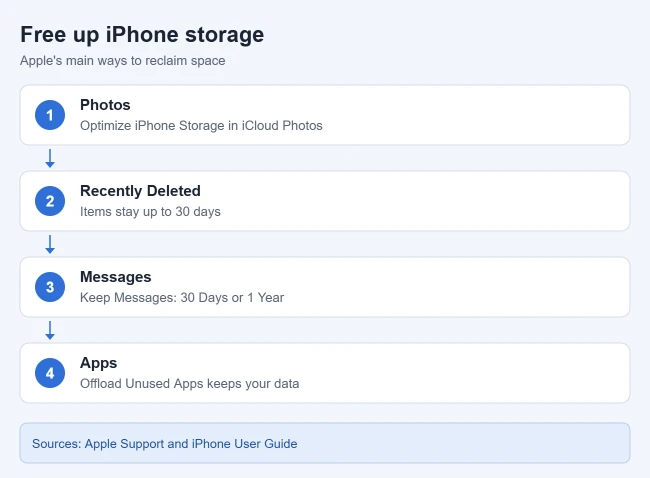
Full-resolution photos stay in iCloud and your iPhone keeps space-saving copies, so space frees up gradually rather than all at once. The steps are in Apple’s Manage your photo and video storage article. Every iCloud account includes 5 GB free, and more is available with iCloud+. The Optimize and Download and Keep Originals choices are explained with the steps to turn iCloud Photos on or off.
Before you delete photos to save space, copy them from your iPhone to a computer.
Empty Recently Deleted
Deleted photos and videos sit in the Recently Deleted album for 30 days before they are removed for good. You unlock the album with Face ID, Touch ID or your passcode. Deleted messages and attachments stay in Messages’ Recently Deleted list for 30 to 40 days; to find it, tap the Filters button on the Messages conversation list (Edit on iOS 18), then Recently Deleted. Removing items from either list frees space sooner, but it can’t be undone, so be sure you don’t need them first.
Clear Out Old Messages
Go to Settings > Apps > Messages, tap Keep Messages, and choose 30 Days or 1 Year. Older conversations, including attachments, are removed as soon as you confirm, so save anything important first. If you use Messages in iCloud, deletions apply on all your devices. You can also open a conversation, tap the contact or group icon at the top, and delete photos or videos in bulk.
If you change your mind later, here’s how to stop your iPhone from deleting old texts.
Remove Downloads and Files
Delete shows you have already watched in the TV app and other streaming apps, and remove files you no longer need in the Files app. If Podcasts is using a lot of space, you can delete podcast downloads on your iPhone while keeping the app. Offloading an app keeps its documents and data, so removing downloaded episodes is a separate step.
Reclaim Safari Data and Downloaded Files Carefully
Clearing Safari data removes your browsing history and cookies and can sign you out of websites, but it doesn’t change your AutoFill information. There’s a full rundown of what it removes on Apple’s site. Other browsers and apps have their own ways to clear cache on iPhone.
- Go to Settings > Apps > Safari (on older iOS, Settings > Safari).
- Tap Clear History and Website Data.
- Choose a timeframe and tap Clear History.
- Open the Files app and tap Browse.
- Open the Downloads folder in iCloud Drive or On My iPhone.
- Delete the files you don’t need, then empty Recently Deleted.
- For an iCloud item, tap Remove Download to free the copy on your iPhone but keep it in iCloud. Delete removes it from your other devices too.
What to Do When iPhone System Data Is Large
System Data (shown as System or Other) holds caches, logs, indexes, and files iOS needs. It isn’t one folder you can empty, and iOS clears much of it on its own. You don’t need to act on System Data itself; delete unneeded apps and content and follow the recommendations instead. To bring the total down:
- Open Settings > General > iPhone Storage and wait for the report to load.
- Note the available space and the System Data figure.
- Work through the recommendations and the app, download, message, and Safari steps on this page.
- Restart your iPhone.
- Install any update in Settings > General > Software Update.
- Check iPhone Storage again. System Data won’t drop by a set amount.
If storage stays full, contact Apple Support before you consider erasing the iPhone and restoring it from a backup.
Troubleshooting Storage Recommendations
- There’s no Show All button: every recommendation may already be on screen. If no recommendations appear at all, your iPhone has nothing to suggest right now; use the app list instead.
- The screen is still calculating: leave it open for a minute. Large photo libraries take longer.
- Space didn’t go up after Enable: iCloud Photos and Offload Unused Apps free space as the iPhone needs it, not instantly. Deleted items also wait in Recently Deleted.
- There isn’t enough space for an update: Apple’s update space guide suggests the recommendations first, then offloading apps, or installing the update from a Mac or PC.
- You’re thinking of buying iCloud storage: iPhone storage and iCloud storage are separate. More iCloud space only helps when you move photos or files to iCloud.
Frequently Asked Questions
Does offloading an app delete my data?
No. Offloading frees up the space the app uses but keeps its documents and data. Deleting the app removes both the app and its related data.
Why doesn’t the storage in Finder match my iPhone?
The Finder, the Apple Devices app, and iTunes count cached music, videos, and photos as “Other,” so their numbers for Music or Videos can differ. For the figures on your device, check Settings > General > iPhone Storage.
Why do the recommendations keep coming back?
They refresh as your phone fills up again. New photos, message attachments and downloads bring the same suggestions back, which is normal.
Are the recommendations the same on an iPad?
Yes. Go to Settings > General > iPad Storage and tap Show All. The list depends on what’s stored on that iPad.
More iPhone Guides
- How to delete apps on iPhone
- How to make your iCloud backup smaller
- How to check how much iCloud storage you have left
Streaming app downloads can be a big storage user. For example, you can check how much space Disney+ downloads are using on your iPhone.

Matthew Burleigh is the founder, head writer, and editor of Solve Your Tech, which he launched in 2012. He has written technology tutorials since 2008 and worked in IT since 2003, including small-business support, IT management, and consulting. He holds Bachelor’s and Master’s degrees in Computer Science from Arizona State University.
Matthew writes practical guides for Windows, iPhone and iPad, Microsoft Office, Outlook, Google apps, and Android. Solve Your Tech’s guides are checked step by step against the device or app maker’s own documentation and tested on his own devices whenever he has the hardware or software, with clear steps, sources, and update dates.
Read more about Matthew and how Solve Your Tech writes and updates its guides, or report a correction.