If iPhone Mail won’t delete emails, the account is usually set to archive messages instead of deleting them, so they leave the inbox but stay in the Archive or All Mail folder. Go to Settings > Apps > Mail > Mail Accounts, open the account’s advanced settings, and choose Deleted Mailbox under Move Discarded Messages Into. If deleted emails keep coming back, the delete isn’t reaching your mail server, and the fixes below cover that too.
These steps are for the built-in Mail app on iOS 18 and later, including iOS 27, and they match iPadOS too. On iOS 17 and earlier, the same settings are under Settings > Mail > Accounts.
Which Problem Do You Have?
| What you see | Most likely cause | Where to start |
|---|---|---|
| The button at the bottom of an email is an archive box, not a trash can | The account archives discarded mail | Make the trash button delete |
| Deleted emails come back after a few minutes | The delete didn’t sync to the server | Deleted emails keep coming back |
| An error says “Cannot Move Message” to Trash | Mail doesn’t know which server folder is Trash | Cannot Move Message to Trash |
| The email is gone from the iPhone but still shows in webmail | A POP account, or a server setting that archives | Check the server’s own settings |
| Your storage is still full after deleting | The messages are sitting in Trash or Archive | Empty the Trash |
Make the Trash Button Delete Instead of Archive
Each account has its own setting, so repeat these steps for every account that archives.
- Open Settings, tap Apps, then tap Mail.
- Tap Mail Accounts, then tap the account.
- For iCloud, tap iCloud, then Mailbox Behaviors. For another account, tap Account Settings, then Advanced.
- Under Move Discarded Messages Into, select Deleted Mailbox instead of Archive Mailbox. A check mark moves next to your choice.
- Go back and tap Done if you see it. The button at the bottom of an email now shows a trash can instead of an archive box, and swiping left offers Trash. The other swipe actions can be changed too; here’s how to change Mail swipe options on iPhone.
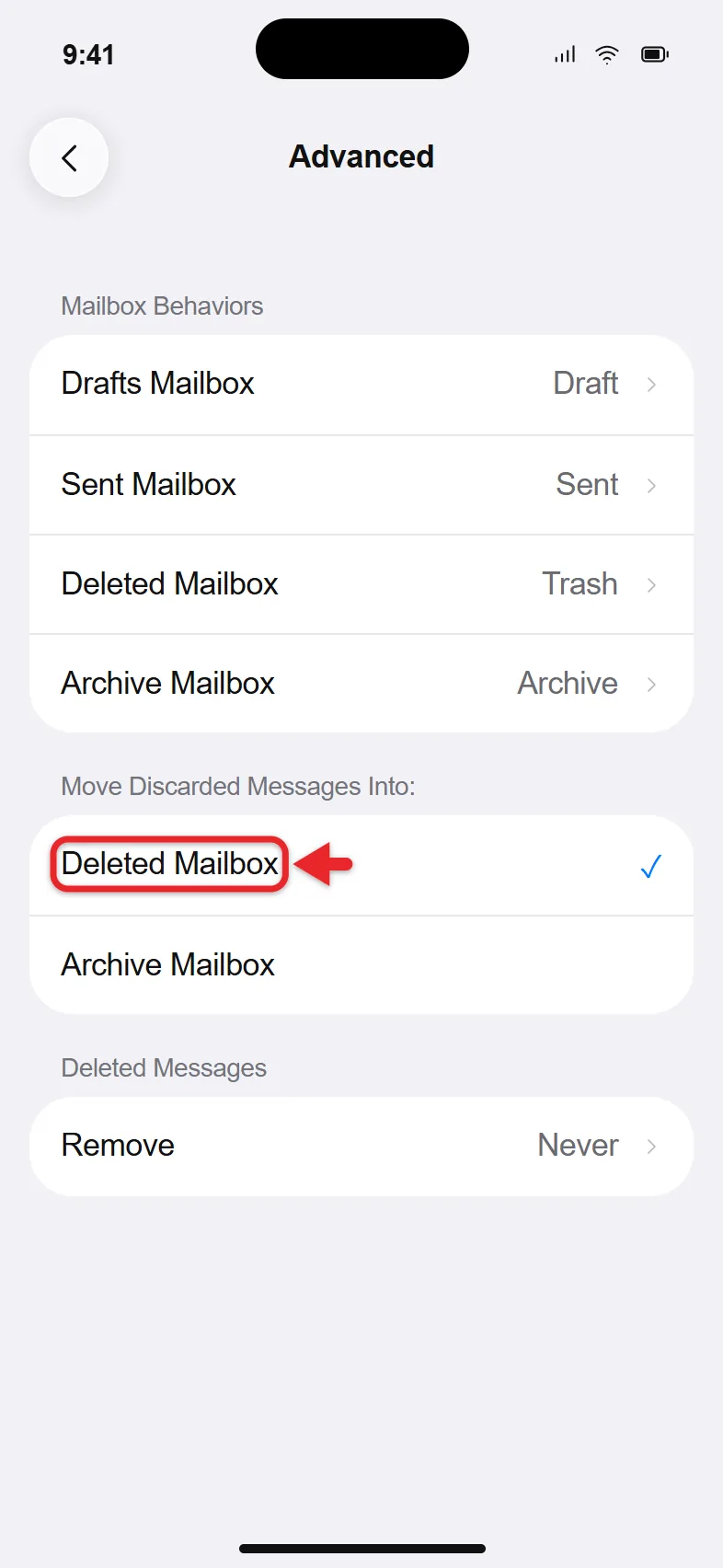
Apple explains this setting in Delete emails on your iPhone or iPad and its guide to deleting and recovering emails. Apple also notes that whether you see Archive or Trash depends on the type of email account, which is why one account on your iPhone can archive while another deletes.
To check that it worked, delete a test message, then open Mailboxes and look in that account’s Trash. The message should be there, not in Archive.
Delete One Email Without Changing the Setting
You can keep archiving as the default and still trash a message when you want to.
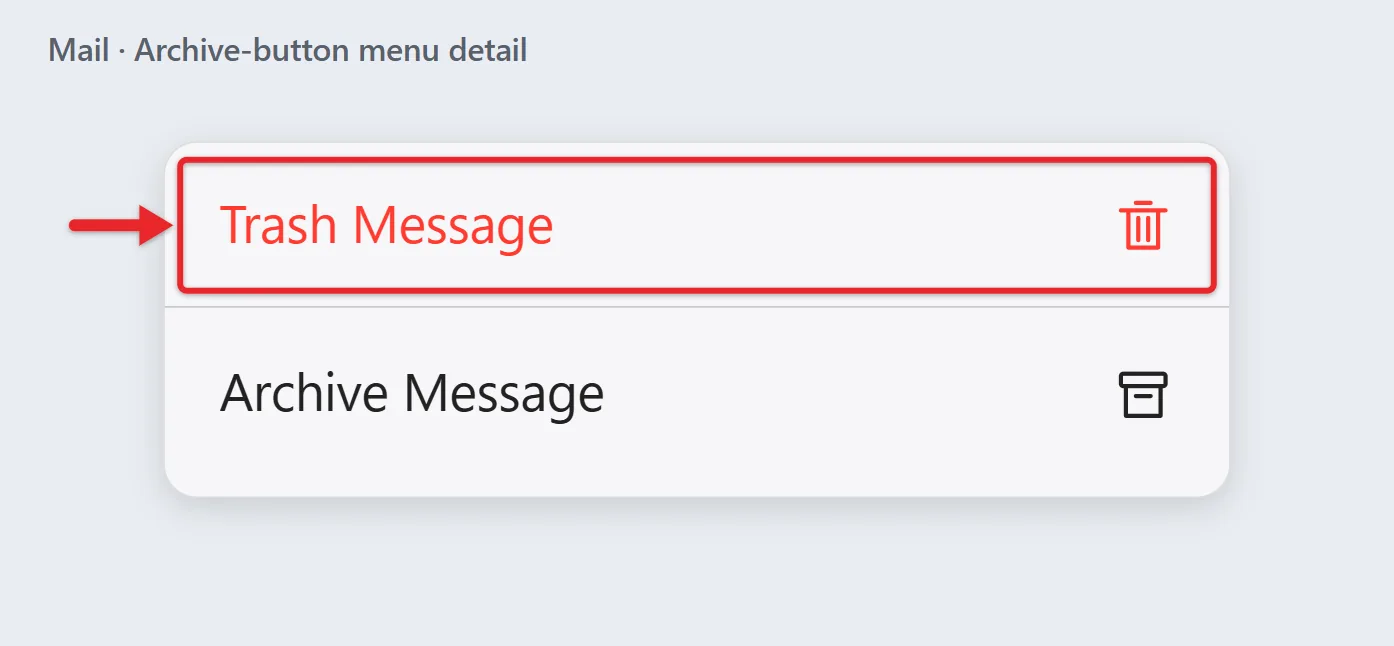
- Touch and hold the Archive button and tap Trash Message, or Trash Selected Messages when several are selected.
- Or touch and hold the email in your inbox and tap Trash Message.
- To delete many at once, tap More, then Select, and swipe down through the checkboxes. To use Select All, tap More and switch to List View first. For a very large number, your email provider’s website can be easier.
- With Mail’s inbox categories on, you can clear out one sender: tap one of their messages to see the rest, tap More, then Trash All.

If You See “Cannot Move Message to Trash”
This error usually means Mail doesn’t know which folder on the server is the Trash. In the account’s Advanced settings (or Mailbox Behaviors), tap Deleted Mailbox and choose Trash under On the Server, not On My iPhone. A Trash folder that lives only on the iPhone is the reason deletes don’t show up in webmail or on your other devices.
Do the same for Drafts and Sent while you’re there, then go back and tap Done. If the error mentions your password, tap the account and re-enter it.
If Deleted Emails Keep Coming Back
Mail tells the server to delete a message, and the server then updates every device. If that message never reaches the server, the email reappears the next time Mail checks for new mail. Work through these in order and test with one message after each.
- Check your connection. On weak Wi-Fi or cellular, deletes may not go through. Turn Airplane Mode on and off to reset the connection, or switch between Wi-Fi and cellular.
- Make sure the account is syncing. In Settings > Apps > Mail > Mail Accounts, tap the account and check that Mail is turned on.
- Force quit Mail by swiping it away in the app switcher, then reopen it. The exact swipe is shown in closing and restarting an app on iPhone. If that doesn’t help, restart the iPhone.
- Check the server’s own settings. Gmail, Outlook, and Yahoo have web settings that control what happens when a mail app deletes a message. See the Gmail section below.
- Ask about work or school accounts. An organization’s retention rules can keep deleted mail or block deletes entirely. If deletes also fail in the account’s webmail, only the IT team can change that.
- Remove and re-add the account. Go to Settings > Apps > Mail > Mail Accounts, remove the account, then add it again. For IMAP accounts like Gmail, Outlook, and iCloud, your mail stays on the server and downloads again. With an older POP account, messages stored only on the iPhone could be lost, so check first.
- Update your iPhone in Settings > General > Software Update.
Check the Server’s Own Settings in Gmail
Gmail uses labels, so when Mail removes a message from the inbox, Gmail can keep it in All Mail instead of moving it to Trash. To change that on a computer:
- Sign in to Gmail on the web, click Settings (the gear), then See all settings.
- Open the Forwarding and POP/IMAP tab.
- In the IMAP access section, turn on Auto-Expunge and set the option for deleted messages to move them to the Trash, then save your changes.
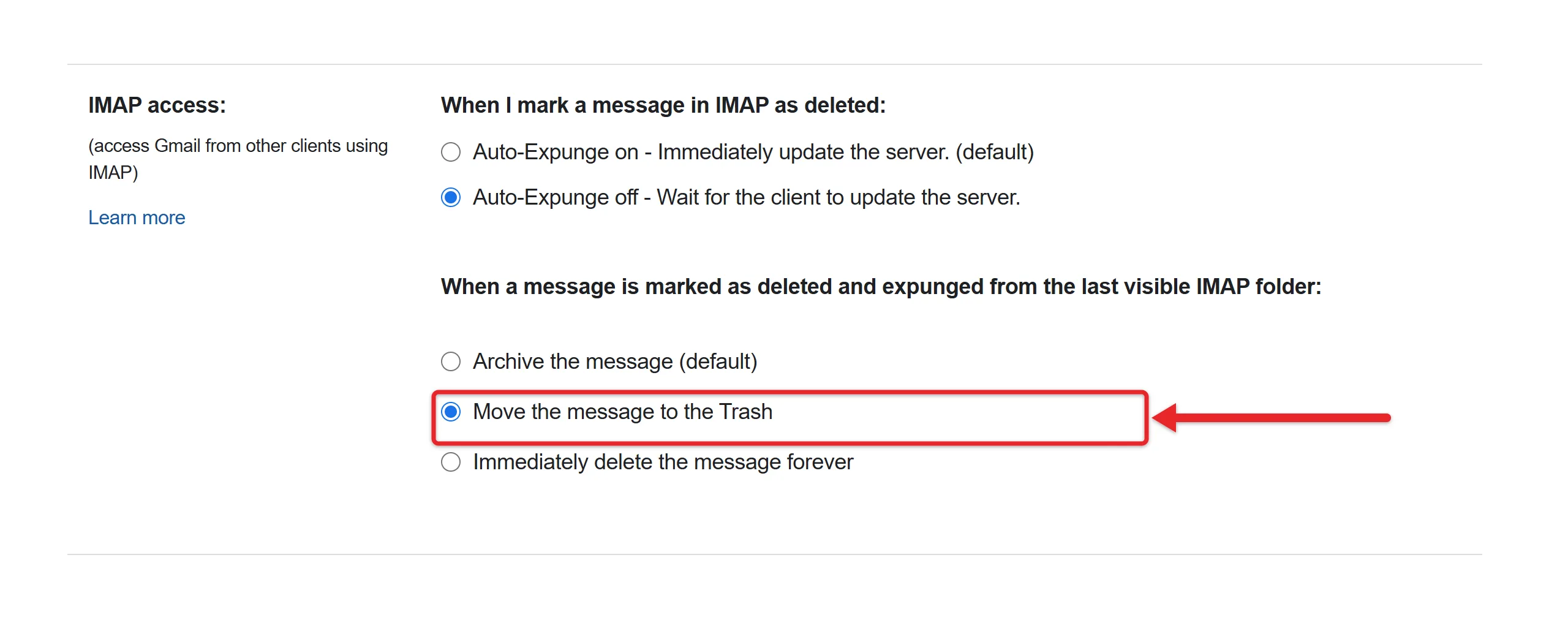
Google’s IMAP settings reference lists the three possible behaviors: archive, move to Trash, or delete forever. Avoid delete forever unless you’re sure, because those messages can’t be recovered. Some work or school Gmail accounts don’t show this tab.
POP Accounts
A POP account downloads mail to the iPhone and doesn’t sync deletes. Deleting a message on the iPhone may leave the server copy in place, so it still appears in webmail and on your other devices. If your provider supports IMAP, set the account up again as IMAP. Save any messages that exist only on the iPhone before you remove it.
If You Use the Gmail App Instead
The Gmail app has its own swipe settings, separate from Apple Mail. Open the app, tap Menu, then Settings, then Inbox customizations > Mail swipe actions. Choose Right swipe or Left swipe, pick the delete option, and tap Done. Google’s Gmail swipe help shows the same path.
Empty the Trash to Free Up Space
Deleting a message moves it to Trash, so it still uses storage until Trash is emptied. Archiving doesn’t free space at all.
Mail from a sender you block in the iPhone Mail app also lands in Trash, so check it before you empty it.
- Open Mail and tap Mailboxes, then the account’s Trash.
- Tap Edit or Select, then Delete All. The Trash mailbox is now empty.
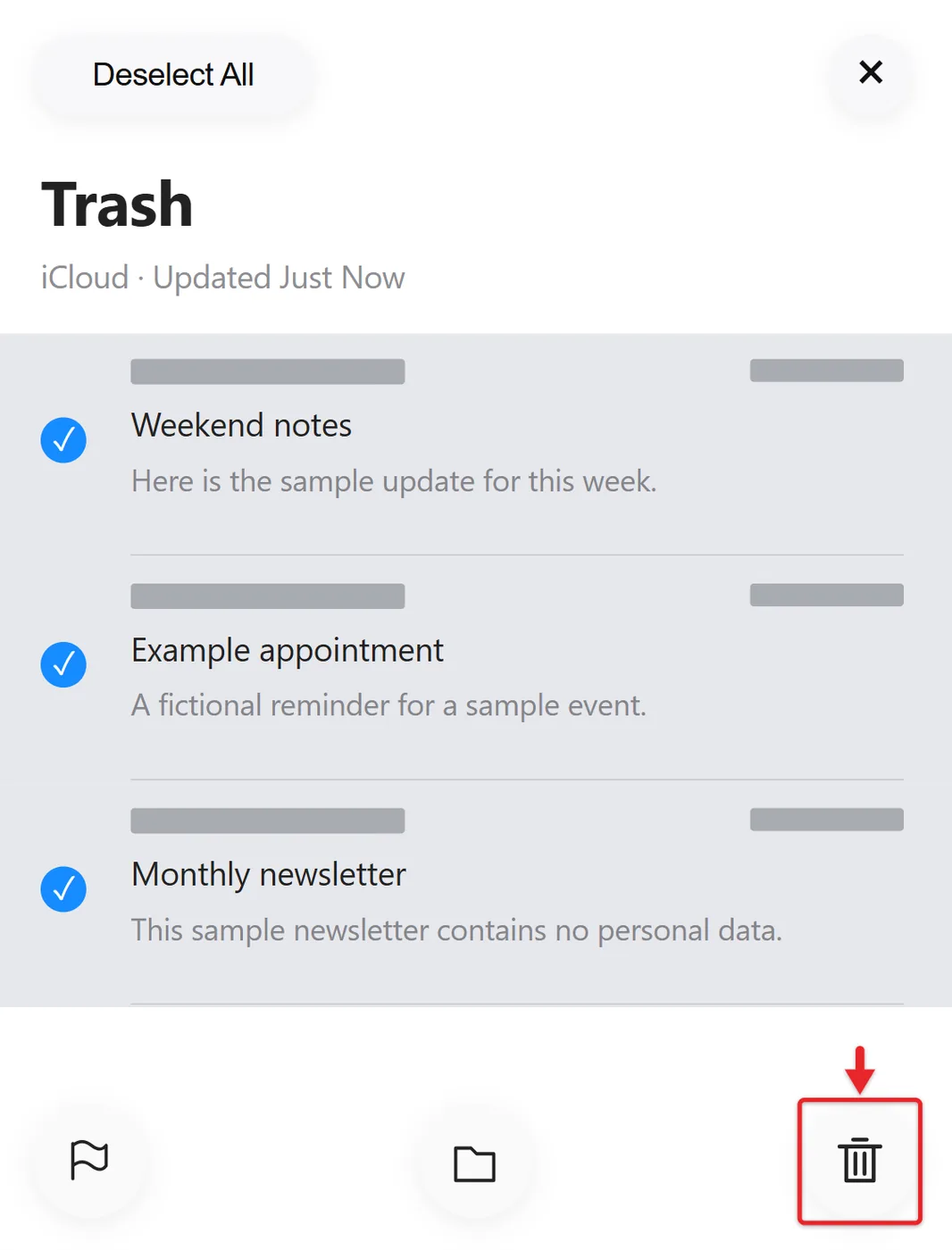
Emptying Trash is permanent. Apple’s iCloud Mail guide says emails you erase from Trash can’t be recovered. You can set how long deleted emails stay in Trash in the same advanced settings under Remove. Some services override this. For example, iCloud keeps deleted messages in Trash for 30 days and then erases them.
iPhone Mail Deletion Questions
How do I get back an email I deleted by mistake?
Open Mailboxes, tap the account’s Trash, open the message, tap the move button, and choose another mailbox. If you archived it instead, look in Archive or All Mail. Once Trash is emptied, the message is gone.
Where do archived emails go?
To the account’s Archive folder, or All Mail for Gmail. They aren’t deleted and still count toward your storage.
Does deleting an email on my iPhone delete it everywhere?
For IMAP, iCloud, and Exchange accounts, yes. The server removes it and your Mac, iPad, and webmail follow. For POP accounts, usually not.
Will removing my email account delete my messages?
It removes them from the iPhone only. IMAP and iCloud mail stays on the server and comes back when you add the account again. Mail that exists only on the iPhone, such as some POP mail, does not.
Mail has other problems. Where can I get help?
Two common problems have their own fixes: “connection to the outgoing server failed” and Yahoo Mail not working on iPhone. If you changed your email password, update it on the iPhone too.
Looking for big emails to clear out? Add an Attachments folder in Mail on an iPhone so you can find them quickly. If a message you archived seems lost, you can find archived emails on iPhone.
To read long email threads more easily, here’s how to put the most recent email at the top of an iPhone Mail conversation.

Matthew Burleigh is the founder, head writer, and editor of Solve Your Tech, which he launched in 2012. He has written technology tutorials since 2008 and worked in IT since 2003, including small-business support, IT management, and consulting. He holds Bachelor’s and Master’s degrees in Computer Science from Arizona State University.
Matthew writes practical guides for Windows, iPhone and iPad, Microsoft Office, Outlook, Google apps, and Android. Solve Your Tech’s guides are checked step by step against the device or app maker’s own documentation and tested on his own devices whenever he has the hardware or software, with clear steps, sources, and update dates.
Read more about Matthew and how Solve Your Tech writes and updates its guides, or report a correction.