Android does not have one trash can for everything. Each app keeps its own. To empty the trash for photos, open Google Photos and tap Collections > Trash > More > Empty Trash > Delete permanently. For other files, open Files by Google, tap Menu > Trash, select the files, and tap Delete. Gmail, Google Drive, and Samsung apps each have their own trash too. Voicemail is separate as well, so see how to clear voicemail on Android if your mailbox is full.
Google says items in the Google Photos, Files by Google, Gmail, and Google Drive trash are deleted automatically after 30 days, so you only need to empty them sooner if you want the space back now. The steps below come from Google and Samsung help pages for each app. Other phone makers use their own gallery and file apps, which may work differently. Text messages are separate again: our guide to keeping old messages on Android explains the Trash in Samsung Messages.
Before You Empty the Trash on Android
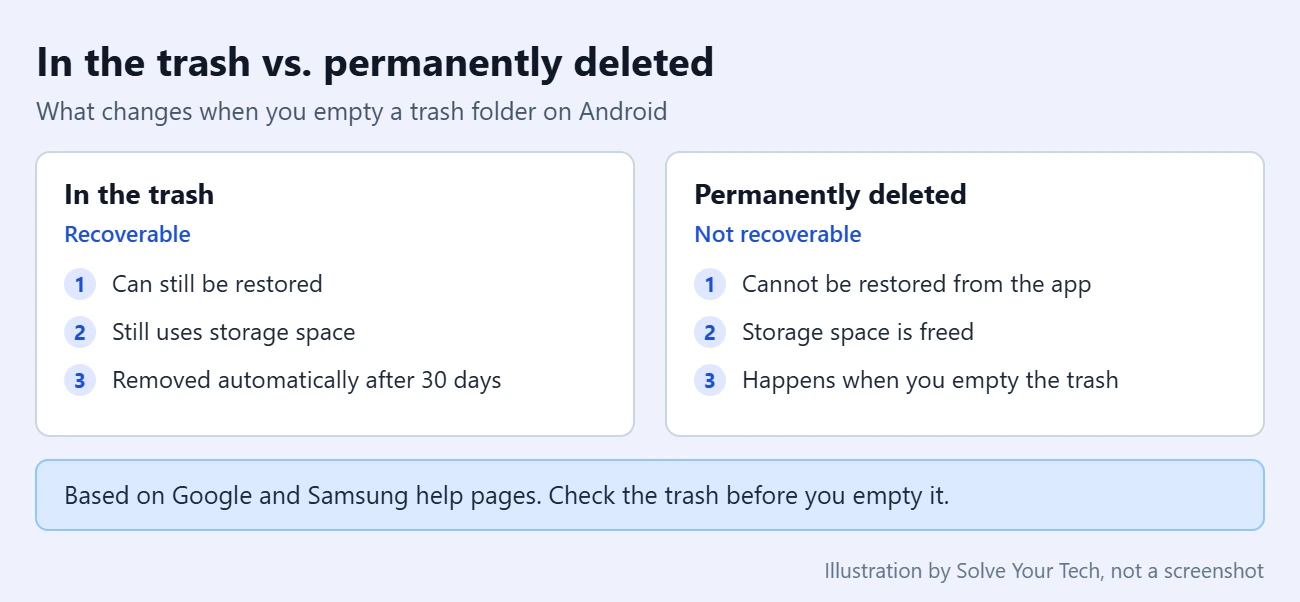
Warning: emptying a trash folder is permanent. Google and Samsung both say that items deleted from the trash cannot be restored. Open the trash and look through it first. If you see something you still need, restore it before you empty the rest.
A few things to know before you start:
- The trash is a holding area. A file you delete usually moves there first and stays until you remove it or the app clears it. Until then it still takes up space.
- You need to check more than one app. Photos, downloads, email, and cloud files each sit in a different trash. Clearing one does not clear the others.
- Menu names vary. Samsung documents the folder as Recycle bin, and some phones show Trash or Bin instead. They are the same thing.
- Use a current app version. Google notes that its Photos steps describe the latest version of the app. Files by Google added its Trash with Android 11, and Google says it is rolling out to other versions in phases.
If you are not sure whether you still need something, back up your Android phone first so you have a second copy of your photos and files.
How to Empty the Trash in Google Photos
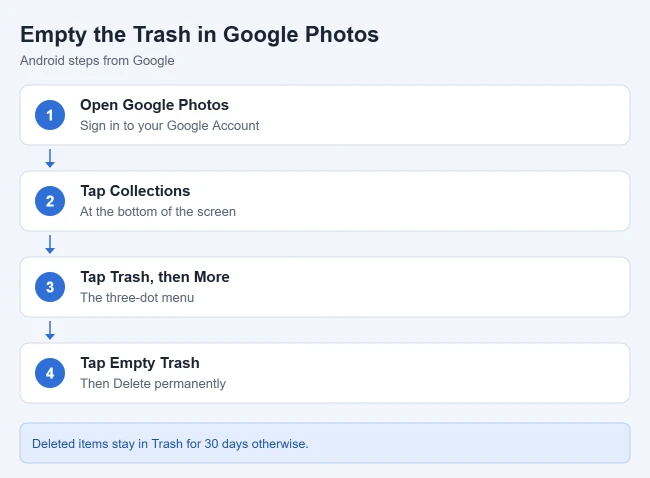
- Open the Google Photos app and sign in to your Google Account.
- At the bottom, tap Collections, then Trash. You will see the photos and videos you deleted recently.
- Tap More (the three-dot menu).
- Tap Empty Trash, then Delete permanently.
Everything in your Photos trash is now permanently deleted, and the Trash screen should be empty. Google warns that permanently deleted photos and videos cannot be restored, and that its Takeout export service cannot recover them either.
To delete just some items, go to Collections > Trash, tap Select, choose the photos or videos, then tap Delete permanently. To get an item back instead, touch and hold it in the Trash and tap Restore. Google says a restored item returns to your Photos library, any albums it was in, and your phone gallery app.
Two details are easy to miss. First, if backup is turned on, Google says deleting a photo in the app removes it from every device where you use Google Photos with backup on, not just this phone. Second, deleted photos might stay on a removable memory card. Google says to use your phone gallery app to remove those. More detail is in Google Photos Help.
If Google Photos Says Your Trash Is Full
Google explains that if you see a Delete permanently prompt when you move photos to the trash, your trash is full. Anything you delete at that point skips the trash. Empty the trash first if you want to keep the option to restore the items you are deleting now.
How to Empty the Trash in Files by Google
Files by Google is the file manager app made by Google. Its trash holds deleted downloads, documents, and other files stored on the phone itself.
- Open Files by Google.
- At the top left, tap Menu (the three lines), then Trash.
- Select the files you want to delete.
- At the bottom, tap Delete.
- On the confirmation box, tap Delete again.
The selected files are permanently deleted and disappear from the Trash list. To recover something instead, select it and tap Restore, then Restore again to confirm.
Google notes one exception. Files you delete from the Junk files card in the Clean menu skip the trash and are permanently deleted right away. See Files by Google Help.
Empty the Trash in Gmail and Google Drive
Gmail and Drive do not use your phone storage in the same way. Their trash counts toward your Google Account storage, which is the online space shared by Gmail, Google Drive, and Google Photos. Google lists up to 15 GB with each account. Empty these two when Google says your account storage is full.
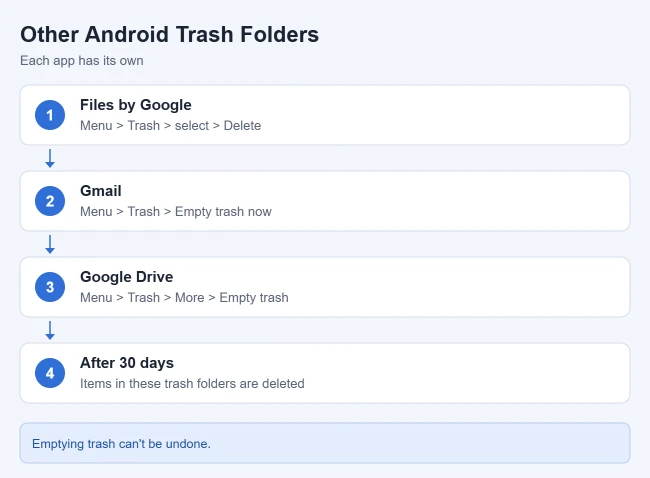
- Gmail: Open the Gmail app, tap Menu > Trash, then tap Empty trash now at the top. Google says you cannot recover messages you permanently delete, and that a deleted draft cannot be recovered from Trash at all. See Gmail Help.
- Google Drive: Open the Drive app, tap Menu > Trash, tap More in the top right, then Empty trash. To remove one file, tap More next to it and choose Delete forever. Google notes that if you own a shared file, everyone you shared it with loses access when you permanently delete it. See Google Drive Help.
Documents you delete in Google Docs, Sheets, or Slides are Drive files, so they land in the same Drive trash. To move a message out of the Gmail trash instead of deleting it, touch and hold it, tap More > Move to, and pick a folder.
How to Empty the Recycle Bin on a Samsung Galaxy
Samsung Galaxy phones add their own apps, and those apps have their own trash. Samsung calls it the Recycle bin in its current help page. On your phone it may be labeled Trash. Samsung says deleted items stay there for 30 days and are then permanently deleted automatically.
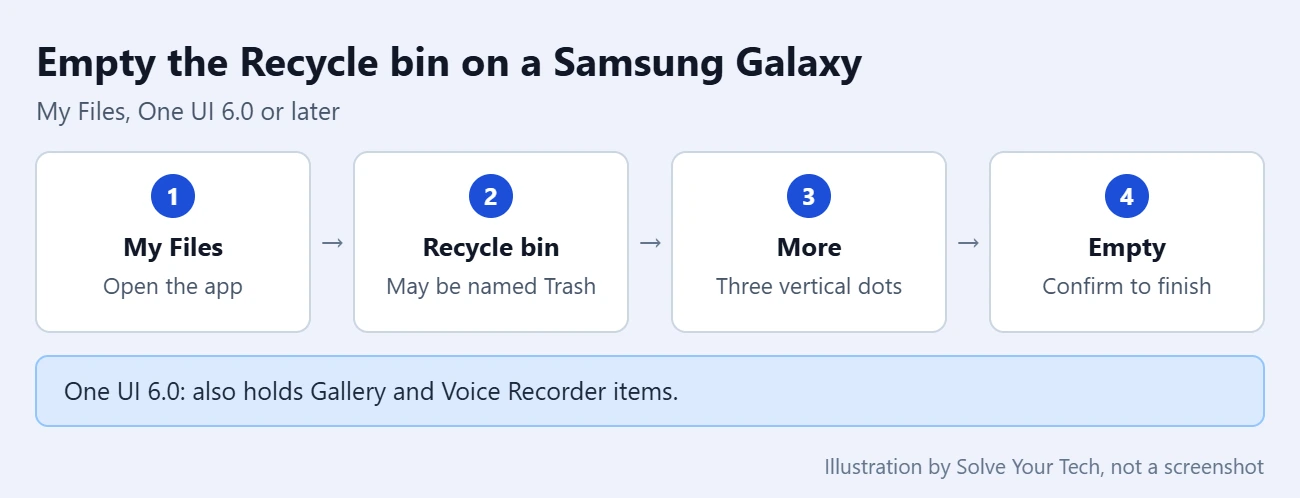
To empty everything at once in My Files:
- Open the My Files app.
- Tap Recycle bin.
- Tap More (the three vertical dots).
- Tap Empty and confirm.
To remove or rescue only some files, open My Files > Recycle bin, tap Edit, select the files (or tap All), then tap Delete or Restore. Samsung also lists another route to the same place: Settings > Device care > Storage management > Recycle bin > My Files.
For photos and videos deleted in the Samsung Gallery app:
- Open Gallery and tap Menu (the three horizontal lines).
- Tap Recycle bin.
- Tap Edit.
- Select the items, or choose Delete All.
- Tap Delete, then Delete again to confirm.
Samsung says that on One UI 6.0 and later (One UI is the Samsung version of Android), the bin in My Files also shows items deleted in Gallery and Voice Recorder, so you can clear all three from one place. Samsung also states that the recycle bin cannot be turned off. The full steps are on Samsung Support.
How to Check That the Trash Is Empty
Reopen the trash in the app you just cleared. It should show no items. Then open Settings > Storage on your phone to see the free space figure. On a Samsung phone, look under Settings > Device care.
Do not expect every number to change at once. Google says that after you delete a large number of files, it normally takes up to 48 to 72 hours for your Google Account storage total to update. That delay applies to the online quota for Photos, Gmail, and Drive.
There is no undo. Once a trash folder is emptied, the app cannot bring those items back. The only way to get a file back is from a separate copy, such as a backup you made earlier or a copy someone else has.
Troubleshooting: Trash Problems on Android
There Is No Trash Option in Files by Google
Google says the Trash feature arrived with Android 11 and is being added to other Android versions in phases. Update the app from the Play Store and check Menu again. If it is still missing, your phone may not have the feature yet, and files you delete there may be removed right away.
The Files by Google Trash Screen Is Blank
Google has a documented fix for a Trash screen that will not load. If you use an SD card, remove it and check again. If that does not help, open Files by Google and tap Menu > Settings. Under Browse, turn on Show hidden files. Go back, tap Internal storage, and find the folder named .FilesByGoogleTrash. Tap More > Delete permanently, confirm, then close and reopen the app. This permanently removes whatever was in the trash.
I Emptied the Trash but Storage Is Still Full
First check that you emptied the right trash. Clearing Gmail or Drive frees Google Account storage, not space on the phone. Clearing Files by Google or Samsung My Files frees space on the phone. If the phone itself is still full, the space is probably used by apps and their data. See our guide to Android phone storage that is full for no reason for the next checks.
The Menu Names on My Phone Are Different
Older versions of Google Photos used a Library tab where current versions show Collections. Some regions say Bin instead of Trash. Some phones may also list a Trash entry inside Settings > Storage, but the Google help pages we checked do not describe it, so use the app steps above if you do not see one.
Frequently Asked Questions
Where is the trash on Android?
There is no single trash folder on Android. Each app keeps its own: Google Photos under Collections > Trash, Files by Google under Menu > Trash, Gmail and Google Drive under Menu > Trash, and Samsung My Files and Gallery under Recycle bin.
Will emptying the trash free up storage?
It can. Items you have moved to the trash are not gone until they are permanently deleted, so emptying it is how you get the space back right away. Google confirms that files in the Drive trash still count toward your storage until then. To free up more room, you can also clear the cache on Android.
How long do deleted files stay in the trash on Android?
Google lists 30 days for Google Photos, Files by Google, Gmail, and Google Drive. Samsung lists 30 days for My Files and Gallery. After that the app deletes the items permanently without asking.
Can I get files back after emptying the trash?
No. Google says permanently deleted photos, videos, files, and messages cannot be restored, so check the trash before emptying it.
Does deleting a photo in Google Photos delete it from my phone?
Yes. Google says deleting a photo or video in the Google Photos app deletes the copy on your device as well as the Google Photos copy. If the item was backed up, it is removed from all devices that have backup turned on.
Is there a trash folder on Windows too?
Yes, Windows calls it the Recycle Bin. See how to empty the Recycle Bin in Windows 11 and how to find deleted files on Windows 11.
What to Do Next
Work through the apps you actually use: Google Photos first, since photos and videos are usually the largest files, then your file manager, then Gmail and Drive. If photos keep filling your phone, see how to take smaller pictures on Android.

Matthew Burleigh is the founder, head writer, and editor of Solve Your Tech, which he launched in 2012. He has written technology tutorials since 2008 and worked in IT since 2003, including small-business support, IT management, and consulting. He holds Bachelor’s and Master’s degrees in Computer Science from Arizona State University.
Matthew writes practical guides for Windows, iPhone and iPad, Microsoft Office, Outlook, Google apps, and Android. Solve Your Tech’s guides are tested on current devices or checked against official product documentation, with clear steps, sources, and update dates.
Read more about Matthew and how Solve Your Tech writes and updates its guides, or report a correction.