To delete a file in Google Drive, go to drive.google.com, right-click the file, and click Move to trash. To recover it, click Trash on the left, right-click the file, and click Restore. Files stay in the Trash for 30 days before Google deletes them forever.
These steps cover Google Drive on the web (any current browser on Windows, Mac or Chromebook), the Drive app for Android, iPhone and iPad, Google Drive for desktop, and both personal Google accounts and work or school (Google Workspace) accounts. They follow Google’s help articles on deleting files in Google Drive and recovering a deleted file.
How Deleting Works in Google Drive
Deleting in Drive happens in two stages, and knowing which stage a file is in tells you whether you can get it back.
| Where the file is | What it means | Can you get it back? |
|---|---|---|
| Trash (up to 30 days) | Moved to Trash but not erased. Still uses your storage. | Yes, restore it yourself. |
| Permanently deleted, personal account | You emptied the Trash, chose Delete forever, or 30 days passed. | Maybe, with Google’s recovery request, within about 25 days, if you owned it. |
| Permanently deleted, work or school account | Same as above. | Your administrator can restore it within 25 days. |
| Past those windows | Gone from Google’s tools. | Only from a copy you kept somewhere else. |
How to Delete Files in Google Drive
- Go to drive.google.com and sign in.
- Right-click the file. To delete several, select them first, then right-click one of them.
- Click Move to trash.
The file moves to the Trash. Google notes that anyone you shared it with can still open it until it’s permanently deleted, and that files in the Trash still count toward your storage.
To cut off access before you delete anything, stop sharing the Google Docs file first.
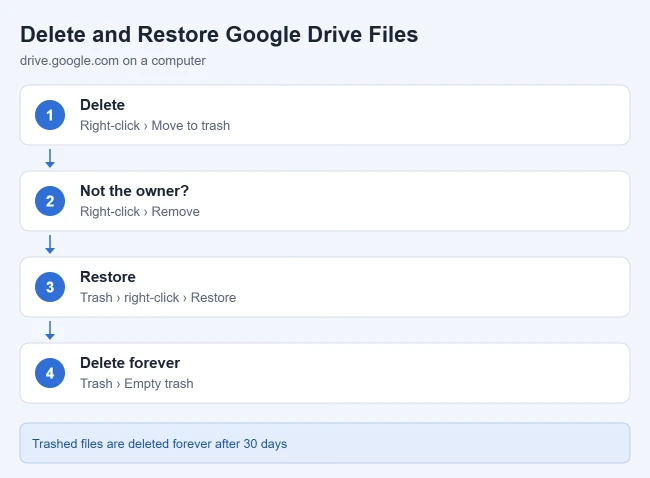
To pick several files, hold Ctrl (Windows or Chromebook) or Command (Mac) and click each one, or click the first file and Shift-click the last one to select a range. You can delete a folder the same way. Its contents go to the Trash with it, and restoring the folder brings them back.
If you don’t own the file
You can only delete files you own. For files someone else owns, Google shows Remove instead. That takes the file out of your Drive, but the owner and other people with access can still use it. To start from the Docs app instead, follow deleting a Google Doc and getting it back.
Delete a file in the Drive app on Android, iPhone or iPad
- Open the Google Drive app. On Android, tap Files at the bottom to see your files.
- Tap More (three dots) next to the file.
- Tap Remove.
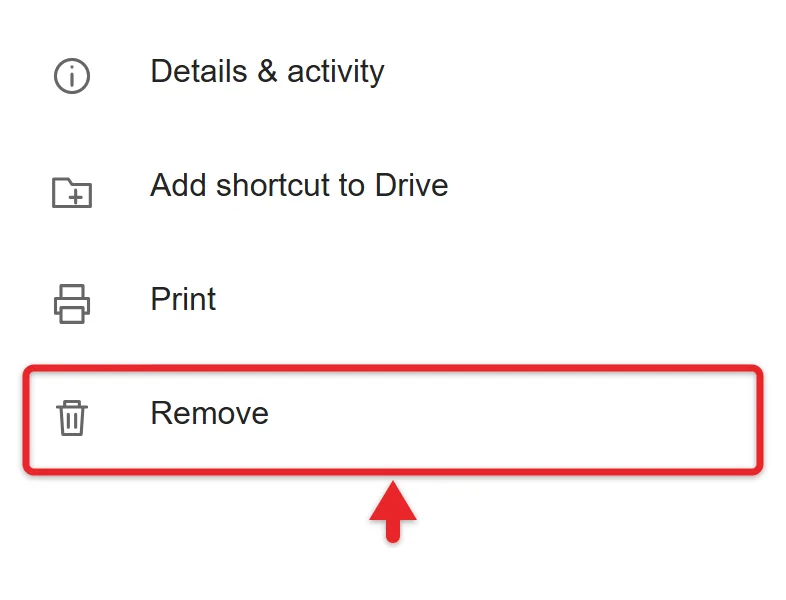
The file goes to the Trash, just as it does on a computer.
Delete a file in a shared drive
Shared drives (used in many work and school accounts) belong to a team, not to one person, so your role decides what you can do. Google’s shared drive permissions guide says Managers and Content managers can move files to the Trash, and only Managers can permanently delete them. Contributors, Commenters and Viewers can’t delete files. Files trashed from a shared drive go to that shared drive’s Trash, not your personal Trash, and Managers, Content managers and Contributors can restore them for up to 30 days.
How to Recover a File From the Trash
- Go to drive.google.com.
- Click Trash on the left.
- Right-click the file and click Restore.
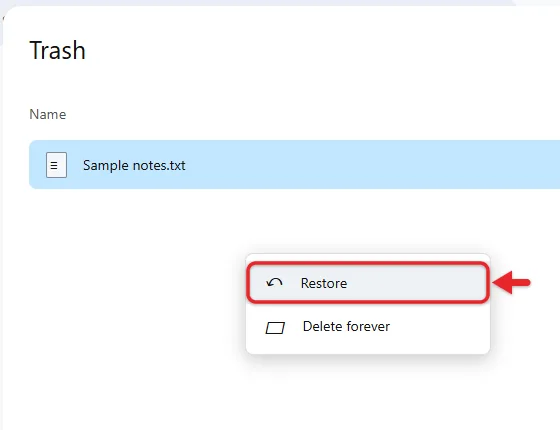
The file returns to its original folder. To find something you deleted recently, sort the Trash by Trashed date. To restore several files at once, select them with Ctrl, Command or Shift, then right-click one of them and click Restore. For Google Docs, the steps to recover a deleted Google Doc also cover version history and files deleted from the Trash.
In the Drive app, open the menu, tap Trash, tap More next to the file, and tap Restore.
If the file isn’t in your Trash
- Someone else owned it. Files shared with you don’t go to your Trash when the owner deletes them. Ask the owner to restore it from their Trash.
- It was in a shared drive. Check that shared drive’s Trash, or ask one of its Managers.
- It was a photo or video in Google Photos. Google Photos has its own Trash at photos.google.com. Restoring there doesn’t put anything back in Drive.
- It was a WhatsApp backup. WhatsApp manages those backups, and Google can’t restore them. Go to WhatsApp’s help center.
- You’re signed in to the wrong account. Click your profile picture at the top right of Drive and check the email address.
How to Permanently Delete Files
Warning: there’s no Trash after this step. When you permanently delete a file you own, everyone you shared it with loses access. If others still need it, make someone else the owner first.
- Everything in the Trash: open Trash, make sure there’s nothing you want, then click Empty trash › Delete forever.
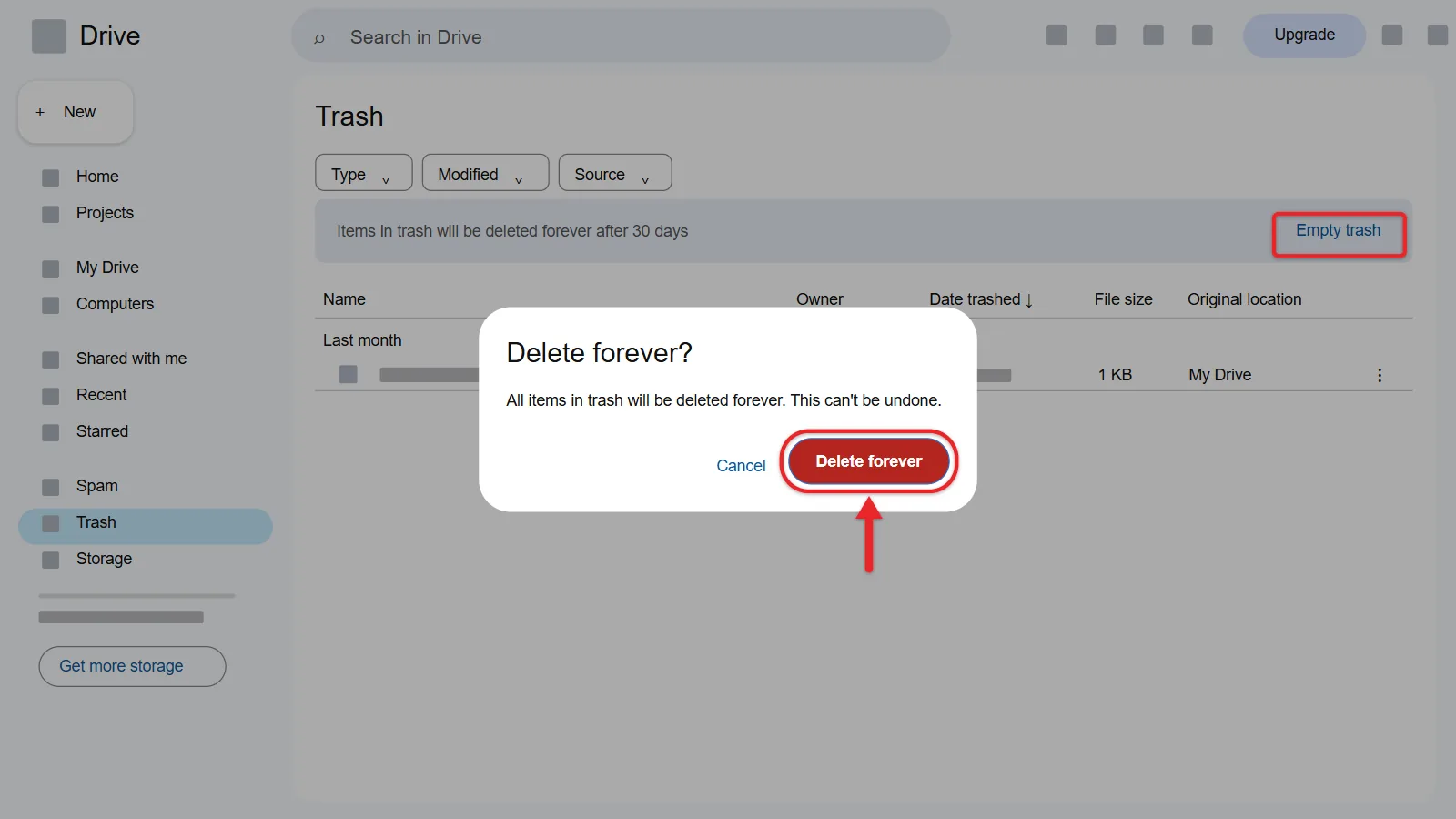
- One file: open Trash, select the file, and choose Delete forever. In the app, tap More next to the file, then Delete forever.
- Everything in the Trash in the app: tap the menu, tap Trash, tap More at the top right, then tap Empty trash.
If you only want to cut off other people, you can unshare a Google Sheets file instead of deleting it. If you’re deleting files to make room, Google One’s storage page shows which services use your space, and checking your Google cloud storage walks through it.
Can You Recover a Permanently Deleted File?
Sometimes. Google offers a few options after a file has left the Trash.

Request recovery from Google
Google’s recovery article includes a Request file recovery button that sends your request to an automated recovery tool. The tool can help if you’re certain the files were permanently deleted from your Drive Trash within the last 25 days and you’re the owner, meaning you created or uploaded them or accepted ownership. You’ll be asked to confirm your identity, and the results arrive by email.
- Sign in to the Google account that owned the file.
- Open Google’s recover a deleted file article and click Request file recovery.
- Fill in the form, confirm the files were deleted in the last 25 days, and submit it.
- Watch your email for the result, then check My Drive for the recovered files.
Permanently deleted files from Gmail, Google Photos and WhatsApp backups can’t be recovered this way. A request isn’t a guarantee, so send it as soon as you notice the file is missing.
Ask your administrator (work or school accounts)
If you use Drive through work or school, your administrator can restore Drive data deleted from your Trash within the last 25 days, according to Google Workspace admin help. The restore covers everything deleted in a chosen date range, may take several days, and restored files need to be shared again.
To make the request easier, tell your administrator the file name, the folder it was in, and the day you emptied the Trash. Keep these points in mind as well:
- The admin restores from Directory > Users > Restore data in the Admin console, choosing Drive and a date range.
- Admins can’t pick one file. Everything removed in that date range comes back to its original folder.
- Only one restore can run at a time, and it stops if the account runs out of storage.
- If your organization uses Google Vault and kept the data, it may be found after 25 days, but Vault can only export it, not put it back in your Drive.
What can’t be recovered
On a personal account, a file you owned is out of reach once the Trash is emptied and the recovery request window has passed or the request fails. Files you never owned can’t be recovered by you at all. Only the owner can restore them.
Recovery programs advertised for this problem scan your own computer’s disk. They can’t reach Google’s servers, so they can’t bring back a file deleted from Drive. If you used Drive for desktop or downloaded a copy, look for that copy on your computer or in a backup you made, such as Time Machine or File History.
Deleting Files With Drive for Desktop
If you use Google Drive for desktop to stream or mirror files, anything you put in the trash on your computer goes to the Trash everywhere. Restore it from the Drive Trash on the web if you delete it by mistake. Once it’s restored, it syncs back to the Google Drive folder on your computer.
Photos and videos that Drive for desktop backs up to Google Photos work differently. Deletions don’t sync between your computer and Google Photos, so deleting a picture on your computer leaves the Google Photos copy alone.
Recover an Older Version Instead
If the file still exists but someone overwrote or broke it, you don’t need the Trash. Google Docs, Sheets and Slides keep a version history you can restore from. Restoring an older version of a Google Sheets file walks through it.
For other files, such as PDFs and Word files, right-click the file in Drive and open Manage versions. Google’s file versions help says an old version may be deleted after 30 days or once there are 100 newer versions, unless you mark it Keep forever.
Google Drive Deletion Questions
Does deleting a file free up storage right away?
No. Files in the Trash still count toward your storage until they’re permanently deleted, so empty the Trash if you need the space now.
If I delete a file someone shared with me, is it gone for everyone?
No. You can only remove it from your own Drive. The owner and other people with access keep it.
How long do files stay in the Google Drive Trash?
30 days. After that, Google deletes them forever on its own. You can’t change that time limit.
What happens to people I shared a file with when I delete it?
They can still open it while it’s in your Trash. Once you delete it forever, they lose access. Transfer ownership first if they still need it.
Can someone else delete a file I own?
Not in My Drive. Only the owner can move a file to the Trash; other people only get Remove, which takes it out of their own Drive. If a file you own seems to be missing, search Drive for its name and check your Trash.
Can I recover a Google Drive file after 30 days?
Only through the recovery request (personal accounts) or your administrator (work and school accounts), and only within about 25 days after the Trash was emptied.
More Google Drive Guides

Matthew Burleigh is the founder, head writer, and editor of Solve Your Tech, which he launched in 2012. He has written technology tutorials since 2008 and worked in IT since 2003, including small-business support, IT management, and consulting. He holds Bachelor’s and Master’s degrees in Computer Science from Arizona State University.
Matthew writes practical guides for Windows, iPhone and iPad, Microsoft Office, Outlook, Google apps, and Android. Solve Your Tech’s guides are checked step by step against the device or app maker’s own documentation and tested on his own devices whenever he has the hardware or software, with clear steps, sources, and update dates.
Read more about Matthew and how Solve Your Tech writes and updates its guides, or report a correction.