An iPad has no single Trash. Deleted photos, files, notes and voice memos wait in each app’s own Recently Deleted folder, usually for 30 days, and deleted email sits in Mail’s Trash. Empty the folders that matter, then check Settings > General > iPad Storage.
Your iPad says its storage is almost full, you deleted a pile of photos and videos, and the free space did not budge. That’s usually because the items haven’t really left yet.
Where Deleted Items Go on an iPad
On a Mac there’s one Trash in the Dock. On an iPad, each app keeps its own holding area, and nothing is truly gone until that folder is emptied or its timer runs out. Apple documents these:
| App | Where deleted items go | How long they stay |
|---|---|---|
| Photos | Recently Deleted (under Utilities) | 30 days |
| Files | Recently Deleted (in the sidebar under Locations) | 30 days |
| The Trash mailbox for each account | Depends on the account’s Remove setting | |
| Notes | Recently Deleted folder | 30 days |
| Voice Memos | Recently Deleted | 30 days by default, adjustable |
Photos and videos are usually the biggest items by far, so if you’re short on space, start there. A long video can take more room than thousands of notes.
Before You Empty Anything
Two warnings apply to every folder below, so read them first.
Emptying is permanent. Apple says photos removed from Recently Deleted can’t be recovered, and files deleted from the Files app’s Recently Deleted folder are deleted immediately and can’t be brought back. If you aren’t sure about an item, recover it or leave it alone.
iCloud may delete it everywhere. If you use iCloud Photos, deleting a photo on your iPad deletes it on every device signed in to the same Apple Account. The same is true for files in iCloud Drive and notes stored in iCloud. If your goal is to free iPad space while keeping a photo on your iPhone, see deleting photos from an iPad but not other devices before you empty anything.
Empty Recently Deleted in Photos
Apple’s page on deleting photos on iPhone and iPad describes this route:
- Open the Photos app.
- Tap Collections. On an iPad you may find it in the sidebar rather than at the bottom of the screen.
- Scroll down to Utilities and tap Recently Deleted.
- Tap View Album and confirm with Face ID, Touch ID or your passcode. Apple says this step applies on iPadOS 16.1 and later.
- Tap Select.
- To clear everything, tap the More button without selecting anything and choose Delete All (Apple says to tap Cancel, then Select again if items are already selected). To clear only some items, tap them first, then tap the More button and choose Delete.
- Confirm. With iCloud Photos the button reads Delete from All Devices. In a Shared Library you may see Delete Photos I Added.
A few details from Apple trip people up:
- In a Shared Library, only the person who added an item can permanently delete it or recover it from Recently Deleted.
- Photos that were synced to the iPad from a computer can’t be deleted in Photos. The Trash button stays gray. Remove them by changing the sync settings on the computer.
- If you’d rather not confirm with Face ID every time, Apple lets you turn that off under Settings > Apps > Photos (Use Face ID).
Here’s an example. Say Cornelius fills a 64 GB iPad with 400 clips from a school play and deletes them all. Until he empties Recently Deleted, the clips still take up space. After he taps Delete All and confirms, the space should be freed, although the storage screen can take a little while to catch up.
Empty Recently Deleted in Files
Files deleted from iCloud Drive or On My iPad stay in Recently Deleted for 30 days, according to Apple’s page on deleting and recovering files in the Files app.
- Open the Files app.
- In the sidebar, look under Locations and tap Recently Deleted. If you don’t see the sidebar, tap the Show Sidebar button.
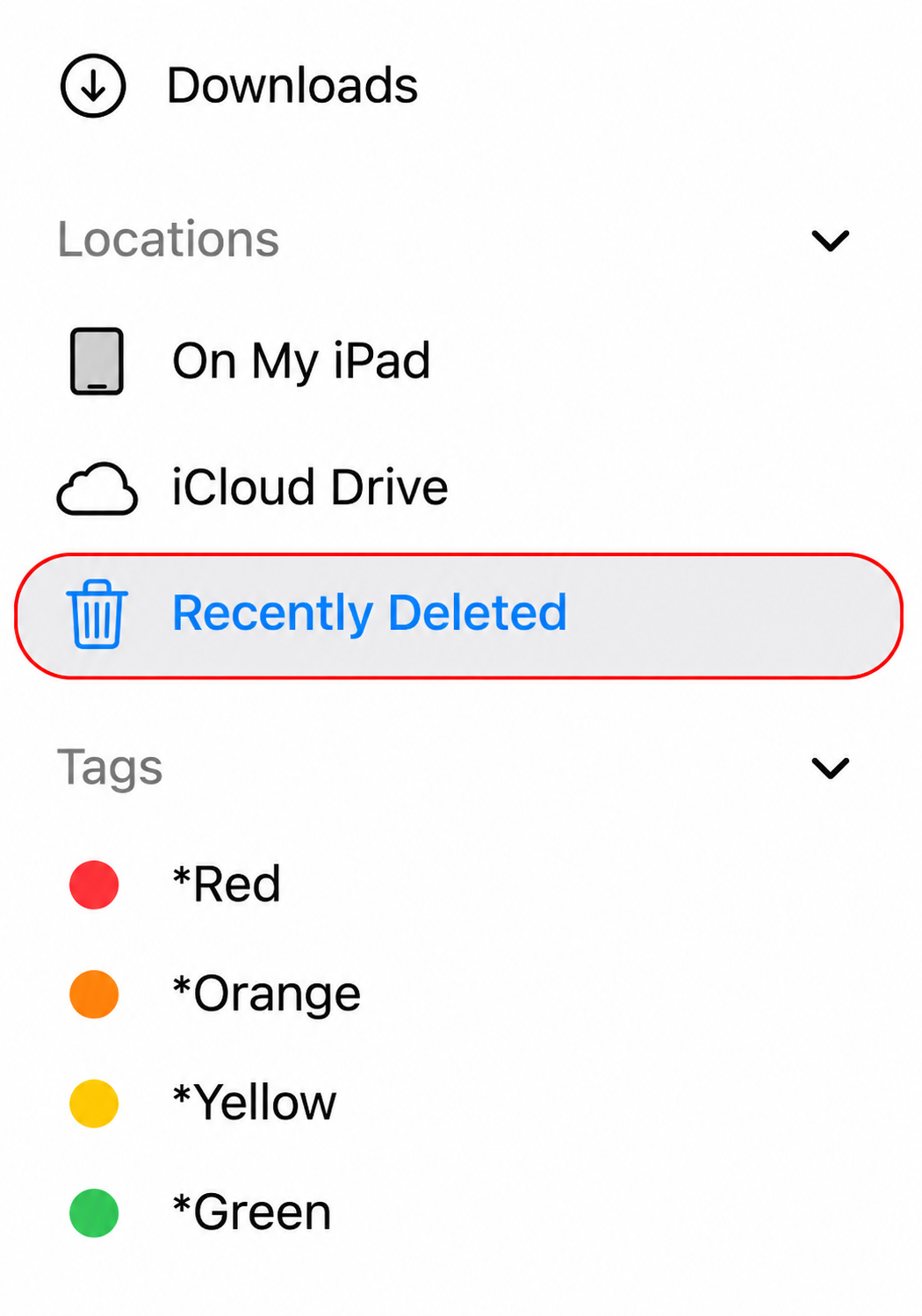
- Tap the More button, then Select.
- Tap the files you want to remove, then tap Delete. Depending on your iPadOS version, you may also see a Delete All option.
- Confirm when asked.
Files you remove here are deleted immediately. Before you clear a file from iCloud Drive, consider whether you only need the space on this iPad. Apple’s Files page also describes Remove Download, which frees the local copy but keeps the file in iCloud Drive. If you’re not sure where a file lives in the first place, finding your files on iPhone or iPad explains the Files layout.
Empty the Trash in Mail
Mail doesn’t use a Recently Deleted folder. Each email account has its own Trash mailbox. Apple’s guide to deleting and recovering email on iPad describes how to reach it:
- Open Mail and tap the button at the upper left to see your mailboxes.
- Tap the arrow next to an account to expand it.
- Tap Trash.
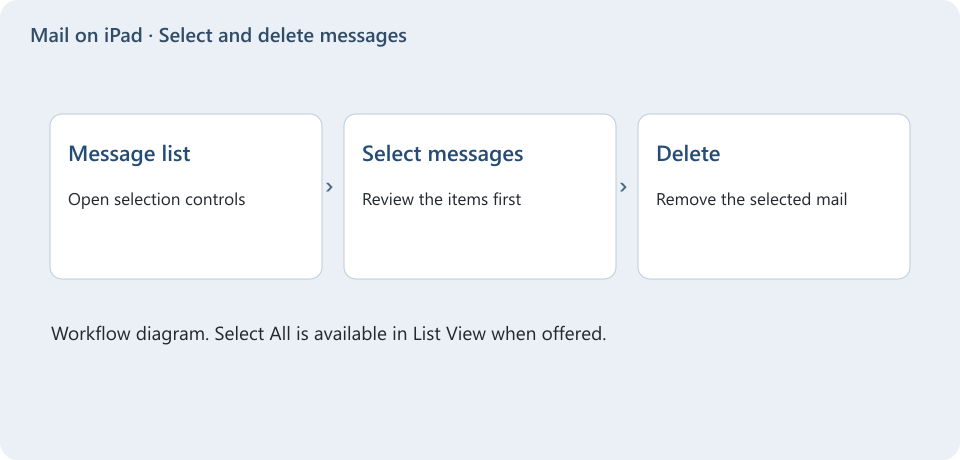
- Open the message selection controls. Tap Edit if it appears, or tap More and choose Select. Review the messages you want to remove, then tap Delete if it is available. If you see Delete All, check that you want to remove every message in the mailbox before using it.
If you have more than one account, Apple says you can add an All Trash mailbox: on the Mailboxes screen tap Edit, then select All Trash. That lets you clear several accounts from one place.
Mail can also empty itself. Go to Settings > Apps > Mail > Mail Accounts, choose an account, then open Mailbox Behaviors (iCloud) or Account Settings > Advanced (other accounts) and pick a Remove interval. Apple notes that iCloud doesn’t keep deleted messages longer than 30 days even if you choose Never.
Empty Recently Deleted in Notes
Apple’s guide to deleting and recovering notes on iPad says deleted notes stay in Recently Deleted for 30 days.
- Open Notes and go to the folder list. Tap the show-folders button if the list is hidden.
- Tap Recently Deleted.
- Swipe left on a note and tap Delete, then confirm with Delete Note.
The folder only appears when it contains something, so if you can’t find it, there’s nothing to clear. Shared notes you don’t own don’t appear there. Notes are rarely large unless they hold scans or video, so this step matters more for privacy than for space.
Empty Recently Deleted in Voice Memos
Apple’s Voice Memos guide for iPad covers this one:
- Open Voice Memos and tap Recently Deleted.
- Tap Edit.
- Tap Delete All, or select single recordings and tap Delete.
Deleted recordings are kept for 30 days by default. To change that, open the Voice Memos setting called Clear Deleted. Apple lists it under Settings > Voice Memos; on newer iPadOS versions that use the Apps list in Settings, look under Settings > Apps > Voice Memos instead.
Things That Look Like Trash but Aren’t
Some cleanup jobs get described as emptying the trash, but they work differently:
- Safari history and website data are not a Recently Deleted folder. Clearing them is a separate process, covered in how to delete history on iPad.
- Messages attachments count under Messages in iPad Storage. They’re managed from that screen or inside the app, not from a trash folder.
- Offloading an app removes the app but keeps its documents and data. Deleting an app removes both. Apple describes the difference on its storage page.
Check Your Storage Afterward
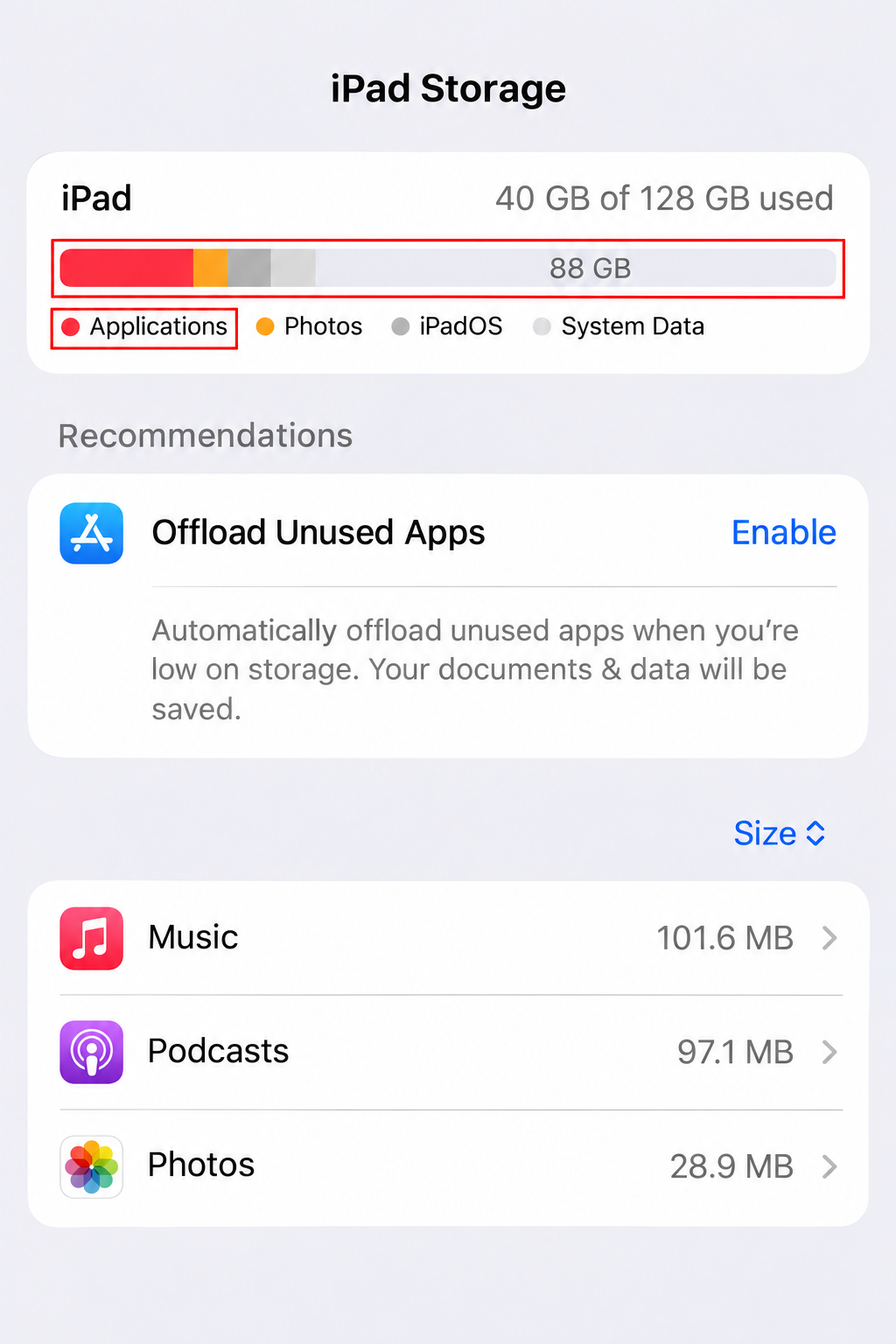
Once the folders are clear, open Settings > General > iPad Storage. Apple’s guide to checking storage on iPhone and iPad explains what the screen shows: a bar split into categories such as Apps, Photos, Media, Mail, Messages, iCloud Drive, Other and System, then recommendations, then a list of apps by size.
If the number didn’t change much:
- Give it a few minutes. The bar is recalculated, and it can lag right after a large delete.
- Look at which category is biggest. If Photos is small and Apps or Messages is large, the trash wasn’t the problem.
- Apple notes that cached and temporary data might not be counted as usage, so the figures won’t always add up exactly.
- If you still need room, try the recommendations on the same screen, or work through clearing iPad storage for larger savings. To see the free-space number on its own, checking how much storage is left on your iPad covers the quick routes.
If You Deleted Something by Mistake
As long as the item is still in Recently Deleted, you can bring it back:
- Photos: open Recently Deleted, tap View Album and confirm with Face ID or Touch ID, tap Select, choose the item, then tap the More button and tap Recover.
- Files: in Recently Deleted, tap the More button, tap Select, choose the file and tap Recover.
- Notes: swipe left on the note and tap Move, then pick a folder.
- Voice Memos: tap Edit, then Recover All, or select one recording and tap Recover.
- Mail: open the message in Trash and use the move button to put it back in your inbox.
Once a folder has been emptied, Apple’s pages give no way to get those items back from the iPad itself. Your only route then is a backup made before the delete.
Common Questions About Deleted Items on iPad
Is There a Trash App on iPad?
No. There’s no system-wide Trash or Bin app. Each app that supports recovery has its own folder, listed in the table above.
Will Emptying Recently Deleted on My iPad Remove Items From My iPhone?
If the items are synced with iCloud (iCloud Photos, iCloud Drive or iCloud notes), yes. A delete on one device applies to all devices signed in to the same Apple Account.
Do These Folders Empty Themselves?
Photos, Files, Notes and Voice Memos clear items after 30 days (Voice Memos lets you change that). Mail follows each account’s Remove setting, and iCloud mail is capped at 30 days.
Why Is the Trash Button Gray in Photos?
Apple says this happens when photos were synced from a computer. Delete them by changing what the computer syncs to the iPad.
Why Didn’t My Free Space Go Up?
The items may still be in another app’s Recently Deleted folder, iCloud items you deleted may not have been stored on the iPad in the first place, or the storage screen hasn’t refreshed. Check the categories in iPad Storage to see where the space is going.
Start with Photos, since it usually holds the most, then check iPad Storage to decide whether the other folders are worth clearing.

Matthew Burleigh is the founder, head writer, and editor of Solve Your Tech, which he launched in 2012. He has written technology tutorials since 2008 and worked in IT since 2003, including small-business support, IT management, and consulting. He holds Bachelor’s and Master’s degrees in Computer Science from Arizona State University.
Matthew writes practical guides for Windows, iPhone and iPad, Microsoft Office, Outlook, Google apps, and Android. Solve Your Tech’s guides are checked step by step against the device or app maker’s own documentation and tested on his own devices whenever he has the hardware or software, with clear steps, sources, and update dates.
Read more about Matthew and how Solve Your Tech writes and updates its guides, or report a correction.