The numbers you see in the message field while typing a green text on your iPhone are a character counter. A reading like 42/160 means you’ve typed 42 characters and a single SMS text holds 160. To hide them, open Settings > Apps > Messages and turn off Character Count. Turn the same switch on if you want the counter back.
These steps are written for iOS 27, and they work the same way in iOS 26 and iOS 18. On iOS 17 and earlier, the Messages settings are directly in Settings > Messages instead of under Apps. The counter only matters for SMS texts, the green bubbles you send to phones that aren’t using iMessage.
What the Counter Is Counting
A standard SMS text message has a fixed size. When your message uses only regular letters, numbers, and common punctuation, one text can hold 160 characters. Spaces and line breaks count too.
When Character Count is on, the iPhone shows two numbers on the right side of the message field, just above the Send button:
- The first number is how many characters you’ve typed so far. It goes up as you type and down as you delete.
- The second number is the limit for one SMS text with the characters you’re using. It’s usually 160.
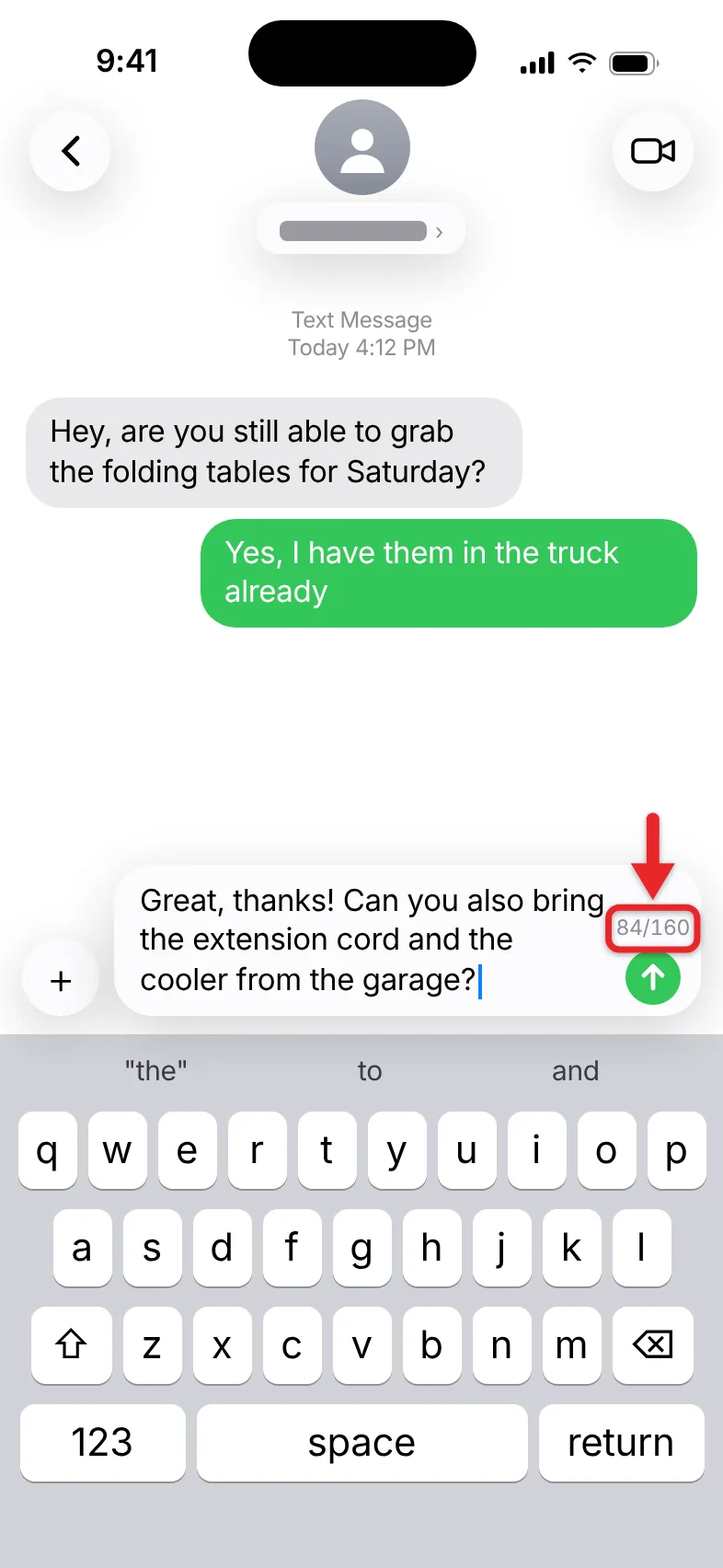
You won’t see the counter right away. It appears once your message wraps onto a second line in the text box, which is when length starts to matter.
Going over the limit doesn’t stop the text from sending. Your message gets split into pieces, called segments, and the recipient’s phone puts them back together into one message. According to Twilio’s explanation of SMS character limits, each piece of a split message holds a little less (153 regular characters) because some space is used to label the parts. That’s why the counter can be useful: if your carrier plan charges per text, or you’re texting someone on an older phone, keeping a message under one segment avoids extra pieces.
Turn the Character Count Off or On
- Open the Settings app on your iPhone.
- Scroll down and tap Apps. A list of your installed apps appears in alphabetical order.
- Tap Messages. You can also type “Messages” in the search bar at the top of the Apps list to find it faster.
- Scroll down to the SMS/MMS section. This group has the settings that only apply to green text messages, such as MMS Messaging and Show Subject Field.
- Tap the Character Count switch. When the switch is gray and slid to the left, the counter is off. When it’s green, the counter is on.
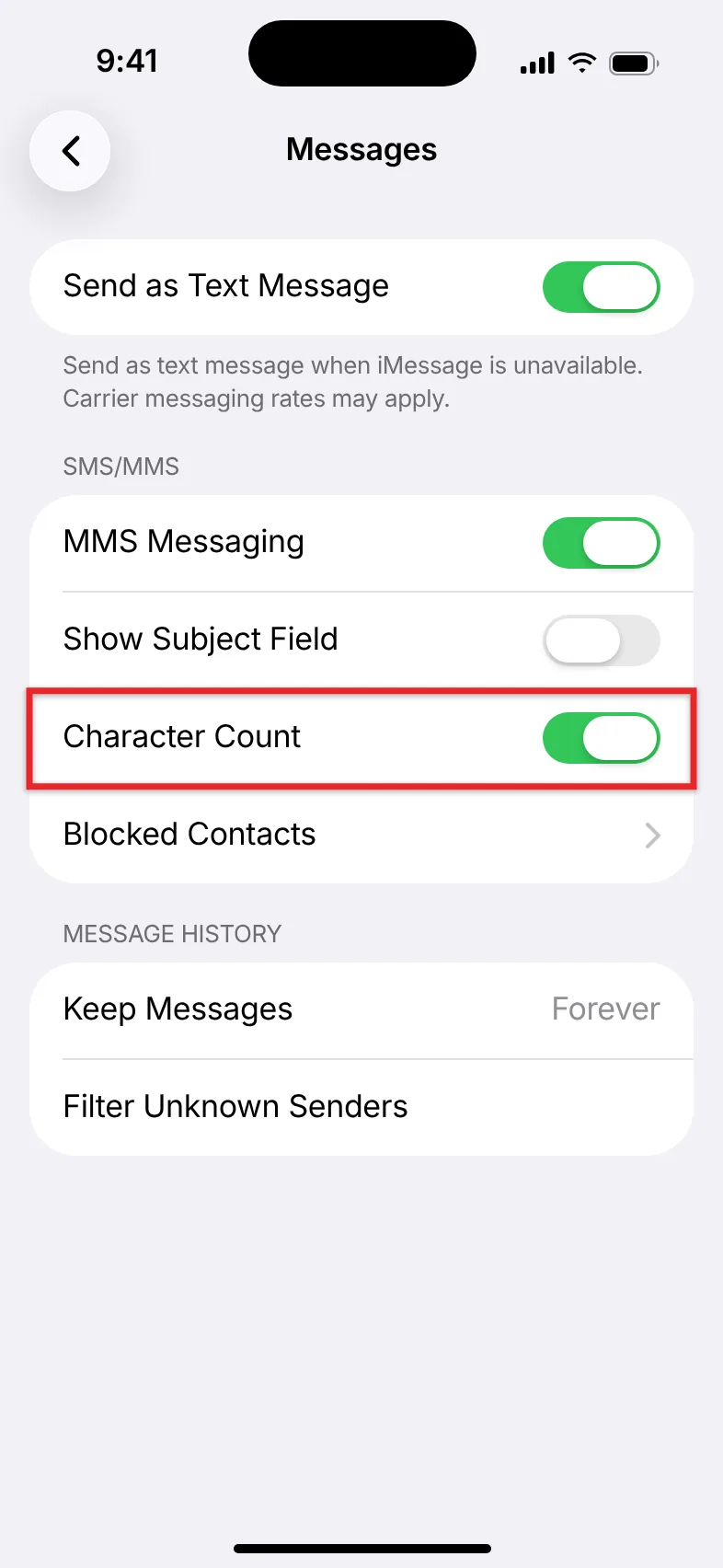
- Go back to Messages, open a conversation with green bubbles, and type a few lines to check. With the setting off, no numbers appear. You can delete the draft without sending it.
The change takes effect right away. There’s no save button, and you don’t need to restart the phone.
On iOS 17 or earlier, the path is Settings > Messages, then scroll to Character Count and tap the switch.
While you’re on this screen, you may notice Show Subject Field just above or near Character Count. If you also see a gray “Subject” line above your messages, here is how to remove the subject line in iPhone Messages with that switch.
If the counter or your messages look too small, you can make text messages bigger on iPhone.
Why the Second Number Changes to 70
If you add an emoji to a text, the counter’s second number can drop from 160 to 70. This isn’t a bug.
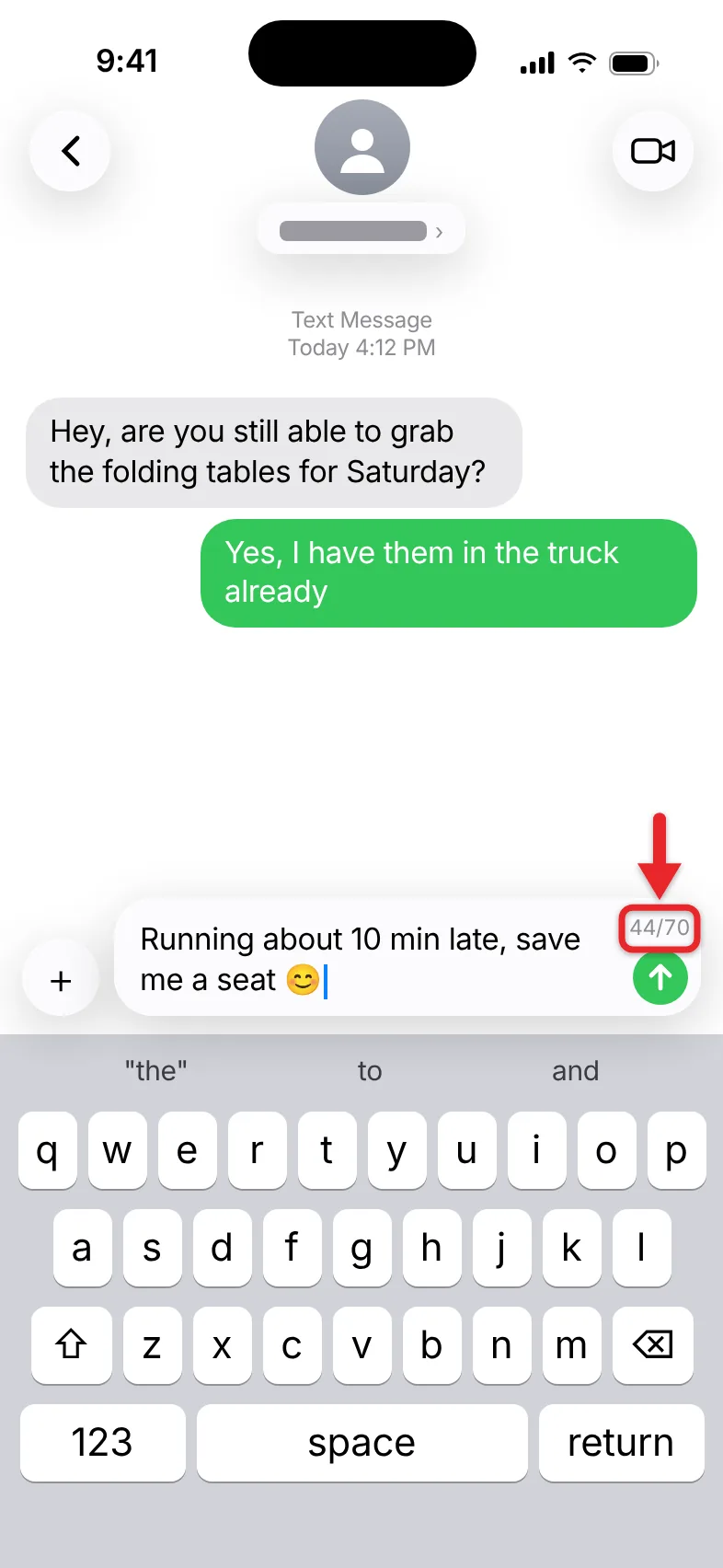
SMS uses a basic character set called GSM-7 for plain English letters, digits, and common symbols. When a message includes even one character outside that set, the entire message switches to a larger encoding called UCS-2 so it can carry the special character. That encoding fits only 70 characters in one text, and 67 per piece once the message is split.
Characters that commonly trigger the switch include:
- Any emoji
- Many accented letters, such as some used in Spanish or French
- Letters from non-Latin alphabets, such as Chinese, Arabic, or Cyrillic
- “Smart” curly quotation marks or apostrophes pasted from a document or webpage
So a 100-character text with one smiley face can turn from one SMS into two. If you want to keep it to one text, remove the emoji and watch the second number go back to 160.
Invisible characters count the same way. The blank character people paste to send an empty text message on an iPhone is outside the basic set, so it also drops the limit to 70.
If you use that blank character often, you can save it as a Text Replacement shortcut instead of pasting it each time.
Why You Only See It on Green Messages
Your iPhone sends messages in three ways, and Apple’s comparison of iMessage, RCS, and SMS/MMS explains how each one works:
- iMessage (blue bubbles) goes between Apple devices over the internet. It doesn’t have the 160-character SMS limit, so the counter doesn’t appear in these conversations.
- RCS (green bubbles) is used with many Android phones when your carrier supports it on iOS 18 or later. RCS is also sent over data and isn’t built around the 160-character limit.
- SMS/MMS (green bubbles) is the older carrier text service. This is where the counter applies.
Since RCS and SMS both show green bubbles, a green conversation doesn’t always mean you’re sending SMS. If you want to know more about what the colors mean, read about blue vs. green text messages on iPhone.
If the Counter Doesn’t Show Up or Won’t Go Away
- You can’t find Character Count. Make sure you’re in Settings > Apps > Messages and scroll down past the iMessage options to the SMS/MMS heading. The switch is in that group.
- The setting is on, but you don’t see numbers. Type enough to fill more than one line in the text box. Also check whether the conversation is blue (iMessage), since the counter is for SMS texts.
- Numbers appear in a conversation with another iPhone user. That person’s messages are going out as green texts, often because iMessage is off on one of the phones or one of you has no data connection. The steps for turning on iMessage on iPhone cover the setting and common activation problems.
- The counter is still there after you turned it off. Close the conversation and open it again. If the numbers are still there, go back to the setting and make sure the switch is gray.
- The limit says 70 for a short, plain message. Look for an emoji, an accented letter, or a curly quote, including one pasted at the end of the text. Removing it brings the limit back to 160.
Message Field Number Questions
What does 160 mean in an iPhone text message?
It’s the number of plain characters that fit in one SMS text. The number before the slash is how many characters you’ve typed so far.
Will my text fail to send if I go over 160 characters?
No. The iPhone sends it anyway, and the message is split into smaller pieces that the other phone shows as a single message. Some carrier plans count each piece as a separate text, so check your plan if you pay per message.
Does the character count work for iMessage?
No. iMessage doesn’t have the SMS length limit, so the counter only appears when you’re composing SMS texts.
Is Character Count on by default?
No. It’s off on a new iPhone, so if you’re seeing the numbers, the switch was turned on at some point in Settings > Apps > Messages.
Does turning off Character Count change how my messages are sent?
No. It only hides the numbers. Your texts are sent the same way whether the counter is on or off.

Matthew Burleigh is the founder, head writer, and editor of Solve Your Tech, which he launched in 2012. He has written technology tutorials since 2008 and worked in IT since 2003, including small-business support, IT management, and consulting. He holds Bachelor’s and Master’s degrees in Computer Science from Arizona State University.
Matthew writes practical guides for Windows, iPhone and iPad, Microsoft Office, Outlook, Google apps, and Android. Solve Your Tech’s guides are checked step by step against the device or app maker’s own documentation and tested on his own devices whenever he has the hardware or software, with clear steps, sources, and update dates.
Read more about Matthew and how Solve Your Tech writes and updates its guides, or report a correction.