To stop Norton 360 from blocking a program’s internet access on Windows, open Norton, click Security, go to Advanced Security > Network > Smart Firewall, open the Program Control tab, select the program, and set Network access to Allow. If Norton is quarantining or deleting the program instead, restore it from Security History and add a scan exclusion for that one file.
These steps follow Norton’s current support pages for the Norton 360 app on Windows, the version with a menu down the left side of its window. Separate sections cover the older Norton window, Norton 360 for Mac, and websites that Norton blocks. Only allow a program you trust, and never treat turning Norton off as the fix.
Before You Change Anything
- Sign in to Windows with an administrator account. Norton says some settings appear grayed out for standard accounts.
- Run LiveUpdate. Open Norton and run LiveUpdate until it reports nothing left to install. New definitions sometimes clear a mistaken block without any rule changes.
- Check where the program came from. Allow it only if you downloaded it from the developer’s own website or the Microsoft Store and you meant to install it. If you aren’t sure, leave the block in place and scan the file first. Norton can scan an individual file before you decide.
Figure Out What Norton Is Blocking
Norton can block a program in two different ways, and each one has its own fix.
- The firewall is blocking its connection. The program opens, but it can’t sign in, update, sync, or find other devices on your network. You may have seen a firewall alert asking whether to allow or block it, and someone picked Block. The fix is a Program Control rule.
- Antivirus protection is removing it. The program won’t start, its file disappears, or Norton reports that it removed or quarantined a threat. Auto-Protect (Norton’s real-time file scanner), Behavioral Protection (which watches how programs act, and was called SONAR in older versions), and Download Intelligence (its check on new downloads) work this way. The fix is to restore the file and add an exclusion.
If you aren’t sure which applies, open Security History from the Security dashboard and look for the program’s name around the time you ran it. A quarantine entry means antivirus protection acted. If there’s nothing there and the program runs but can’t connect, start with the firewall.
Allow a Program Through the Smart Firewall on Windows
These steps match Norton’s Smart Firewall settings article.
- Open Norton 360 from the Start menu, or double-click the yellow Norton icon in the notification area at the right end of the taskbar. If you don’t see it, click the up arrow to show hidden icons.
- Click Security in the left pane. The Security dashboard opens.
- Go to Advanced Security > Network > Smart Firewall. The Smart Firewall window opens with tabs across the top, including General, Program Control, and Traffic Rules.
- Click the Program Control tab. You’ll see the programs on your PC that have firewall rules.
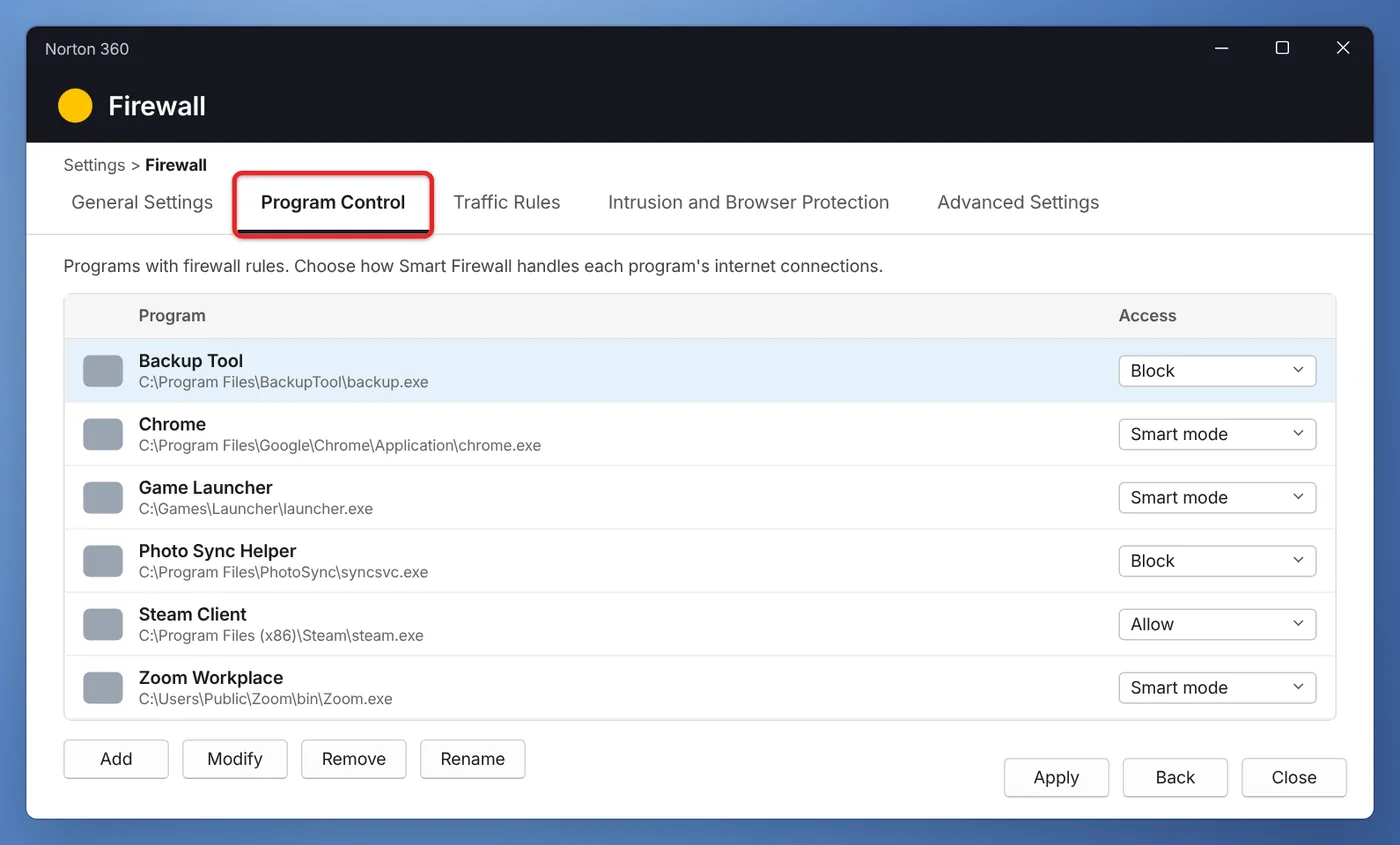
- Select the program that’s being blocked. It’s usually listed under the same name you see in the Start menu.
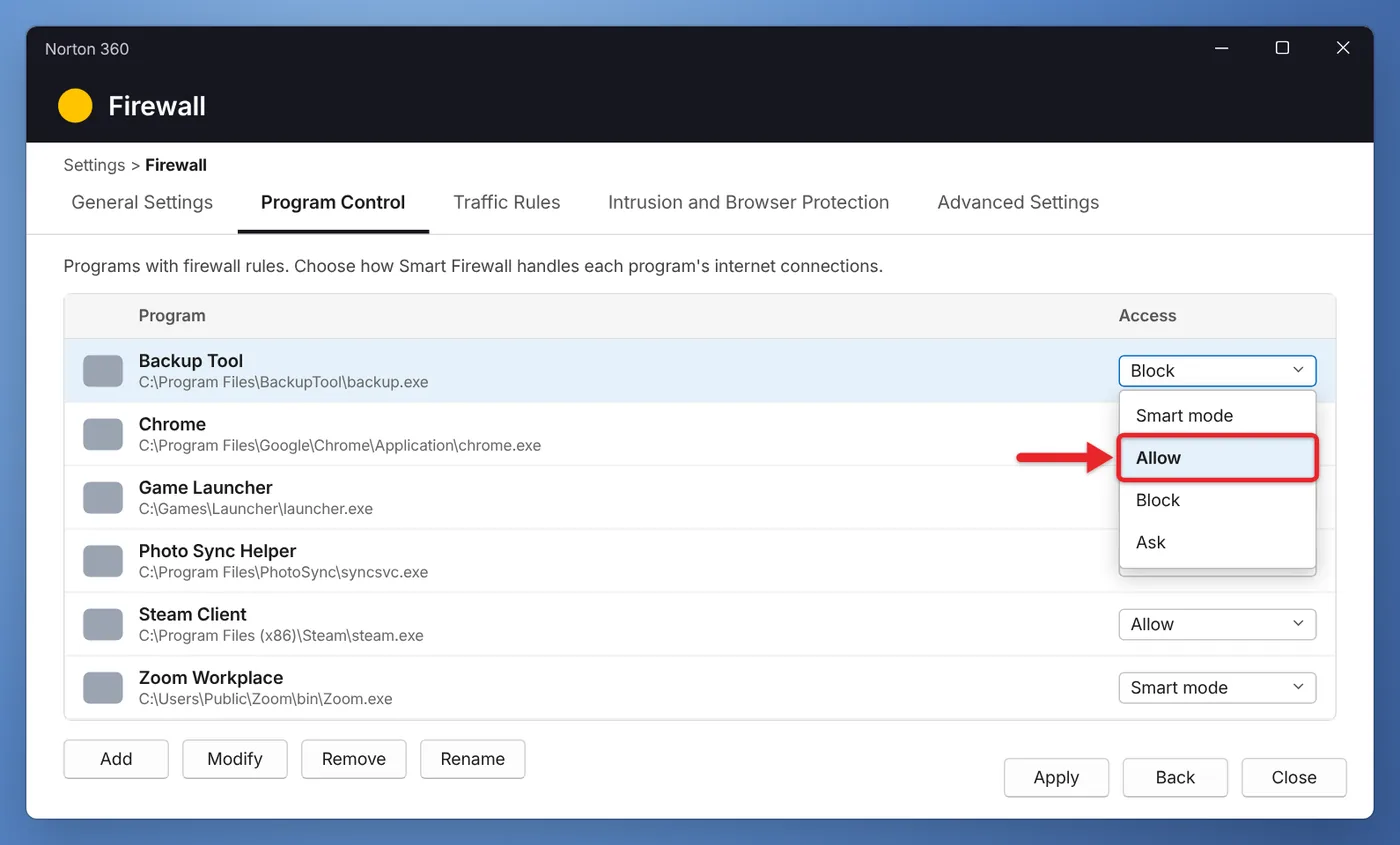
- Open the Network access drop-down list and choose Allow. The program can now make any connection it tries.
- Close the Smart Firewall window and restart the program you just allowed so it can open a fresh connection.
The Network access list has three choices:
| Choice | What Norton does |
|---|---|
| Allow | Lets every connection attempt from the program through. |
| Block | Stops every connection attempt from the program. |
| Ask | Shows an alert each time the program tries to connect, so you choose. |
Some versions also show an automatic choice, such as Smart mode, where Norton decides based on how it rates the program. If you aren’t sure you trust a program yet, Ask lets you answer each connection alert case by case.
Add a Program That Isn’t in the List
Norton creates a rule the first time a web-enabled program runs, through a feature called Automatic Program Control on the General tab. A program that has never connected, or a portable app you run from a USB drive, may not appear yet.
- On the Program Control tab, click More.
- Choose Allow new app.
- Browse to the program’s .exe file, usually in a folder under C:\Program Files or C:\Program Files (x86), and select it. Pick the program file itself, not a shortcut.
- Confirm the new rule. The program now appears in the list with its access set to Allow.
If you want finer control, such as allowing only outbound traffic or only on your home network, click the add icon and choose Add app rule on the same tab. It lets you set the action, the direction, the protocol, and the network type, then click Save.
Stop Norton from Quarantining or Deleting a Program
When antivirus protection is the problem, changing the firewall won’t help. Restoring a file from Quarantine is a high security risk, and Norton does not repair a file it restores. Only do this for a program you got from its official source and are confident is safe.
Restore the File
These steps follow Norton’s article on acting on quarantined risks.
- In Norton, click Security in the left pane, then click Security History.
- In the Recent History drop-down list, choose Quarantine.
- Select the program’s file. Open Advanced details and check File Insight to see where the file came from and how widely it’s used.
- Click the action icon next to the item and choose Create exception & restore. Click Yes if Norton asks you to confirm. The file goes back to its original folder and is excluded from future scans.
The same menu has three other choices. Restore puts the file back without an exception, and Norton offers it only for items that were quarantined manually. Restore as lets you pick a different folder. Send for analysis sends the file to Norton if you think it was flagged by mistake, without restoring it. For more on this screen, read about viewing quarantined files in Norton 360.
Exclude Only What You Need
An exclusion means Norton’s Auto-Protect and Behavioral Protection scans skip that item, so keep it as small as you can. Exclusions reduce your computer’s protection and should only be used for items you’re confident are not infected. The steps come from Norton’s article on excluding files and folders from scans.
- Click Security in the left pane.
- In the Scans tile, click Open.
- Click the Exclusions tab.
- Click Add (or Add Exclusion), then click the browse icon in the Add Exclusion window.
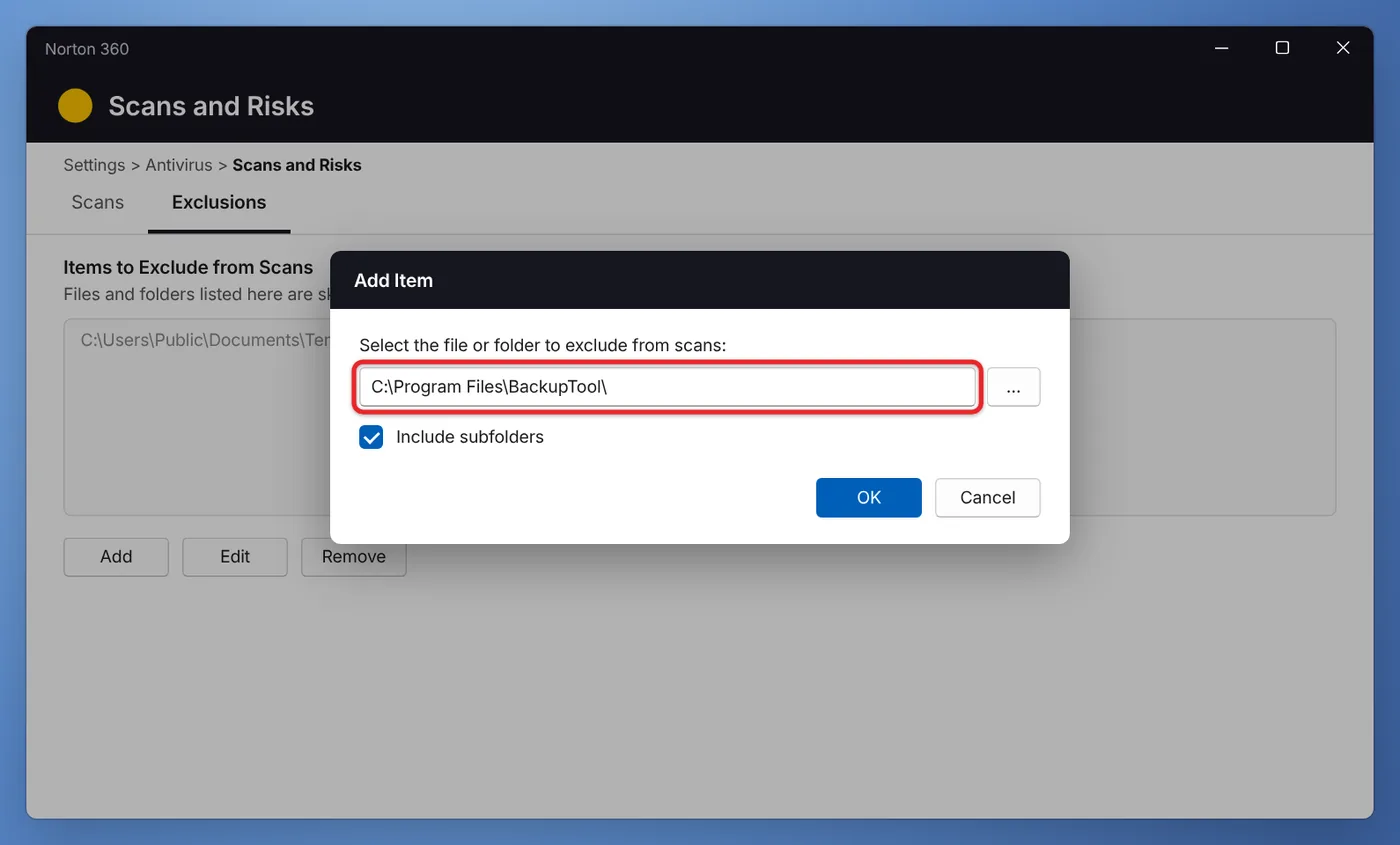
- Select the program’s .exe file and click OK. Select its folder instead only if the program keeps getting flagged after each update, for example a game launcher or a program you compile yourself. Never exclude a whole drive, the Windows folder, or your Downloads folder.
- Click Add. The item now appears in the Exclusions list. Click the X next to it any time you want to remove the exclusion.
If you write software and Norton blocks your builds, exclude only the project’s output folder, not every folder on the drive.
If Download Intelligence keeps stopping a trusted installer, Norton’s tip is to add an empty folder to the Exclusions list and download the installer into that folder. Remove that exclusion after the program is installed.
Report a False Positive to Norton
A false positive is a safe file that Norton flags as a threat. Reporting it lets Norton fix the detection, so you may not need an exclusion after a later update.
- Note the detection name and the Alert ID shown at the bottom of Norton’s alert.
- Open the false positive form on the Norton Submission Portal, choose file, and enter your email address, the detection name, the Alert ID, and a short description.
- Upload the file in a ZIP or RAR archive without a password (one sample, under 500 MB), complete the check, and submit.
Norton’s article on reporting a suspected incorrect detection has the details.
If You Need to Turn Protection Off Briefly
Norton has a temporary switch for troubleshooting. Use it only to confirm that Norton is the cause, and only for a program from a source you trust. An Allow rule or a single-file exclusion is the lasting fix.
- Right-click the Norton icon in the notification area.
- Choose Disable Auto-Protect or Disable Firewall, depending on which one you’re testing.
- In the Security Request window, pick the shortest time in the Select the duration list and click OK.
- Try the program once.
- Right-click the Norton icon again and choose Enable Auto-Protect or Enable Firewall. Norton also turns the feature back on by itself when the time runs out.
Norton’s article on temporarily turning off protection warns that this leaves your computer vulnerable to attacks. If the program works only while protection is off, go back and add the matching rule or exclusion above instead of leaving Norton disabled.
Older Norton 360 Window (Settings > Firewall)
If your Norton window has a My Norton screen or a Settings link along the top instead of a left-side menu, you have an older version. Norton has announced end of life for version 22 and earlier, so update through LiveUpdate or reinstall from your Norton account when you can. Until then, the program rules are in a different place:
- Open Norton. If the My Norton window appears, click Open next to Device Security.
- Click Settings at the top of the main window.
- Click Firewall.
- Click the Program Control tab. Some versions label it Program Rules.
- Find the program in the Program column, open the drop-down list next to it, and choose Allow. The other choices include Block and Custom, and some versions also show Auto.
- Click Apply, then close the window.
Allow an App in Norton 360 for Mac
On a Mac, the firewall has two lists: Application Blocking controls which apps can reach the internet, and Connection Blocking controls specific connections. These steps follow Norton’s Mac internet access article, which suggests running LiveUpdate first.
- Open Norton. If the My Norton window appears, click Open next to Device Security.
- Click Settings (or Advanced in some versions).
- Click Firewall in the left pane.
- Click the tools icon next to Application Blocking.
- Select the app in the list and set its access to allow.
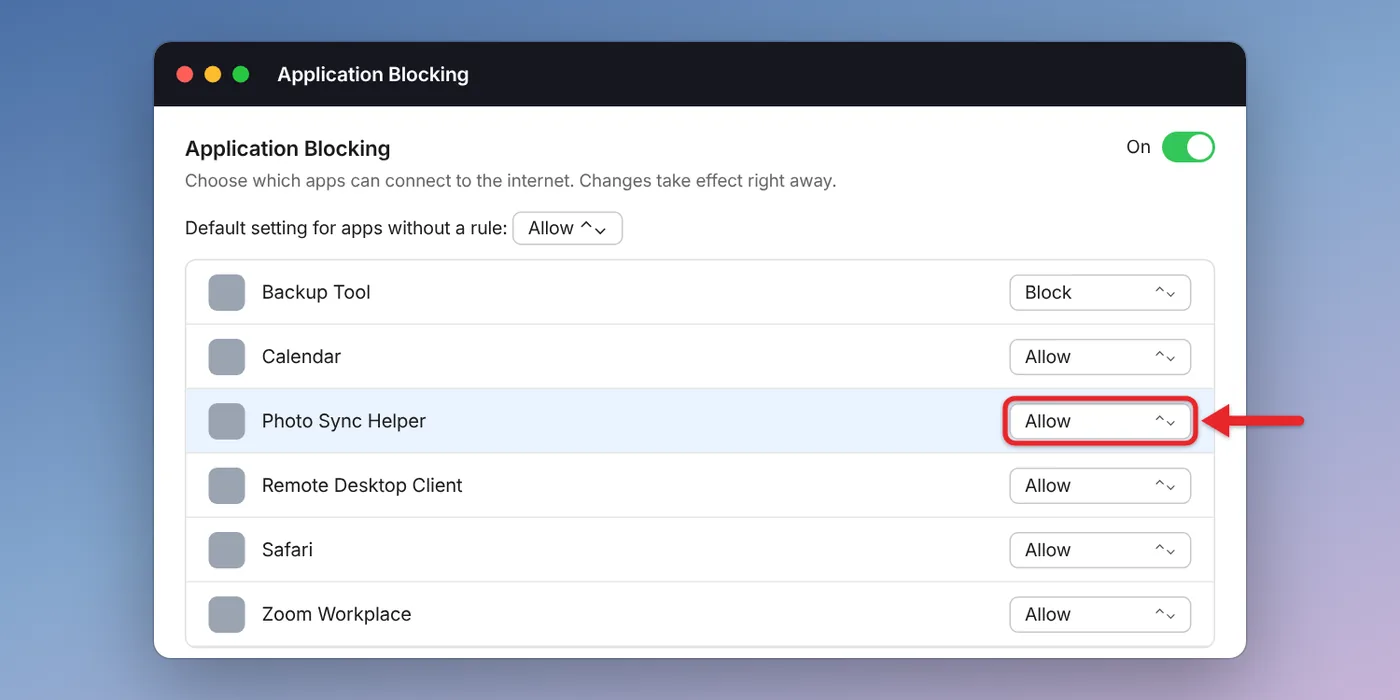
- If the app isn’t listed, click Add Application, select it (use Other if you need to find it), click Choose, and click Done. New apps are set to allow by default.
- If the app still can’t connect, go back to the Firewall settings, click the tools icon next to Connection Blocking, and set the app to allow there too.
If Norton Blocks a Website Instead
Websites are handled by Norton Safe Web, not the firewall. For a site you know is safe, go to Security > Advanced Security > Web > Safe Web, open the Blocked Websites tab, and click the X next to it, as described in Norton’s Safe Web article.
If the Program Is Still Blocked
- You changed the wrong entry. Many programs use a helper or updater with a different name, such as a separate “Updater” or “Service” file. Check the Program Control list for every entry from the same company and allow the one that’s actually connecting.
- The rule changed after an update. Some Norton users have reported Program Control rules changing after a product update. Recheck the Program Control tab after Norton updates and fix the rule if needed.
- A traffic rule is overriding it. Rules on the Traffic Rules tab apply to all programs and can still block a port or address your program needs. Only advanced users, or users working with Norton support, should change these, and the default traffic rules are locked.
- It’s a game or app that finds devices on your network. Make sure your home network isn’t marked as public. To check network trust levels, read about Norton 360 firewall settings.
- Another security app is the real blocker. If allowing the program in Norton changes nothing, check whether a second antivirus or firewall product is installed, and look at its settings too.
- Norton blocked another computer, not a program. If a device on your network lost access, go to Smart Firewall > General > Additional settings > Manage devices and click Unblock next to its IP address, then OK.
- The alert names a feature you can’t find. Use Send for analysis in Quarantine, or contact Norton support with the program name, the file path, and the time of the alert.
Norton Program Blocking Questions
Is it safe to allow a program through the Norton firewall?
It’s reasonable for software you installed on purpose from the developer’s own website or the Microsoft Store. Allowing a program only changes what it can send and receive over the network. It doesn’t stop Norton from scanning it, so Auto-Protect still watches the file unless you also excluded it.
Can I turn off the Norton firewall or Auto-Protect instead?
Only briefly, as a test. Turning a feature off removes protection for every program, so an Allow rule or a single-file exclusion is the better fix.
Why doesn’t my program appear on the Program Control tab?
A program is added to the list the first time it tries to connect. Use More > Allow new app to add it yourself, or open the program once and check the list again.
Will Norton block the program again after it updates?
It can, because an update replaces the program’s files. If that keeps happening with a trusted program, report the false positive and consider excluding the program’s own folder.
How do I undo an exclusion or an Allow rule?
For a firewall rule, set Network access back to its earlier choice or delete the rule with the X icon. For an exclusion, open Security > Scans > Open > Exclusions and click the X next to the item.
Next step: once the program works, open Security History in a day or two and confirm that Norton hasn’t flagged it again.

Matthew Burleigh is the founder, head writer, and editor of Solve Your Tech, which he launched in 2012. He has written technology tutorials since 2008 and worked in IT since 2003, including small-business support, IT management, and consulting. He holds Bachelor’s and Master’s degrees in Computer Science from Arizona State University.
Matthew writes practical guides for Windows, iPhone and iPad, Microsoft Office, Outlook, Google apps, and Android. Solve Your Tech’s guides are checked step by step against the device or app maker’s own documentation and tested on his own devices whenever he has the hardware or software, with clear steps, sources, and update dates.
Read more about Matthew and how Solve Your Tech writes and updates its guides, or report a correction.