To allow Google Chrome through the Norton 360 firewall on Windows, open the Norton app, click Security, go to Advanced Security > Network > Smart Firewall, open the Program Control tab, select Google Chrome, and set its Network access drop-down to Allow. If Chrome is not in the list, click More and choose Allow new app.
Those labels come from Norton Support’s current article on configuring Smart Firewall settings. The rest of this guide walks through each step, covers older Norton 360 windows that look different, and explains what to check when Chrome still will not load pages afterward.
Before You Change the Firewall Rule
A firewall is security software that uses rules to allow or block connections between your computer and the internet. Norton’s firewall is called Smart Firewall, and it keeps a separate rule for each program that goes online.
- What this covers: the Norton 360 app on Windows. Norton lists its Smart Firewall instructions as applying to Windows, so the Mac app is not covered here.
- What you need: Norton 360 installed and open, and Google Chrome installed on the same PC.
- What it changes: only how Norton treats Chrome’s network connections. It does not turn the firewall off, and it does not change Norton’s website warnings.
- When to use it: Chrome cannot reach any website, other programs on the same PC can get online, and Norton is the likely cause.
A caution first. Change firewall rules only when it is really necessary, because Smart Firewall normally sets the right rule by itself. Norton also says it blocks an infected program from going online no matter how the firewall is configured. If Norton shows an alert saying Chrome was blocked as a threat, do not override it. Check that Chrome came from Google, and reinstall it if you are unsure. You can confirm the browser is current by checking your Google Chrome version.
How to Allow Chrome in the Current Norton 360 App
These steps match the redesigned Norton 360 app for Windows, the one with a menu down the left side of the window.
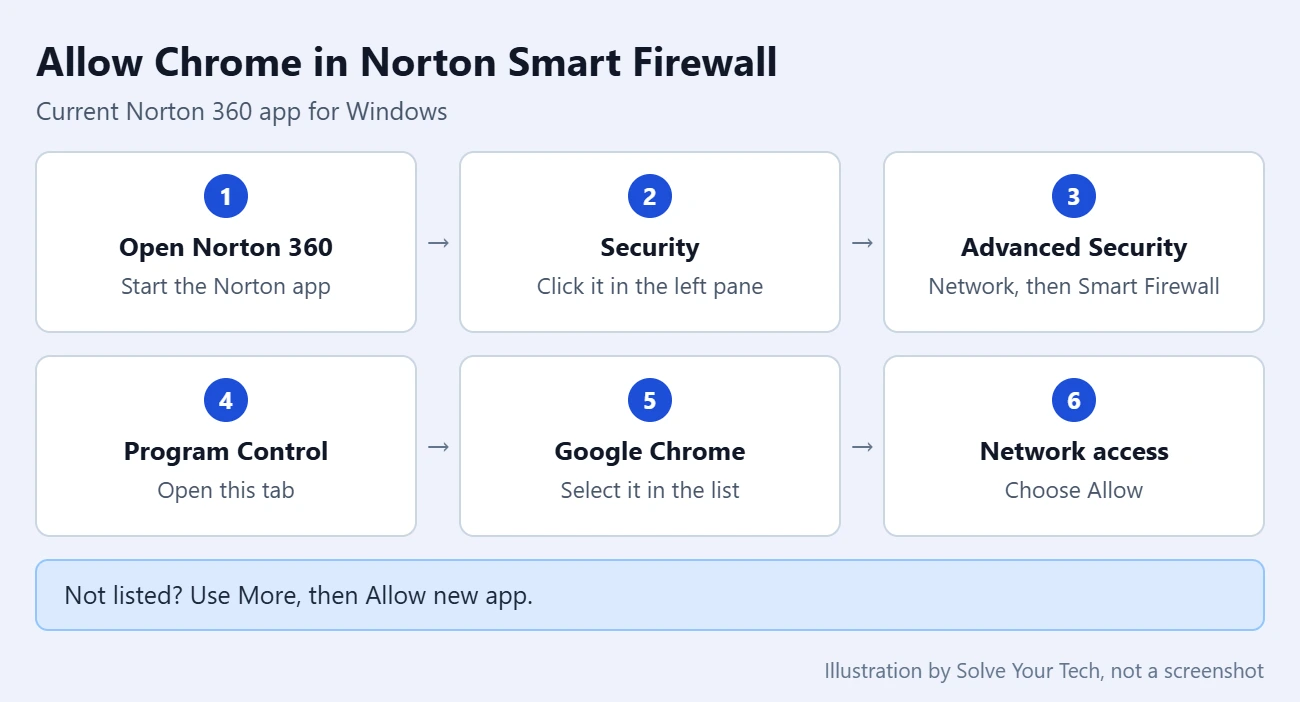
- Open Norton 360. Start it from the Start menu, or use the Norton icon in the notification area at the right end of the taskbar.
- Click Security. It is in the pane on the left side of the Norton window.
- Go to Advanced Security > Network > Smart Firewall. The Smart Firewall window opens with several tabs across the top.
- Click the Program Control tab. This tab lists the programs that have tried to use the network. For each one you can see its name, trust level, internet usage, and network access setting.
- Select Google Chrome. Scroll through the list to find it. If the list is long, the Filter option lets you narrow which programs are shown.
- Open the Network access drop-down list and choose Allow. This option allows all access attempts by the program.
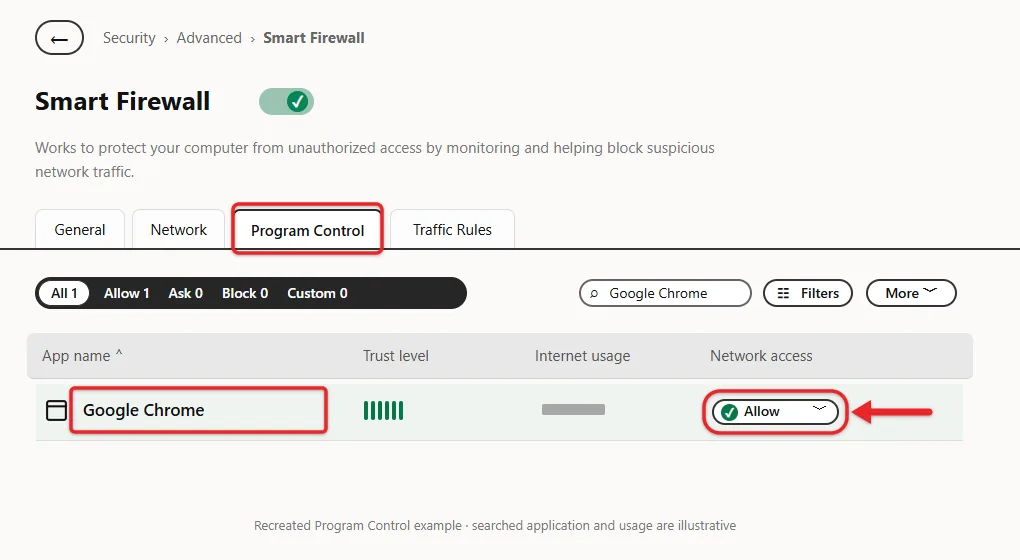
- Close the Smart Firewall window, then open Chrome and load a website. A page that loads normally means the rule is working.
If you see more than one Google Chrome entry in the list, check each of them. One blocked entry can be enough to keep the browser offline.
What the Network Access Options Mean
| Option | What Norton does | When it fits |
|---|---|---|
| Allow | Allows all access attempts by the program. | A browser you installed yourself and trust. |
| Block | Denies all access attempts by the program. | A program you never want online. This is the setting to change if Chrome is stuck on it. |
| Ask | Requests your permission when the program accesses the internet. | A program you want to approve case by case. |
If Chrome Is Not in the Program Control List
A program is added to Program Control the first time it tries to connect to the internet or another network. A copy of Chrome that has never tried to connect has no rule yet, so it does not appear.
- Follow the steps above to reach the Program Control tab.
- Click More.
- Select Allow new app. The other choice in that menu, Block new app, denies all access attempts, so make sure you pick the right one.
- Choose Google Chrome when Norton asks which program to add. Chrome’s program file is named
chrome.exe.
On most Windows PCs, chrome.exe is in C:\Program Files\Google\Chrome\Application. To see the exact location on your PC, type chrome://version in Chrome’s address bar and read the Executable Path line.
If Your Norton 360 Window Looks Different
Norton has been moving its Windows and Mac customers to a redesigned app in groups. According to Norton’s page about the new Norton 360 app, existing custom settings are carried over during the upgrade, a restart may be needed before the new design appears, and going back to the previous version is not possible.
If your Norton window has a Settings link on the main screen and no Security pane on the left, you are probably still on the older design. Norton’s current help pages no longer document that layout, so treat these steps as a guide and expect some labels to differ:
- Open Norton 360. If a My Norton window appears, click Open next to Device Security.
- Click Settings.
- Click Firewall. Some versions label it Network.
- Open the tab that lists your programs. It has been called Program Rules in early Norton 360 releases and Program Control in later ones.
- Find Google Chrome, open the drop-down menu beside it, and choose Auto or Allow.
- Click Apply, then close the window.

The picture above shows one of the earliest Norton 360 designs. If you are on a release that old, letting Norton update itself is the more reliable fix, because the current app is the one Norton supports and documents. The same older layout appears in the fix to stop Norton from blocking a program, which applies to any application and not just Chrome.
How to Confirm the Change and Undo It
Confirm it: return to Security > Advanced Security > Network > Smart Firewall > Program Control and check that the Network access setting for Google Chrome reads Allow. Then open Chrome and visit two or three different websites. If Norton prompts you to restart the computer at any point, do that before testing.
Undo it: go back to the same drop-down list and pick Ask or Block. To throw away every firewall change you have made, the General tab of the Smart Firewall window includes a Restore default settings option. This resets any changes you made to the Smart Firewall settings, which includes rules for programs other than Chrome.
Be careful with Remove app. The menu for a program in Program Control includes a Remove app command. It removes the program from Program Control along with all of the rules tied to it. That does not uninstall Chrome, but it does erase the rule you just set.
Chrome Still Will Not Load Pages
If the setting already says Allow, or changing it made no difference, work through these checks in order.
Look for a Blocking Rule Inside the Chrome Entry
Each program in Program Control can hold several individual rules, and each rule has its own action: Smart mode, Allow, Block, or Ask. Open the Chrome entry and look for a rule whose action is Block. You can switch a rule off with the slider next to it, edit it with the pencil icon, or delete it with the X icon. Norton processes the rules inside one program entry from top to bottom, so a Block rule near the top wins over an Allow rule below it.
Check the Traffic Rules Tab
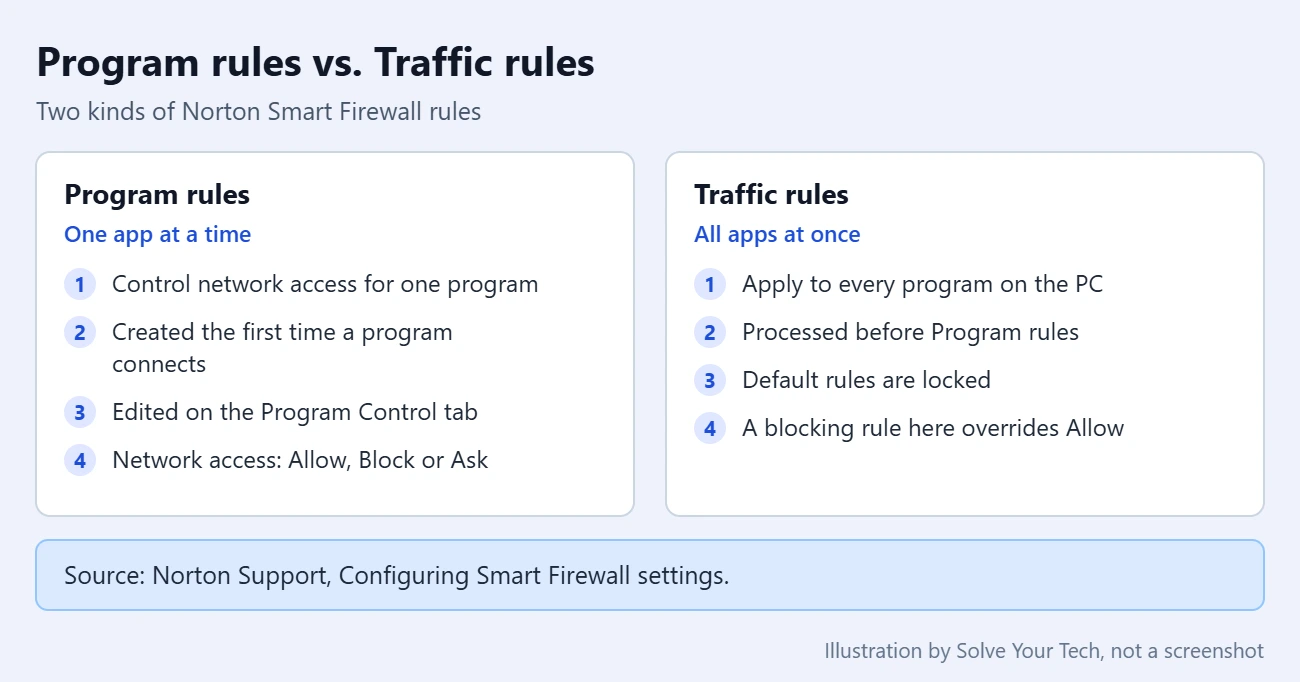
Smart Firewall uses two kinds of rules. Program rules apply to one program. Traffic rules apply to every program on the PC, and Norton processes them first. Norton’s own example is a Traffic rule that blocks TCP communication on port 80: the browser cannot get online even though its Program rule allows it.
The default Traffic rules are locked and cannot be edited, so look only at rules that you or another program added. Secure websites normally use remote port 443, the default port for HTTPS, so a custom rule blocking that port would stop most browsing. Norton’s guidance is that only advanced users, or people following its support team’s directions, should change Traffic rules. Turning a custom rule off with its slider is safer than deleting it.
Rule Out Safe Web
If Chrome opens some sites but Norton stops others, the firewall is probably not the cause. Safe Web is the Norton feature that blocks websites it considers malicious or deceptive. Norton’s article on being unable to access websites after installing the Norton 360 app suggests turning Safe Web off and back on:
- Open Norton 360 and click Security.
- Go to Advanced Security > Web > Safe Web.
- Switch off Safe Web and click Disable in the confirmation window.
- Wait a few seconds, switch it back on, and try the website again.
The same article points to separate fixes for the Norton Safe Web browser extension, Norton VPN, and the Norton AntiTrack extension, since any of them can stop a specific site from loading. Only do this for a website you are confident is safe.
If websites load but Norton stops a program you download, that comes from a different feature. Follow the steps for Norton Download Intelligence blocks instead.
Read the Firewall History
The Smart Firewall settings include a Smart Firewall activity history option that opens Norton’s Security History window. It lists what Norton did to protect the PC, so an entry naming Chrome at the time the browser failed is good evidence that Norton was involved. No entry at all suggests the cause is somewhere else.
Check Chrome and Your Connection
Google’s help page on how to fix connection and loading errors in Chrome lists firewall or antivirus software as only one of several possible causes. Its other steps include checking the internet connection, updating and restarting Chrome, trying the site in Incognito mode, disabling extensions, deleting browsing data, and resetting Chrome settings. If the site works in Incognito mode, an extension or stored data is the likelier culprit. You can remove a Chrome extension or reset Chrome to its default settings to test that.
If only Google’s own pages fail to load, work through this checklist for when Google is not working.
Leave Automatic Program Control on Smart Mode
On the General tab, Automatic Program Control decides how Norton treats programs it has not seen before. Its choices are Smart Mode, Block, Allow, and Ask. If someone set it to Block, newly installed programs are denied internet access until you add a rule for them. Smart Mode is the recommended choice: Norton decides automatically and does not show firewall alerts for programs it recognizes as safe.
Frequently Asked Questions
Do I have to turn off the Norton firewall to use Chrome?
No. Setting the Network access option for Google Chrome to Allow in Smart Firewall’s Program Control tab affects Chrome only. The firewall stays on for every other program and for incoming connections, which is why this is a better fix than switching Smart Firewall off.
Why did Norton block Google Chrome in the first place?
Norton does not publish a single reason. Smart Firewall creates a rule the first time a program connects, and that rule can end up as Block if someone chose Block in a firewall alert, if Automatic Program Control was set to Block, or if Norton did not recognize that copy of the program as safe. A custom Traffic rule can also stop a browser even when its Program rule says Allow.
Is it safe to set Chrome to Allow in Norton?
For a genuine, up-to-date copy of Chrome it is a normal setting, since a browser cannot do its job without internet access. The risk is in allowing a program you do not recognize. Even so, change firewall rules only when necessary; Norton continues to block programs it identifies as infected regardless of this setting.
What is the difference between Allow and Ask in Norton Program Control?
Allow lets every connection attempt by the program go through without a prompt. Ask makes Norton request your permission when the program accesses the internet. Ask gives you more control, but it is impractical for a browser that connects constantly.
Will allowing Chrome in the firewall unblock a website Norton is warning me about?
No. Website warnings come from Norton Safe Web and related web protection features, not from the Program Control rule for Chrome. A firewall rule controls whether the Chrome program may use the network at all. It does not decide which individual sites are considered safe.
Does this work for other browsers and programs?
Yes. Program Control lists every program that has tried to use the network, so the same Network access drop-down list works for Microsoft Edge, Firefox, games, and other software. Norton’s Smart Firewall overview explains how these Program rules are created and managed.
Next Step
Once Chrome is back online, leave the rest of the Smart Firewall settings alone unless another program has the same problem. The overview of Norton 360 firewall settings covers the other options in that window, and if you also use Norton’s cloud backup, the Norton backup settings tutorial shows how to control it. You can also change the default browser in Windows 11 so it opens your links.

Matthew Burleigh is the founder, head writer, and editor of Solve Your Tech, which he launched in 2012. He has written technology tutorials since 2008 and worked in IT since 2003, including small-business support, IT management, and consulting. He holds Bachelor’s and Master’s degrees in Computer Science from Arizona State University.
Matthew writes practical guides for Windows, iPhone and iPad, Microsoft Office, Outlook, Google apps, and Android. Solve Your Tech’s guides are checked step by step against the device or app maker’s own documentation and tested on his own devices whenever he has the hardware or software, with clear steps, sources, and update dates.
Read more about Matthew and how Solve Your Tech writes and updates its guides, or report a correction.