To turn on Screen attention on a Google Pixel 4a, open Settings, tap Display & touch (just Display on older Android versions), tap Screen timeout, and turn on Screen attention. Your screen then stays on while you’re looking at it, even after the normal screen timeout runs out.
Google lists Screen attention as a feature of the Pixel 4 and later Pixel phones, so it works on the Pixel 4a. Below are the current steps, how to change the timeout itself, what to try if the screen still turns off, and the older Android 11 steps with screenshots.
How to Turn On Screen Attention
- Open the Settings app.
- Tap Display & touch. If you don’t see it, tap Display.
- Tap Screen timeout.
- Turn on Screen attention.
Result: The Screen attention switch shows as on, and the screen stays lit while you’re looking at it. When you look away, the screen goes dark on its normal timeout schedule.

These steps follow Google’s Pixel display settings help page, which lists Screen attention under Screen timeout.
Change How Long the Screen Stays On
Screen attention only matters once your screen timeout runs out, so it helps to set a timeout you’re comfortable with.
- Open Settings.
- Tap Display & touch (or Display).
- Tap Screen timeout.
- Choose how long the phone waits before the screen goes dark.
Result: The screen turns off after the time you picked when you aren’t using it, unless Screen attention sees you looking at it.

Google also describes an Adaptive timeout option in the same Screen timeout menu, which turns the screen off early when you’re not using the phone. If your Pixel shows it, you can use it alongside Screen attention. The same Display menu also holds the rotation setting, covered in how to enable or disable auto-rotate on a Google Pixel 4a.
If Screen Attention Doesn’t Keep the Screen On
- Check the lighting. Google says Screen attention works best when the screen is well-lit but not in direct sunlight. A dark room or bright sun can stop it from noticing you.
- Keep the front camera clear. On our Pixel 4a, the Screen attention menu explains that the feature uses the front camera, so a case lip, finger or smudge over it can get in the way.
- Look at the screen directly. Reading from an angle or from far away may not register.
- Make sure the switch stuck. Go back to Screen timeout and confirm Screen attention is still on.
Privacy: What Screen Attention Does With the Camera
The Screen attention screen on our Pixel 4a says the check happens on the device and that images from the front camera are never stored or sent to Google. If you’d rather not have the front camera check for you at all, leave Screen attention off and set a longer screen timeout instead.
Older Steps: Android 11 on the Pixel 4a
Our original screenshots were taken on a Pixel 4a running Android 11. In that version, Screen attention was under Settings > Display > Advanced > Screen attention.
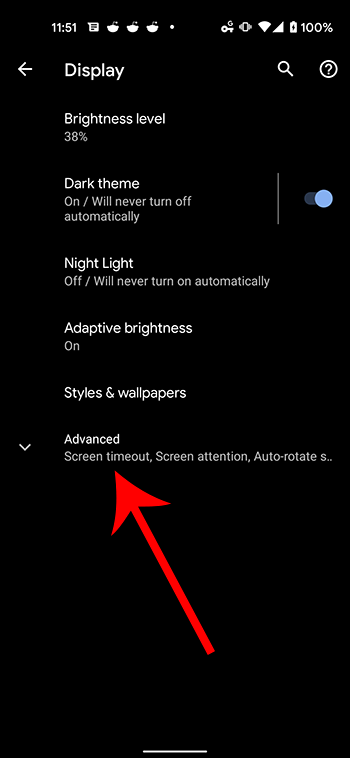
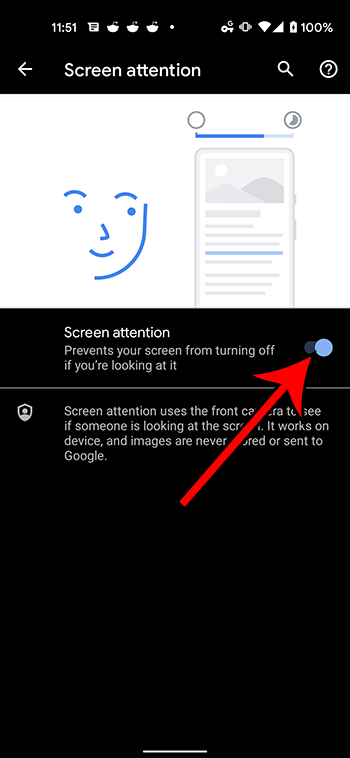
If your phone matches these screens, tap Advanced at the bottom of the Display menu, then tap Screen attention and turn on the switch.
Frequently Asked Questions
Does Screen attention work on the Pixel 4a?
Yes. Google lists Screen attention as a Pixel 4 and later feature, and the Pixel 4a has the setting.
Does Screen attention drain the battery?
It keeps the screen on while you’re looking at it, and a lit screen uses power. When you look away, the screen still turns off on your normal timeout.
Is Screen attention the same as Adaptive timeout?
No. Screen attention keeps the screen on while you look at it. Adaptive timeout, per Google, turns the screen off early when you aren’t using the phone.
For more on the Pixel 4a, see how to take a screenshot on a Google Pixel 4a and how to show the battery percentage on a Pixel 4a.
You can also share your phone’s data with a laptop or tablet by turning on the Pixel 4a hotspot.

Matthew Burleigh has been writing tech tutorials since 2008. His writing has appeared on dozens of different websites and been read hundreds of millions of times.
After receiving his Bachelor’s and Master’s degrees in Computer Science he spent several years working in IT management for small businesses. However, he now works full time writing content online and creating websites.
His main writing topics include iPhones, Microsoft Office, Google Apps, Android, and Photoshop, but he has also written about many other tech topics as well.