To stop your iPhone 13 from naming voice memos after your location, open Settings, tap Apps, tap Voice Memos, and turn off Location-based Naming. On iOS 17 or earlier there is no Apps step, because Voice Memos sits in the main Settings list. New recordings are then saved as New Recording instead of a street, building or city name.
The change only applies to memos you record from now on. Recordings you already have keep their names until you rename them, which is covered below.
Why Voice Memos Uses Your Location
Apple’s iPhone User Guide says a recording is saved with the name New Recording, or with the name of your location if Location Services is turned on. Location Services is the iPhone feature that lets apps work out where you are from GPS, Wi-Fi, Bluetooth and cellular signals.
That is handy if you record in many different places. It is less helpful if most of your memos are made at home or at work, because they end up with nearly identical names. It can also be a privacy concern: if you send a memo to someone, a name based on your street tells them where you were.
Before You Start
- Which iPhones: the setting belongs to the Voice Memos app, not to one model, so the steps are the same on an iPhone 13, 13 mini, 13 Pro and 13 Pro Max, and on other iPhones running the same iOS version.
- Which iOS version: the iPhone 13 originally shipped with iOS 15, and Apple lists it as compatible with iOS 27. The only difference between versions is where Voice Memos appears in Settings. To check yours, go to Settings > General > About.
- Nothing is deleted: turning the setting off does not remove or change any recording.
How to Turn Off Location-Based Naming on iOS 18 or Later
Starting with iOS 18, Apple moved the settings for individual apps into an Apps section. Apple’s guide uses this same path for other Voice Memos options, such as Recording Mode.
- Open the Settings app.
- Scroll to the bottom of the main list and tap Apps.
- Tap Voice Memos. The list is alphabetical, so it is near the end. You can also type its name in the search field at the top.
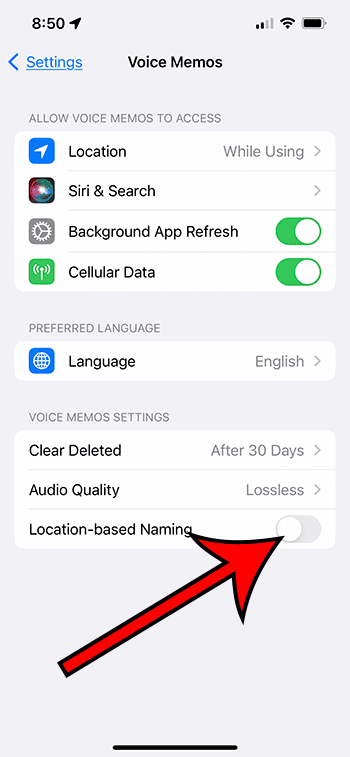
- Find Location-based Naming and tap the switch to turn it off. The switch is off when it is gray instead of green.
There is no Save button. The setting takes effect as soon as you tap the switch, and you can leave Settings.

How to Turn Off Location-Based Naming on iOS 17 or Earlier
If your iPhone 13 is still on iOS 15, 16 or 17, the switch is the same but the route is one tap shorter.
- Open the Settings app.
- Scroll down the main list to the block of Apple apps and tap Voice Memos.
- Turn off Location-based Naming.
The screenshot below shows the Voice Memos settings screen on an iPhone 13 running iOS 16.4. The screen may look slightly different on your version, but the switch has the same name.
Another Way: Stop Voice Memos From Using Your Location
Apple ties location names to Location Services, so you can also take away the app’s access to your location. This is a broader change than the naming switch: Voice Memos gets no location information at all.
- Open Settings and tap Privacy & Security. On older iOS versions this menu is called Privacy.
- Tap Location Services.
- Tap Voice Memos in the list of apps.
- Choose Never.
An app only appears in this list after it has asked to use your location. If Voice Memos is not there, it has not requested access, and it should not be using location names.
Warning: do not turn off the main Location Services switch at the top of that screen just to fix memo names. Apple warns that many important iPhone features stop working when Location Services is off, which affects apps like Maps, Weather and Find My. Change the setting for Voice Memos only. Apple explains these controls in Control the location information you share on iPhone. If you do want to switch off location for the whole phone, see our guide to turning off location on an iPhone.

How to Check That It Worked
- Open the Voice Memos app. If it is not on your Home Screen, look in the Utilities folder or search for it.
- Tap the red record button, wait a couple of seconds, then tap it again to stop.
- Look at the top of the list. The new memo should be named New Recording. Later memos get a number added, such as New Recording 2.
You can delete the test memo afterward. If you are new to the app, our guide on how to record audio on iPhone covers the basics.
How to Rename Recordings You Already Have
Older memos keep their location names. Apple’s steps for changing one are short:
- Open Voice Memos.
- Tap the recording you want to rename so it expands.
- Tap the name, then type a new one.
- Tap Return on the keyboard, or tap elsewhere on the screen, to finish.
Renaming changes only the title. The audio is not affected. Apple documents this in Search for or rename a recording in Voice Memos on iPhone. A clear name with a date or topic also makes memos easier to find with the search field in the app.
How to Turn Location Names Back On
Go back to the same Voice Memos settings screen and turn Location-based Naming on. If you also set location access to Never, return to Settings > Privacy & Security > Location Services > Voice Memos and choose While Using the App. Both need to be on for location names to return.
Troubleshooting
- You can’t find Voice Memos in Settings. On iOS 18 or later it is under Apps, not in the main list. You can also pull down on the Settings screen and type Voice Memos in the search field.
- Voice Memos is missing from Settings and from your phone. The app may have been removed. Download Voice Memos again from the App Store, open it once, and its settings will reappear.
- There is no Location-based Naming switch. Apple’s iPhone guide does not describe this switch for every iOS version. If you do not see it, use the Location Services method above, which Apple documents as the setting that controls location names.
- Old memos still show a place name. That is expected. The setting only decides how new memos are named, so rename older ones by hand.
- Memos on your iPad or Mac still use location names. This setting is separate on each device. Turn it off on each one. On a Mac, the option is in the Voice Memos app’s own settings.
Frequently Asked Questions
Does turning off Location-based Naming rename my old voice memos?
No. The setting affects how new recordings are named. Recordings you made earlier keep the name they were saved with until you tap the name in Voice Memos and type a different one.
What are voice memos called when location naming is off?
Apple says a recording is saved with the name New Recording when a location name is not used. Additional recordings get a number at the end, so you will see New Recording 2, New Recording 3 and so on unless you rename them.
Do I have to turn off Location Services for the whole iPhone?
No. Turning off Location-based Naming in the Voice Memos settings is enough, and it leaves every other app alone. Switching off Location Services for the whole phone would also stop location names, but Apple warns that many iPhone features stop working when it is off.
Does the same setting work on an iPad?
Yes, the Voice Memos app on iPad has its own settings screen in the Settings app, and it works the same way. Changing the setting on your iPhone does not change it on your iPad, so you need to turn it off on both.
Can other people see where I recorded a voice memo?
If a memo was named after your location, anyone you send it to can see that name. Rename the recording before you share it if you would rather keep the place private. For the sharing steps, see how to share a voice memo via text message on an iPhone.
Next Steps
Once your recordings have names you recognize, see the quickest way to play a voice memo on your iPhone. If you are recording a discussion or a call, read how to record a conversation on iPhone first, since consent rules can apply.

Matthew Burleigh is the founder, head writer, and editor of Solve Your Tech, which he launched in 2012. He has written technology tutorials since 2008 and worked in IT since 2003, including small-business support, IT management, and consulting. He holds Bachelor’s and Master’s degrees in Computer Science from Arizona State University.
Matthew writes practical guides for Windows, iPhone and iPad, Microsoft Office, Outlook, Google apps, and Android. Solve Your Tech’s guides are tested on current devices or checked against official product documentation, with clear steps, sources, and update dates.
Read more about Matthew and how Solve Your Tech writes and updates its guides, or report a correction.