To use Google Voice on an iPhone, install the Google Voice app from the App Store, sign in with your Google account, and pick a number by searching a city or area code. Then link your iPhone’s own number. Personal Google Voice numbers are available in the US only.
You want a second number for a side business or online listings without paying for another phone line, and your iPhone is the only phone you carry.
What Google Voice Costs
Google Voice is a phone number from Google that lives in an app rather than on a SIM card. It can make calls, send texts and take voicemail, separate from your carrier number. Check these points before you install anything:
- A Google account. A personal Gmail account works. Google’s Google Voice plans page says personal @gmail.com accounts can get Google Voice in the US only.
- A work or school account, if that’s what you use. Google says Google Workspace accounts get Voice through an administrator, with local numbers in 14 countries. If you see “Your account isn’t ready for Google Voice yet,” Google says to contact your admin.
- A recent version of iOS. The Google Voice listing on the App Store shows the minimum iOS version under Compatibility. Update your iPhone in Settings > General > Software Update if the store says your iPhone isn’t supported.
- An existing phone number you can link. Google uses a linked number as a fallback for calls when you have no internet connection. Your iPhone’s own number is the usual choice.
What It Costs
Google lists a Basic personal plan at $0. Its iPhone setup page says calls from the US to the US and Canada are mostly free, with some at 1 cent per minute, and calls outside the US are charged at international rates. Google’s plans page also lists Voice Starter (Standalone) at $10 per month and Voice Standard (Standalone) at $20 per month for business use. Prices can change, so check Google’s plans page before you buy.
Google Voice is one of several ways to have two numbers on one phone. If you’re still deciding, see how to add a second number to an iPhone, which covers the carrier and eSIM route as well.
Set Up Google Voice and Choose a Number
These steps follow Google’s iPhone and iPad setup instructions.
- Open the App Store, search for Google Voice, and install the app published by Google LLC.
- Open the app and sign in to your Google account.
- Review and accept the Terms of Service and Privacy Policy.
- Tap Search and enter a city or area code. If nothing comes up, try a nearby city or area code.
- Tap Select next to the number you want.

- Follow the on-screen instructions to finish.
Choose the area code with the people who’ll call you in mind. A dog walker who works in one town, for example, might pick that town’s area code so clients see a local number. Google notes that it doesn’t offer toll-free (1-800) numbers.
When the app first asks for access to things like your contacts, microphone and notifications, allow them. Voice needs the microphone for calls and notifications to tell you about calls and texts. If you denied a request earlier, scroll to the Voice app in your iPhone’s Settings and turn the access back on.
Link Your iPhone Number to Google Voice
A linked number is a phone number Google Voice can forward calls to and use when you’re offline. Google’s page on setting up your phone to make and receive calls explains how to add one:
- In the Voice app, tap Menu, then Settings.
- Under Account, tap Devices and numbers.
- Tap New linked number and enter the number.
- Verify it. Google texts a code to a mobile number or places an automated call to a landline. Enter the code and tap Verify.
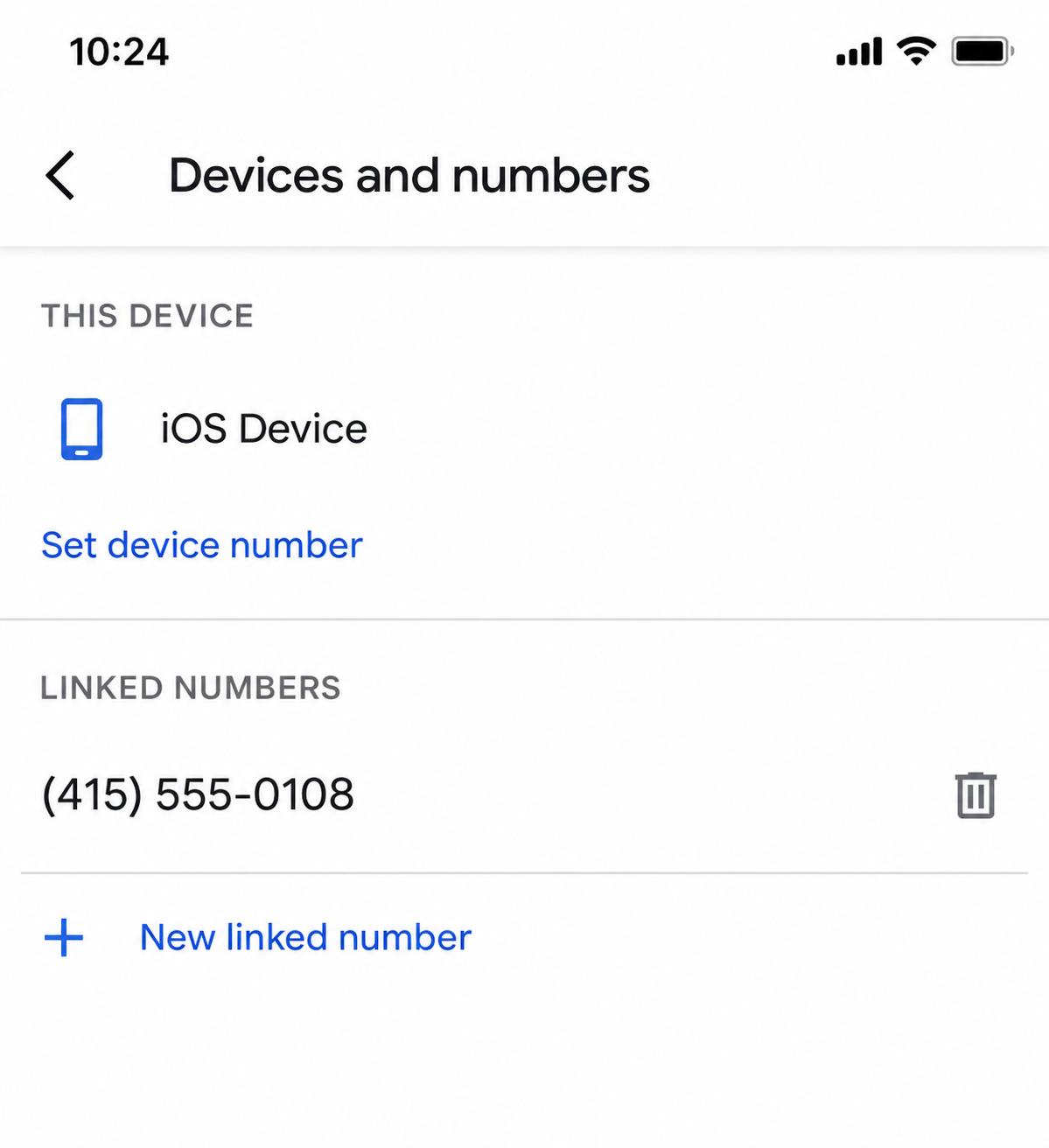
You can link up to six numbers, but not one that’s already linked to another Google Voice number. To control which devices ring, go to Settings and find Incoming calls under Calls, then turn devices on or off. To remove a linked number, open it in Devices and numbers and tap Remove.
The iPhone you’re holding appears as This device. Google says you can use Change device number to set which number it uses (its own number, no number, or a new linked number). That number matters when you have no internet, because it’s the one used to place calls then.
Choose Whether Calls Use Wi-Fi and Data or Your Carrier
This setting decides how Google Voice actually connects your calls, and it’s the one most people never look at. Google’s calling settings page describes it:
- In the Voice app, tap Menu > Settings.
- Under Calls, tap Making and receiving calls.
- Choose Prefer Wi-Fi and mobile data or Use carrier only.
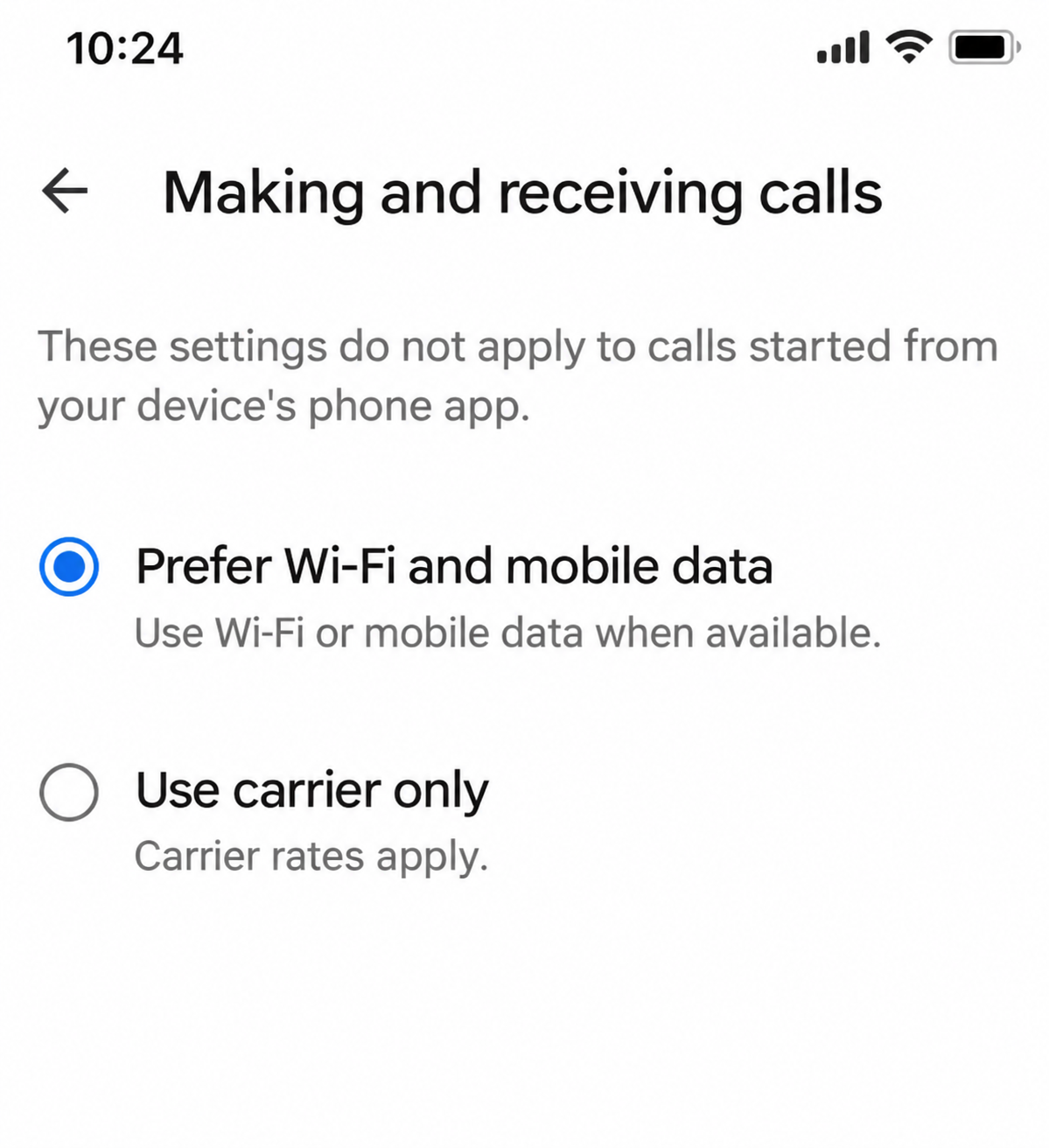
| Option | How calls connect | Good for |
|---|---|---|
| Prefer Wi-Fi and mobile data | Over the internet, using about 0.2 MB of data per minute, according to Google | Saving plan minutes, calling from places with Wi-Fi but weak cell signal |
| Use carrier only | Through your mobile plan’s voice service | Spotty data connections, when you’d rather use plan minutes |
One detail catches people out. Google says a call you start from the iPhone’s own Phone app uses minutes from your mobile plan. To call from your Voice number, start the call in the Voice app.
Make and Answer Calls
- Open the Voice app and tap Calls at the bottom.
- To call a contact, type the name in the search bar at the top and select it. For any other number, tap Dial and enter it (add the country code for international calls).
- Tap Call. Google’s page on making calls with Google Voice covers the same steps.
Incoming calls to your Voice number ring the app and any linked numbers you’ve turned on. Google says call waiting is supported. Google also notes that some Bluetooth headset or car buttons may not answer Voice calls, so if a button does nothing, answer on the screen instead.
Before you rely on Google Voice as your main number, know its emergency limit. Google says emergency calling in Voice is available only with Google Workspace-managed accounts. On a personal account, call emergency services from the iPhone’s Phone app with your carrier number.
Send and Receive Texts
Texting happens in the Messages tab of the Voice app, not in Apple’s Messages app. Google’s texting help page covers the details:
- Tap the Messages tab, then Compose.
- Enter a name or number. For a group text, add up to seven people (eight including you).
- Type your message, or tap the image button to attach a photo, then send.
Google lists several limits worth knowing:
- Images over 2 MB are shrunk, and GIFs over 2 MB aren’t sent.
- You can’t text the five- and six-digit short codes that some services use.
- Some sites, such as banks, won’t send verification texts to a Google Voice number.
- Messages sent in bulk or with certain links may be blocked.
- Texts to the US and Canada are free over Wi-Fi or mobile data.
Google also says Voice isn’t compatible with iMessage. If the number you moved to Google Voice was once registered with iMessage, you need to de-register it from iMessage, or texts from other iPhone users may never arrive. Suspicious texts land in a separate spam folder: tap Menu > Spam to check it.
Check Voicemail and Transcripts
- Tap the Voicemail tab at the bottom of the app.
- Tap a message to read the transcript, or tap Play to listen.
- To turn transcripts on or off, go to Menu > Settings > Voicemail transcripts.
Google warns that transcripts may be incorrect or missing, so play the recording when the details matter, such as an address or a callback number. If a voicemail you expected isn’t there, check the Spam folder too. This voicemail is separate from your carrier’s; for Apple’s own feature on your regular number, see how Live Voicemail on iPhone works.
Set Up Notifications, Focus and Do Not Disturb
Google says the app notifies you about texts, missed calls and voicemails by default. If those alerts don’t appear, check three places.
iPhone Notification Settings
Open the iPhone’s Settings app, tap Notifications, find the Voice app (it may be listed as Voice or Google Voice), and turn on Allow Notifications. Google’s notification help page also mentions email alerts for missed calls, set in the Voice app under Settings > Calls.
Focus
A Focus, such as Work or Sleep, silences apps that aren’t on its allowed list. Google suggests opening Settings > Focus, choosing the Focus you use, and adding the Voice app under allowed notifications. For more on how iPhone silencing works, see how to fix notifications silenced on iPhone.
Do Not Disturb in the Voice App
Voice has its own Do Not Disturb, separate from the iPhone’s. In the app, tap Menu > Settings > Do not disturb and turn it on. Google says a yellow banner appears while it’s active, with an End Now option. Workspace accounts also get calendar-based options. This is handy for a business number: turn it on in the evening so client calls stop ringing your phone while your carrier number still works normally.
Move an Existing Number to Google Voice
Instead of picking a new number, you can port (transfer) a number you already own. Google’s number porting page sets these conditions:
- Porting is for personal Google Voice accounts, and the number must be an active US mobile number.
- There’s a $20 fee, which Google refunds if a stuck port is cancelled.
- You need your carrier account number and PIN.
- Keep your carrier plan active until Google confirms the port is done.
- Calls can take up to 48 hours to move, and texts up to three business days.
- Not every number can be ported, and Google says minors can’t port numbers.
Porting moves the number away from your carrier. Google says your carrier ends service on that number once the port finishes, so check with your carrier about the rest of your plan before you start. It suits an old line you no longer want to pay for. If you want to keep your iPhone’s main number with your carrier, choose a new Google Voice number instead.
Fix Common Google Voice Problems on iPhone
Google’s iPhone call quality page suggests these checks. Start at the top.
- Calls don’t ring the app: in Voice, go to Settings and, under Calls, open Incoming calls and make sure your devices are turned on. Turn off Do Not Disturb in Voice and check that your Focus allows the app.
- Poor or choppy audio: try switching between your router’s 5 GHz and 2.4 GHz Wi-Fi networks, and turn off any VPN while you test.
- Calls blocked or missed: turn off any third-party call-blocking app you’ve installed. Google also suggests turning on Call screening in the Voice app’s settings.
- Calls going to an old phone: remove linked phones you no longer use in Devices and numbers.
- Voicemail lands in the wrong place: set Google Voice as the voicemail provider in the app’s settings so missed calls go to Voice voicemail.
- Missing calls or texts: open Menu > Spam to see if they were filtered.
If a call fails to connect at all, check the number format and country code. Google’s calling troubleshooting page also lists places where Voice calling isn’t available: Crimea, Cuba, Iran, North Korea, Sudan and Syria, and calls to numbers within India.
Google Voice on iPhone Questions
Will My Google Voice Number Show Up in the iPhone Phone App?
Google’s instructions place calls, texts and voicemail inside the Voice app. Google says calls started from the Phone app go out on your carrier plan, so use the Voice app whenever you want your Google Voice number to show.
Can I Use Google Voice With No Signal and No Wi-Fi?
Partly. Google says that without an internet connection, calls are placed using the number set for This device, which goes through your carrier. Google describes Voice texting as free over Wi-Fi or mobile data, so plan on having a connection for texts.
Can I Use the Same Google Voice Number on an iPad?
Yes. Google’s setup page covers iPhone and iPad together. Sign in to the Voice app with the same Google account and the number, messages and voicemail appear on both.
Why Don’t Other iPhone Users’ Texts Reach Me?
One cause Google documents is that the number was still registered with iMessage, so their iPhones try to send a blue-bubble iMessage instead of a regular text. De-register the number from iMessage, then ask the sender to try again. For background on how iPhones choose between the two, see the difference between green and blue texts on iPhone.
Once your number is set up, send a test text and place a short test call from the Voice app to a friend so you can confirm both directions work before you hand the number out.

Matthew Burleigh is the founder, head writer, and editor of Solve Your Tech, which he launched in 2012. He has written technology tutorials since 2008 and worked in IT since 2003, including small-business support, IT management, and consulting. He holds Bachelor’s and Master’s degrees in Computer Science from Arizona State University.
Matthew writes practical guides for Windows, iPhone and iPad, Microsoft Office, Outlook, Google apps, and Android. Solve Your Tech’s guides are checked step by step against the device or app maker’s own documentation and tested on his own devices whenever he has the hardware or software, with clear steps, sources, and update dates.
Read more about Matthew and how Solve Your Tech writes and updates its guides, or report a correction.