To clear a full voicemail box on iPhone, delete the messages in the Phone app, then open Deleted Messages and clear it (look for Clear All). Depending on your carrier, deleted voicemails may keep counting against your mailbox until that folder is emptied.
Callers hear that your mailbox is full, even though you thought you had deleted your old voicemails. That usually means the second step never happened, or the carrier’s mailbox needs clearing separately.
Why Your Mailbox Still Says Full After You Delete Messages
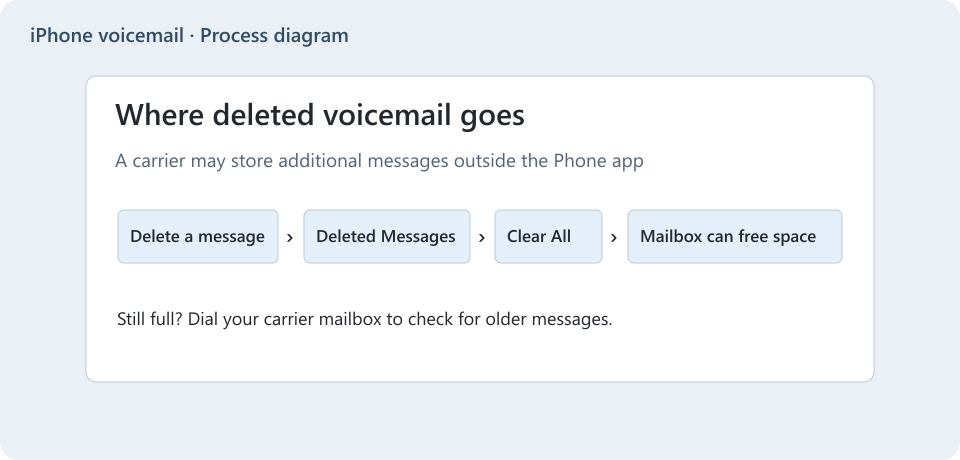
Your voicemail box is run by your carrier: Apple notes that messages not stored in iCloud are kept until you delete them or your carrier erases them, and the carrier sets how many messages fit before callers hear a “mailbox full” announcement. The list you see in the Phone app (Apple calls it Visual Voicemail) is a view of that carrier mailbox, which lets you play and delete messages in any order without dialing in.
Three things explain most “still full” situations:
- Deleted is not the same as gone. When you delete a voicemail, the iPhone moves it to a Deleted Messages folder. Apple’s iPhone User Guide shows that you can still recover messages from that folder, which means they have not been erased yet. Depending on your carrier, those messages may still use space in the mailbox.
- The carrier sets the limit. The size of the mailbox and any automatic cleanup are carrier rules, not iPhone settings.
- Old messages may never have reached the list. Messages left before Visual Voicemail was set up, or while it was not working, may sit in the carrier mailbox without appearing in the Phone app at all.
Two more details matter before you start. In some countries or regions, deleted messages may be permanently erased by the carrier right away, so there is no second chance. And your voice messages may be deleted if you change your SIM card. If a message matters, save it first.
Save Any Voicemail You Want to Keep
Clearing the mailbox is meant to be final, so take a minute to pull out anything you would regret losing: a message from a family member, a doctor’s instructions, a recording you might need for a dispute. Apple’s Phone app has a share option for each voicemail, which lets you send the recording to another app, such as Files or Messages, depending on what is installed.
For the full set of options, including saving to iCloud Drive and copying a recording to a computer, see how to save voicemails on iPhone. Once a recording is saved somewhere else, deleting it from the voicemail list does not affect the copy.
Delete Voicemails in the Phone App
The Phone app has two layouts in the iPhone User Guide for iOS 26: the newer Unified layout and the Classic layout with a separate Voicemail tab. Use the set of steps that matches what you see at the bottom of the Phone app.
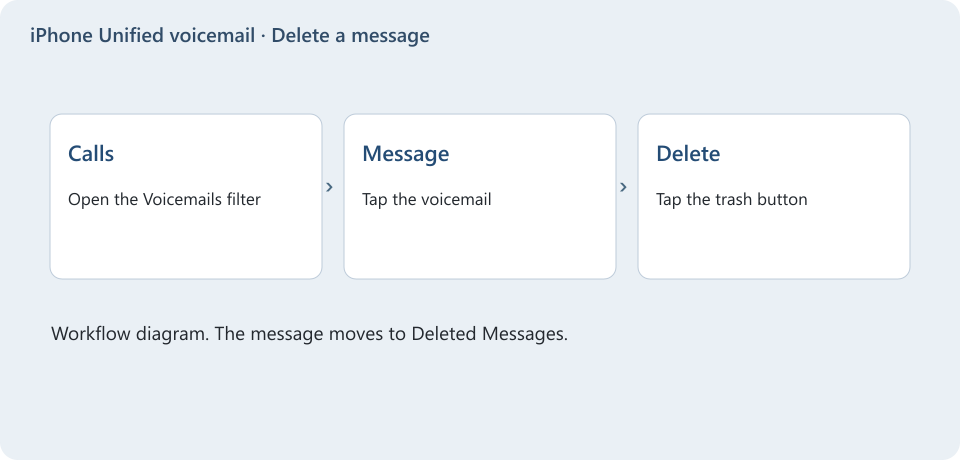
Unified Layout
- Open the Phone app and tap Calls.
- To see only voicemail, tap the filter button, then tap Voicemails. (You can also find voicemails mixed into the Recents list.)
- Tap a voicemail to open it.
- Tap the delete button (it looks like a trash can) to move the message to Deleted Messages.
Classic Layout
- Open the Phone app and tap Voicemail at the bottom of the screen.
- Tap a message.
- Tap the delete (trash can) button.
Delete Several Messages at Once
The iPhone User Guide only covers deleting one message at a time, but the voicemail list on most iPhones offers faster options:
- Swipe to delete. In the voicemail list, you may be able to swipe left on a message and tap Delete.
- Edit and select. Look for an Edit or Select button at the top of the voicemail list. Tap it, tap each message you want to remove so it shows a check mark, then tap Delete. Whether this button appears can depend on your carrier’s Visual Voicemail service.
A practical approach for a mailbox with dozens of old messages: sort out the few keepers first (save them as described above), then delete everything else in one pass instead of opening each message.
Clear the Deleted Messages Folder
This is the step most people miss, and on many carriers it is what actually frees the mailbox. Before you do it, scroll through the folder once: anything you clear here is meant to be gone for good.
- Go back to the voicemail list (Calls > filter > Voicemails in the Unified layout, or the Voicemail tab in the Classic layout).
- Scroll down and tap Deleted Messages (usually near the end of the list). This row usually appears only when there are recently deleted voicemails in it.
- Look for Clear All, typically in the upper-right corner, and tap it.
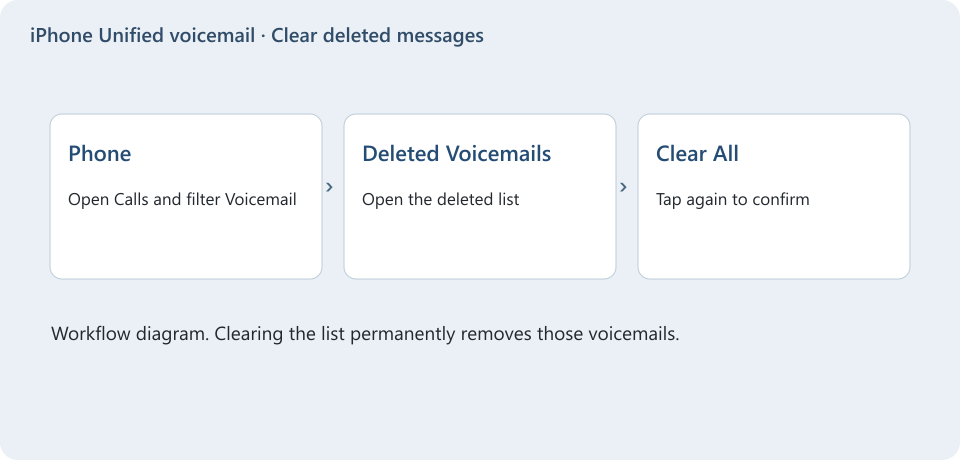
- If the iPhone asks you to confirm, confirm the clear.
When the folder is empty, the Deleted Messages row may disappear from the list. Give the phone a minute or two on a cellular or Wi-Fi connection so the change can reach your carrier, then call your number from another phone. If you get your greeting and the option to leave a message, the mailbox has room again.
Changed Your Mind? Undelete First
Until you clear the folder, there is a way back: tap Deleted Messages, tap the message, then tap the undelete button. The message returns to your main voicemail list. Keep in mind that in some countries or regions the carrier may erase deleted messages permanently, in which case the folder may not hold them at all.
Clear the Mailbox by Calling Voicemail
If you do not see a voicemail list, if Visual Voicemail is not available from your carrier, or if the list is empty but callers still hear “mailbox full,” clear the carrier mailbox directly by phone. This reaches messages the app never showed.
- On the iPhone, tap Voicemail in the Phone app (or the voicemail option in the Unified layout). When Visual Voicemail is not available, tapping Voicemail lets you follow the instructions to reach your mailbox. On many iPhones you can also open the Keypad and touch and hold 1 to call voicemail.
- Enter your voicemail password if asked.
- Listen to the main menu. Each carrier uses its own key presses, so wait for the option to play saved messages and the option to delete.
- Play each message and press the key the menu gives for delete. Repeat for saved messages and new messages, since many systems keep them in separate queues.
- Wait for the system to confirm each deletion before you hang up, since some voicemail systems save changes only when you exit the menu.
If you are away from your iPhone, there is another route: call your own mobile number from another phone, press * or # (depending on your carrier) to skip your greeting, then enter your voicemail password. From there the same menu applies.
Do not know the password? You may be able to reset it in the Phone app’s voicemail settings, or through your carrier’s account page or support line. Some carriers require identity checks before resetting it, so allow a little time.
If Callers Still Hear That the Mailbox Is Full
Work through these in order. Each one rules out a different cause.
- Check Deleted Messages again. New deletions land there too, so a folder you emptied last week may have filled up again.
- Dial in once. Use the phone method above even if the app list looks empty. Messages left before Visual Voicemail was active may hide only in the carrier mailbox.
- Restart the iPhone. A restart can refresh the Visual Voicemail connection and a voicemail badge that will not go away.
- Wait a short while. Some carrier systems take time to recalculate the mailbox after a large cleanup.
- Contact your carrier. Ask support to check the mailbox and, if needed, reset it. A reset can erase every stored message and may remove your greeting, so save anything important first. Carriers can also tell you their message limit and whether they delete old messages automatically.
A worked example: a contractor who uses one iPhone for work deletes forty voicemails from the list on Friday, but clients still hear the full message on Monday. The Deleted Messages folder holds all forty. After Clear All and a quick test call from a coworker’s phone, the mailbox accepts messages again. If the test call had still failed, dialing in would have been the next step.
If calls go straight to voicemail without ringing at all, that is a different problem from a full mailbox; see why your iPhone goes straight to voicemail for Focus, call forwarding and blocked-caller checks.
Live Voicemail, Transcripts and iCloud Storage
These features change what appears in your voicemail list, so it helps to know how they relate to a full mailbox.
- Live Voicemail shows a real-time transcription while a caller leaves a message, so you can pick up mid-message. You turn it on in Settings > Apps > Phone > Live Voicemail. If your iPhone is off or out of range, the call goes to your carrier voicemail instead, when available. Live Voicemail messages usually appear in the same voicemail list and can be deleted the same way. For setup and troubleshooting, see how to use Live Voicemail on iPhone.
- Transcriptions of regular voicemail are a separate feature. Transcription is available only from select carriers in select countries or regions, so a missing transcript does not mean anything is wrong with your mailbox.
- Voicemail in iCloud keeps your voicemail in sync across your Apple devices. To turn it on, go to Settings > [your name] > iCloud, tap See All next to Saved to iCloud, then turn on Phone & FaceTime. Since messages not stored in iCloud are kept only until your carrier erases them, iCloud is worth turning on if you often lose old messages to carrier cleanup.
Apple’s Check voicemail on iPhone page covers listening, deleting, recovering and sharing messages, and its Set up voicemail on iPhone page covers the greeting, Live Voicemail and iCloud settings. Both are worth checking if your Phone app looks different from the steps here.
Full Mailbox Questions
Does clearing voicemail free up storage on my iPhone?
Do not count on it. Apple’s voicemail pages do not describe voicemail as a meaningful use of iPhone storage, and the “mailbox full” problem is about the carrier’s mailbox, not the phone. If your iPhone itself is low on space, check Settings > General > iPhone Storage instead.
Can I delete every voicemail with one tap?
For the main list, usually not; you select messages with Edit or swipe them one by one. The Deleted Messages folder is different: its Clear All button empties everything in it at once.
I switched to a new iPhone. Why are my old voicemails back?
Because the mailbox lives with your carrier (or in iCloud, if you turned that on), a new phone may download whatever is still stored there, so messages that were deleted but never cleared from the carrier can reappear. Clear them again on the new phone. Changing your SIM card may also delete voice messages, so save important ones before a SIM swap.
Is Live Voicemail the same as Visual Voicemail?
No. Visual Voicemail is the list of messages you can play and delete in any order. Live Voicemail transcribes a message as it is being left, so you can answer. Both usually end up in the same voicemail list.
How many messages can my mailbox hold?
That depends on your carrier and plan. Apple does not set the limit, so your carrier’s support pages or support line are the only reliable answer.
Next time the badge on the Phone app starts climbing, clear Deleted Messages as part of the same routine as deleting, and the “mailbox full” message should not come back.

Matthew Burleigh is the founder, head writer, and editor of Solve Your Tech, which he launched in 2012. He has written technology tutorials since 2008 and worked in IT since 2003, including small-business support, IT management, and consulting. He holds Bachelor’s and Master’s degrees in Computer Science from Arizona State University.
Matthew writes practical guides for Windows, iPhone and iPad, Microsoft Office, Outlook, Google apps, and Android. Solve Your Tech’s guides are checked step by step against the device or app maker’s own documentation and tested on his own devices whenever he has the hardware or software, with clear steps, sources, and update dates.
Read more about Matthew and how Solve Your Tech writes and updates its guides, or report a correction.