Open the Phone app, select the voicemail, tap Share, then choose Save to Files, Notes, Mail, or another available destination. To keep an independent audio copy, save it outside the Phone app and play the saved file before deleting the original.
The exact route to your voicemail depends on the Phone app layout. In the unified layout, use Calls and its voicemail filter. In the classic layout, use the Voicemail tab.
Before You Start
Find the message and make sure you can play it in the Phone app. Visual Voicemail and related features depend on your carrier, country, and configuration. If the app only tells you to call a voicemail number, you may not have a shareable audio message in its list.
Choose where you want the copy to live. On My iPhone is local storage; iCloud Drive can make the file available through your signed-in Apple Account on other devices. A sent email or message is another copy, but its continued availability depends on that service and your retention settings.
For a meaningful long-term archive, keep a copy you have verified and a separate backup. A voicemail remaining in your carrier’s inbox is not the same as an exported file under your control.
Find the Voicemail in Either Phone Layout
- Open the Phone app.
- In the unified layout, tap Calls. Use the filter control and choose Voicemails to view only voicemail messages.
- In the classic layout, tap Voicemail.
- Tap the message you want to save.
- Play it to confirm you have selected the correct recording.
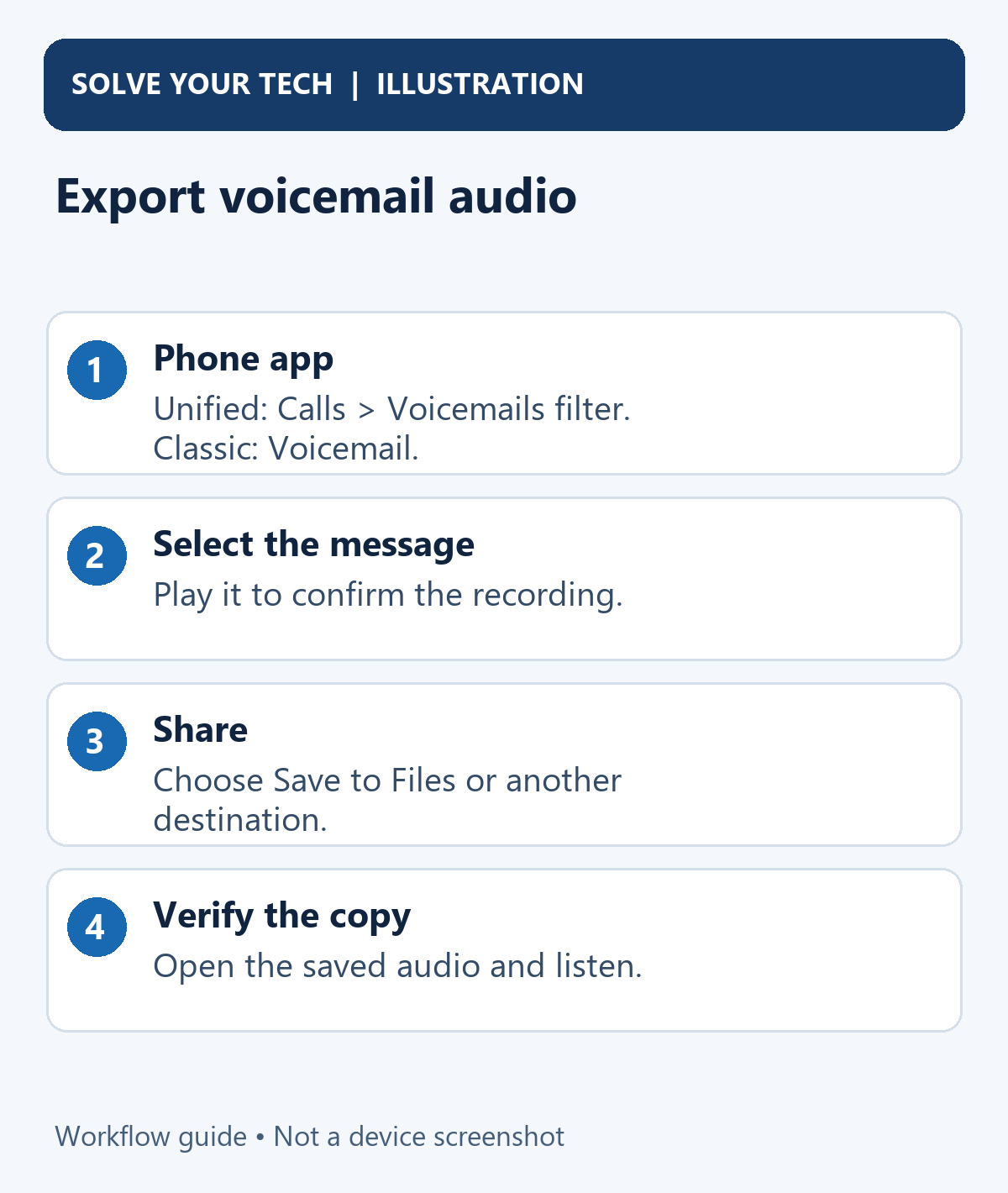
Apple’s current voicemail guide documents both layouts. If a screenshot in an older article shows a Voicemail tab that your screen does not have, use the unified Calls route instead.
Check the caller and the message content before exporting. Several messages from the same number can be easy to confuse. The displayed caller name also depends on your contacts, so it should not be your only check.
Save the Audio to Files
- Open the voicemail message.
- Tap Share, the square with an upward arrow.
- Scroll through the share sheet and tap Save to Files.
- Choose On My iPhone, iCloud Drive, or another configured location you intend to use.
- Choose a folder and give the file a useful name if the save screen offers that control.
- Tap Save.
- Open the Files app and navigate to that same location.
- Open the saved audio and listen to it.
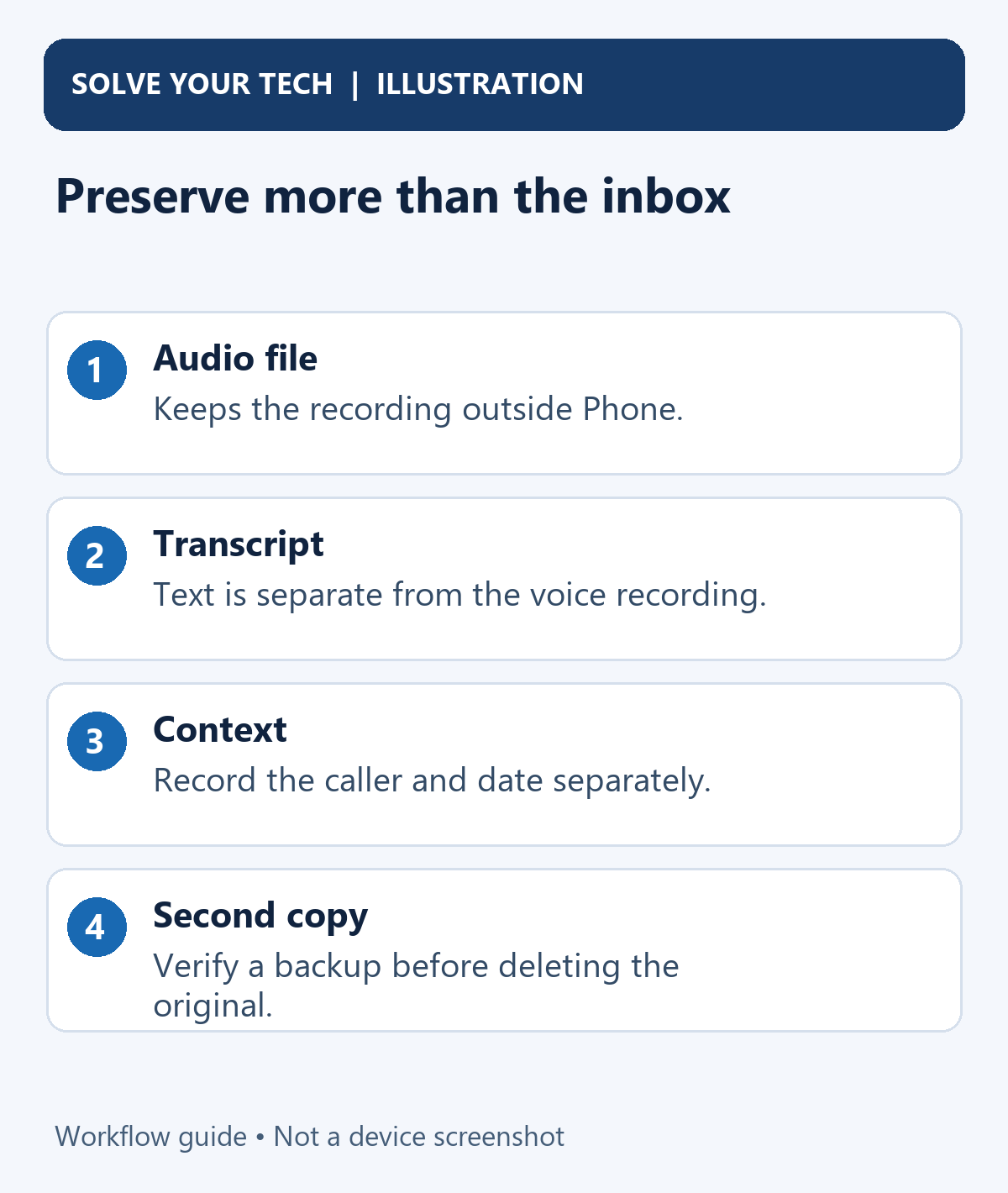
A descriptive name such as the caller and date helps you distinguish several exported messages. Do not simply save repeatedly and assume every file is a different voicemail. Check the file you just created.
Voicemail exports commonly use an audio format such as M4A. Keep the exported extension rather than changing it to MP3 by renaming. Renaming an extension does not convert the recording into another audio format.
Choose Local Storage or iCloud Drive
On My iPhone keeps the file in a local location exposed by Files. It is convenient for playback on that phone, but a local-only copy should not be your sole archive of an irreplaceable message if the phone could be lost, reset, or damaged.
iCloud Drive provides a place to save and access the file through your Apple Account. Check that it finishes uploading before you rely on access from another device. If you want a second archive, download a copy to a computer or another location you control and verify that copy too.
Third-party storage locations appear according to the apps and providers configured on your phone. If you choose one, follow its save or upload confirmation and check the finished file in that service. Seeing a provider in the share sheet does not prove an upload succeeded.
Save to Notes or Voice Memos
The share sheet may offer Notes or Voice Memos, depending on what is available on your iPhone.
For Notes, choose the destination note or create a new one, then save the audio attachment. Open the note afterward and play the recording. You can add your own caller and date information alongside the attachment for context.
For Voice Memos, select the app if it is available, complete any save prompt, then open Voice Memos and play the new recording. From there you can also send the voice memo in a text message. If your memos get place names by default, see how to stop location naming in Voice Memos. Review whether that app is using iCloud if you want access on other devices; do not assume every destination has the same synchronization settings.
If the preferred app is not visible, look through the share sheet’s additional apps or use Save to Files. Available share destinations depend on the installed apps and their supported actions.
- Open the message and tap Share.
- Choose Mail, Messages, AirDrop, or another available app.
- Select or enter the intended recipient.
- Check that the audio attachment is present.
- Add any context needed, then send or complete the transfer.
- If the copy is important, confirm the recipient can open and play it.
AirDrop is useful for transferring to a nearby Apple device. Mail or another compatible messaging app can send an audio attachment to someone using a different platform. The recipient needs an app that can play the exported format.
Review the recording before sharing; voicemail may contain personal information belonging to you or the caller. A transfer creates another copy. Deleting the original from your phone does not recall a file you sent to someone else.
Save a Transcript Separately
When a voicemail transcript is available, you can select and copy the text, then paste it into a note or another document. Availability and accuracy depend on the supported voicemail and language features.
A transcript is useful for finding details quickly, but it is not the original audio. Listen to the recording to check names, dates, numbers, and other important details. If you want to preserve someone’s voice, export the audio even if you also save the text.
When archiving a message, consider keeping the caller, received date, and your own context beside the audio. The exported filename or a transcript alone may not preserve every detail displayed in the Phone app.
You only have a dial-in voicemail service: Ask your carrier whether it supports Visual Voicemail or another export method. Apple documents checking dial-in voicemail, but that does not mean the Phone app has an audio file it can share.
The message will not play: Check the connection and whether the voicemail has finished loading. Try again before treating an empty or failed export as a saved message.
Save to Files is not immediately visible: Scroll through the share actions rather than only the top row of app icons. Check that the intended storage location is available in Files.
The file did not appear: Revisit the exact folder and filename selected during saving. Check available device or cloud storage, then retry the export if necessary.
The recipient cannot play it: Confirm that the attachment transferred completely and use a compatible audio player. Keep your original export while diagnosing the problem.
You need a recording without a native export: Ask the carrier about supported options first. As a fallback, a separate recording device may capture playback, but check the resulting audio immediately. Do not assume same-phone screen recording reliably captures voicemail or call audio in every configuration.
Recover a Deleted Voicemail if Available
Apple documents a recovery route through Deleted Messages: open it, select the voicemail, and use the restore or undelete control. If you recover it, export and verify a copy promptly.
Recovery is not guaranteed. Apple warns that some carriers may permanently erase deleted messages and that changing your SIM card can delete voice messages. If the message is not recoverable on the phone, contact the carrier about its options.
Do not erase and restore the whole iPhone simply because a guide promises that a backup will recover a deleted voicemail. The availability of that message depends on how it was stored and what the backup contains.
Common Questions
Does sharing delete the original?
No. Sharing or saving creates a copy. Keep the original until you have played the exported recording and confirmed your backup.
How long will my carrier keep the message?
Carrier limits vary. Apple says messages remain until you delete them or the carrier erases them when they are not stored in iCloud. Check your carrier’s policy instead of relying on a universal 14-, 30-, or 60-day promise.
Can I save several at once?
Use the Phone app’s Share action for each message you need, then organize the exported files together. Do not assume a bulk selection for deletion also provides bulk audio export.
Where can I investigate calls going directly to voicemail?
That is a separate calling problem. See why an iPhone goes straight to voicemail. To correct a caller’s saved name or number before organizing your archive, see how to edit an iPhone contact.

Matthew Burleigh is the founder, head writer, and editor of Solve Your Tech, which he launched in 2012. He has written technology tutorials since 2008 and worked in IT since 2003, including small-business support, IT management, and consulting. He holds Bachelor’s and Master’s degrees in Computer Science from Arizona State University.
Matthew writes practical guides for Windows, iPhone and iPad, Microsoft Office, Outlook, Google apps, and Android. Solve Your Tech’s guides are tested on current devices or checked against official product documentation, with clear steps, sources, and update dates.
Read more about Matthew and how Solve Your Tech writes and updates its guides, or report a correction.