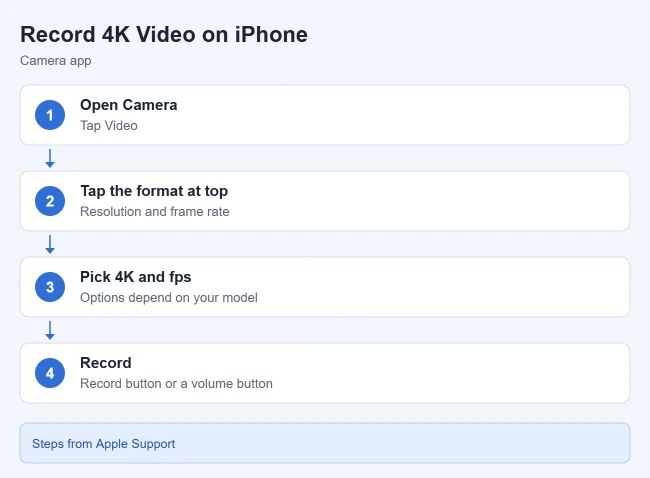
To record 4K video on iPhone, open Camera, swipe to Video, and tap the resolution and frame rate shown at the top of the screen to choose 4K. Formats and frame rates depend on your iPhone model. More video settings are in Settings > Camera > Record Video.
This guide covers recording a video, choosing 4K or HD and a frame rate, the extra video settings, sound recording options, and 4K in other modes like Slo-mo and Cinematic. It is based on Apple’s Record a video with your iPhone camera and Change video recording settings on iPhone.
How to Record a Video
- Open the Camera app.
- Tap Video.
- Tap the Record button or press either volume button to start.
- Tap the Record button or press a volume button again to stop.
Result: The video saves to your Photos library. To post it online without losing detail, see how to enable full quality uploads in the iPhone YouTube app. Apple says you can pinch to zoom or tap the zoom numbers (like .5x, 1x or 2x, depending on your model) while recording, tap the white Shutter button to grab a still photo, or tap Pause. Video recording isn’t available during a phone or FaceTime call.
How to Choose 4K or HD
- In Video mode, tap the resolution and frame rate values at the top of the screen.
- Tap the resolution you want, such as 4K or HD.
- Tap a frame rate, such as 30 or 60.
Result: New videos use that format. Apple says that, depending on your model, you can record HD, 4K, HD (PAL) and 4K (PAL), at 24, 25, 30, 60 or 120 fps. To enable more formats, go to Settings > Camera > Record Video and pick from the list your iPhone supports. Apple notes that faster frame rates and higher resolutions make larger files.
Other Video Settings
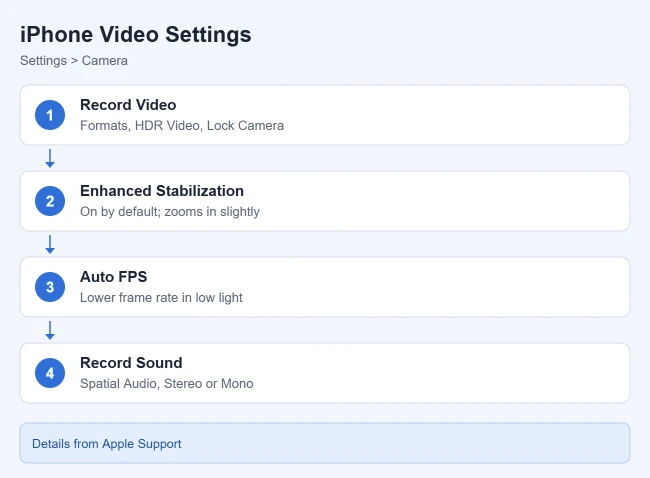
Apple lists these options in Settings > Camera > Record Video:
- HDR Video: on supported models iPhone records in HDR; other devices receive an SDR version when you share.
- Enhanced Stabilization: on by default; zooms in slightly for steadier video.
- Lock Camera: off by default; stops the iPhone from switching cameras while recording.
- Lock White Balance: Apple says locking it can improve accurate color capture based on lighting conditions.
- Auto FPS: lowers the frame rate to 24 fps in low light to improve quality. Apple says it also works in 4K on iPhone 18 Pro models.
For sound, Apple says iPhone 16 models and later record Spatial Audio by default; go to Settings > Camera > Record Sound to choose Spatial Audio, Stereo or Mono. On older models, turn off Record Stereo Sound (see how to record stereo sound on an iPhone 11) under Settings > Camera.
4K in Other Camera Modes
- Slo-mo: Apple says it records 1080 HD at 240 fps by default; on supported models, Settings > Camera > Record Slo-mo includes 4K at 120 fps.
- Cinematic: 1080 HD at 30 fps by default; switch to 4K at 24 or 30 fps in Record Cinematic.
- Action mode: Apple says it has a maximum capture resolution of 2.8K.
Frequently Asked Questions
Why don’t I see 4K at 60 fps?
Apple says available formats and frame rates depend on your iPhone model. Check the list in Settings > Camera > Record Video to see what yours supports.
Does 4K take up a lot of storage?
Yes. Apple notes that higher resolutions and faster frame rates result in larger video files.
After recording, you can add music to your iPhone video in iMovie, balance it with the original sound, and save the finished clip to Photos.
More iPhone Guides
- How to take HDR photos on iPhone
- How to make the iPhone camera keep your settings
- How to turn on the grid in the iPhone camera

Matthew Burleigh is the founder, head writer, and editor of Solve Your Tech, which he launched in 2012. He has written technology tutorials since 2008 and worked in IT since 2003, including small-business support, IT management, and consulting. He holds Bachelor’s and Master’s degrees in Computer Science from Arizona State University.
Matthew writes practical guides for Windows, iPhone and iPad, Microsoft Office, Outlook, Google apps, and Android. Solve Your Tech’s guides are tested on current devices or checked against official product documentation, with clear steps, sources, and update dates.
Read more about Matthew and how Solve Your Tech writes and updates its guides, or report a correction.