You’re filming a birthday toast with the rear camera and want to turn the phone around to catch your own reaction without stopping the clip. Apple’s guide doesn’t list a way to flip from the back camera to the front camera once a normal video is recording. What does work: Dual Capture on supported models, switching between rear lenses mid-clip, or recording two clips.
Can You Flip Between the Front and Back Camera While Recording?
Apple’s iPhone User Guide page on recording a video with the Camera app lists what you can do while a video is recording: take a still photo, pause, zoom with a pinch, tap a different rear lens, use the 1x zoom dial, and zoom with Camera Control on models that have it. A front and back camera switch isn’t on that list. The flip control Apple documents is something you tap before you press Record, for selfies or for front-camera Slo-mo.
Apple doesn’t describe a flip control on the recording screen, so you may not find one once the clip is running. If an older article told you to tap the flip icon mid-recording, that advice doesn’t match Apple’s own documentation.
So the real choice is between these routes:
| What you want | Best route | One file or several? |
|---|---|---|
| See the scene and your face at the same time | Dual Capture (supported models only) | One video |
| Go from a wide shot to a close-up without stopping | Tap .5x, 1x, 2x or another lens button while recording | One video |
| Show the scene, then cut to yourself | Stop, flip, record again | Two clips |
| A true mid-clip flip | A third-party camera or social app that offers it | Depends on the app |
Record Front and Back Together With Dual Capture
Dual Capture records the front and rear cameras at the same time, so the person holding the phone appears in the same video as the scene in front of it. Apple says it works on “supported models” and doesn’t publish a model list on that page, so if you don’t see the option, your iPhone or iOS version likely doesn’t offer it.
- Open the Camera app and swipe to Video mode.
- Tap the camera controls button to show the extra options for that mode.
- Tap Dual Capture.

- Tap the screen if the Record button isn’t showing, then tap Record.
- Tap the Record button again (or press a volume button) to stop. The clip appears in the Photos app.

- To go back to a normal single-camera video, tap the Dual Capture button again to turn it off.
Dual Capture is the closest built-in match to the birthday-toast idea: the rear camera films the person speaking while the front camera catches your reaction, and nothing has to be stitched together afterward. Frame both views before you start recording.
Switch Between Rear Lenses While You Record
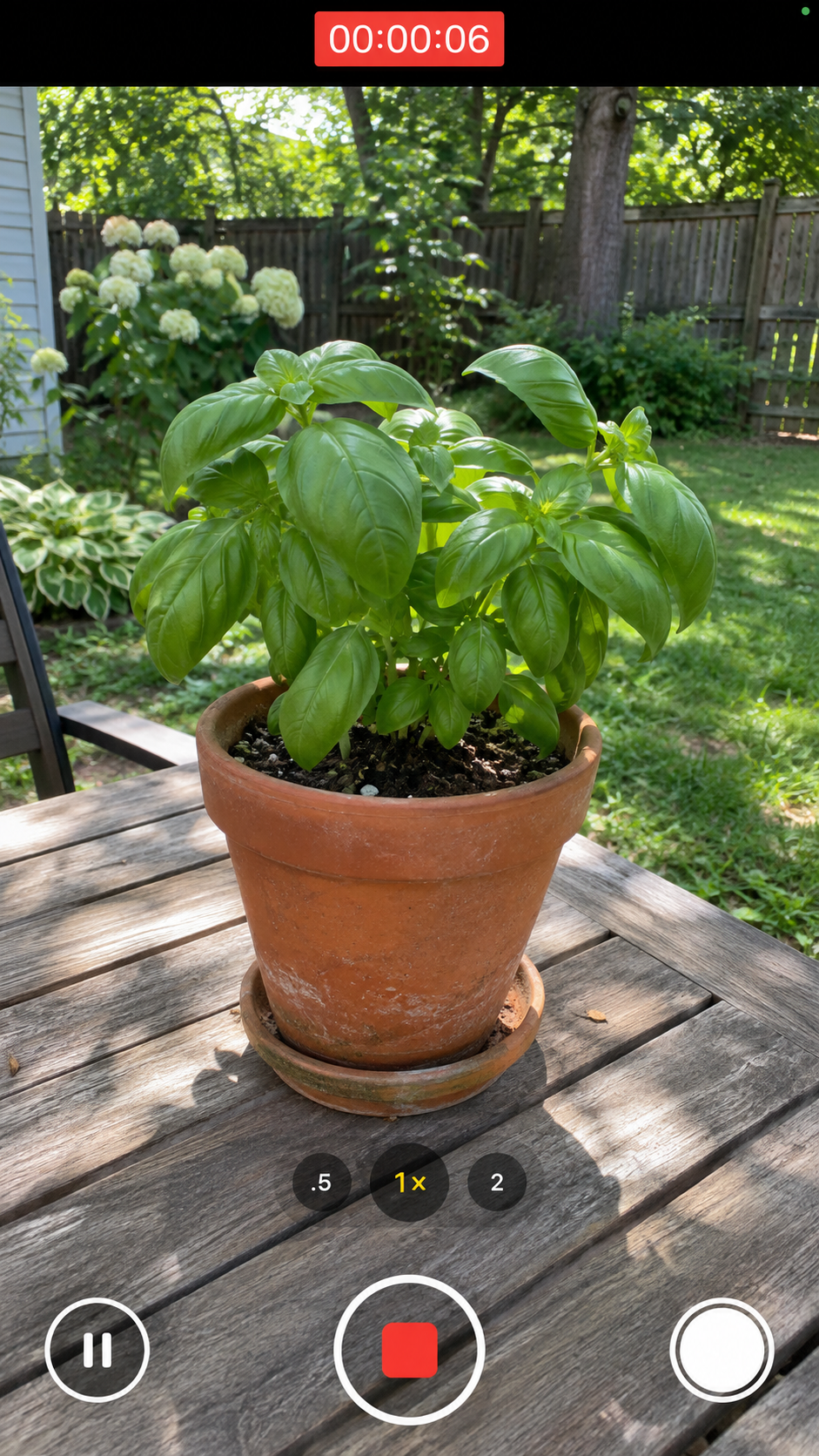
If what you saw in someone else’s video was a jump from a wide shot to a tight one, that’s a lens change, not a front and back flip. Apple documents these controls while a video is recording:
- Lens buttons: tap .5x, 1x, 2x, 3x, 4x, 5x or 8x. Which buttons appear depends on your iPhone model.
- Zoom dial: touch and hold the 1x button, then slide the dial for a smoother zoom.
- Pinch: pinch the screen to zoom in or out.
- Camera Control: on models that have it, you can zoom with Camera Control.
A worked example: you start a clip of a soccer field at .5x to show the whole pitch, tap 2x when a player lines up a penalty kick, then tap 1x again as the team celebrates. All of that stays in one video file.
The Lock Camera Setting
On some models, the iPhone can change which rear camera it uses on its own while recording. Apple’s video recording settings page says that on supported models, the Lock Camera setting prevents switching between cameras while recording video, and that it’s off by default. You’ll find it at Settings > Camera > Record Video > Lock Camera.
Turn it on if the picture keeps jumping between lenses during a clip. Leave it off if you prefer the iPhone to pick the best lens for you. There’s more on this in how to lock the camera lens during video recording. Lock Camera only stops automatic switching; it doesn’t add a front and back flip.
Record Two Clips Instead
When Dual Capture isn’t available and you want a clean cut from the scene to yourself, two short clips are the most reliable option.
- In Video mode, tap Record and film the first part with the rear camera.
- Tap the Record button again to stop.
- Tap the camera flip button to switch to the front camera.
- Tap Record again for the second part, then tap the Record button again to stop.
- Open the Photos app. Both clips sit next to each other in your library.
Apple’s page on trimming video in the Photos app shows how to drag either end of the frame viewer to change where each clip starts and stops, which tidies up both parts. Joining the two clips into a single file needs a video editing app, since Apple’s camera pages don’t describe a merge feature in Photos.
A tip for smoother results: before you stop the first clip, hold the shot steady for a moment. That gives you a clean point to trim, so the cut to the front camera doesn’t start on a blur.
Other Things You Can Do During a Recording
These controls don’t change cameras, but they solve some of the same problems people try to fix by flipping:
- Take a still photo: tap the Shutter button while recording to save a photo without stopping the video.
- Pause: tap the Pause button to stop briefly and then continue in the same clip. This is handy for skipping a dull stretch.
- Start and stop without the screen: Apple lists the volume buttons and, on supported models, Camera Control as ways to start a recording.
- Record a video from Photo mode: touch and hold the Shutter button to start a video. Slide the button onto the lock to keep recording after you let go, and you can then tap the Shutter button to take a still.
- Remote control: Apple also documents recording a video by pressing the AirPods stem (supported AirPods and AirPods Pro models) and from Apple Watch with Camera Remote. See controlling the iPhone camera from an Apple Watch.
For Slo-mo, Apple says that on supported models you can tap the flip button to record with the front camera. As with regular video, you make that choice before you press Record. Cinematic mode lets you pick 2x or 3x on supported models; Apple’s Cinematic page doesn’t describe a front and back flip during recording.
Use an App That Can Flip Mid-Recording
Some third-party camera apps and social video apps may let you switch cameras without ending a clip; check the app’s own help pages for how it works. If you need a single uncut file with a true flip, that’s the route, but keep these points in mind:
- The app will ask for camera and microphone access the first time. Only grant it to apps you trust.
- Videos made inside a social app may be compressed or saved at lower quality than the Camera app’s recordings.
- Some apps save to their own library first, so you may need to export the clip to Photos.
Front Camera Settings Worth Checking
If you plan to switch to the front camera for the second clip, check how it saves the image. Apple’s selfie page describes Settings > Camera > Mirror Front Camera, which saves front camera shots as you see them in the preview instead of reversed. Apple describes this setting on its selfie page, so check a short test clip to see how your front camera video saves. For more on the reversed look, see how to turn off the inverted selfie camera.
It’s also worth matching quality settings between the two cameras before an event. Resolution and frame rate options live under Settings > Camera > Record Video, and recording 4K video on iPhone covers those choices.
When the Camera Controls Don’t Behave
- You can’t record at all: Apple notes that video recording isn’t available during a phone call or FaceTime call. End the call first.
- No Dual Capture option: your model or iOS version may not support it. Check that you’re in Video mode, then look under the camera controls. Updating iOS (Settings > General > Software Update) may add it if your iPhone is a supported model.
- The picture jumps between lenses: turn on Lock Camera, as described above.
- The lens buttons you expected are missing: the available buttons depend on the model, so a phone without a telephoto lens won’t show 3x or 5x.
- A green dot at the top of the screen: that’s the indicator Apple shows when the camera is in use. It’s normal while recording.
Questions About Switching Cameras Mid-Video
Why does the flip button disappear when I press Record?
Apple documents the flip control as a choice you make before recording. During a normal video, the controls Apple lists are the Shutter, Pause, zoom and lens buttons, so the flip control may not appear while the clip is running.
Does Lock Camera stop me from flipping to the front camera?
No. It stops the iPhone from changing cameras automatically during a recording on supported models. Apple describes it only as preventing switching between cameras while recording, and turning it off won’t add a mid-clip flip.
Can I use the front camera for Slo-mo or Time-lapse?
For Slo-mo, Apple says supported models let you tap the flip button to record with the front camera, chosen before you start. Apple’s default Slo-mo setting records at 240 fps with the rear camera and 120 fps with the front camera. Apple’s Time-lapse instructions don’t mention switching cameras.
Will a Dual Capture video take up more space?
Apple doesn’t give file sizes for Dual Capture. Any video file grows with length, resolution and frame rate, so if storage is tight, check your Record Video settings and free some space before a long event.
Can someone else start and stop the recording for me?
Apple documents the Camera Remote app on Apple Watch as a way to control the iPhone camera from a distance, which helps when the phone is on a tripod facing you. Someone nearby can also start the video with a volume button, which Apple lists as a Record option.
Before your next event, open the Camera app in Video mode and check whether Dual Capture appears under the camera controls. If it does, that’s your one-tap answer; if not, practice the two-clip method once so the switch is quick when it counts.

Matthew Burleigh is the founder, head writer, and editor of Solve Your Tech, which he launched in 2012. He has written technology tutorials since 2008 and worked in IT since 2003, including small-business support, IT management, and consulting. He holds Bachelor’s and Master’s degrees in Computer Science from Arizona State University.
Matthew writes practical guides for Windows, iPhone and iPad, Microsoft Office, Outlook, Google apps, and Android. Solve Your Tech’s guides are checked step by step against the device or app maker’s own documentation and tested on his own devices whenever he has the hardware or software, with clear steps, sources, and update dates.
Read more about Matthew and how Solve Your Tech writes and updates its guides, or report a correction.