To turn off the regular Roku screensaver, press Home on the remote, open Settings > Theme > Screensaver wait time, choose the option to disable the screensaver, and press OK to save. On some older Roku TV menus, the route is Settings > Screensaver > Change Wait Time > Disable Screensaver.
If your television shows artwork after you press Power, check Backdrops separately. If a show stops after several hours, check Bandwidth Saver or the streaming app's own inactivity prompt. Those features have different controls, so changing the screensaver timer may not affect the behavior you are seeing.
Identify the setting you need
A Roku TV has Roku software built into the television. A Roku player or Streaming Stick connects to a separate TV through HDMI. Both can display Roku screensavers, but power behavior can differ between them and the connected television.
The regular screensaver displays an idle scene when the Roku is not being used. Disabling it changes that idle display. It does not promise that your TV will stay powered on forever, that a paused streaming app will keep its picture indefinitely, or that every app will continue playing unattended.
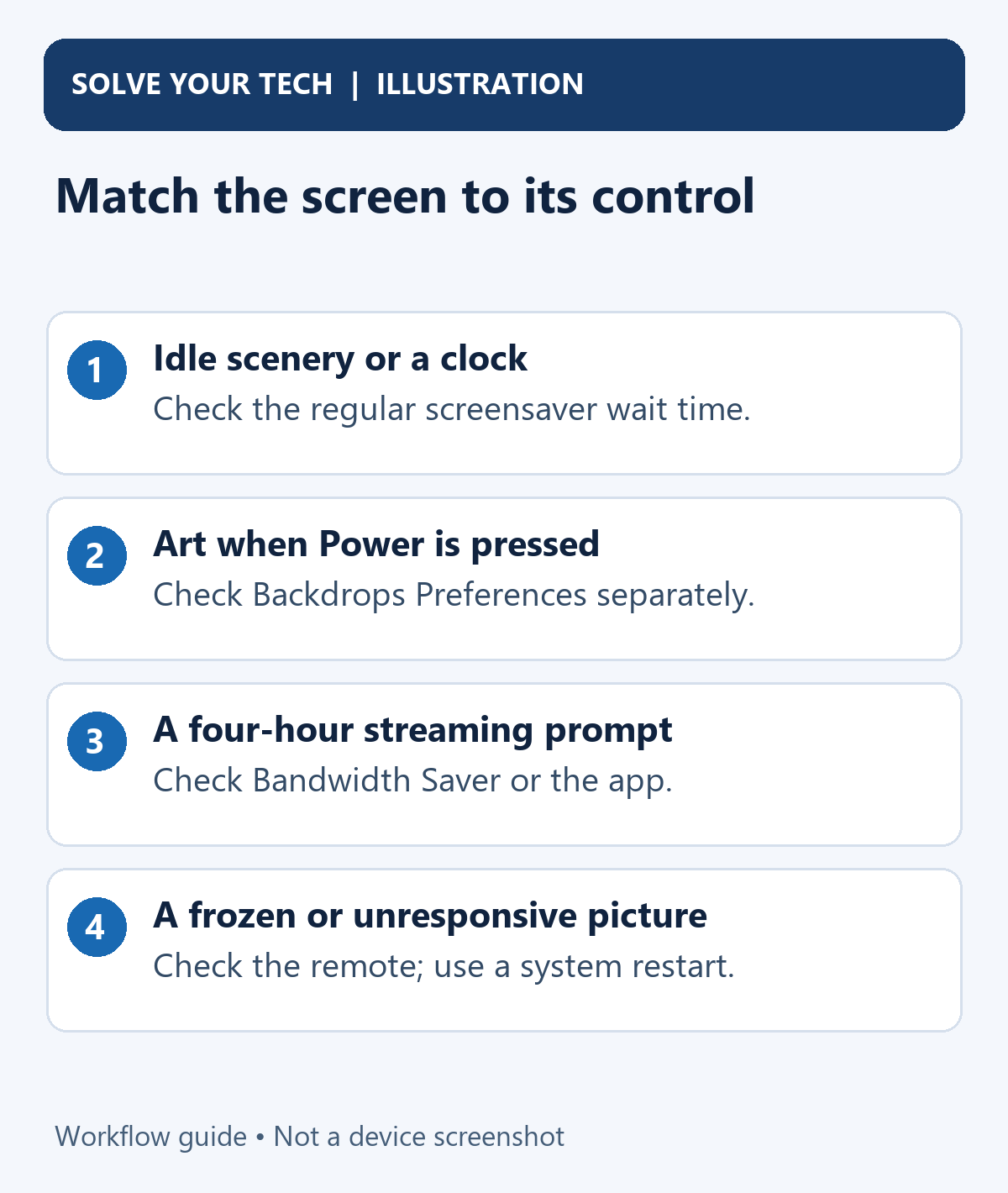
Use these clues to choose your next step:
- An idle Roku scene or clock appears: Check the screensaver wait time in Theme settings.
- Art appears when you try to switch off a Roku TV: Check the separate Backdrops app and its preferences.
- A message asks whether you are still watching after four hours: Check Roku Bandwidth Saver. Some streaming services also have their own prompts.
- The entire television turns off or the screen goes black: Check the TV's sleep or power settings rather than assuming its screensaver is still active.
- A picture will not respond to Home or other remote buttons: Treat that as a control or frozen-device problem and use the troubleshooting section below.
If you only dislike the current scenery, you can select a different screensaver or use a longer wait time instead of disabling it. Our guide to setting a clock as a Roku screensaver explains one alternative.
Disable the regular screensaver
These are the current menu steps documented in Roku's screensaver support guide. You need a remote that can operate the device's Home screen and Settings menu.
- Press Home on your Roku remote. You should see the Roku Home screen and its navigation menu. If you are using a separate player, make sure the TV is on that player's HDMI input.
- Move to Settings and select it. Use the directional pad to navigate and OK to choose the highlighted item.
- Select Theme. This is where the current Roku menu groups its appearance controls.
- Select Screensaver wait time. This controls how long the Roku waits before starting its idle screensaver; it is separate from choosing which screensaver is installed.
- Choose the option that disables the screensaver. Your software may describe it as disabling the screensaver rather than showing a numbered wait time.
- Press OK to save the selection. Return to the wait-time setting once to confirm that the disabled option remains selected.
- Return to Home and leave the device idle long enough to pass the previous timer. Confirm that the regular screensaver no longer starts. If another type of screen or power change occurs, match it to the features described below.

You do not need to uninstall every screensaver, remove your Roku account, or factory reset the TV to change this timer. Choosing a different screensaver under Theme > Screensavers changes its appearance; that is not the same operation as disabling its start time.
If your TV has the older Screensaver menu
Some older TV software puts Screensaver directly inside Settings. Element's older Roku TV instructions use this route:
- From the Home screen, open Settings.
- Choose Screensaver, then Change Wait Time.
- Select Disable Screensaver and confirm the selection shown on the TV.
Use the route your screen actually provides. Do not try to find a Theme submenu inside the older Screensaver menu or assume a setting is unavailable just because its label differs from the current instructions.
If neither route appears, note the model number from the TV or player's label and check the software version on the software-update screen described below. Inspect the related appearance settings as well. The television manufacturer's model-specific guide can clarify older menu arrangements.
Turn the screensaver back on, or choose a longer delay
Return to the same wait-time menu, choose one of the available time intervals, and press OK. Then leave the Roku idle on Home to check that the chosen scene starts after the selected delay.
If the wrong scene starts, open Settings > Theme > Screensavers, select an installed option under My screensavers, open its details, and choose Set as screensaver. This lets you check the appearance separately from the timer. If the Roku TV picture itself looks too dim or too bright, change the Roku TV brightness in the picture settings instead.
You can browse additional screensavers in that menu. Review their details and previews before installing anything; some are free and others require a purchase. You do not need to buy a new screensaver to disable the old one. Roku changes its default selections from time to time, and the choices can vary by device.
For example, if you want more time to read the Home menu before a clock appears, a longer delay may fit better than turning the feature off entirely. Record the original time before changing it so you can easily restore that preference.
For broader appearance changes, see changing the Roku theme. A theme pack can change several parts of the interface, so recheck the screensaver selection and timer after making other appearance changes if the result is unexpected.
If the screen is showing Backdrops artwork
Backdrops is a separate artwork feature. Disabling the regular idle screensaver does not disable it. Roku's current Backdrops instructions provide this route:
- Open the Backdrops app. One documented entry point is Settings > Home Screen Menu > Backdrops > Open Backdrops app.
- Select the gear icon and open Backdrops Preferences.
- Select Backdrops (Enabled), then choose Disabled. Check that the preference now shows the disabled state.
On a Roku TV, a quick press of Power can start Backdrops. Roku says to hold Power for three seconds to turn the TV off instead. That Backdrops power-button behavior is specific to Roku TVs; it is not supported by a Streaming Stick connected to another TV.
Backdrops also has a daily stop timer, which Roku distinguishes from the TV's Sleep Timer. Choose the control that matches what you want the television to do.
If streaming stops after four hours
Roku Bandwidth Saver looks for remote or mobile-app activity during streaming. After four hours without that activity, it can ask whether you want to keep streaming. If you do not respond, playback stops and the device returns to Home. That is a separate feature from the idle screensaver.
To disable that Roku prompt for all apps, open Settings > Network > Bandwidth saver and choose Off. The prompt can also offer Don't ask again for this app for an individual app. Roku's Bandwidth Saver guide explains both choices.
Before changing it, consider whether you want streaming to continue unattended, particularly if your internet plan has a data cap. Disabling Roku's control does not disable a streaming service's own “still watching” mechanism. If only one app stops, check that app's behavior rather than repeatedly changing the screensaver timer.
Troubleshoot a screensaver that will not go away
Check the remote and the TV input
Press Home and see whether the Roku responds. If the remote is not controlling the device, replace matching disposable batteries or charge a rechargeable remote. For a separate Roku player, confirm that you are watching its HDMI input; changing the TV's native settings will not change the player's Roku menu.
If Home works but the screen returns later, inspect the screensaver wait time and identify whether the returning display is regular scenery, Backdrops artwork, or an app screen. Make one relevant change, save it, and check its effect before changing several other preferences.
Restart a frozen device
If the picture remains stuck and normal controls do not respond, a system restart is a useful next step. Roku distinguishes a system restart from simply pressing the TV's Power button.
Use Settings > System > Power > System restart. If your model does not have a Power submenu, choose System restart directly under System. If the menus are unresponsive, Roku documents unplugging the device's power cord for at least ten seconds, then reconnecting it.
A system restart preserves your settings. Follow our Roku restart guide for the complete procedure. A factory reset erases device setup information and is not the routine next step for disabling an idle scene. If another problem does call for one, here is how to factory reset a Roku.
Check for software updates when menus or behavior remain unexpected
Open Settings > System > Software update > Check Now. Older layouts may call the screen System update. If software or app updates are available, allow their installation and the resulting reboot to finish, then check the screensaver setting again.
Roku's software-update instructions also explain where the version and last-update information appear. An update check does not guarantee that an older device will gain every newer appearance feature.
If the problem remains, record the TV or player model, software version, exact setting selected, and what appeared during the idle check. Those details help the television manufacturer or Roku support distinguish a menu change from a frozen device or a separate power feature.
Frequently asked questions
Does disabling the screensaver stop my Roku TV from turning off?
It changes the regular idle scene. TV power savings, Sleep Timer, Backdrops, and app inactivity features can still behave separately. Check the feature responsible for the actual change you see.
Why do the instructions for my TV look different?
Roku software has used different menu arrangements. Current documentation places the wait time under Theme; some older TV guides use Screensaver and Change Wait Time. Follow the matching menu on your device.
Can I keep the clock but stop other screensavers?
Choose a clock under Theme > Screensavers and leave a wait time enabled. Disabling the regular screensaver timer also stops an automatically started clock screensaver using that timer.
Will these steps remove screensaver apps?
No. The timer choice controls automatic starting. Installed screensaver choices can remain available if you later want to turn the feature back on.
Is a static screen safe to leave up indefinitely?
Do not treat the disabled timer as a guarantee of display protection. Follow your TV manufacturer's guidance about static images and panel care, and turn the television off when you are finished using it.
Start by disabling the regular wait-time setting and confirming that it stays selected. If the behavior you wanted to stop remains, use the screen's appearance and timing to identify the separate control that needs attention.

Matthew Burleigh has been writing tech tutorials since 2008. His writing has appeared on dozens of different websites and been read hundreds of millions of times.
After receiving his Bachelor’s and Master’s degrees in Computer Science he spent several years working in IT management for small businesses. However, he now works full time writing content online and creating websites.
His main writing topics include iPhones, Microsoft Office, Google Apps, Android, and Photoshop, but he has also written about many other tech topics as well.