To make your iPad wait longer before it locks, open Settings, tap Display & Brightness, tap Auto-Lock, and choose a longer time or Never. If Auto-Lock is gray or won’t stay changed, Low Power Mode, Guided Access or a school or work profile is usually the reason.
These steps are for iPadOS 27 and iPadOS 26 on every iPad model, and they follow Apple’s iPad guide to keeping the display on longer. Older versions of iPadOS use the same path.
What Auto-Lock Does
Auto-Lock is the timer that decides how long your iPad waits, with no taps or swipes, before the screen dims and then turns off and locks. When you wake it again, you unlock it with Face ID, Touch ID or your passcode, if you’ve set one.
A short timer saves battery and protects your apps if you walk away. A longer one helps when you’re reading, following a recipe or a sheet of music, or watching someone else’s slideshow without touching the screen.
How to Change Auto-Lock on iPad
- Open the Settings app from the Home Screen.
- Tap Display & Brightness in the sidebar on the left.
- Tap Auto-Lock on the right side of the screen. A list of time choices opens, with a check mark next to your current setting.
- Tap a longer time, or tap Never. The check mark moves to your choice, and the change takes effect right away.

On most iPads, the choices are 2, 5, 10 and 15 minutes, plus Never. With Never, the iPad no longer locks on its own, but you can still lock it with the top button. Apple notes that delaying or preventing Auto-Lock may increase power consumption, so expect the battery to drain faster when the screen stays on.
Which time to pick
| Choice | Good for |
|---|---|
| 2 minutes | Everyday use, carrying the iPad around, saving battery |
| 5 minutes | Reading articles or email at a normal pace |
| 10 or 15 minutes | Recipes, sheet music, long documents or slides you read without touching |
| Never | Short jobs where the screen must stay on, ideally while the iPad is plugged in |
Check that it worked
Open a screen that doesn’t move, such as Settings, and leave the iPad alone. It should dim and lock after about the time you chose. Don’t test with a video playing, because video apps can keep the screen awake on their own.
To undo the change, go back to Settings > Display & Brightness > Auto-Lock and pick a shorter time.
Auto-Lock and the Lock / Unlock switch
If you use a compatible cover or case, you may see a Lock / Unlock switch just below Auto-Lock. It locks the iPad when you close the cover and wakes it when you open it. It doesn’t change the Auto-Lock timer, so you can leave it on.
Can’t Change Auto-Lock?
If the Auto-Lock time is gray, or your iPad keeps going back to a short time, check these:
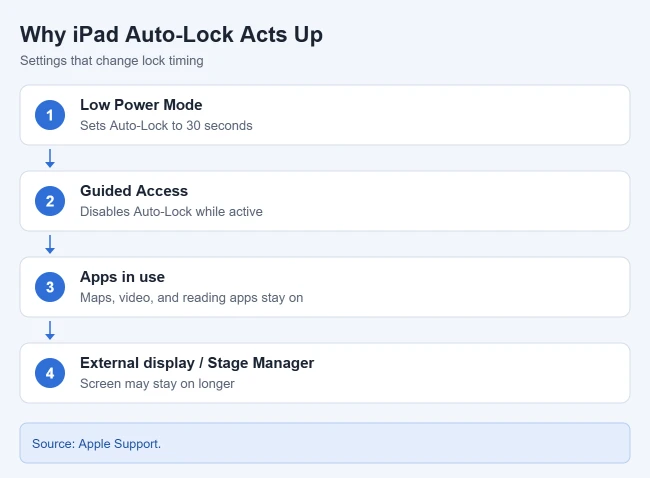
- Low Power Mode is on. Apple’s Low Power Mode article lists a shorter Auto-Lock among the changes the mode makes, and the Auto-Lock setting can’t be changed while it’s on. Apple’s article names 30 seconds, the iPhone’s shortest choice. On iPads, which don’t have that option, owners in the Apple Support Community report it stays at 2 minutes. Go to Settings > Battery, turn off Low Power Mode, then open Auto-Lock again. Low Power Mode also turns off by itself once the battery charges to 80% or higher. This Low Power Mode guide covers the other ways to switch it off.
- Guided Access is running. Guided Access locks the iPad to one app and uses its own timer. Apple’s Guided Access article says you set it under Settings > Accessibility > Guided Access > Display Auto-Lock. To end a session, triple-click the top button (or the Home button), enter the Guided Access passcode, and tap End.
- A school or work profile manages the iPad. Organizations can set a maximum Auto-Lock time. Apple’s passcode management settings list a Maximum Auto-Lock option that can limit the choices to a few minutes. Check Settings > General > VPN & Device Management, and ask the school or IT team if you need a longer time. Don’t remove the profile to get around it.
- The setting still won’t respond. Restart the iPad, then try again. If that doesn’t help, install any iPadOS update in Settings > General > Software Update.
Why Isn’t My iPad Screen Turning Off?
The opposite problem has its own causes:
- Auto-Lock is set to Never. Change it with the steps above.
- An app is in use. Many apps, such as Maps, video players, and reading apps, prevent the iPad from locking while they’re actively being used.
- An external display or Stage Manager is on. The screen may stay on longer than your Auto-Lock setting, and the iPad stays active while content is shown on the external screen.
- Attention Aware Features is on. On an iPad with Face ID, the screen won’t dim while you’re looking at it. To turn this off, open Settings > Face ID & Passcode, enter your passcode, and turn off Attention Aware Features. Leave Require Attention for Face ID alone, because it controls unlocking, not the screen timer. iPads with Touch ID don’t have this setting. See Apple’s Face ID and attention settings guide.
- Guided Access is running with a long Display Auto-Lock. End the session, or shorten the time in the Guided Access settings.
Keep the Screen On Only for One App
If one app locks the screen too soon, look in that app’s own settings for an option to keep the screen on or stop Auto-Lock. Many reading, music and recipe apps have one. That way you can keep a short Auto-Lock time for everything else.
For a presentation or a child’s video, Guided Access is another option. Its Display Auto-Lock setting only applies during a session, and your normal Auto-Lock time comes back when you end it.
If a second app keeps opening beside the one you want, here is how to get rid of split screen on iPad.
Auto-Lock Isn’t the Same as the Passcode Setting
Auto-Lock decides when the screen turns off. Your passcode, Face ID or Touch ID decides what it takes to get back in. Making Auto-Lock longer doesn’t turn off your passcode, and Apple doesn’t let you delay when the passcode is required if you use Face ID, Touch ID or Apple Pay. If you’re tired of unlocking, a longer Auto-Lock time is the safer fix. To review your lock settings, follow the steps to set a passcode to unlock your iPad.
Auto-Lock doesn’t remove the code itself; to do that, turn off the passcode on iPad.
How to Lock Your iPad Right Away
Press the top button once. The screen turns off and the iPad locks, no matter what Auto-Lock is set to. Closing a compatible cover does the same thing when Lock / Unlock is on. This is a good habit if you set Auto-Lock to Never or a long time.
Frequently Asked Questions
What’s the best Auto-Lock time for an iPad?
Use the shortest time that doesn’t interrupt what you’re doing. For most people, that’s 2 or 5 minutes. Switch to 10 minutes, 15 minutes or Never for a specific task, then switch back when you’re done.
Is it safe to set Auto-Lock to Never?
It works, but anyone who picks up your iPad can use it while it’s unlocked, and it may use more power. Lock the iPad with the top button when you put it down.
Why is my iPad Auto-Lock stuck on 2 minutes?
Low Power Mode is the most common reason. Turn it off in Settings > Battery, and the other Auto-Lock times become available again. If Low Power Mode is already off, check for a school or work profile under Settings > General > VPN & Device Management.
Does music stop when the iPad auto-locks?
Music and podcast apps keep playing with the screen off, and you can control them from the Lock Screen. You don’t need a longer Auto-Lock time just to keep audio going.
Does changing Auto-Lock on my iPad change my iPhone too?
No. Each device has its own Auto-Lock setting, and the iPhone has different choices. To change it there, change the lock screen timeout on iPhone.

Matthew Burleigh is the founder, head writer, and editor of Solve Your Tech, which he launched in 2012. He has written technology tutorials since 2008 and worked in IT since 2003, including small-business support, IT management, and consulting. He holds Bachelor’s and Master’s degrees in Computer Science from Arizona State University.
Matthew writes practical guides for Windows, iPhone and iPad, Microsoft Office, Outlook, Google apps, and Android. Solve Your Tech’s guides are checked step by step against the device or app maker’s own documentation and tested on his own devices whenever he has the hardware or software, with clear steps, sources, and update dates.
Read more about Matthew and how Solve Your Tech writes and updates its guides, or report a correction.