To hide the toolbar in PowerPoint’s full-screen slide show, select File > Options > Advanced, scroll to Slide Show, clear Show popup toolbar, and select OK. To hide it during one show without changing the setting, press Ctrl+H after the show starts.
These steps are for PowerPoint for Windows: Microsoft 365, PowerPoint 2024, 2021, 2019 and 2016. PowerPoint 2013 uses the same File > Options > Advanced path. Microsoft documents the checkbox on its PowerPoint Options (Advanced) page.
How to turn off the popup toolbar
The popup toolbar is the faint row of buttons that shows up in the lower-left corner of the screen when you move the mouse during a full-screen slide show. It lets you move between slides and add annotations.
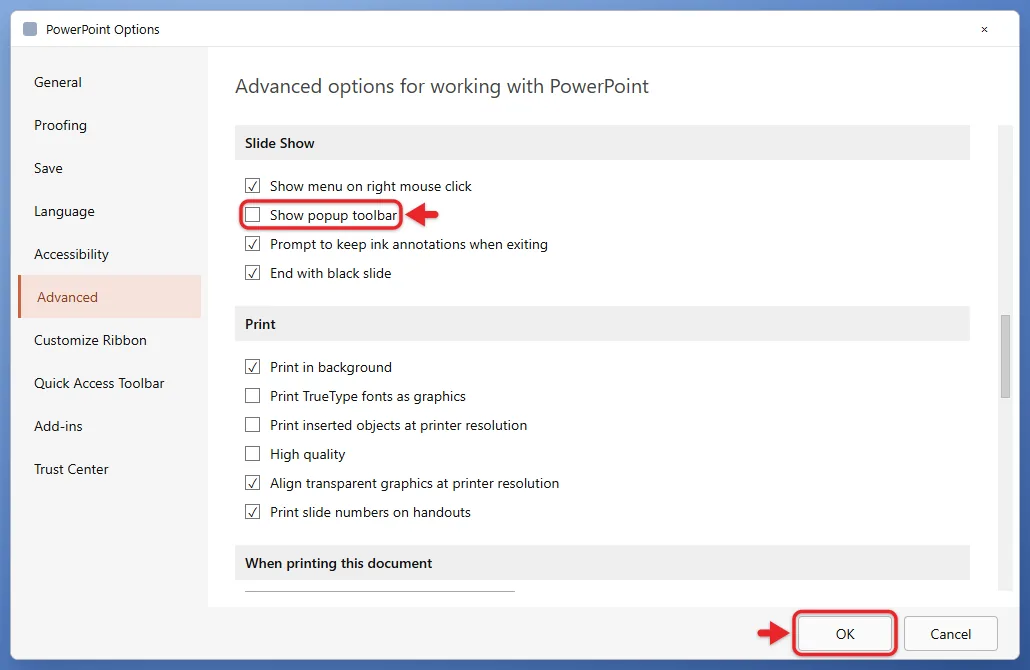
- Open PowerPoint and select File, then Options at the bottom of the left pane. The PowerPoint Options window opens.
- Select Advanced in the left column.
- Scroll down the right side to the Slide Show heading.
- Clear the Show popup toolbar check box.
- Select OK to save the change and close the window.
To confirm it worked, press F5 to start the show and move the mouse to the bottom-left corner. No buttons appear. Press Esc to return to editing.
The setting belongs to PowerPoint, not your file. It applies to every presentation on that computer until you turn it back on. On a borrowed laptop or conference room PC, that computer’s setting counts, so check it before you present.
If your show includes an interactive menu, such as a drop-down list in PowerPoint, rehearse it on the presenting computer too, since its ActiveX and macro settings can block the control.
Example: The Popup Toolbar Setting
In PowerPoint for Microsoft 365 on a Windows 11 laptop, File > Options > Advanced has a Slide Show section with four check boxes: Show menu on right mouse click, Show popup toolbar, Prompt to keep ink annotations when exiting, and End with black slide. All four were checked.
Show popup toolbar is the one that controls the small toolbar in the bottom-left corner during a full-screen show. Unchecking it and clicking OK hides it for every presentation.

Hide it for one show only with Ctrl+H
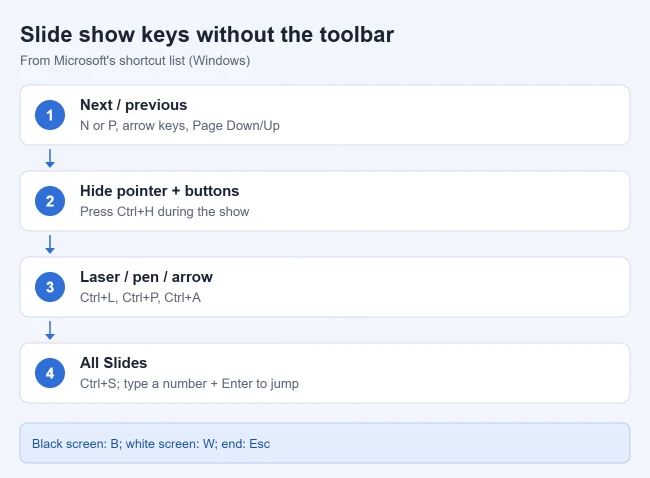
For a single talk, leave the setting alone. Start the show, then press Ctrl+H. Microsoft’s slide show keyboard shortcuts list Ctrl+H as the key that hides the pointer and navigation buttons. Press Ctrl+A if you need the arrow pointer back. The change lasts only for that show.
Keyboard shortcuts to use without the toolbar
With the toolbar gone, the keyboard does the same jobs. These are the Windows keys from Microsoft’s list:
| To do this | Press |
|---|---|
| Next slide or animation | N, Enter, Spacebar, Page Down, Right arrow or Down arrow |
| Previous slide or animation | P, Backspace, Page Up, Left arrow or Up arrow |
| Jump to a slide | Type the slide number, then press Enter |
| See all slides | Ctrl+S |
| Laser pointer | Ctrl+L |
| Pen, then back to the arrow | Ctrl+P, then Ctrl+A |
| Eraser for pen marks | Ctrl+E, or E to erase everything |
| Black or white screen | B or W (press again to return) |
| End the show | Esc |
A presenter remote usually sends Page Down and Page Up, so it keeps working. Forget a key mid-talk? Press F1 for the full list.
The same Slide Show section has Show menu on right mouse click. Clearing it stops the shortcut menu from appearing when you right-click a slide. With the toolbar off, that menu is your mouse route to See All Slides, pointer options and End Show, so leave it on unless you never use the mouse.
Other ways to remove the controls
Kiosk mode. On the Slide Show tab, select Set Up Slide Show, choose Browsed at a kiosk (full screen) and select OK. Microsoft’s self-running presentation guide says the show loops until someone presses Esc. This is for unattended displays, not a speaker-led talk, because the slides need saved timings to move on their own. To record them, follow the steps for setting the time between slides in PowerPoint.
Kiosk shows depend on clickable objects, and you can also make things appear with clickable buttons on a slide.
Export a video. A video has no slide show controls at all. If you are sending the deck to people who will only watch it, turn the PowerPoint into a video.
When the Buttons or Taskbar Still Show
The buttons still appear
Make sure you changed the setting on the computer you are presenting from. If you opened the deck in a web browser, the desktop setting does not apply. A Microsoft Q&A moderator confirmed that the controls in the online PowerPoint viewer can’t currently be removed, even with Show popup toolbar cleared and kiosk mode on. Present from the desktop app instead.
The Windows taskbar shows during the show
That is a separate problem from the popup toolbar. In a Microsoft Q&A thread, the suggested fixes were to clear Show popup toolbar and restart PowerPoint, check Set Up Slide Show for Presented by a speaker (full screen), and, if it continues, run a Quick Repair of Office from Windows Settings.
You use a Mac
The Show popup toolbar check box is part of PowerPoint for Windows options. On a Mac, press / (forward slash) to show the slide show shortcut list during a show, and the hyphen key or Command+Period to end it.
Slide Show Toolbar Questions
How do I get the toolbar back?
Select File > Options > Advanced, scroll to Slide Show, check Show popup toolbar, and select OK. For a show where you pressed Ctrl+H, end the show and start it again.
Does hiding the toolbar hide my notes or Presenter View?
No. Presenter View is controlled by Automatically extend display when presenting on a laptop or tablet, higher on the Advanced page. Clearing that box turns Presenter View off.
Will the people I send the file to see the toolbar?
Their own PowerPoint decides. The setting lives in each person’s copy of PowerPoint, not in the presentation, so turning it off on your computer doesn’t change what they see.
Does hiding the toolbar remove the black slide at the end?
No. That is a separate option in the same section, End with black slide. Clear it if you want your last slide to be the final thing the audience sees.
If you plan to keep some slides in reserve for questions, you can hide a slide in PowerPoint next.

Matthew Burleigh is the founder, head writer, and editor of Solve Your Tech, which he launched in 2012. He has written technology tutorials since 2008 and worked in IT since 2003, including small-business support, IT management, and consulting. He holds Bachelor’s and Master’s degrees in Computer Science from Arizona State University.
Matthew writes practical guides for Windows, iPhone and iPad, Microsoft Office, Outlook, Google apps, and Android. Solve Your Tech’s guides are checked step by step against the device or app maker’s own documentation and tested on his own devices whenever he has the hardware or software, with clear steps, sources, and update dates.
Read more about Matthew and how Solve Your Tech writes and updates its guides, or report a correction.