To change line spacing on every slide at once in PowerPoint, click View > Slide Master, click the large slide master at the top of the left pane, select the text placeholders, and pick a spacing from Home > Line Spacing. Click Close Master View. Every slide that uses those layouts updates.
This guide covers the Slide Master method, setting spacing per layout, fixing slides that don’t follow the master, exact spacing values, and the single-slide method. Slide Master and spacing details come from Microsoft’s guide to customizing a slide master and Microsoft’s spacing guide.
How to Change Line Spacing on Every Slide
- Click View > Slide Master.
- Click the top (largest) slide in the thumbnail pane. Microsoft notes that the slide master is the larger image at the top, with its layouts below it.
- Click the border of the body text placeholder to select it.
- Click Home > Line Spacing and choose 1.0, 1.5, 2.0, or Line Spacing Options.
- Click Slide Master > Close Master View.
Result: text in the body placeholders on your slides takes on the new spacing. Changes made to the top-level master flow down to every slide, whatever layout it uses.

Change spacing for one layout only
If you only want certain kinds of slides to change, click one of the smaller layout thumbnails under the master instead. Changes there only affect slides that use that layout. You can set spacing for each outline level in the body placeholder, such as more space after first-level bullets than second-level ones.
Why Some Slides Don’t Change
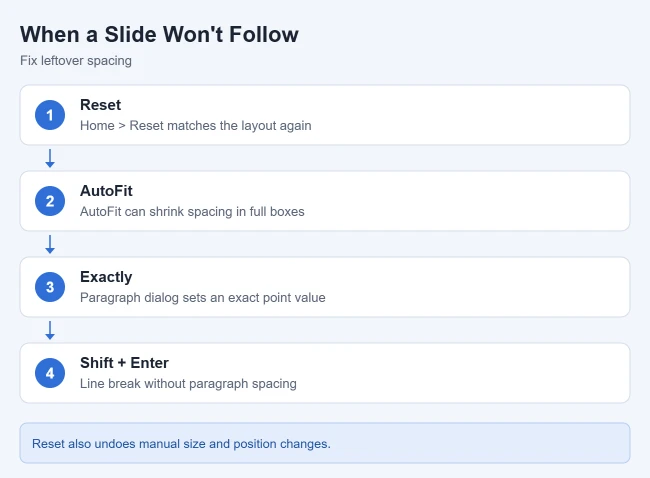
Text you already formatted by hand on a slide keeps its own spacing, because direct formatting wins over the master. The fix is to select the placeholder and click Home > Reset (in the Slides group) so it matches the layout again. Reset also undoes any size and position changes you made by hand, so check the slide afterward.
The master’s settings apply to its placeholders, so text boxes you added yourself with Insert > Text Box may not follow them. SmartArt graphics, such as a PowerPoint timeline, also manage their own text spacing. Change those on the slide itself.
AutoFit can also change spacing. Microsoft’s spacing guide explains that when text runs out of room in a placeholder, AutoFit adjusts line spacing and font size to fit. To stop that, click the AutoFit Options button and choose Stop Fitting Text to This Placeholder.
How to Set an Exact Line Spacing Value
The Line Spacing button only lists round presets. For anything finer, select the text (or the master placeholder) and click the dialog box launcher in the Paragraph group on the Home tab. Microsoft lists these options:
- Single, 1.5 Lines or Double.
- Exactly: a point value between 0 and 1584 in the At box.
- Multiple: any value up to 9.99, where 1 is single spacing and 3 is triple.
- Before and After: space above or below each paragraph.
How to Change Line Spacing on One Slide
Per Microsoft’s spacing guide, select the text, then use Home > Line Spacing, or open the Paragraph dialog for exact settings. If you need a new line without the extra paragraph spacing, a Microsoft Q&A answer from a PowerPoint MVP suggests pressing Shift + Enter for a line break instead of Enter.
Frequently Asked Questions
Is there a “Select All Text” option for every slide?
Some guides describe one, but we couldn’t confirm it in Microsoft’s documentation. The Slide Master is the reliable way to change spacing across the whole deck.
Can I save the spacing for future presentations?
Yes. Microsoft says you can save the presentation as a template with File > Save As and the template file type, so new decks start with your master settings.
Related Guides
- How to outline text in PowerPoint
- How to save PowerPoint as a Word document
- How to make a timeline in PowerPoint

Matthew Burleigh is the founder, head writer, and editor of Solve Your Tech, which he launched in 2012. He has written technology tutorials since 2008 and worked in IT since 2003, including small-business support, IT management, and consulting. He holds Bachelor’s and Master’s degrees in Computer Science from Arizona State University.
Matthew writes practical guides for Windows, iPhone and iPad, Microsoft Office, Outlook, Google apps, and Android. Solve Your Tech’s guides are tested on current devices or checked against official product documentation, with clear steps, sources, and update dates.
Read more about Matthew and how Solve Your Tech writes and updates its guides, or report a correction.