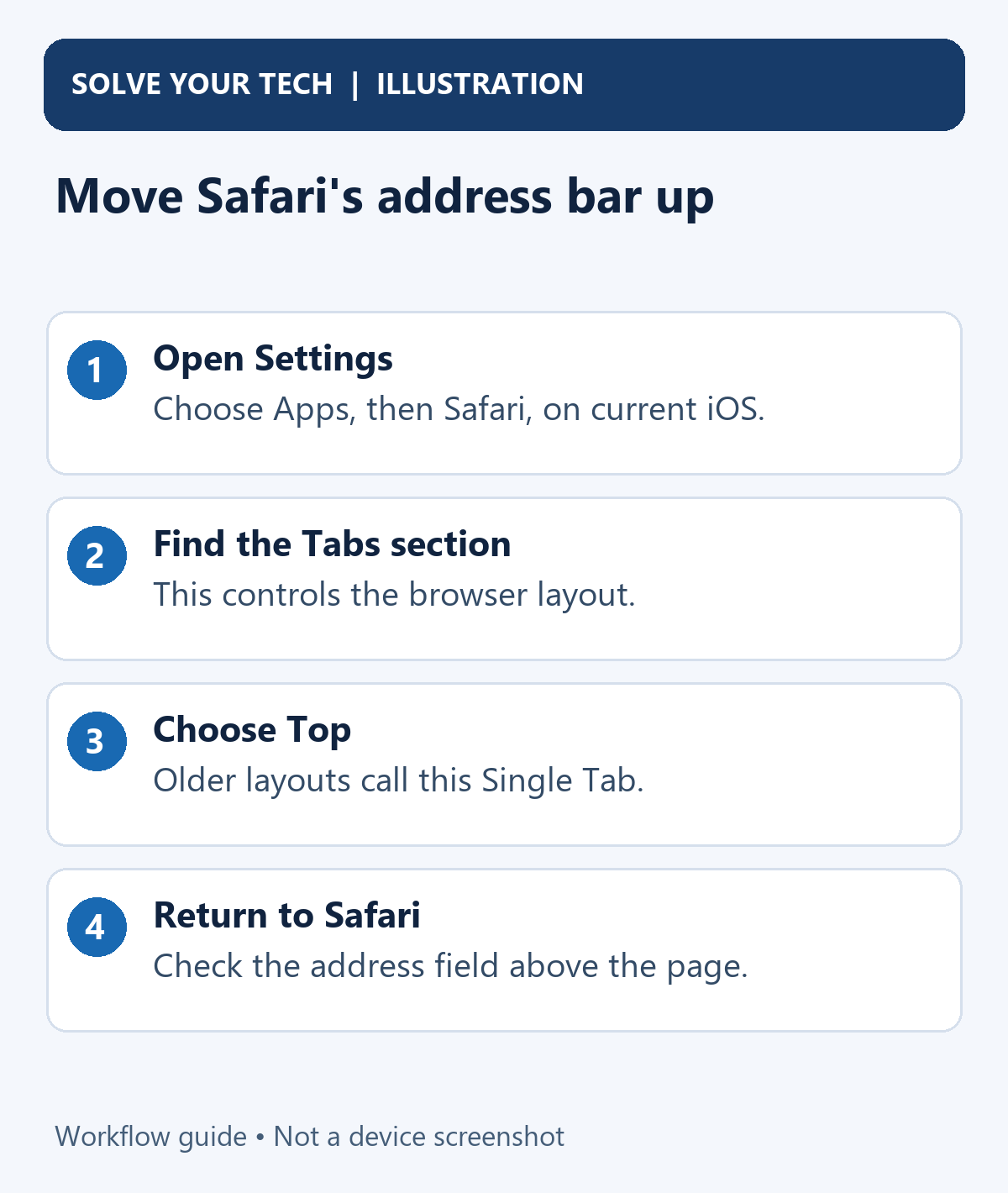
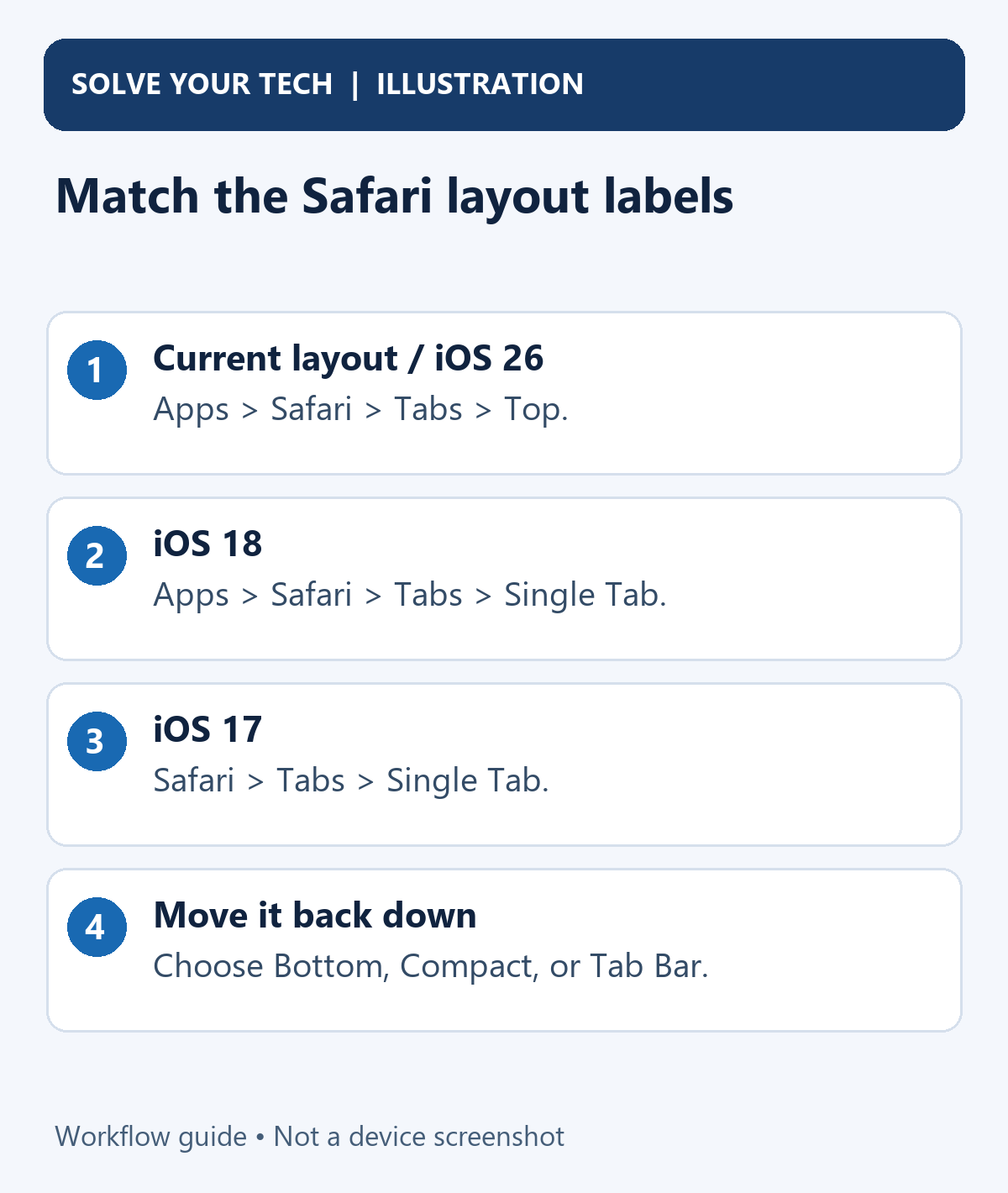
To move Safari's address bar to the top on iPhone with iOS 26 or the current layout, open Settings > Apps > Safari, scroll to Tabs, and choose Top. On iOS 18, choose Single Tab in the same section. On iOS 17, open Settings > Safari > Tabs > Single Tab.
The iPhone model is not the deciding factor here: the menu labels come from its installed iOS version. This works for an iPhone 13 using the corresponding software, as well as other supported iPhone models.
Before you start
Make sure you are changing the settings for Apple's Safari browser. Chrome, Edge, and a browser window embedded inside another app have their own interfaces. Changing Safari's tab layout will not rearrange every screen that can display a webpage. The iPad uses different layout names, so see how to change the Safari tab bar on iPad for that device.
If the instructions do not match your settings, open Settings > General > About and check iOS Version. In particular, newer versions place Safari inside Apps, while older versions list Safari directly on the main Settings screen.
You can change the layout without deleting your browsing history or closing all your tabs. Keep a familiar webpage open so you can check the result immediately afterward. Remember your original layout if you want to switch back.
Move the address bar to the top in the current Safari layout
- Open Settings on the iPhone.
- Tap Apps. Find and select Safari in the app list.
- Scroll down to Tabs. This is the layout section inside Safari settings; you are not selecting a webpage tab.
- Choose Top. Select the layout preview labeled Top.
- Return to Safari. Open your webpage and check that the address and search field is above the page.
You can tap that field to enter another website address or search term. If you had Safari open while changing the setting, returning to the browser is the useful check; the Settings preview alone does not show your actual browsing screen.
Apple documents these choices in its Safari layout guide. Its iOS 26 version uses the same Compact, Bottom, and Top labels.
What Top, Bottom, and Compact mean
The three current choices change the position and arrangement of the tab bar and nearby controls:
| Layout | Address and tab bar position | Other controls |
|---|---|---|
| Top | Expanded, above the webpage | Additional controls at the bottom |
| Bottom | Expanded, below the webpage | Additional controls at the bottom |
| Compact | Compressed, below the webpage | Additional controls on both sides of the bar |
Choose Top when your priority is having the address field above the content. Some browsing controls still appear at the bottom in this layout, so their position is not evidence that you selected the wrong option.
If you prefer entering an address nearer your thumb, try a bottom layout instead. Compare the choices on the same page and select the one that is most comfortable for you. You do not need to change page zoom to evaluate where the address field sits.
Move the address bar to the top on iOS 18
The setting is in Apps on iOS 18, but its name is different:
- Open Settings > Apps > Safari.
- Scroll to Tabs.
- Select Single Tab.
- Return to Safari and check the field above the webpage.
Here, Tab Bar is the bottom-position choice. Single Tab selects the top arrangement; the name does not mean you must keep only one webpage open.
If a newer guide tells you to choose Top and that label is absent, do not search through unrelated privacy or website settings. Use the layout controls your version actually provides. Apple's iOS 18 Safari layout instructions show the Single Tab and Tab Bar choices.
Move the address bar to the top on iOS 17
On iOS 17, Safari appears directly in Settings:
- Open Settings.
- Scroll to Safari and tap it.
- Find Tabs.
- Choose Single Tab.
- Reopen Safari and confirm the address field is at the top.
Apple's iOS 17 layout guide confirms that path. If you have another older version, start by checking whether Safari is listed directly in Settings and inspect the labels in its Tabs section.
Change the layout while using VoiceOver
With VoiceOver enabled, the usual touchscreen gestures work differently. Move through controls with a one-finger swipe right or left, listen to the selected control's name, then double-tap to activate it. Follow the same version-specific Settings route above and activate Top or Single Tab when announced.
Return to Safari and explore the page's controls to confirm where the address field is now located. Do not interpret the position of your last VoiceOver selection as proof that the layout changed. The selected layout in Settings and the address field in Safari are the useful checks.
Apple's VoiceOver gesture reference explains selection and activation if these gestures are unfamiliar. Moving the address bar is a preference change; you can keep VoiceOver enabled throughout it.
Switch the address bar back to the bottom
Use the same path you followed to move it up:
- Current layout and iOS 26: open Settings > Apps > Safari > Tabs and choose Bottom or Compact.
- iOS 18: open Settings > Apps > Safari > Tabs and choose Tab Bar.
- iOS 17: open Settings > Safari > Tabs and choose Tab Bar.
Then return to Safari and compare the result. A layout preference is easy to reverse, so it is reasonable to try both positions before deciding which to keep.
If the address bar will not move
You cannot find Apps or Safari
Check the iOS version first. The missing Apps entry is often a sign that you should use the older Settings > Safari route. If Apps is present, open it and look for Safari there rather than expecting Safari in the older location.
Searching Settings for Safari can also help you locate its settings page. Once there, find the Tabs section and use the version's layout choices.
You see Single Tab instead of Top
Use Single Tab on the older layouts described above. Both choices serve the top-address-bar goal in their respective versions. Do not treat a missing Top label as a requirement to reset the phone.
The buttons are still at the bottom
Check the address field itself. In the current Top layout, additional controls remain at the bottom. The setting places the tab bar above the webpage; it does not move every Safari button to the upper edge.
You changed the preview, but another app looks the same
Open Safari directly from its app icon and check a webpage there. An article opened inside a social app or an email app may be displayed in a different browser view. Safari's main app layout is the relevant place to verify this change.
The saved layout seems unchanged in Safari
Return to Safari settings and check which choice is selected. If the intended choice is saved but the browser still looks wrong, close and reopen Safari, then inspect a normal webpage again. Restarting the phone is a later troubleshooting step if the setting genuinely fails to apply. The layout choice does not affect the picture behind a new tab; for that, see how to change the Safari background on iPhone.
Clearing website data is not part of the normal layout procedure. It creates extra work signing back into websites without addressing which layout option is selected.
Address bar position, tabs, and page zoom are separate
Moving the field changes the browser arrangement. It does not select a different website, organize your open tabs, or adjust the size of the text within a page.
If you also want to manage open pages, see our guide to opening, finding, and closing Safari tabs on iPhone. If a page still feels difficult to read after moving the address field, review Safari's separate zoom controls after confirming the layout. Our guide to zooming in or out in Safari on iPhone covers them.
Keeping these choices separate makes troubleshooting easier: first confirm the field is in the preferred location, then adjust the page or tabs if needed.
Frequently asked questions
Does this work on an iPhone 13?
Yes, use the instructions for the iOS version installed on it. The same iPhone model can show different labels after a software update.
Will Single Tab close my other Safari tabs?
It is a layout selection, not a command to close tabs. You can keep multiple webpages open while using the top arrangement. If the tab list gets crowded, you can set Safari to close tabs automatically after one week.
Can I put the bar at the top in Chrome with this setting?
No. This preference belongs to Safari. Inspect Chrome's own settings if you want to change its interface.
Do I need to install an extension?
No. The layout choices described here are built into Safari's settings.
Why does an old guide say Single Tab instead of Top?
Apple changed the labels and, in newer iOS versions, moved Safari's settings into Apps. Match the instructions to your version rather than the publication date of a guide.
Choose Top or Single Tab as appropriate, reopen Safari to check the address field, and use the same settings page whenever you want to reverse the change.

Matthew Burleigh is the founder, head writer, and editor of Solve Your Tech, which he launched in 2012. He has written technology tutorials since 2008 and worked in IT since 2003, including small-business support, IT management, and consulting. He holds Bachelor’s and Master’s degrees in Computer Science from Arizona State University.
Matthew writes practical guides for Windows, iPhone and iPad, Microsoft Office, Outlook, Google apps, and Android. Solve Your Tech’s guides are tested on current devices or checked against official product documentation, with clear steps, sources, and update dates.
Read more about Matthew and how Solve Your Tech writes and updates its guides, or report a correction.