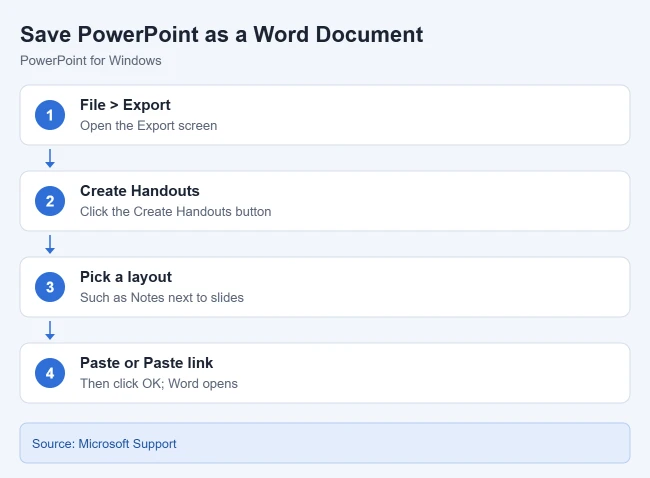
To save a PowerPoint file as a Word document, click File > Export > Create Handouts, then click the Create Handouts button. Pick a page layout, like Notes next to slides or Outline only, choose Paste or Paste link, and click OK. Your presentation opens as a Word document that you can edit, print, or save.
The Windows steps and the fixes for failed exports come from Microsoft’s guide to editing PowerPoint handouts in Word. The Mac workaround comes from Adobe’s PowerPoint to Word guide. One thing to know first: This export places your slides in Word as thumbnail pictures, not as editable text boxes.
How to Save PowerPoint as a Word Document
- Open the presentation in PowerPoint.
- Click File > Export.
- Under Export, click Create Handouts, then click the Create Handouts button under Create Handouts in Microsoft Word.
- In the Send to Microsoft Word box, click the page layout you want.
- Choose Paste or Paste link, then click OK.
Result: Microsoft says the presentation opens as a Word document in a new window, where you can edit, print, or use Save As like any other Word file.
Which Page Layout Should You Pick?
The Send to Microsoft Word box has five layouts. Pick a “notes” layout to include your speaker notes, a “blank lines” layout for audience handouts, or Outline only for the text alone:
- Notes next to slides: slide thumbnails with your speaker notes beside them.
- Blank lines next to slides: room for your audience to write notes.
- Notes below slides: one slide per page with notes underneath.
- Blank lines below slides: one slide per page with writing lines.
- Outline only: just the slide text, with no pictures.
The slide layouts put the thumbnails in a table, so you can format the table to change how the handout looks.
Paste or Paste Link?
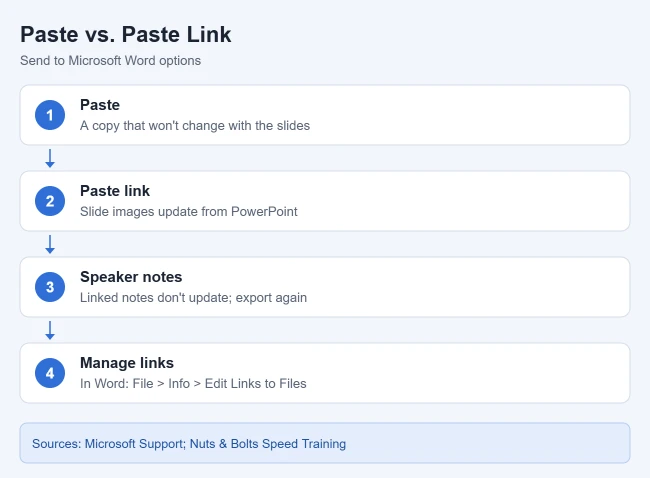
- Paste: Microsoft says this keeps the Word content unchanged when you update the presentation.
- Paste link: Microsoft says updates to the original presentation are reflected in the Word document.
There are two caveats about Paste link. Only the slide thumbnails stay linked, so changes to speaker notes won’t carry over unless you export again. And changes you make to the thumbnails in Word don’t go back to PowerPoint. In Word, File > Info > Edit Links to Files lets you update, change, or break those links.
How to Do It on a Mac
Adobe’s guide describes a different route for PowerPoint on a Mac, using a Rich Text Format file.
- In PowerPoint, click File > Export.
- Name the file and choose where to save it.
- Under File Format, choose Rich Text Format (.rtf), then click Export.
- Open the .rtf file in Word.
Result: the presentation’s content opens in Word, where you can save it as a Word document.
If Exporting Fails
Microsoft says exporting to Word uses a lot of memory, and longer files are harder to export. If you see “PowerPoint couldn’t write to Microsoft Word,” restart your computer, open only PowerPoint, and try again.
For a very large file, Microsoft suggests using Save As to make a second copy, deleting the slides that already exported from that copy, and exporting the rest. Then combine the two .docx files.
FAQs
Can I edit the slide text in Word?
Not in the slide thumbnails. You’d need to copy text slide by slide for that. Choose Outline only if you mainly need the text.
Do I need Word to make a PDF?
No. You can save the presentation as a PDF directly. See how to save PowerPoint as a PDF.
Related Guides
- How to save PowerPoint as a PDF
- How to change line spacing on every slide
- How to convert PowerPoint to Google Slides
- How to take a screenshot in PowerPoint

Matthew Burleigh is the founder, head writer, and editor of Solve Your Tech, which he launched in 2012. He has written technology tutorials since 2008 and worked in IT since 2003, including small-business support, IT management, and consulting. He holds Bachelor’s and Master’s degrees in Computer Science from Arizona State University.
Matthew writes practical guides for Windows, iPhone and iPad, Microsoft Office, Outlook, Google apps, and Android. Solve Your Tech’s guides are tested on current devices or checked against official product documentation, with clear steps, sources, and update dates.
Read more about Matthew and how Solve Your Tech writes and updates its guides, or report a correction.