To insert a square root symbol in Word, go to Insert > Symbol > More Symbols, type 221A in the Character code box, and select Insert. For a full square root over a number, press Alt + = to start an equation, type \sqrt(25), and press the spacebar.
These steps cover Word for Microsoft 365, Word 2024, 2021, 2019 and 2016 on Windows, with a separate section for Word on a Mac. They follow Microsoft’s symbol, Unicode character code and equation articles.
Which Method Should You Use?
There are two different things people mean by “square root” in Word, and the right method depends on which one you need.
| You want | Best method | What you get |
|---|---|---|
| √ in a sentence, like “√2 is about 1.41” | Symbol dialog, Alt + X, or Alt + 251 | A text character that stays the same size as your font |
| A root sign with a bar over the number | Equation (Alt + =) | A math object where the bar stretches over the whole number |
| √ many times in one document | AutoCorrect entry or custom shortcut | Your own code or key combination that types √ |
How to Insert the √ Symbol in Word
- Click where you want the symbol.
- Go to the Insert tab.
- Select Symbol, then More Symbols.
- Make sure from is set to Unicode (hex), then type 221A in the Character code box. The √ symbol is highlighted in the grid.
- Select Insert, then Close.
The √ symbol appears at your cursor. It’s ordinary text, so you can change its size with the Font Size setting like any other character.
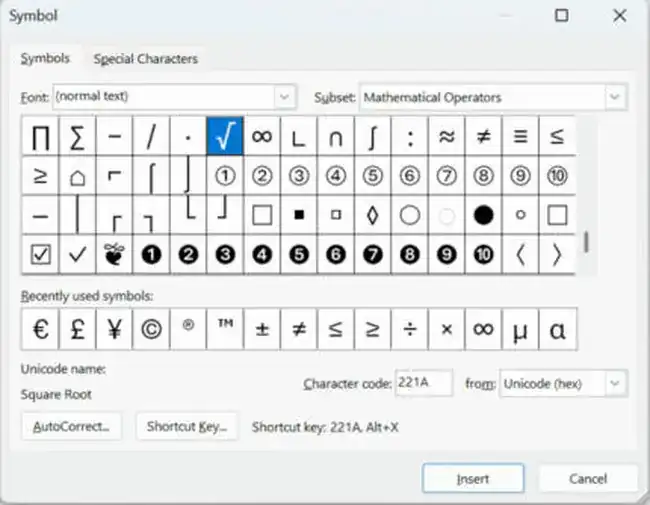
If you’d rather browse than type a code, set Font to (normal text) and Subset to Mathematical Operators, then double-click √. Once you’ve used it, √ usually shows up in the recently used row at the top of the Symbol menu, so you can pick it again without opening the dialog.
How to Type √ With Alt + X
- Type 221A where you want the symbol.
- Press Alt + X.
Word turns the code into √ right away. Microsoft notes that if the code comes straight after another character, select just the code before you press Alt + X. If you get the wrong character, check that the right font is selected. Press Alt + X again with √ selected to turn it back into 221A.
The same trick works for other Unicode characters, including accented letters. For those, read about typing accent marks above letters.
How to Type √ With an Alt Code
On a keyboard with a number pad, you can type √ without remembering a hex code:
- Turn on Num Lock.
- Hold Alt and type 251 on the number pad, not the number row.
- Release Alt.
Leave off the leading zero for this one. Alt + 0251 gives you û instead, because codes with a leading zero use a different character table. On a laptop without a number pad, use Alt + X or the Symbol dialog.
How to Write a Square Root Equation
The √ symbol on its own doesn’t stretch over a number. For a proper square root with a bar over the number, use an equation:
- Press Alt + =, or go to Insert > Equation. An equation box appears with the text “Type equation here.”
- Type \sqrt(25) and press the spacebar.
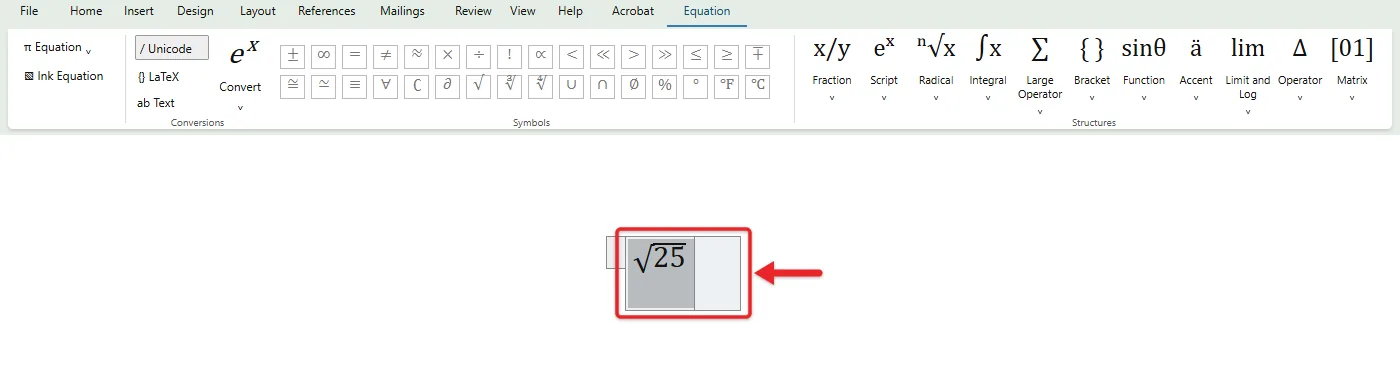
Word builds the square root sign over the number. If the equation stays in its typed (linear) form, select Convert > Professional or press Ctrl + =. Press Ctrl + Shift + = to go back to the linear format.
To build a root by clicking instead of typing, select the equation box, open the Equation tab (named Design under Equation Tools in some older versions), select Radical in the Structures group, and pick a square root layout. Click the dotted placeholder box under the bar and type your number.
Cube Roots and Other Roots
Microsoft’s list of math symbol codes includes:
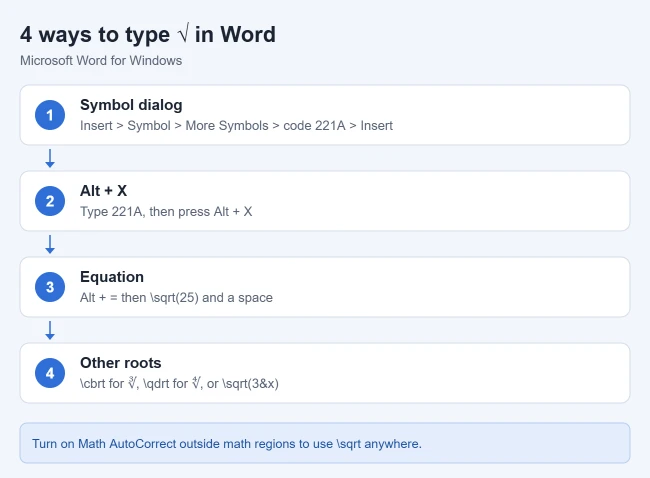
- \sqrt for the radical sign √
- \cbrt for the cube root ∛
- \qdrt for the fourth root ∜
For any other root inside an equation, use an ampersand to separate the root from the number. Microsoft’s example is \sqrt(5&a^2), which builds the fifth root of a². So \sqrt(3&x) gives you the cube root of x.
The caret in a^2 is what makes the exponent. Word has other ways to type an exponent as well.
Type Roots in LaTeX
Word for Microsoft 365 subscribers can also type equations in LaTeX, according to Microsoft. In the equation box, choose LaTeX on the Equation tab, then type \sqrt{x} for a square root or \sqrt[3]{x} for a cube root, and convert it with Ctrl + =. Microsoft’s example is \sqrt[5]{a^2}. If your Equation tab has no LaTeX option, use the UnicodeMath codes above, which work in every version.
How to Make Your Own Square Root Shortcut
If you type √ a lot, set it up once in the Symbol dialog. Select √ in Insert > Symbol > More Symbols, then use one of these buttons:
- AutoCorrect: In the Replace box, type a code you won’t use by accident, such as \rt or SQRT. Select Add, then OK. Typing that code followed by a space now gives you √. AutoCorrect entries are case sensitive, so SQRT works but sqrt doesn’t.
- Shortcut Key: Click in the Press new shortcut key box and press a key combination, such as Ctrl + Alt + Q. Check the “Currently assigned to” line so you don’t replace a built-in shortcut, then select Assign and Close.
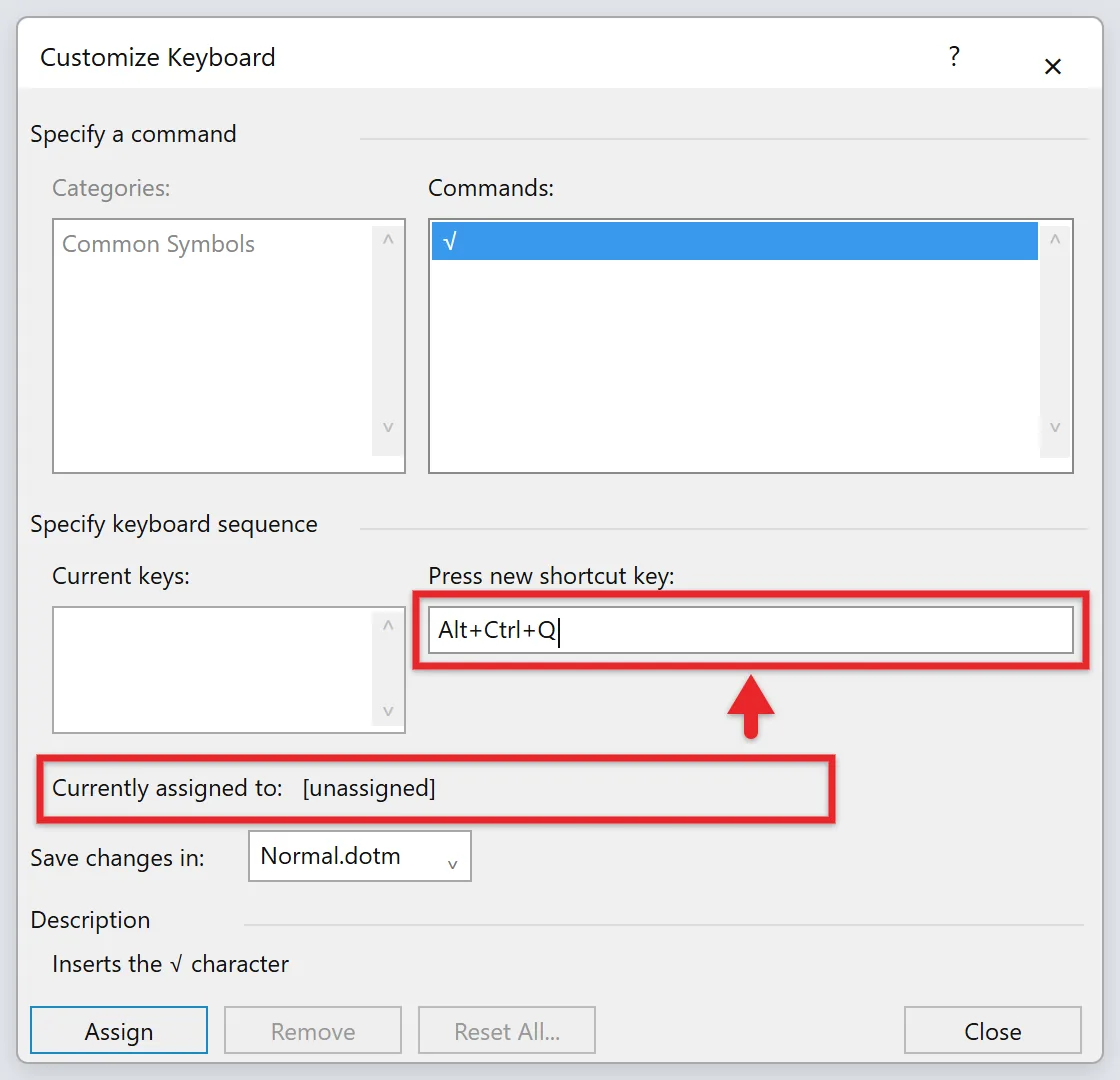
Word stores both in its Normal template. If Word asks to save changes to it when you quit, select Save to keep your shortcut.
How to Use Math AutoCorrect Outside Equations
Math AutoCorrect turns codes like \sqrt into symbols. By default it only works inside equation boxes. To use it anywhere in your document:
- Select File > Options.
- Select Proofing, then AutoCorrect Options.
- Open the Math AutoCorrect tab.
- Check Use Math AutoCorrect rules outside of math regions.
- Select OK.
Typing \sqrt followed by a space in regular text gives you √. These codes are case sensitive, so \Sqrt won’t convert.
Square Root Symbol in Word for Mac
- Keyboard: With the US keyboard layout, press Option + V to type √ in Word or any other Mac app.
- Symbol menu: On the Insert tab, select Symbol, then More Symbols, find √, and double-click it. Microsoft’s Mac symbol steps are the same as on Windows from that point.
- Equation: Press Control + = to start an equation, then type \sqrt(25) and press the spacebar.
- Character Viewer: Press Fn/Globe + E (or Control + Command + Space), search for “square root,” and click √.
Other Ways to Get √ on Windows
- Emoji and symbols panel: Press Windows key + . (period), select Symbols (the Ω icon), and look in the math symbols group. This works in Word and most other apps.
- Copy and paste: Copy √ from this page with Ctrl + C and paste it with Ctrl + V. Use Paste Options > Keep Text Only if it brings in the wrong font.
Insert a Rupee, Trademark, or Another Symbol in Word
In Word for Windows, place the cursor, open Insert > Symbol > More Symbols, choose a font that has the character, and select Insert, then Close. With from: Unicode (hex), the Indian rupee character ₹ uses 20B9 and the trademark character ™ uses 2122. Check that the symbol appears; an empty box usually means the font doesn’t include it.
For the keyboard route, type 20B9 or 2122, select just that code, and press Alt + X. Microsoft’s Unicode instructions explain converting a code and checking the font. These are text characters, whereas a square-root equation uses the equation tools described above. For a tick or an empty box, insert a check box in Word instead.
On an iPhone, symbols like ° are hidden behind keys instead. Here’s how to type a degree symbol on iPhone.
Troubleshooting
- Alt + 251 types nothing. Num Lock is off, or you used the number row. Turn on Num Lock and use the number pad.
- You get û instead of √. You typed Alt + 0251. Use Alt + 251 with no zero.
- \sqrt stays as text. You’re outside an equation box and Math AutoCorrect outside math regions is off. Press Alt + = first, or turn on the setting above. Make sure you press the spacebar after the code.
- The equation shows \sqrt(25) instead of a root. It’s still in linear format. Press Ctrl + = to convert it.
- The √ looks different from the rest of the line. Equations use the Cambria Math font by default. For a plain character that matches your text, use the Symbol dialog or Alt + X instead.
Frequently Asked Questions
What is the Unicode for the square root symbol?
It’s 221A. That’s the code Word shows in the Symbol dialog when you select √, with from set to Unicode (hex). The cube root ∛ is 221B and the fourth root ∜ is 221C.
Is there a built-in keyboard shortcut for √ in Word?
No. Word doesn’t assign one, but Alt + X with 221A works out of the box, and you can add your own shortcut key in the Symbol dialog.
How do I make the square root bar cover the whole number?
Use an equation instead of the symbol. Press Alt + =, type \sqrt( followed by your number and ), and press the spacebar.
Do these methods work in Excel and PowerPoint?
The Symbol dialog and the equation tools are on the Insert tab in Excel and PowerPoint too. Alt + X is a Word and Outlook feature, so use the Symbol dialog in Excel and PowerPoint.

Matthew Burleigh is the founder, head writer, and editor of Solve Your Tech, which he launched in 2012. He has written technology tutorials since 2008 and worked in IT since 2003, including small-business support, IT management, and consulting. He holds Bachelor’s and Master’s degrees in Computer Science from Arizona State University.
Matthew writes practical guides for Windows, iPhone and iPad, Microsoft Office, Outlook, Google apps, and Android. Solve Your Tech’s guides are checked step by step against the device or app maker’s own documentation and tested on his own devices whenever he has the hardware or software, with clear steps, sources, and update dates.
Read more about Matthew and how Solve Your Tech writes and updates its guides, or report a correction.