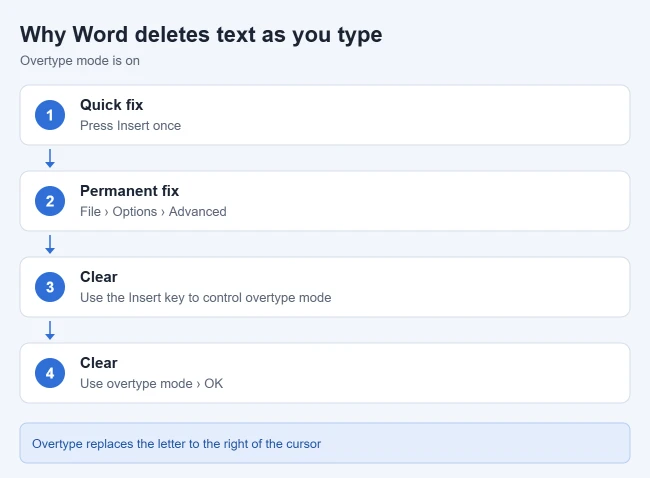
If Word deletes letters as you type, overtype mode is turned on. Microsoft says this happens when overtype is enabled and the Insert key gets pressed, usually by accident. Press Insert once to switch back right away, or turn it off for good in File › Options › Advanced by clearing the two overtype check boxes.
This guide is based on Microsoft’s Text disappears as I type and Type over text in Word for Windows articles for Word for Microsoft 365 and recent versions on Windows. Below you will find the permanent fix, how to tell whether overtype is on, and the other reasons Word can seem to delete text.
What overtype mode does
Normally Word is in insert mode: new letters push existing text to the right. In overtype mode, each letter you type replaces the character to the right of the cursor. That is why it looks like Word is deleting your words. Overtype was common in older programs, and most people never need it.
How to stop Word from deleting text as you type
- Click File › Options.
- Click Advanced.
- Under Editing options, clear Use the Insert key to control overtype mode.
- Also clear Use overtype mode.
- Click OK.
Result: Word goes back to normal insert mode, and pressing the Insert key by accident no longer turns overtype on.
Quick fix: press the Insert key
If you just need to keep typing, press Insert (sometimes labeled Ins) once. On some laptops it shares a key with another function, so you may need to hold Fn as well. This only works if Use the Insert key to control overtype mode is checked.
How to tell if overtype mode is on
- Right-click the status bar at the bottom of the Word window.
- Click Overtype so it has a check mark.
Result: the status bar shows Insert or Overtype, so you can see the current mode at a glance. Clicking it switches between the two.
How to get back text that was typed over
- Press Ctrl + Z to undo the last change.
- Keep pressing it until the original text comes back. You can also click the Undo arrow on the Quick Access Toolbar or the Home tab.
- Turn off overtype using the steps above before you continue typing.
Result: the replaced characters reappear. Undo works step by step, so long passages may take several presses.
How to stop the Insert key from causing problems anywhere
Turning off the Word option only fixes Word. If you keep hitting Insert by accident in other programs too, you can remap the key in Windows with Microsoft PowerToys’ Keyboard Manager, for example by turning Insert into a key you use. Our guide to changing keybinds on Windows 11 walks through it.
Other reasons Word deletes text
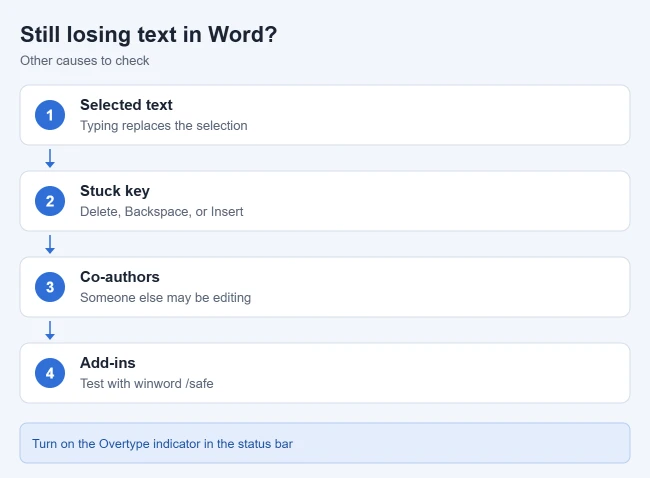
- Text is selected: Word replaces highlighted text when you start typing. Click once to deselect first. To change this, clear Typing replaces selected text in File › Options › Advanced.
- A stuck key: a sticking Delete or Backspace key can remove text on its own. Try another keyboard to rule it out.
- Someone else is editing: in a shared document, a co-author may be deleting text. Look for other people’s names or cursors in the document.
- An add-in is misbehaving: press Windows + R, type winword /safe, and press Enter to start Word without add-ins. If the problem stops, turn off add-ins in File › Options › Add-ins.
Frequently asked questions
Can I use overtype on purpose?
Yes. Microsoft explains that checking Use the Insert key to control overtype mode lets you toggle it with Insert, and checking Use overtype mode keeps it on all the time.
Does this happen in Word for Mac or Word on the web?
The Insert-key behavior described by Microsoft applies to Word for Windows. Mac keyboards usually don’t have an Insert key, so the other causes above are more likely there.
Related: How to search for a word in Microsoft Word, How to fix line spacing that is too big in Word, and How to insert a check box in Word.

Matthew Burleigh is the founder, head writer, and editor of Solve Your Tech, which he launched in 2012. He has written technology tutorials since 2008 and worked in IT since 2003, including small-business support, IT management, and consulting. He holds Bachelor’s and Master’s degrees in Computer Science from Arizona State University.
Matthew writes practical guides for Windows, iPhone and iPad, Microsoft Office, Outlook, Google apps, and Android. Solve Your Tech’s guides are tested on current devices or checked against official product documentation, with clear steps, sources, and update dates.
Read more about Matthew and how Solve Your Tech writes and updates its guides, or report a correction.