To turn on Do Not Disturb on an iPhone, open Control Center, tap Focus, and tap Do Not Disturb. A moon icon appears in the status bar and on the Lock Screen while it is on. Tap Do Not Disturb again to turn it off.
Do Not Disturb silences calls, alerts, and notifications. Since iOS 15 it has been one of the options inside Focus, which is the iPhone feature that controls who and what can interrupt you. A Focus is a profile such as Do Not Disturb, Sleep, Work, or Personal, each with its own rules.
Which iPhones This Covers
These steps apply to any iPhone running iOS 15 or later, and the menu names here match Apple’s current iPhone User Guide. Apple suggests updating to the latest iOS before you start. You do not need an account, an app, or a data connection to use Do Not Disturb.
On iOS 14 and earlier, Do Not Disturb had its own entry in Settings rather than sitting under Focus. If your iPhone still shows that older layout, the Control Center moon button and the standalone Settings entry are the places to look, but the rest of this guide describes the newer Focus screens.
How to Turn On Do Not Disturb from Control Center
This is the shortest route, and it works from the Home Screen, the Lock Screen, or inside an app.
- Open Control Center. On an iPhone X or later, swipe down from the top-right corner of the screen. On an iPhone SE or an iPhone 8 or earlier, swipe up from the bottom edge.
- Tap Focus. A list of your Focus options opens. If the button already shows the name of another Focus, touch and hold it to open the same list.
- Tap Do Not Disturb. The option is highlighted and the moon icon appears in the status bar. If a different Focus was on, it turns off when you choose Do Not Disturb.
- Close Control Center. Do Not Disturb stays on until you turn it off or its end time arrives.
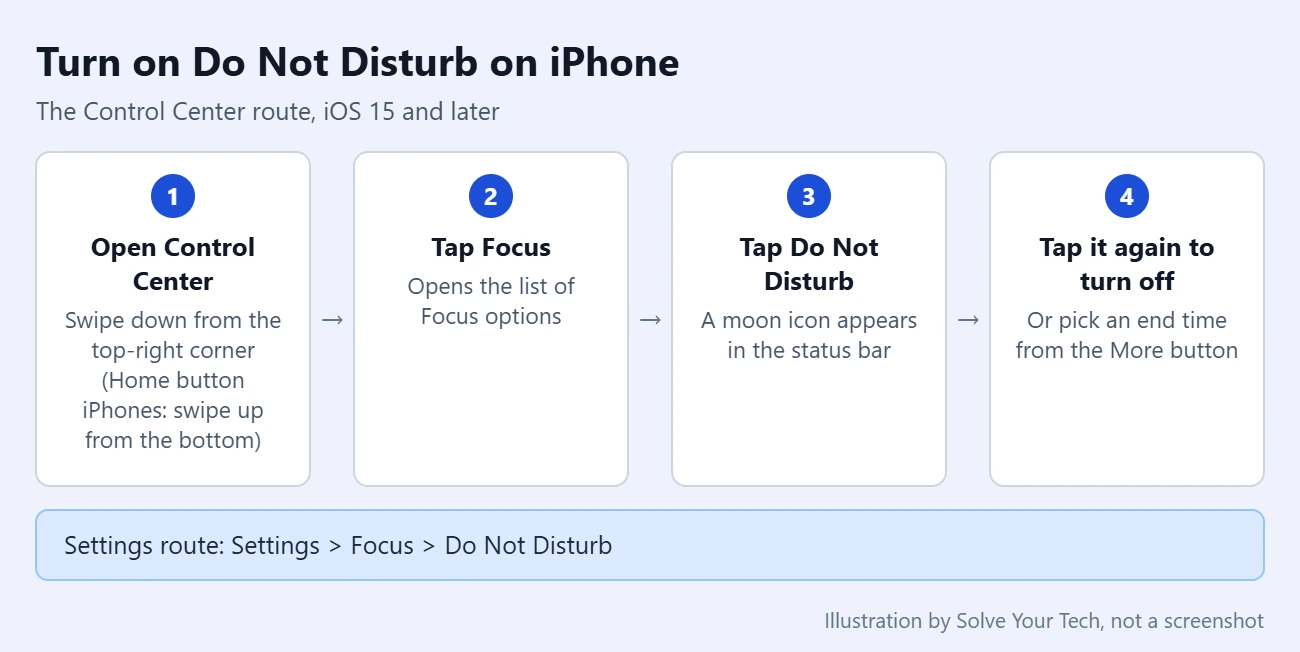
There is also a one-tap shortcut. Once Do Not Disturb has been used, the Focus button in Control Center shows the moon icon. Tapping the icon itself, not the rest of the button, switches Do Not Disturb on or off without opening the list.
Set an End Time
If you only want quiet for a while, open the Focus list in Control Center and tap the More button (three dots) next to Do Not Disturb. Choose an ending point such as For 1 hour or Until I leave this location. The choices offered can vary with the time of day and where you are. Do Not Disturb then turns itself off at that point.
Other Ways to Turn It On
Each of these does the same thing as the Control Center button. Pick whichever suits the moment.
From Settings
- Open the Settings app.
- Tap Focus.
- Tap Do Not Disturb.
- Turn on the Do Not Disturb switch at the top of the screen.
Settings is slower for a quick on or off, but it is the screen where every other option in this guide lives.
With Siri
Ask Siri something like “Turn on Do Not Disturb.” The same request with “off” turns it off. This is handy when you cannot reach the screen.
With a Linked Lock Screen
On iOS 16 and later, a Lock Screen wallpaper can be connected to Do Not Disturb. Touch and hold the Lock Screen to open the wallpaper gallery, swipe to a wallpaper that shows Do Not Disturb at the bottom (or tap the Focus label on a wallpaper to change it), then tap that wallpaper. Switching to it turns Do Not Disturb on automatically.
With the Action Button
iPhones that have an Action button in place of the Ring/Silent switch can assign it to a Focus. Go to Settings > Action Button, swipe to Focus, and use the menu below it if one appears to choose which Focus it controls. After that, pressing and holding the button switches the Focus on or off. Apple lists the available actions in its Action button guide.
How to Turn Do Not Disturb Off
Use any of these:
- Open Control Center, tap Focus, then tap Do Not Disturb so it is no longer highlighted.
- Touch and hold the Focus icon on the Lock Screen, then tap Do Not Disturb.
- Go to Settings > Focus > Do Not Disturb and turn the switch off.
- Ask Siri to turn it off.
You can tell it worked when the moon icon disappears from the status bar and the Lock Screen, and the Control Center button dims and reads Focus. Notifications that were held back show up in Notification Center.
If the button shows a different name, such as Sleep, Work, Personal, Driving, or Reduce Interruptions, that Focus is the one that is on. Tap it to turn it off. Those profiles can hold back calls and alerts in the same way.
How to Schedule Do Not Disturb
A schedule turns Do Not Disturb on and off for you, for example overnight.
- Open Settings and tap Focus.
- Tap Do Not Disturb.
- Scroll to Set a Schedule and tap Add Schedule.
- Choose what should trigger it: a time of day, a location, or an app. For a time, set the start, the end, and the days it repeats.
- Finish the setup. The schedule now appears under Set a Schedule.
To change or stop a schedule later, return to the same screen and tap the schedule that is listed. You can edit it or turn it off there. A location schedule depends on the iPhone knowing where it is, so it may need Location Services.
Choose Who and What Can Get Through
Do Not Disturb does not have to silence everyone. Open Settings > Focus > Do Not Disturb and use the two sections below.
People
- Tap People.
- Tap Allow Notifications From, tap the Add button, and select contacts. Their calls and messages will come through.
- Use the calls option to allow calls from a wider group if you want one.
- Turn on repeated calls if you want a second call from the same person within 3 minutes to ring.
You can do the reverse instead. Tap Silence Notifications From and pick only the people you want muted, which leaves everyone else able to reach you.
Apps
Tap Apps, then choose Allow Notifications From and add the apps that may interrupt you, or choose Silence Notifications From and add the apps to mute. The same screen has a Time Sensitive Notifications switch. When it is on, any app can deliver notifications marked time sensitive right away. Allowing an app here does not switch on that app’s notifications if they are turned off under Settings > Notifications.
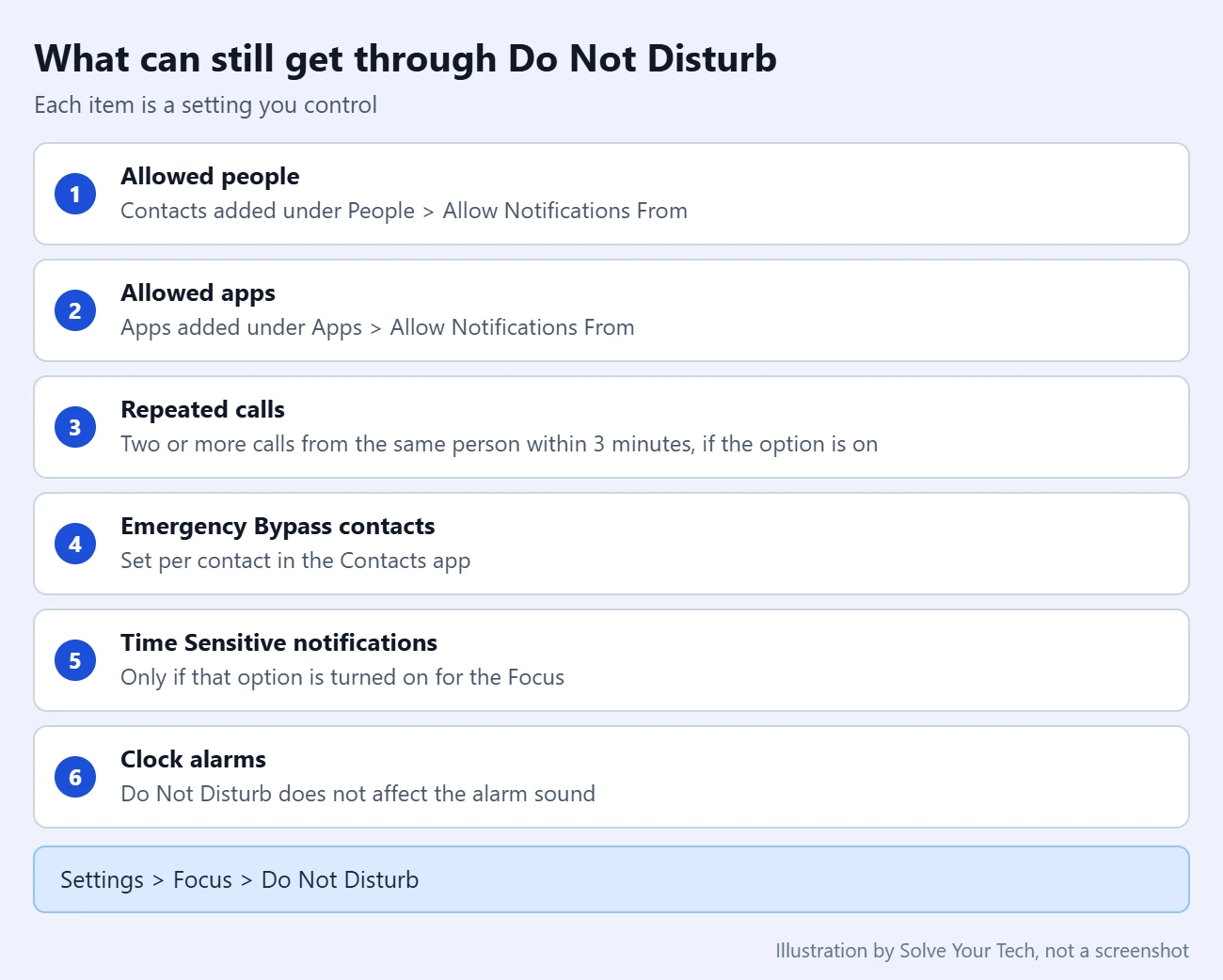
Two exceptions sit outside the Focus screen. A contact with Emergency Bypass turned on can always ring or alert you. That switch is in the Contacts app: open the contact, tap Edit, then tap Ringtone or Text Tone. Clock alarms are the other exception, covered in the questions below. Apple documents all of these controls in Allow or silence notifications for a Focus on iPhone.
Other Settings on the Same Screen
- Options: choose whether silenced notifications appear on the Lock Screen and whether the Lock Screen dims while Do Not Disturb is on.
- Customize Screens: pick a Lock Screen or Home Screen page to use with Do Not Disturb.
- Focus Filters: limit what certain apps show, such as one mail account or one calendar.
- Intelligent Breakthrough & Silencing: on iPhones that support Apple Intelligence, this lets notifications judged important interrupt you. People and apps you allowed or silenced yourself keep those settings.
Troubleshooting
Do Not Disturb Keeps Turning Itself On
Check three things. First, look under Settings > Focus > Do Not Disturb > Set a Schedule for an active schedule and turn it off. Second, check whether your current Lock Screen wallpaper is linked to Do Not Disturb, since choosing that wallpaper turns it on. Third, open Settings > Focus and look at Share Across Devices. When it is on, turning on Do Not Disturb on an iPad, Mac, or Apple Watch signed in to the same Apple Account turns it on for the iPhone too.
You Cannot Find Do Not Disturb in Settings
Look under Focus. Do Not Disturb has not had its own row on the main Settings screen since iOS 15. If Do Not Disturb is missing from the Focus list as well, it may have been deleted. Apple says a deleted built-in Focus can be set up again from the Add button on the Focus screen.
The Phone Still Rings
Review the People section for allowed contacts, a wide calls group, or repeated calls, and check the caller’s contact card for Emergency Bypass. Also confirm the moon icon is showing. If it is not, Do Not Disturb is off.
Alerts Stay Quiet After You Turn It Off
Another Focus, Silent mode, or an app’s own notification settings may be the cause. Our notifications silenced troubleshooting guide walks through each check. For call sound in particular, see how to silence or unsilence calls on iPhone.
Frequently Asked Questions
Will my alarm still go off in Do Not Disturb?
Yes. Apple states that Do Not Disturb and Silent mode do not affect the alarm sound from the Clock app. If an alarm is quiet or only vibrates, check that its Sound is not set to None and raise the volume under Settings > Sounds & Haptics. Apple covers both checks in its iPhone alarm guide. Reminders from other apps follow the app rules described above.
Does Do Not Disturb block calls and texts?
No. It silences them. Messages still arrive and missed calls are still listed, so you can see them when you check your iPhone. Blocking a number is a separate feature.
Can people tell that I have Do Not Disturb on?
They may. When Focus status sharing is on, someone who messages you in the Messages app can see that you have notifications silenced, and they can choose to notify you anyway if it is urgent. To change this, go to Settings > Focus > Focus Status and turn Share Focus Status on or off, or choose which Focus profiles share it.
What is the difference between Do Not Disturb and Focus?
Focus is the overall feature. Do Not Disturb is one Focus inside it, meant for silencing everything quickly. Sleep, Work, Personal, and Driving are other Focus options with their own allowed people, apps, and schedules. Only one Focus is on at a time.
Does Do Not Disturb turn off by itself?
Only if you gave it an end time in Control Center or it was started by a schedule. If you turned it on with a plain tap, it stays on until you turn it off.
Next Step
Turn Do Not Disturb on from Control Center once, confirm the moon icon appears, then add the few people who should always reach you under People. Apple’s own walkthroughs are How to turn Do Not Disturb on or off on your iPhone, Turn on or schedule a Focus on iPhone, and Set up a Focus on iPhone.
If you want to stop just one app’s alerts permanently, or keep banners without sound, use our guide to silencing iPhone notifications instead.
More iPhone Guides

Matthew Burleigh has been writing tech tutorials since 2008. His writing has appeared on dozens of different websites and been read hundreds of millions of times.
After receiving his Bachelor’s and Master’s degrees in Computer Science he spent several years working in IT management for small businesses. However, he now works full time writing content online and creating websites.
His main writing topics include iPhones, Microsoft Office, Google Apps, Android, and Photoshop, but he has also written about many other tech topics as well.