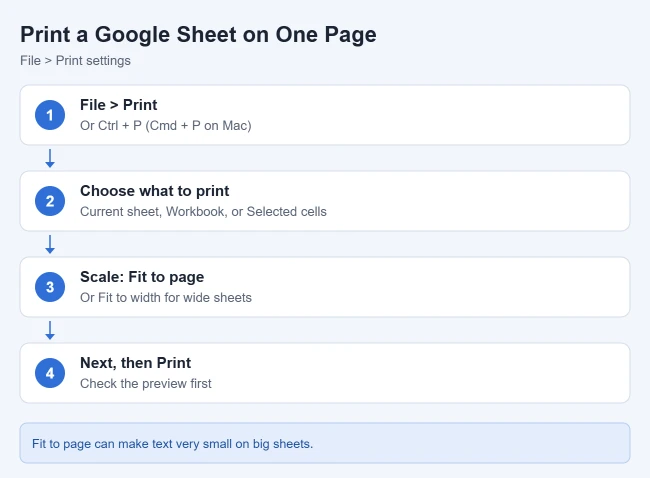
To print a Google Sheet on one page, click File > Print, open the Scale menu in the settings panel, and choose Fit to page. Then click Next and print. If shrinking everything makes the text too small, choose Fit to width instead so all the columns fit and the rows continue onto more pages.
Google’s Print from Google Sheets help page covers what to print, page breaks, margins, headers and footers, repeated rows, and orientation.
How to Print a Google Sheet on One Page
- If you only want part of the sheet, select those cells first.
- Click File > Print. You can also press Ctrl + P (Cmd + P on a Mac).
- In the Print menu, choose Current sheet, Workbook, or Selected cells (Google).
- Under Scale, choose Fit to page.
- If the sheet is wide, switch Orientation to Landscape (Google).
- Click Next. In Chrome, click Print in the window that appears.
Result: The preview shows the whole sheet on a single page. Fit to page shrinks the text, which can make it hard to read on large sheets, so check the preview before printing. Google notes that in Firefox or Safari, clicking Next downloads a PDF that you then print from your PDF viewer.
Fit to Page vs. Fit to Width vs. Fit to Height
- Fit to page: Shrinks everything onto one page.
- Fit to width: Fits all the columns across the page; rows can continue onto more pages.
- Fit to height: Fits all the rows on the page; columns can spill onto more pages.
Fit to page works best for smaller sheets and suggests Fit to width for wide ones. To fit more without shrinking the text, hide rows or columns you don’t need and narrow column widths. Also try Narrow margins first.
How to Repeat the Top Row on Every Page
- Freeze your header row if you haven’t already. See how to freeze rows in Google Sheets.
- Click File > Print.
- Click Headers & footers.
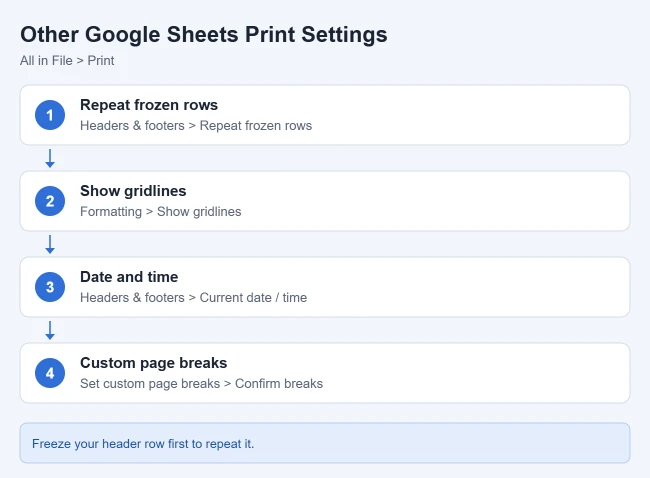
- Choose Repeat frozen rows (or Repeat frozen columns).
Result: Google says the frozen rows or columns repeat across the printed pages.
Print Gridlines, Add the Date, and Set Page Breaks
- Gridlines: In the print settings, open Formatting and check Show gridlines. Gridlines are off by default; the same section can also print row and column headings. For lines around only certain cells, add borders in Google Sheets instead. To change the on-screen gridlines from a phone, see how to show or hide gridlines in the Google Sheets iPhone app.
- Date and time: Click Headers & footers and choose the info you want, such as the current date and time or page numbers. Google says you can click Edit custom fields to change the format or location, then click Confirm.
- Page breaks: Click Set custom page breaks, drag the lines to where each page should end, then click Confirm breaks (Google).
- Margins and paper size: Under Margins, choose a type or Custom numbers; under Paper size, pick a size or Custom size (Google).
An earlier version of this guide also described an Alignment option under Formatting for printing against the left margin. Google’s current help page doesn’t mention it, so check the Formatting section to see whether your print settings include it.
Frequently Asked Questions
Can I set a permanent print area in Google Sheets?
Not like Excel. Google Sheets has no permanent print area, so select the range and choose Selected cells each time you print.
Why does my sheet print blank pages?
Blank pages usually come from data or formatting in cells far from your actual content. Delete the extra rows and columns, or select only your data and print Selected cells.
Related Guides
- How to freeze rows in Google Sheets
- How to save a Google Sheet as a PDF
- How to align text in Google Sheets
- How to make a header row that repeats when printing

Matthew Burleigh is the founder, head writer, and editor of Solve Your Tech, which he launched in 2012. He has written technology tutorials since 2008 and worked in IT since 2003, including small-business support, IT management, and consulting. He holds Bachelor’s and Master’s degrees in Computer Science from Arizona State University.
Matthew writes practical guides for Windows, iPhone and iPad, Microsoft Office, Outlook, Google apps, and Android. Solve Your Tech’s guides are tested on current devices or checked against official product documentation, with clear steps, sources, and update dates.
Read more about Matthew and how Solve Your Tech writes and updates its guides, or report a correction.