To delete a document from Microsoft Word, open Word, find the file in the Recent list, right-click it and choose Delete file. You can also close the document, press Windows key + E to open File Explorer, select the file and press Delete. To just hide a file from Word’s recent list without deleting it, right-click it and choose Remove from list.
The File Explorer, recent list and Microsoft 365 steps come from Microsoft’s Delete a file, Customize the list of recently used files and Delete a file from Microsoft 365 articles.
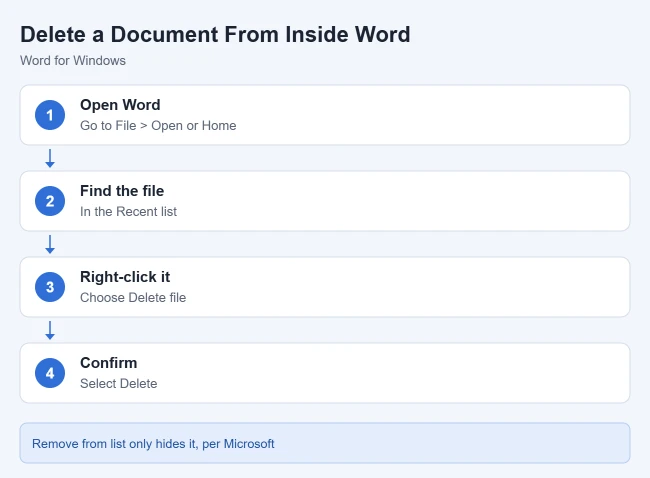
How to Delete a Document From Inside Word
- Open Word and go to the Home page or File > Open.
- Find the document in the Recent list.
- Right-click it and choose Delete file.
- Select Delete to confirm.
Result: The document is deleted from your computer’s drive. Microsoft warns to pick Remove from list instead of Delete file if you only want it off the list.
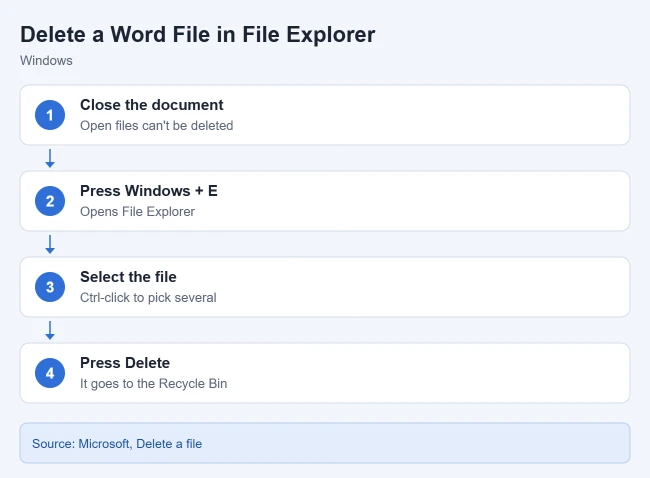
How to Delete a Word Document in File Explorer
Microsoft says File Explorer is the best way to delete files:
- Close the document in Word. Microsoft notes you can’t delete a file while it’s open in any program, and shared files must be checked in.
- Press Windows key + E to open File Explorer.
- Go to the folder with your document.
- Select the file and press Delete, or select Delete on the ribbon.
Result: files on your hard drive go to the Recycle Bin. Microsoft says files deleted from a disk, CD or network location are destroyed instead.
Delete several files at once
Hold Ctrl while you select each file. To select a long run of files, Microsoft says to click the first one, hold Shift, and click the last one.
Can’t find the file?
Try right-clicking the document in Word’s Recent list and choosing Open file location, which opens its folder in File Explorer.
How to Delete Documents Saved in OneDrive
- From Word: Select Open, choose your OneDrive account, find the document, right-click it and choose Delete.
- From Microsoft 365 on the web: Microsoft says to find the file on the home page under Quick access, select More options (…), choose Delete, and confirm. You can’t delete files you don’t own or that someone is editing.
How to Remove a Document From Word’s Recent List
- In Word, select File > Open.
- Find the document in the recent list.
- Right-click it and choose Remove from list.
This only hides it from the list; the file itself isn’t deleted. Microsoft adds that you can clear all unpinned files by right-clicking any file and choosing Clear unpinned Documents, or hide the list entirely by setting File > Options > Advanced > Show this number of Recent Documents to zero.
Hide the Entire Recent Documents List
- In desktop Word for Windows, choose File > Options > Advanced.
- Scroll to Display. Set Show this number of Recent Documents to 0.
- Select OK, then return to the Recent list to check the result.
This changes the list, not the documents stored on your computer or in OneDrive. The same option is available in Word 2013. To show recent documents again, return here and enter a positive number; files you open afterward can appear in the list. Microsoft’s recent-files guide explains the difference between hiding links and deleting files.
Deleted the Wrong File?
- Files from your computer go to the Recycle Bin. Open it from your desktop, right-click the file, and choose Restore.
- OneDrive or Microsoft 365 files go to the OneDrive recycle bin. Microsoft says to open Recycle bin in OneDrive, select the file and choose Restore.
Frequently Asked Questions
Why won’t Word let me delete a document?
The file is probably still open in Word or another program. Microsoft says you have to close it first, and shared files must be checked in.
Does Remove from list delete the file?
No. It only removes the entry from Word’s Recent list. Microsoft notes that removing a file from Recent also removes it from Favorites.
More Word Guides
- How to save as a PDF from Word Online
- How to search for a word in Word
- How to delete an empty page in Word

Matthew Burleigh is the founder, head writer, and editor of Solve Your Tech, which he launched in 2012. He has written technology tutorials since 2008 and worked in IT since 2003, including small-business support, IT management, and consulting. He holds Bachelor’s and Master’s degrees in Computer Science from Arizona State University.
Matthew writes practical guides for Windows, iPhone and iPad, Microsoft Office, Outlook, Google apps, and Android. Solve Your Tech’s guides are tested on current devices or checked against official product documentation, with clear steps, sources, and update dates.
Read more about Matthew and how Solve Your Tech writes and updates its guides, or report a correction.