To change your startup page in Google Chrome, click the three-dot More menu, choose Settings, and click On startup. Pick Open the New Tab page, Continue where you left off, or Open a specific page or set of pages and add the sites you want.
This guide covers each startup option, how to edit or remove startup pages, the difference between the startup page and the homepage, and what to do if Chrome’s startup page changes by itself. The steps follow Google’s guide to Chrome’s homepage and startup page.
In this article:
- How to change the startup page
- Open multiple pages on startup
- Continue where you left off
- Startup page vs. homepage
- Show Chrome profiles on startup
- Startup page changed by itself?
- Frequently asked questions
How to Change the Startup Page in Chrome
- Open Chrome on your computer.
- Click the three-dot More menu at the top right, then Settings.
- Click On startup on the left.
- Choose one of the three options.
Result: The next time you launch Chrome, it opens the way you chose. Open the New Tab page shows a fresh New Tab page, which you can customize with shortcuts and themes.

How to Open Multiple Pages on Startup
- In Settings > On startup, choose Open a specific page or set of pages.
- Click Add a new page, type the web address, and click Add. Repeat for each page.
- Or click Use current pages to add every tab you have open.
Result: Chrome opens each page in its own tab when it starts. To change one later, click the three-dot menu to the right of that page and choose Edit or Delete.
How to Continue Where You Left Off
Choose Continue where you left off to have Chrome reopen the pages you had open when you quit. Google notes your cookies and data are saved, so sites you were signed in to open again still signed in.
If you don’t want to stay signed in to those pages, Google suggests turning on automatic site data deletion:
- Go to Settings > Privacy and security > Site settings > Additional content settings.
- Select On-device site data.
- Turn on Delete data sites have saved on your device when you close all windows.
Result: Your tabs still come back, but sites sign you out when you close Chrome. To stop Chrome from reopening your last session at all, switch On startup to the New Tab page or a specific set of pages.
Startup Page vs. Homepage
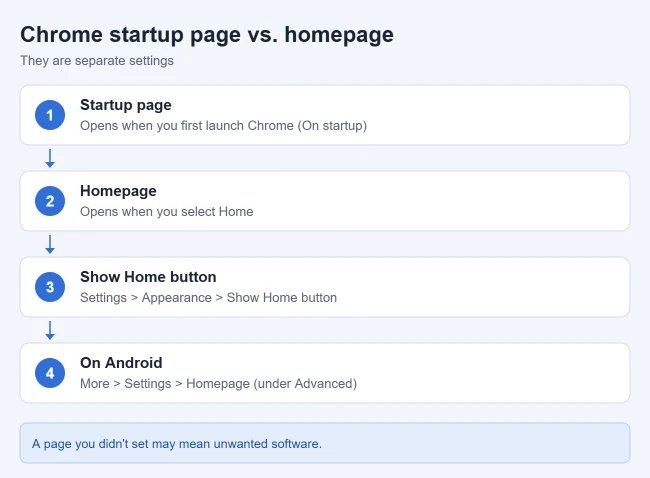
Google explains that these are two different settings. The startup page is what you see when you first launch Chrome. The homepage is what opens when you select the Home button. They aren’t the same unless you set them that way.
To set your homepage on a computer:
- Go to Settings.
- Under Appearance, turn on Show Home button.
- Choose the New Tab page or enter a custom page.
Result: A Home button appears to the left of the address bar and opens the page you chose. In Chrome for Android, tap More > Settings, then under Advanced, tap Homepage.
Show Chrome Profiles on Startup
If several people share the computer, you can have Chrome show all its profiles when it opens. Click your Profile icon at the top right, select Manage Chrome profile under “Other Chrome profiles,” and check Show on startup.
Startup Page Changed by Itself?
Google says that if your startup page, homepage or search engine suddenly changes, you may have unwanted software. Check the On startup setting first, and then see how to reset Chrome to its default settings. On a work or school Chromebook, Google notes that your administrator controls the startup page and homepage, so you can’t change them yourself.
Frequently Asked Questions
How many startup pages can I add?
Google’s steps don’t list a limit. Each page you add opens in its own tab, so keep the list to the pages you need every time.
Can I make Chrome open with my bookmarks?
Add the bookmarked pages as startup pages with Add a new page, or open them all and click Use current pages. See how to bookmark in Google Chrome.
Why do sites sign me out when Chrome restarts?
Check whether site data is set to delete when you close all windows. See how to delete cookies in Chrome for more on site data.
Related Guides
- How to reset Chrome to default settings
- How to bookmark in Google Chrome
- How to delete cookies in Chrome
- How to start Google Chrome automatically when your computer starts

Matthew Burleigh is the founder, head writer, and editor of Solve Your Tech, which he launched in 2012. He has written technology tutorials since 2008 and worked in IT since 2003, including small-business support, IT management, and consulting. He holds Bachelor’s and Master’s degrees in Computer Science from Arizona State University.
Matthew writes practical guides for Windows, iPhone and iPad, Microsoft Office, Outlook, Google apps, and Android. Solve Your Tech’s guides are tested on current devices or checked against official product documentation, with clear steps, sources, and update dates.
Read more about Matthew and how Solve Your Tech writes and updates its guides, or report a correction.