Chrome bookmarks are stored in three places: in the Bookmark Manager inside Chrome, in a file named Bookmarks inside your Chrome profile folder on your computer, and in your Google Account if you are signed in to Chrome. To see them, click More (the three dots) > Bookmarks and lists > Bookmark Manager, or press Ctrl + Shift + O (Command + Option + B on a Mac).
To get a copy you can keep or move, you usually do not need the file at all. Open the Bookmark Manager, click More at the top, and choose Export Bookmarks.
Quick Answer: Where Each Copy Lives
| Where | What is there | How to get to it |
|---|---|---|
| Inside Chrome | Your bookmarks and folders, ready to open, edit or export | More > Bookmarks and lists > Bookmark Manager |
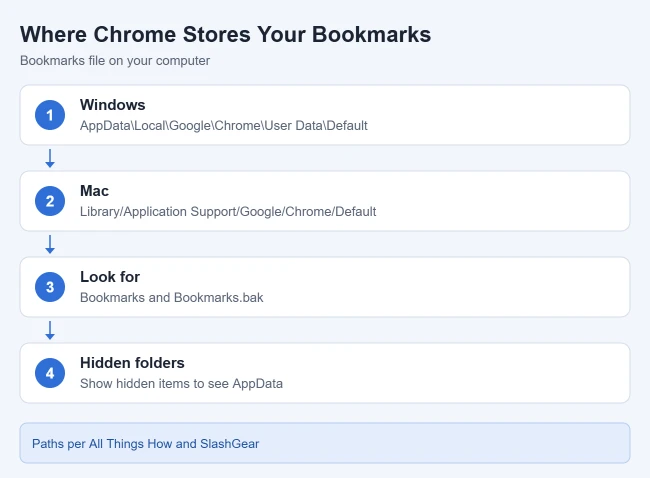
| Windows | A file named Bookmarks | %LOCALAPPDATA%\Google\Chrome\User Data\Default |
| Mac | A file named Bookmarks | ~/Library/Application Support/Google/Chrome/Default |
| Linux | A file named Bookmarks | ~/.config/google-chrome/Default |
| Google Account | Bookmarks saved while you are signed in to Chrome | Sign in to Chrome with the same account on another device |
These folder paths are for the regular version of Chrome and come from Google’s User Data Directory documentation for Chrome and Chromium. Chrome Beta, Dev and Canary use slightly different folder names.
How to Open Your Bookmarks in Chrome
If you only want to find or open a saved site, stay inside Chrome. Google’s Create, find and edit bookmarks page lists these ways on a computer:
- Bookmark Manager: click More > Bookmarks and lists > Bookmark Manager, or press Ctrl + Shift + O (Command + Option + B on a Mac).
- Bookmarks bar: click More > Bookmarks and lists > Show bookmarks bar, or press Ctrl + Shift + B (Command + Shift + B on a Mac) to show or hide it.
- Address bar search: type @bookmarks in the address bar, press Tab or Space, then type a keyword and pick the bookmark from the list.
- Android: tap More > Bookmarks, then tap a folder.
- iPhone or iPad: tap More > Bookmarks, then tap a folder.
The shortcuts above are from Google’s Chrome keyboard shortcuts list. If you are still building your collection, see how to bookmark in Google Chrome.
Where the Bookmarks File Is on Your Computer
Chrome keeps everything that belongs to you (bookmarks, history, cookies and more) in a user data directory. Inside it, each Chrome profile has its own folder. A profile is a separate set of Chrome data for one person or one account. The first profile’s folder is usually named Default. Additional profiles are commonly named Profile 1, Profile 2 and so on.
The bookmarks for a profile are saved in that profile’s folder in a file named Bookmarks. The file has no extension, so it will not open when you double-click it. It is a data file that Chrome reads and writes on its own, not a document meant for editing.
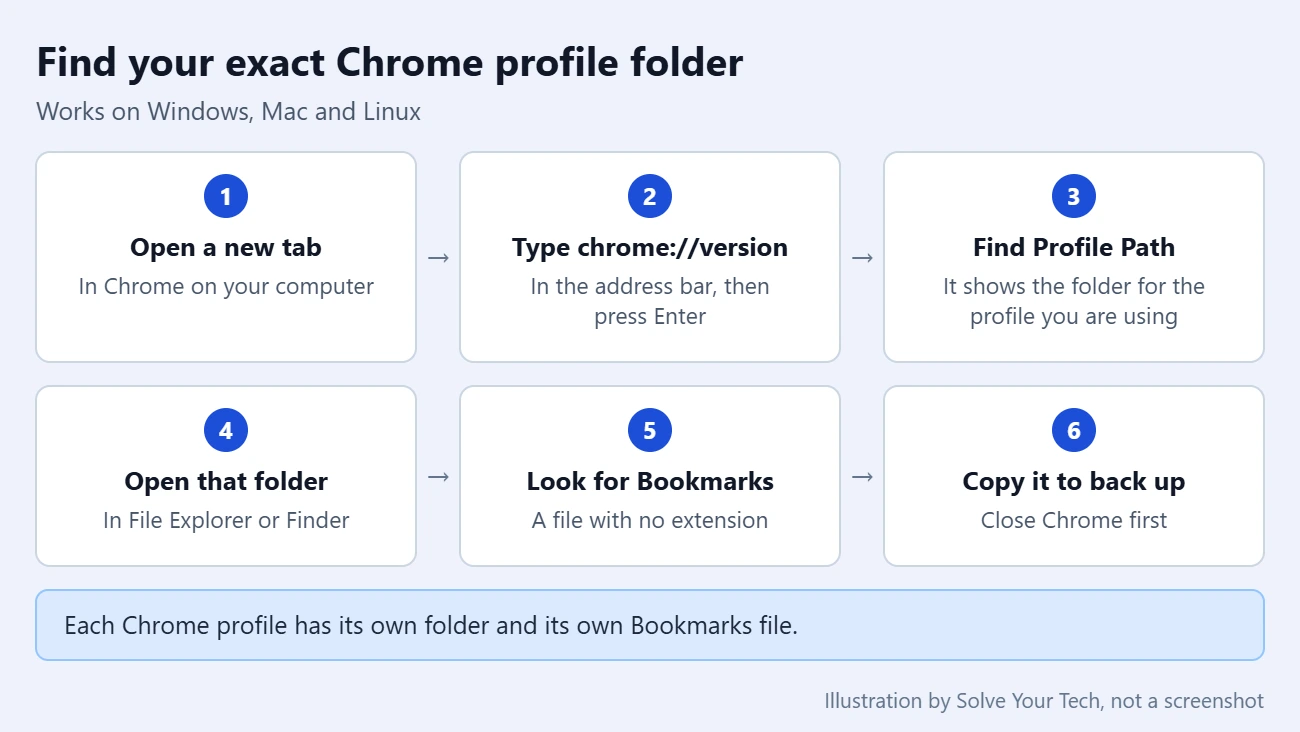
The Reliable Way: chrome://version
Folder names differ if you use more than one profile, so let Chrome tell you the exact location.
- Open Chrome using the profile whose bookmarks you want.
- Type
chrome://versionin the address bar and press Enter. - Find the line labeled Profile Path. It shows the full path to the folder for the profile you are using right now.
- Open that folder in File Explorer or Finder and look for the file named Bookmarks.
Windows
- Open File Explorer. On Windows 11 you can press the Windows logo key + E.
- Click the address bar at the top, type
%LOCALAPPDATA%\Google\Chrome\User Dataand press Enter. - Open the Default folder, or the profile folder shown on your Profile Path line.
- Scroll to the file named Bookmarks.
On most PCs that address expands to C:\Users\YourName\AppData\Local\Google\Chrome\User Data. Typing the short version takes you straight there, which matters because the AppData folder is normally hidden when you browse to it by clicking. If you would rather click through the folders, our guide on how to find the AppData folder in Windows 11 shows how to reveal it.
Mac
- Open Finder and choose Go > Go to Folder in the menu bar.
- Type
~/Library/Application Support/Google/Chromeand press Return. The tilde (~) stands for your home folder. Apple describes this in its guide to going directly to a specific folder on Mac. - Open the Default folder, or the profile folder shown on your Profile Path line.
- Find the file named Bookmarks.
Linux
Chrome’s user data directory is ~/.config/google-chrome, and the first profile is in the Default folder inside it. The .config folder starts with a dot, so your file manager may hide it until you turn on its option to show hidden files.
Other Files You May See Next to It
Many profile folders also contain a file named Bookmarks.bak. It is widely described as a backup copy that Chrome makes of the Bookmarks file. Google’s help pages do not explain when it is created or how to use it, so do not count on it as your only backup.
Chrome’s source code also names a second file, AccountBookmarks, for bookmarks that belong to a signed-in Google Account. Depending on your Chrome version and how you sign in, some of your bookmarks may be in that file and not in Bookmarks. That is one more reason to prefer the export method below.
How to Export Chrome Bookmarks
Exporting makes a copy. It does not remove or change anything in Chrome, so you can do it as often as you like. These steps are from Google’s Import Chrome bookmarks & settings page and are for Chrome on a computer.
- Open Chrome on your computer.
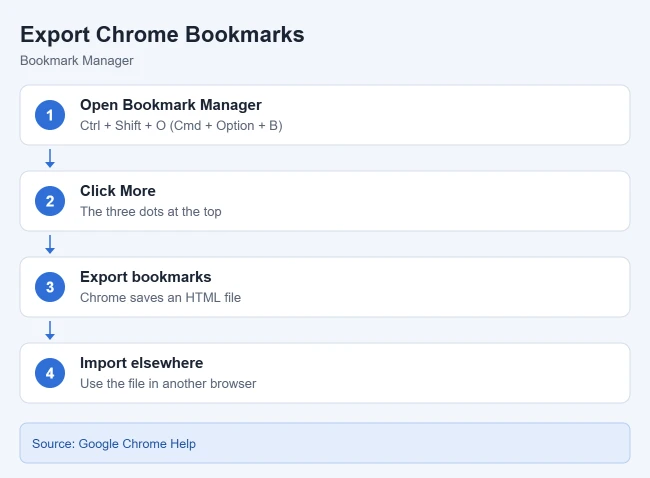
- At the top right, click More > Bookmarks and lists > Bookmark Manager.
- At the top of the Bookmark Manager page, click its own More button. This is a second three-dot button on the page, separate from Chrome’s main menu.
- Click Export Bookmarks.
- Choose where to save the file, such as your Documents folder or a USB drive, and save it.
What to expect: Chrome saves your bookmarks as a single HTML file. To confirm it worked, open the folder you chose and double-click the file. It opens in your browser as a plain list of links.
The export is a snapshot. Bookmarks you add later are not in it, so export again before you reset Chrome, replace a computer, or hand a work laptop back. Google’s export steps are written for computers only. On a phone or tablet, sign in to Chrome with the same Google Account on a computer and export from there.
Export or Copy the File: Which One?
For most people the HTML export is the better choice. Google documents it, and the file can be imported into Chrome or a different browser. Copying the Bookmarks file is mainly useful when Chrome will not open. If the bookmarks you want to bring in are in Safari on a tablet, start with our guide on how to export Safari bookmarks on iPad.
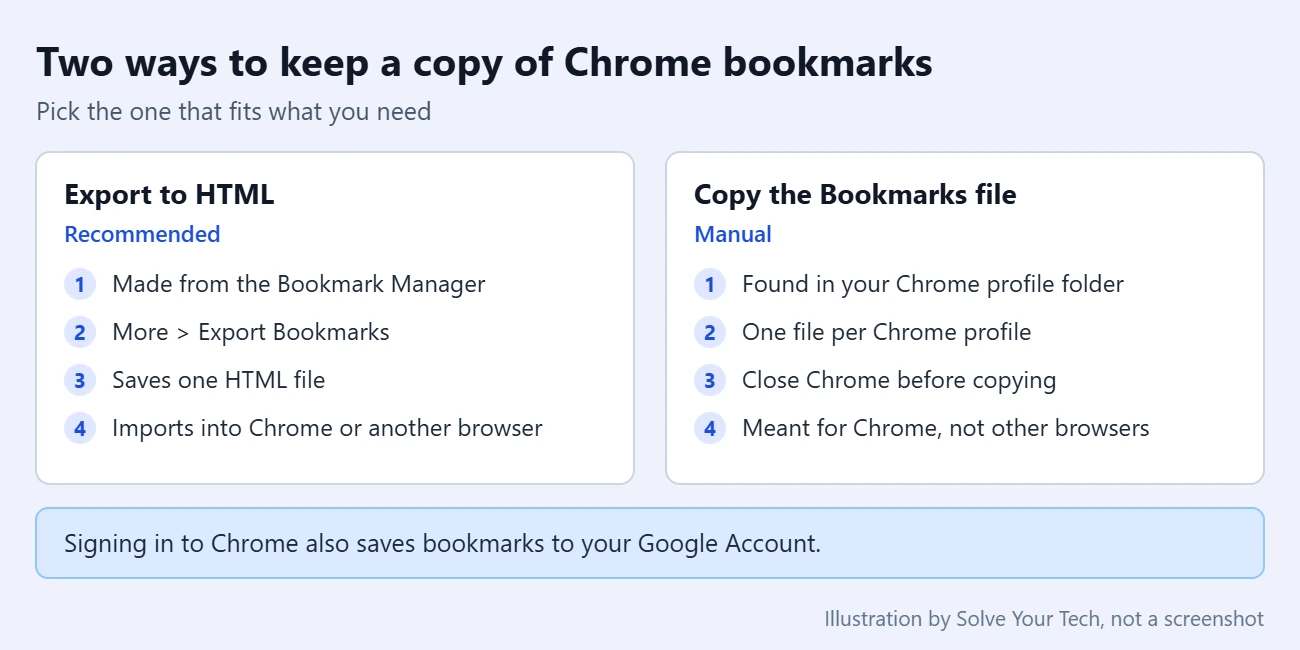
Before you touch the file: close every Chrome window first, and copy the file. Do not move, rename or edit it. Chrome reads this file to load your bookmarks, so moving or deleting it can leave that profile with no bookmarks. Google does not publish steps for restoring bookmarks by putting a copied file back, so treat that as a last resort and keep an HTML export as well.
How to Import Bookmarks Into Chrome
- Have the HTML file ready. For another browser, such as Firefox or Safari, follow that browser’s steps to export bookmarks as an HTML file.
- In Chrome, click More > Bookmarks and lists > Import bookmarks and settings.
- Select Choose file.
- Pick the file, then select Open > Done.
Where they land: if Chrome had no bookmarks, the imported ones appear on the bookmarks bar. If Chrome already had bookmarks, the imported ones are added to the Other bookmarks folder at the end of the bookmarks bar. Importing adds to what you have. It does not replace it. To undo an import, open the Bookmark Manager and delete the bookmarks or folders that were added.
Bookmarks in Your Google Account
When you sign in to Chrome with a Google Account and save a bookmark, Chrome saves it in your account. Sign in to Chrome with the same account on another computer, phone or tablet and your bookmarks appear there too. No file is needed.
- Check what is saved: click More > Settings > You and Google, select your account name, and make sure bookmarks are included in what Chrome saves to your account.
- Bookmarks made while signed out: these are stored only on that device. After you sign in, click your Profile picture at the top right and look for Save items in Account to add them to your account.
- Signing out: Google says that when you sign out of Chrome, your info stays in your Google Account and is removed from the device. Bookmarks that were saved to the account come back when you sign in again.
When you are ready for a next step, export your bookmarks once and keep the HTML file somewhere other than your computer’s main drive. The account details are on Google’s Get your bookmarks, passwords, and more on all your devices page. If you want to keep full copies of pages and not just links, the Evernote Web Clipper in Chrome is a separate option.
Troubleshooting
- You do not see Bookmarks and lists: menu names change between Chrome versions. Update Chrome, or press Ctrl + Shift + O (Command + Option + B on a Mac) to open the Bookmark Manager directly.
- The Default folder has no Bookmarks file, or it looks old: you are probably in the wrong profile folder. Open
chrome://versionin the Chrome window that shows your bookmarks and use its Profile Path. - The AppData or Library folder is missing: both are hidden by default. Type the path into the File Explorer address bar or Finder’s Go to Folder box as shown above.
- Bookmarks are missing on a second device: confirm you are signed in to Chrome with the same Google Account on both, then check Settings > You and Google.
- You are on a work or school computer: your organization may manage Chrome and restrict some options. Ask your administrator before copying browser data off the device.
Frequently Asked Questions
What is the Bookmarks.bak file?
Bookmarks.bak sits next to the Bookmarks file in the Chrome profile folder and is generally described as a backup copy that Chrome creates automatically. Google’s help pages do not document it, so an HTML export or a signed-in Google Account is a more dependable backup.
Can I get back a bookmark I deleted?
Google’s help page for Chrome on a computer says that after you delete a bookmark, you cannot get it back. Your options are an HTML file you exported before the deletion, which you can import again, or adding the bookmark again by hand.
Where are Chrome bookmarks stored on Android or iPhone?
In the Chrome app, tap More > Bookmarks. The app keeps its data in its own private storage, so there is no Bookmarks file for you to browse to. To get those bookmarks onto a computer, sign in to Chrome with the same Google Account on both devices.
Does each Chrome profile have its own bookmarks?
Yes. Each profile is a separate folder inside Chrome’s user data directory with its own Bookmarks file. Exporting from the Bookmark Manager only exports the bookmarks of the profile you are using, so repeat the export in each profile you want to keep.

Matthew Burleigh has been writing tech tutorials since 2008. His writing has appeared on dozens of different websites and been read hundreds of millions of times.
After receiving his Bachelor’s and Master’s degrees in Computer Science he spent several years working in IT management for small businesses. However, he now works full time writing content online and creating websites.
His main writing topics include iPhones, Microsoft Office, Google Apps, Android, and Photoshop, but he has also written about many other tech topics as well.