To add folders like Documents, Downloads or Pictures to the Start menu in Windows 11, go to Settings > Personalization > Start > Folders and turn on the folders you want. They appear as small icons next to the Power button at the bottom of Start. In Windows 10, the same page has a link called Choose which folders appear on Start, and the folders show up in the narrow strip above the Power button.
These steps cover current Windows 11 releases, including the redesigned Start menu with the All apps section, and Windows 10 version 22H2. Microsoft ended support for Windows 10 on October 14, 2025, so Windows 10 PCs no longer get regular security updates unless they’re enrolled in Extended Security Updates. Both methods follow Microsoft’s Customize the Windows Start menu article.
What Start Folders Are
Start folders are one-click shortcuts to common locations on your PC. Microsoft places them in the account area at the bottom of Start, beside your profile picture and the Power button, so they stay out of the way of your pinned apps. Each one opens in File Explorer or the Settings app. You can’t add your own folders to this row, but you can choose any combination of these:
- Settings
- File Explorer
- Documents
- Downloads
- Music
- Pictures
- Videos
- Network
- Personal folder (your user folder, such as C:\Users\YourName)
All of them are off by default, so a new PC shows only your account picture and the Power button. Turning on Downloads, for example, saves you from opening File Explorer and finding Downloads in the sidebar every time you save something from a browser.
Start folders vs. app folders
Windows uses the word “folders” for two different things on Start:
| Feature | What it is | Where it appears | How to set it up |
|---|---|---|---|
| Start folders | Shortcuts to built-in locations like Downloads | Next to (Windows 11) or above (Windows 10) the Power button | Settings > Personalization > Start |
| App folders | Groups of pinned apps you create and name | In the Pinned section (Windows 11) or among tiles (Windows 10) | Drag one pinned app onto another |
This article covers both, starting with Start folders. If you came here to group your apps, skip to “Group Pinned Apps Into Folders” below.
Add Folders to Start in Windows 11
- Select Start on the taskbar, or press the Windows key.
- Right-click an empty area near the bottom of the Start menu and select Start settings. You can also open Settings > Personalization > Start. The Start settings page opens.
- Scroll down and select Folders. A list of switches appears, one for each available folder.
- Turn on the switch next to each folder you want. The switch turns blue (or your accent color) when it’s on. There’s no Save button; Windows applies each change right away.
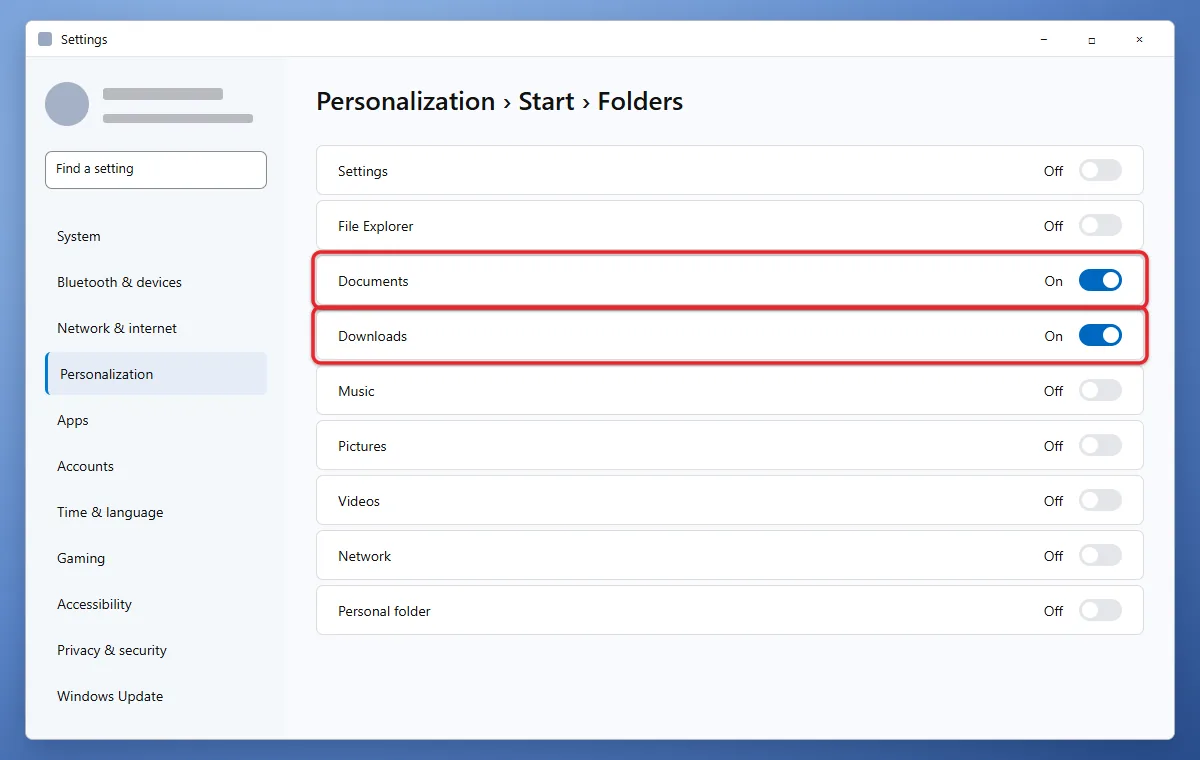
- Open Start again.

The folders you turned on now appear as icons to the left of the Power button. They have no text labels, so hover over an icon to see its name, and select it to open that folder. Windows keeps them in a fixed order, and you can’t drag the icons around.
Shortcut: Once at least one folder icon is showing, right-click any of them and select Personalize this list to jump straight back to the Folders page.
You can also press Windows + R, type ms-settings:personalization-start, and select OK to open the Start settings page directly.
Pick the right folders
Fewer icons are easier to tell apart. A good starting set for most people is Downloads (where browser downloads land), Documents, and File Explorer. Add Settings if you change settings often, since it saves a trip through the Start search box. Network is mainly useful on a home or office network with shared drives or other PCs.
Add Folders to Start in Windows 10
- Select Start, then the Settings gear, or press Windows + I.
- Select Personalization, then Start in the left pane.
- Scroll to the bottom and select Choose which folders appear on Start. A page of switches opens.
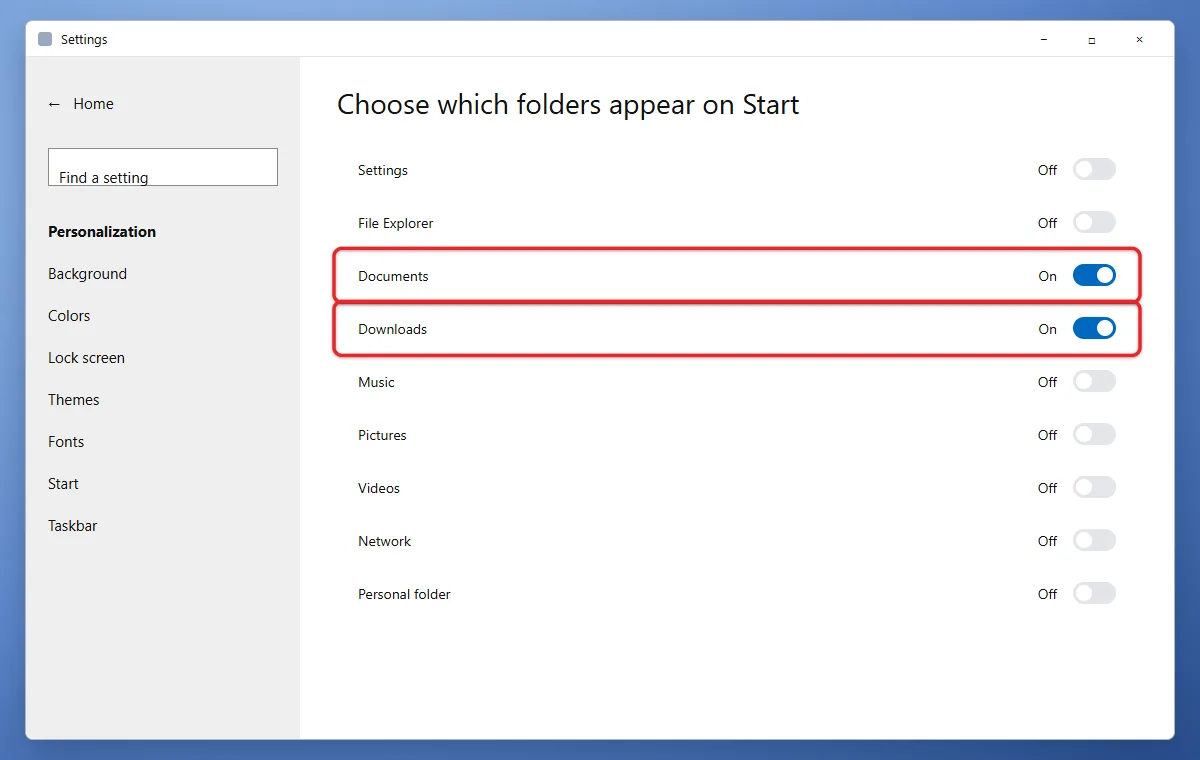
- Turn on each folder you want.
- Open Start.
In Windows 10, the folders appear as icons in the thin column on the left side of Start, above the Power button. Select the three-line menu icon at the top of that column to expand it and see each folder’s name.
Remove a Folder From Start
Go back to the same page (Settings > Personalization > Start > Folders in Windows 11, or Choose which folders appear on Start in Windows 10) and turn off the switch for the folder you no longer want. The icon disappears from Start right away. Turning a switch off only removes the shortcut. The folder and its files stay where they are, and you can turn it back on at any time.
Get to Any Other Folder From Start
The Folders list only offers the built-in locations above. To put a different folder, such as a project folder or a OneDrive folder, on the Start menu, pin it instead:
- Open File Explorer and find the folder.
- Right-click the folder and select Pin to Start. In Windows 11, if you don’t see it, select Show more options first.
- Open Start. The folder appears at the end of your pinned items.
Pinned folders sit with your pinned apps, not next to the Power button. To move one closer to the top, drag it, or right-click it and select Move to front. To remove one, right-click it in Start and select Unpin from Start. Unpinning doesn’t delete the folder.
You can pin websites the same way. Here’s how to add a web page to the Start menu in Microsoft Edge.
Group Pinned Apps Into Folders
Microsoft’s guide to Start menu folders describes this second kind of folder, which bundles several pinned apps under one icon.
In Windows 11
- Open Start. If an app you want isn’t pinned, find it under All, right-click it, and select Pin to Start.
- Drag one pinned app on top of another and hold it there until both icons shrink together, then let go. Windows creates a folder holding both apps.

- Drag more pinned apps onto the folder to add them.
- Select the folder to open it, select the name box at the top, type a name such as Work or Games, and press Enter.
To take an app out, open the folder and drag the app back into the Pinned area. When only one app is left, Windows removes the folder automatically. You can drag the whole folder to a new position in Pinned, the same as an app.
In Windows 10
Windows 10 uses live tiles instead of a Pinned grid. Drag one tile onto another and release when a frame appears around it to create a tile folder. Select the folder to expand it. To name a group of tiles instead, hover just above the group and select Name group.
If the Folders Setting Is Missing or Won’t Stay On
- You can’t find Folders. Make sure you’re on Settings > Personalization > Start and scroll all the way down. In Windows 10, the link is the last item on the page. If you’re in Taskbar settings instead, go back and select Start.
- The settings are grayed out or say “Some of these settings are managed by your organization.” A work or school PC can lock the Start layout through Group Policy or device management. Ask your IT department; there’s no safe workaround on a managed PC.
- Folders turn back off after a restart. A third-party Start menu replacement or a cleanup tool can reset Start settings. Check for those under Settings > Apps > Installed apps and look for an option in the tool to leave Start alone.
- You don’t see the icons next to Power. Make sure the switches are on, then close and reopen Start. If the icons still don’t show, sign out and back in, or restart File Explorer from Task Manager: press Ctrl + Shift + Esc, right-click Windows Explorer on the Processes tab, and select Restart. The taskbar disappears for a moment and comes back.
- A folder icon opens the wrong place. If you moved Documents or another folder to a different drive, the icon follows that move. The Personal folder icon opens your user profile folder, which holds Desktop, Documents, Downloads and other folders. That’s normal.
- Pin to Start is missing for a folder. In Windows 11, select Show more options in the right-click menu. If it’s still missing, make a desktop shortcut to the folder and pin the shortcut instead.
Frequently Asked Questions
Can I add any folder I want next to the Power button?
No. Only the built-in folders on the Folders page can appear there. Use Pin to Start in File Explorer to add other folders to the pinned section.
Where do Start folders appear in Windows 11?
At the bottom right of the Start menu, as icons to the left of the Power button. They don’t have text labels, so hover over one to see its name.
Can I change the order of the Start folder icons?
No. Windows places them in a fixed order, and you can’t drag them around. Pinned folders and app folders in the Pinned section can be dragged into any order.
Do these steps work on Windows 10?
Yes, with a different label. In Windows 10, go to Settings > Personalization > Start and select Choose which folders appear on Start. The folders appear above the Power button instead of beside it.
Will Start folders slow down my PC?
No. They’re only shortcuts. Turning them on or off doesn’t change any files or affect performance.
Does this change Start for other people who use the PC?
No. Start folders, pins and app folders are saved for your user account, so each person who signs in to the PC sets up their own.
For more ways to reach folders quickly, read about using Quick Access in Windows 11 to pin folders inside File Explorer, and pinning to the taskbar in Windows 11 to keep File Explorer one click away. To change where Start opens on the screen, you can move the Windows 11 taskbar icons to the left.

Matthew Burleigh is the founder, head writer, and editor of Solve Your Tech, which he launched in 2012. He has written technology tutorials since 2008 and worked in IT since 2003, including small-business support, IT management, and consulting. He holds Bachelor’s and Master’s degrees in Computer Science from Arizona State University.
Matthew writes practical guides for Windows, iPhone and iPad, Microsoft Office, Outlook, Google apps, and Android. Solve Your Tech’s guides are checked step by step against the device or app maker’s own documentation and tested on his own devices whenever he has the hardware or software, with clear steps, sources, and update dates.
Read more about Matthew and how Solve Your Tech writes and updates its guides, or report a correction.