To make Chrome your iPhone’s default browser, open Settings > Apps > Default Apps > Browser App, then tap Chrome. Web links you tap in other apps, such as Mail and Messages, will then open in Chrome instead of Safari, and you can switch back from the same menu at any time.
These steps match iOS 27 and work the same on an iPad; iOS 14 through 17 use a different path, covered below.
Installing Chrome isn’t enough. You also have to select it as the default.
Install and Open Chrome
Install Chrome from the App Store and make sure it opens normally. Google says you need iOS 14 or later to set Chrome as the default, but the version of Chrome currently in the App Store can require a newer iOS version. Check the Compatibility section of the App Store listing if the download is unavailable on an older iPhone.
You don’t need to sign in to a Google account to make Chrome the default. Apple also recommends keeping iOS up to date, because its Default Apps steps are written for the latest version.
On a work or school iPhone, your organization may manage browser choices or the way links open in work apps. Contact the administrator if a setting is unavailable or locked.
Choose Chrome in Default Apps
- Open the Settings app on your iPhone.
- Scroll down and tap Apps. A list of your installed apps opens, with Default Apps at the top.
- Tap Default Apps. You see categories such as Email, Messaging, Calling and Browser App.
- Tap Browser App. This is the category for opening web links.
- Tap Chrome. A checkmark appears beside Chrome. Follow any prompt that appears on screen.
- Leave Settings and tap a web link in another app to check the result.

If Chrome is already checked, you do not need to change anything. The change takes effect right away; you don’t need to restart the iPhone. This setting chooses the app that receives a web link. It does not move bookmarks, passwords, open tabs or your Safari history into Chrome.
The same Browser App list shows every installed browser that supports this setting, such as Firefox, Microsoft Edge or DuckDuckGo. Only one browser can be the default at a time. Apple’s guide to changing default apps lists the other categories you can change from the same screen.
If Your iPhone Has an Older Settings Layout
If Apps is present but Default Apps is not, open Settings > Apps > Chrome, then tap Default Browser App and select Chrome.
On iOS 14 through iOS 17, apps appear directly on the main Settings screen. The route there is Settings > Chrome > Default Browser App > Chrome. Scroll down past the Apple apps to the list of installed apps to find Chrome.
Use the route that matches the labels on your phone. A missing Apps menu on an older version does not mean Chrome cannot be the default. Versions before iOS 14 do not support choosing a different browser at all.
Start From Inside Chrome
Chrome also has a shortcut to this iPhone setting. Google’s default-browser instructions describe this route:
- Open Chrome.
- Tap More, the three-dot button.
- Tap Settings, then tap Default Browser.
- Tap Go to Settings. The iPhone Settings app opens to Chrome’s settings page.
- Tap Default Browser App, if shown, and choose Chrome.
The change only happens once you pick Chrome in iPhone Settings. Opening Chrome or closing its prompt doesn’t change the default.
The Browser Choice Screen in the EU and Japan
iPhones in the European Union and Japan may show a browser choice screen that asks you to pick a default browser. If you chose Safari or another browser there, you can still switch to Chrome later with the Default Apps steps above. The choice screen does not lock in your answer.
Check That the Change Worked
Pick an ordinary web link in a message or note, rather than a link to an installed app. Tap it and look for Chrome’s address bar and browser controls. Return to Browser App in Settings to confirm the checkmark is still beside Chrome.
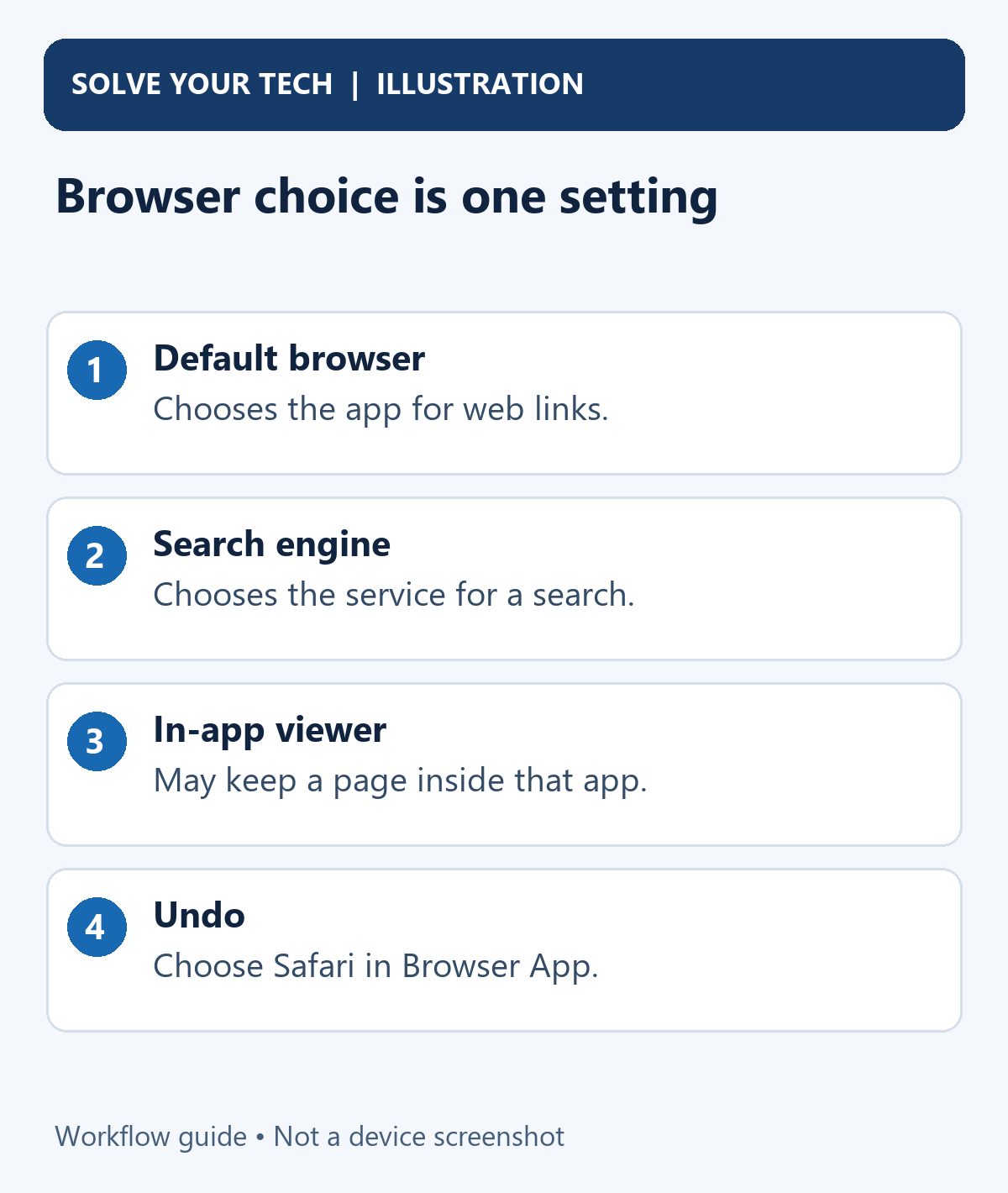
Some apps, like social and chat apps, open links in their own built-in viewer, and a link to a service you have installed may open that app instead. That’s separate from the default-browser setting. Many built-in viewers have a menu or share button with an option to open the page in your browser, which then sends it to Chrome. Reddit is one example with its own setting, and you can change the web browser used by the Reddit iPhone app in that app.
You can still open Safari yourself to browse a website. Making Chrome the default does not stop Safari from working or redirect pages that you open inside Safari. The Mac has a similar setting, and you can change the default web browser on a Mac in System Settings.
If Chrome Is Missing or Links Still Open Elsewhere
Chrome does not appear in Browser App: Confirm it is installed by finding and opening the Chrome app. Check for a Chrome update in the App Store, which is Google’s fix when the default-browser option is missing. To see which version you have, check your Chrome version. If an app never appears in a Default Apps list, contact that app’s developer.
There is no Default Apps menu: Try the older app-specific paths above, and check Settings > General > About for your iOS version. Don’t keep following a newer menu path when the phone has an older layout.
One app still uses Safari or Edge: Check that app’s own settings for a link or browser option. Some apps, including some Google apps, have a separate choice for where links open. Managed work apps, such as Outlook or Teams on a company phone, may send links to Microsoft Edge because of an organization’s policy. Test a link from a different app before deciding that the iPhone setting failed.
A website opens its own app: That may be an app link rather than a normal browser link. Use a plain website address for your test. The browser default does not control every type of link on the phone. Discord map links are one example. Here’s how to get iPhone Discord map links to open in Google Maps.
Chrome opens, but the website will not load: The default setting has worked. Check your connection and try a different website, since page-loading problems are a separate issue.
Our guide to updating Google Chrome shows where to find the Chrome update in the App Store.
Switch Back to Safari
Open Settings > Apps > Default Apps > Browser App and choose Safari. On an older layout, return to Default Browser App under Chrome and select Safari there.
Check for the checkmark beside Safari and repeat the ordinary-link test. You don’t need to uninstall Chrome to undo the change. Keeping both browsers installed makes it easy to use either one when a site works better in the other.
Default Browser Questions
Does this make Google my search engine everywhere?
No. A browser and a search engine are different choices. This setting picks Chrome to open web links. Chrome’s search engine is set inside Chrome, and Safari keeps its own search setting under Settings > Apps > Safari > Search Engine. To change it, follow the steps for setting Google as the Safari search engine on iPhone.
Will links open in Incognito automatically?
No. Choosing Chrome does not turn regular browsing into Incognito browsing. When you want a private Chrome session, open one with these Incognito tab steps for iPhone.
Does this work the same way on an iPad?
Yes. Apple’s Default Apps steps cover both iPhone and iPad, and Google’s Chrome instructions apply to both devices. Open Settings > Apps > Default Apps > Browser App on the iPad and choose Chrome.
Do I need to remove Safari or change my Dock?
No. The Browser App selection is enough. You can move Chrome to the Dock for quick access, but that only changes your Home Screen layout and does not decide where web links open.

Matthew Burleigh is the founder, head writer, and editor of Solve Your Tech, which he launched in 2012. He has written technology tutorials since 2008 and worked in IT since 2003, including small-business support, IT management, and consulting. He holds Bachelor’s and Master’s degrees in Computer Science from Arizona State University.
Matthew writes practical guides for Windows, iPhone and iPad, Microsoft Office, Outlook, Google apps, and Android. Solve Your Tech’s guides are checked step by step against the device or app maker’s own documentation and tested on his own devices whenever he has the hardware or software, with clear steps, sources, and update dates.
Read more about Matthew and how Solve Your Tech writes and updates its guides, or report a correction.